
ArxBridge
Bollard regulations in the UK: spacing, height and depth
Bollard regulations in the UK: no single law, but DfT and NPSA guidance sets the 1.2m spacing rule, plus highway consent and foundation requirements.
- ✓Third-party test evidence with every product
- ✓Written specification you can issue to tender
- ✓Supplied and installed across the UK
Get a free project quote
Rating, written specification and budget range within one working day.
Confidential. No cost, no obligation.
Third-party tested
Evidence with every quote
UK manufactured
Made to your sizes
One accountable team
Specify, supply, install
Confidential handling
Details never shared
There is no single UK law that sets bollard height, spacing or foundation depth. What applies is a mix of DfT and NPSA guidance, accessibility best practice, and consent from the highway or planning authority. Get the mix right and the bollards stop vehicles without blocking the people they are meant to protect.
- No single bollard lawDfT and NPSA guidance plus local consent govern
- 1.2m air gapsThe spacing the official research is built around
- Rated barriersNPSA recommends independently impact tested units
- ATTRO routeStatutory basis under the Road Traffic Regulation Act 1984
There is no single bollard law, so what applies instead
Search for bollard regulations and most results present themselves as the law. They are not. No Act of Parliament sets a minimum bollard height, a maximum gap between bollards or a required foundation depth. What exists is guidance, and guidance from the right bodies carries real weight even though it is not statute.
The two bodies that matter are the Department for Transport and the National Protective Security Authority. The DfT publishes Traffic Advisory Leaflets on bollards and pedestrian movement, written jointly with NPSA. The key one is TAL 2/13, first published in May 2013 and amended in October 2017, which reports studies on how bollard schemes affect pedestrians and gives planning advice for hostile vehicle mitigation schemes. You can read the publication on gov.uk.
NPSA publishes the hostile vehicle mitigation guidance itself, including a public realm design guide now in its third edition and research on how vehicle security barriers affect crowd flow. Its hostile vehicle mitigation pages set the approach: start from the threat, design the scheme, build it as designed, and maintain it.
Then come the consenting authorities. Anything placed on the public highway needs the highway authority’s agreement. Anything that changes the appearance of a street or a building’s setting can need planning permission. And where traffic itself is restricted for security reasons, there is a statutory route, the Anti-Terrorism Traffic Regulation Order, covered below. Accessibility runs through all of it: bollards are street furniture, and street furniture must not make life harder for disabled people.
Spacing: why 1.2 metres is the working figure
The number that recurs through the official documents is 1.2 metres of clear air gap between bollards. TAL 2/13 reports studies in which bollards spaced with 1,200mm air gaps had only a minor effect on pedestrian convenience. NPSA’s later research at event venues used the same geometry, studying arrays of bollards no more than 1.2m high and 0.3m wide, set with 1.2m air gaps.
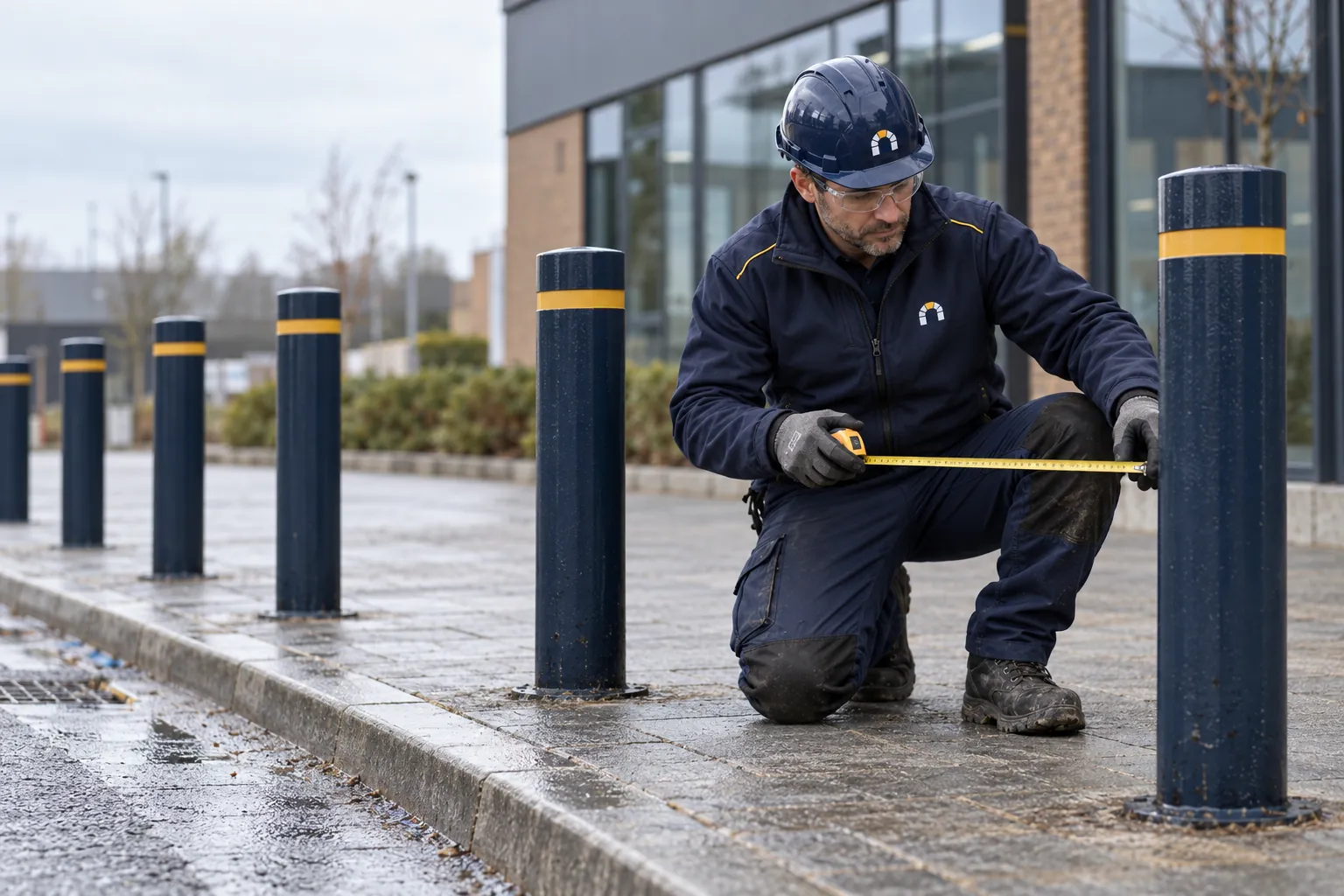
The figure works because it does two jobs at once. It is wide enough for wheelchairs, pushchairs and people walking side by side to pass through comfortably, and it is too narrow for a car to drive through. Measure it as the clear distance between the faces of neighbouring bollards, not centre to centre, because a wide bollard body eats into the gap.
NPSA’s event venue research adds planning numbers for crowded conditions. Below 0.4 people per square metre, bollard arrays did not significantly affect flow, and no capacity reduction is needed. At higher densities, with crowds approaching head on, planners should reduce assumed flow and throughput capacity by about 10 per cent. Arrays at least 3m from a building exit did not significantly affect dispersing crowds, while arrays only 2m from an exit could cut flow by up to 9 per cent. The guide to choosing HVM bollards walks through product selection in more detail.
Height, visibility and keeping pedestrians moving
Height is a trade off. A bollard must be tall enough to be seen in poor light and in crowds, but NPSA’s research found evidence that bollards above 1.2m reduced pedestrian flow. The arrays the research endorses use bollards of 1.2m or less. Height also affects behaviour: NPSA observed people sitting and leaning on bollards up to 900mm high, which can obstruct flow at peak times.
Visibility matters as much as height. NPSA says the barrier should clearly contrast with its surroundings in all lighting conditions, because pedestrians who cannot read the array start avoiding it in ways that disrupt flow. A contrasting band around the bollard is the usual answer, and it helps drivers see the array before they reach it.
Placement decides how much the array interferes with movement. NPSA found that bollard lines running perpendicular to pedestrian movement had less impact than lines running parallel, and made better use of space. Avoid corners, junctions and queuing areas where possible, and respect desire lines: people walk where they want to walk, and an array that fights that gets walked around. Our hostile vehicle mitigation overview shows how arrays fit into a wider scheme.
Small choices add up. Flat topped bollards collect litter, which NPSA found made people alter their path more than the bollard alone, and the litter later becomes a slip hazard; slanted tops avoid the problem. Do not link bollards with chains or ropes. They create a trip hazard, particularly for visually impaired people, and they add nothing to vehicle stopping power.
Foundations: shallow mount versus deep
For a protective bollard, what is below ground matters more than what is above it. A bollard that stops a 7,500 kg truck in a test does so because of the foundation it stands in. Put the same bollard on a shallower or weaker foundation and the rating no longer means anything.
This is why NPSA recommends that barriers deployed for counter terrorism be rated vehicle security barriers: tested to a recognised vehicle impact standard at an independent test house, with a performance rating to prove it. The current standards are PAS 68, IWA 14-1 and ISO 22343-1, the international standard that now supersedes both. A rating states the vehicle type and mass, the impact speed, the impact angle and how far the vehicle kept moving. Our vehicle impact ratings guide explains the rating format, and the PAS 68, IWA 14-1 and ISO 22343 guide compares the three.
Shallow mount bollards exist for sites where deep excavation is impossible: a basement slab below, dense utilities, or listed paving that cannot be disturbed. The same rule applies. Only the tested unit with its tested foundation counts. If a supplier cannot show the foundation detail that was actually tested, ask for the test certificate before believing the rating claim.
For non protective bollards the foundation is a durability question, not a security one. A car park bollard that only guides traffic needs a fixing that survives knocks and weather, not one that stops a truck. Do not pay for impact performance you do not need, and do not expect ordinary traffic bollards to stop a determined driver.
Car park bollards and private land
Most bollards in the UK are not stopping terrorists. They mark bays, protect building corners, guide one way systems and keep cars off footways in car parks. For these jobs the 1.2m protective spacing is a useful reference but not a rule. Spacing follows the task: a pedestrian route wants generous gaps, while bollards guarding a shutter want to be close enough to take the hit before the door does.
What still applies on private land is pedestrian access. Bollards that force wheelchair users or parents with pushchairs into the traffic lane are a problem whatever the land ownership. Keep gaps generous on walking routes and keep the bollards visible.
Consent is simpler on private land because the highway authority is not involved, but planning permission can still apply, particularly in conservation areas or around listed buildings. Check with the local planning authority before installing anything prominent. The public spaces sector page looks at how these decisions play out in shared environments.
Highway consent, planning and ATTROs
On the public highway, the highway authority is the gatekeeper. You cannot place bollards on a footway or carriageway without its agreement, and it will want to know the design, the positioning and who maintains them. Authorities publish their own requirements for street furniture, so check the local rules early.
Planning permission is a separate question from highway consent. A row of security bollards in front of a building can need permission depending on the location, the design and local policy. The answer varies by authority, so ask the local planning authority rather than assuming.
Where traffic itself must be restricted for security, there is a statutory route. An Anti-Terrorism Traffic Regulation Order, made under the Road Traffic Regulation Act 1984, gives traffic regulation a legal basis for counter terrorism purposes. NPSA notes that an ATTRO can be permanent or temporary, and can only be made by a traffic authority on the recommendation of a Chief Officer of Police. It can provide for vehicle control measures, prohibit parking near a vulnerable site, or restrict pedestrian access to affected roads.
Consent gets the bollards into the ground legally; the rating decides whether they work. For product choice, see our security bollards range and HVM street furniture for protection that blends into the streetscape. Entrances that must stay open to vehicles need a different answer: the anti-ram gates and barriers and HVM planters and street furniture guides cover those, and venues weighing wider duties should read the Martyn’s Law guide for premises. Browse the full set in our guides hub.
| What | Figure | Source | Checked |
|---|---|---|---|
| Clear air gap between protective bollards | 1,200mm | DfT TAL 2/13; NPSA event venue guidance | 19 Oct 2026 |
| Bollard size in the NPSA flow research | 1.2m or less high, 0.3m or less wide | NPSA Vehicle Security Barriers at Event Venues | 19 Oct 2026 |
| Density below which no capacity cut is needed | 0.4 people per square metre | NPSA Vehicle Security Barriers at Event Venues | 19 Oct 2026 |
| Capacity reduction to plan at higher densities | About 10 per cent | NPSA Vehicle Security Barriers at Event Venues | 19 Oct 2026 |
| Array distance from a building exit | At least 3m | NPSA Vehicle Security Barriers at Event Venues | 19 Oct 2026 |
| Flow cut if the array is 2m from the exit | Up to 9 per cent | NPSA Vehicle Security Barriers at Event Venues | 19 Oct 2026 |
| Statutory basis for traffic measures | Road Traffic Regulation Act 1984 (ATTRO) | NPSA hostile vehicle mitigation guidance | 19 Oct 2026 |
The foundation rule. A bollard’s impact rating belongs to the tested unit on its tested foundation. Change the foundation and the rating no longer applies, whatever the brochure says.
What the regulations do not prove
Consent is not performance. Highway consent, planning permission and an Anti-Terrorism Traffic Regulation Order let the bollards be placed, and none of them proves a bollard stops a vehicle. A line of bollards with full consent and no test rating is street furniture, not protection, and the consent letter will not help when a vehicle reaches it.
The 1.2 metre spacing figure is about pedestrians, not stopping power. The Department for Transport and NPSA use 1,200 mm clear gaps because people pass through comfortably and a car cannot, and the figure says nothing about what happens when a vehicle hits a bollard at speed. Spacing and rating are separate questions, and getting one right does not answer the other.
The regulations set no foundation depth. No Act of Parliament sets a minimum depth, and the guidance leaves the foundation to the tested system. A PAS 68, IWA 14-1 or ISO 22343-1 rating covers the bollard and its foundation together, so a bollard on a shallower foundation than the test is outside its evidence, whatever the bollard above ground looks like.
The guidance does not name the threat vehicle. The threat assessment must state the vehicle type, mass, speed and angle, and the rating format states them too. A scheme that copies a neighbour’s bollards without a threat assessment may guard against a car and fail against a truck, and the gap will only show when it matters most.
The regulations also say nothing about what happens after the scheme is built. A bollard that has been struck, or a line that has been dug up for roadworks and put back, needs its foundation checked again, because the rating describes the bollard as installed, not as left after damage. The scheme needs a named person who checks it and a record of what was found, or the protection decays unnoticed.
Evidence to ask for before you order
Ask for the evidence before the order is placed, not after the bollards are in the ground. The six checks below catch the gaps that appear most often.
- The threat assessment, naming the vehicle type, mass, speed and angle the scheme must stop.
- The test report and classification to PAS 68, IWA 14-1 or ISO 22343-1, for the exact bollard and its tested foundation.
- The foundation drawing as tested, with depth, reinforcement and the ground conditions it assumes.
- The utility survey, showing the services under the line before digging starts.
- The consent letters: highway authority, planning authority, and the Anti-Terrorism Traffic Regulation Order where traffic is restricted.
- The maintenance note: what to check after an impact or damage, and who checks it.
Compare the submittal with the evidence line by line before the order is signed. Where the evidence is missing or does not match, the order should wait: a bollard ordered on a promise and evidenced later is a bollard that may have to come out of the ground again. For how the rating is read, see the PAS 68 bollards guide and the vehicle impact ratings page, and for automatic bollards that manage access as well as stopping vehicles, see rising bollards. For choosing between fixed, removable and automatic types, see the guide to choosing HVM bollards.
Is there a legal minimum bollard height in the UK?
No. No statute sets a minimum or maximum bollard height. NPSA’s flow research studied bollards of 1.2m or less and found evidence that taller bollards reduced flow, while bollards up to 900mm attracted sitting and leaning. Choose the height for visibility and the site.
What spacing should I leave between bollards?
For protective arrays, 1.2m of clear air gap between bollard faces is the figure used in DfT TAL 2/13 and NPSA guidance. It lets wheelchairs and pushchairs through while blocking cars. Measure face to face, not centre to centre.
Do I need permission to put bollards on the pavement?
Yes. The highway authority must agree to anything placed on the public highway. Where traffic is restricted for security, an Anti-Terrorism Traffic Regulation Order under the Road Traffic Regulation Act 1984 provides the statutory route.
Do car park bollards need to be crash tested?
Only if stopping a vehicle is the job. Bollards that mark bays or guide traffic need durability and visibility, not an impact rating. Do not expect ordinary traffic bollards to stop a determined driver.
Who maintains protective bollards?
The owner or operator of the site. NPSA warns that poor maintenance creates vulnerabilities that can be exploited, and can make the product dangerous. Check fixings, finish and the visibility band, and keep records.
Get a free quote
Related
More in guides for specifiers
Products
One supplier for the whole building envelope
Ready to specify your project?
Free assessment, written specification and test evidence. Reply within one working day.