
ArxBridge
Ballistic Panels
Ballistic panels for walls, counters and safe rooms: BR and FB ratings, fixings and joints, and a single schedule for the whole protected line.
- ✓Third-party test evidence with every product
- ✓Written specification you can issue to tender
- ✓Supplied and installed across the UK
Get a free project quote
Rating, written specification and budget range within one working day.
Confidential. No cost, no obligation.
Third-party tested
Evidence with every quote
UK manufactured
Made to your sizes
One accountable team
Specify, supply, install
Confidential handling
Details never shared
A ballistic panel is a rated layer that sits inside a wall, behind a counter or round a safe room, and it does the work a door cannot do on its own. A door guards an opening, but the wall beside it must hold the same threat, or the line fails at the panel that was never rated. The panel, the door and the glass must all carry the same proof.
The order starts with the threat, not with the panel. A counter that faces the public asks for a different rating from a safe room that must hold while help arrives, and a wall that guards a cash office asks for a different build from a screen that takes a lighter threat. The room and the weapon the rating must stop decide the panel before the thickness is chosen.
One list should hold every panel on the protected line, with each one named plainly, so the right panel lands on the right opening. The bullet resistant doors page covers the doors that sit in the line, and the choosing a ballistic rating guide works through the grades a panel can carry.
- EN 1063 BR1-BR7Ballistic ratings for glazing
- EN 1522 FB1-FB7Ballistic ratings for doors and panels
- EN 356 P6B / P7B / P8BManual attack resistance for glazing
- LPS 1175 B3 / C5 / D10Forced entry ratings, three, five and ten minutes
Where a panel sits on a protected line: walls, counters and safe rooms
A panel sits where a door cannot, in the wall beside the door, in the counter between staff and the public, and in the walls of the room where people wait for help. Each position asks for its own rating, because the threat follows the room, and a panel that guards a cash office takes a higher class than one that guards a reception screen.
The wall beside a rated door is the first place a panel belongs. A door proved to FB4 with a plain wall beside it leaves the line open at the wall, so the panel in the wall must carry the same class as the door, and the joint between the two must be proved with them, because a gap at the joint is a way through the line.
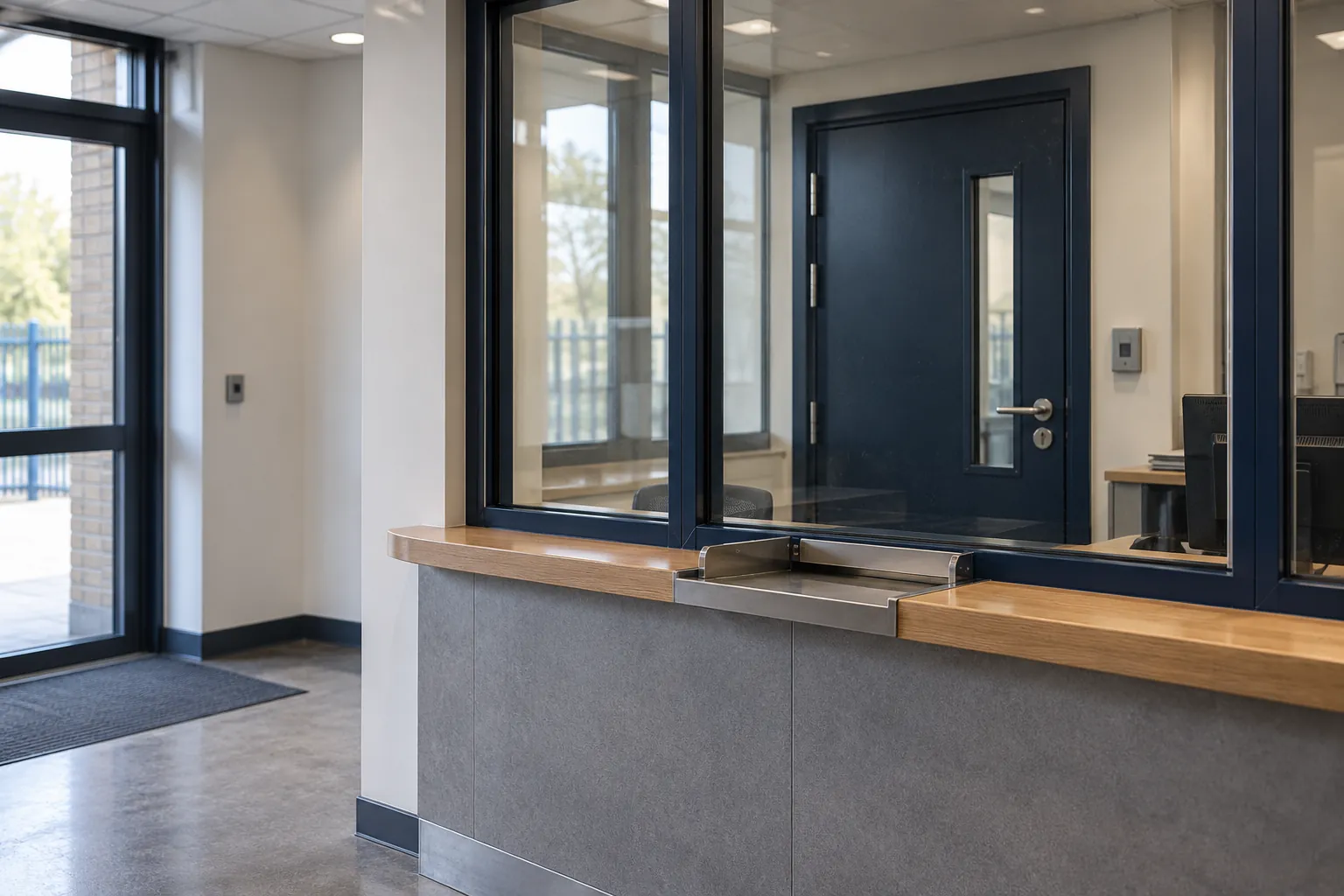
A counter takes a panel that must stop the round it is rated for and still let staff pass cash, documents and goods across it, so the panel, the tray and the screen above it belong on the same schedule line, and the bullet resistant windows page covers the glazing that sits above the counter.
BR and FB: the two ratings a panel can carry
Ballistic proof comes in two families. Glazing is proved to EN 1063, with BR1 to BR7 naming the class and SG1 and SG2 naming the splinter guard, while doors, windows, shutters and panels are proved to EN 1522, with FB1 to FB7 naming the class and FSG naming the splinter guard.
Each class names the weapon and the ammunition the panel was shot with, and the panel must stop every shot in the test without letting a fragment through to the safe side. A higher class means a heavier threat, so the class follows the risk the room faces, and the order should name the class beside each panel.
The two ratings must not be mixed on one line. A panel rated to FB4 and glass rated to BR4 are not the same proof, because each was tested on its own standard, and the grades in full are set out on our ballistic ratings page. The rating on the order should match the threat the line must stop.
The panel behind the door: matching the rating across the line
A protected line is a chain, and every link must hold the same threat. The door, the panel in the wall, the glass in the screen and the frame round them all take the same class, because an attack that cannot pass the door will be tried on the wall beside it.
The frame carries the rating as much as the panel does. A panel proved in one frame and fitted in another has no proof left, so the frame, the fixings and the seals belong on the same line as the panel, and the test report must name all three.
Forced entry sits beside the ballistic proof on the same line. A panel that stops a round but gives way to a crowbar leaves the room open on the other side, so the line takes LPS 1175 beside the ballistic class, with B3 holding three minutes, C5 holding five minutes and D10 holding ten minutes, all under Issue 8.2, dated September 2024. The bullet resistant versus bulletproof glass guide works through the choice between glass types.
What a panel is made of: layers, weight and thickness
A ballistic panel is a layered build, and each layer does part of the work. The face takes the first impact, the layers behind it slow the round, and the back layer holds the splinters that would fly into the room. The layers work together, so a panel tested as one build cannot be split and reordered on their own.
Weight and thickness follow the class, and both belong on the order beside the rating. A higher class takes a heavier and thicker panel, and the wall, the counter and the floor under it must carry that weight, so the structure that holds the panel belongs on the schedule with the panel itself.
Thinner is not always weaker, and thicker is not always stronger, because the build matters more than the depth. Two panels of the same thickness can carry different classes, so the order should name the class and the test report, not the thickness alone, and the bullet resistant door cost factors guide works through what each step up the scale adds.
Fixings and joints: the line is only as strong as its weakest joint
A panel is only as strong as the fixings that hold it. Screws, bolts and brackets must hold the panel against the force of the shot, and a fixing that pulls out under impact leaves the panel hanging on one edge, so the fixings belong on the test report with the panel.
Joints are the places a line fails first. Where two panels meet, where a panel meets a door frame, and where a panel meets the floor, the joint must be covered by a rated overlap, because a gap at the joint is a way through the line, and the overlap must be proved with the panels it joins.
The installer who fits the panel must follow the test report, because a panel fitted with different fixings or a wider joint than the report names has no proof behind it. The file should hold the report for every panel on the line, naming the panel, the fixings and the joint as fitted.
Reading the quote: the columns a panel quote must carry
A panel quote is read line by line, and each line must carry the position, the class, the size, the fixings and the joint beside it, because a quote that names the class alone leaves the fitter to guess the rest. The class follows the threat the room faces, proved to EN 1522 with FB1 to FB7 naming the class and FSG naming the splinter guard, while glazing is proved to EN 1063 with BR1 to BR7 and SG1 and SG2 naming the splinter guard. The test report must name the panel, the frame, the fixings and the joint as fitted, because a panel proved in one frame and fitted in another has no proof left.
Compare two quotes by the same columns, not by the total at the bottom. A quote that leaves the fixings off the list has not saved money, it has only moved the cost to the day the panel is fitted, and a quote that names one panel for the whole line leaves the fitter to guess which panel goes where. The grades a panel can carry are laid out in the choosing a ballistic rating guide, and the bullet resistant doors page names the doors that sit in the same line.
| Quote line | What it names | Why it matters |
|---|---|---|
| Position and class | Room, position, EN 1522 class | The class follows the threat the room faces |
| Size | Width and height of each panel | The rating was proved at one size |
| Fixings and joint | Type, spacing, overlap | A gap at the joint is a way through the line |
| Test report | Panel, frame, fixings, joint as fitted | Proof stays with the panel it belongs to |
Where the wall already stands, the panel must fit the wall, not the other way round
A panel fitted into a wall that already stands asks for more than a rating. The wall must carry the weight of the panel, and a higher class takes a heavier and thicker panel, so the structure that holds the panel belongs on the schedule with the panel itself. Services run through most walls, and a fixing that strikes a cable or a pipe stops the job, so the survey that maps the services belongs on the order before the wall is opened.
The joint between the new panel and the old wall is the place the line fails first. Where the panel meets the existing wall, the door frame and the floor, the joint must be covered by a rated overlap proved with the panels it joins, because a gap at the joint is a way through the line. Where the wall already carries services, the fixings must miss them, so the survey marks every cable and pipe before the drill starts. The door that guards the room is named in the safe room door specification guide, the fire and security doors dual certification guide puts two proofs on one product, the bullet resistant glass cost guide prices each step up the scale in turn, and the columns the schedule needs are laid out in the how to specify security doors guide.
Counters and screens: the panel the public sees
A counter panel works in public view all day, so it must stop the round it is rated for and still look like part of the room. The panel sits below the counter top, the glass sits above it, and the tray between them lets cash and documents pass, and the bullet resistant glass page covers the glazing that sits above the counter.
The glass above the counter takes its own proof. It is proved to EN 1063, with BR1 to BR7 naming the class, and to EN 356 for manual attack, with P6B holding 30 to 50 axe blows, P7B holding 51 to 70, and P8B holding 70 or more. The ballistic glass ratings guide sets out the classes in full.
A counter that must also hold fire takes a second proof. Fire is proved to EN 1634-1, with FD30 or FD60 naming the period, and the two proofs sit on separate lines because each is proved on its own test. How the two proofs sit together is worked through in our fire and security doors dual certification guide.
The maintenance round: fixings that loosen and joints that open
A panel earns its proof on the day it is fitted, and the months after handover decide whether that proof still stands. Vibration from the building, knocks from trolleys and the daily use of the room all work on the fixings, and a fixing that has worked loose holds less than the fixing the test report names. The maintenance round looks at every fixing on the line in turn, and it looks at every joint where one panel meets the next, because a joint that has opened leaves a gap the line cannot close. Each fault is written down the day it is found, with the panel and the position beside it, so the next team knows what was checked and what was done.
A joint that has opened by only a few millimetres is still a way through the line, and it will not close itself. The overlap that covers the joint must still sit square across it, and the seal behind the overlap must still hold, because a panel that has shifted in its frame leaves the overlap short on one side and the joint open on the other. Where the round finds a panel that has moved, the fixings are checked before the panel is pushed back, because a panel pushed back onto loose fixings will move again the next time the room is used. What breaks a rating is set out in the keeping the rating valid guide, and the maintenance checklist names the checks for each round.
| Check | What to look for | What it means |
|---|---|---|
| Fixings | Screws and bolts that have worked loose | The panel holds less than the report names |
| Joints | A gap where one panel meets the next | The overlap no longer covers the joint |
| Overlap | An overlap that sits short on one side | The line stands open at the joint |
| Frame | A frame that has moved with the panel | The panel no longer sits true in its frame |
A panel that has moved is a panel that must be proved again
Moving a panel back into place is a repair, not a proof, and the proof only returns when the panel, the fixings and the joint match the test report again. A fixing of a different type or a different spacing from the one the report names leaves the panel different from the one that was tested, so the replacement fixing belongs on the order beside the panel it holds. The same rule holds for the joint: an overlap cut shorter than the one the report names leaves the joint open, and the panel behind it holds nothing until the overlap is put right. The fire door inspection checklist sets out what the round looks for on each visit.
Keep the test report in the file beside the panel it belongs to, and write the replacement against the report before the order goes out, so the panel that arrives is the panel the report names. The choosing a ballistic rating guide lays out the grades a panel can carry, and the doors in the line are covered on the bullet resistant doors page. When the round finds a panel that must be replaced, the security door enquiry checklist is where the replacement goes, with the class and the fixings beside it.
Safe rooms: the panel that holds while help comes
A safe room is the last line in the building, and its panels must hold while the people inside wait for help. The walls, the ceiling and the door all take the same class, because a room with a rated door and plain walls is a room with a way in, and the safe room door specification guide covers the door that guards the room.
The door on a safe room must lock from the inside and open from the inside without a key, because the people inside must be able to leave when the danger passes. A lock that needs a key from the inside is a lock that traps the people it should guard, so the release belongs on the order beside the lock, and the door must still release when the power goes.
Communication belongs in the room with the panels. A phone, a radio or an alarm link lets the people inside call for help, and the link must work without power from the building. The rating on the order should match the time help takes to arrive.
One schedule for the whole line: every panel on one line
Put the order together as one list with a line for every panel on the protected line, naming the position, the class, the fixings and the joint beside each one, so the panel that arrives matches the panel that was proved. A schedule that names one panel for the whole line leaves the fitter to guess which panel goes where, and a guess is not a proof.
Read every quote against the list before anything is ordered. Parts left off a quote do not vanish; they turn up later, fitted round a panel that is already in place, at a higher cost than ordering them with the panel. The security door cost factors guide works through what each step up the scale adds.
Keep the test reports in the file with the panels from the day they arrive, so the proof stays with the panel it belongs to, and the how to specify security doors guide sets out the columns the schedule needs. The fire door inspection checklist names what each round should look for, and the security door maintenance checklist covers the panels and doors that must hold both fire and forced entry.
| Position | Panel | Rating | What to check |
|---|---|---|---|
| Wall beside door | Ballistic wall panel | EN 1522 FB4 | Fixings, joints, frame |
| Counter | Ballistic counter panel | EN 1522 FB4 | Tray, glass, fixings |
| Safe room wall | Ballistic wall panel | EN 1522 FB6 | Joints, ceiling, door |
| Screen | Ballistic glazing | EN 1063 BR4 | Glass, frame, splinters |
| Cash office | Ballistic wall panel | EN 1522 FB4 | Fixings, joints, lock |
A ballistic panel must hold the same threat as the door beside it, so the class, the fixings and the joints must all sit on the same schedule.
What rating do ballistic panels need?
It depends on the threat. Panels are proved to EN 1522, with FB1 to FB7 naming the class, and glazing to EN 1063, with BR1 to BR7, and the class follows the risk the room faces.
Do panels need the same rating as the door?
Yes. A door proved to one class with a plain wall beside it leaves the line open at the wall, so the panel in the wall must carry the same class as the door.
What holds a ballistic panel in place?
Fixings proved with the panel. Screws, bolts and brackets must hold the panel against the force of the shot, and the test report should name the spacing and the type of every fixing on the line.
Can a panel also hold fire?
Only where it has been tested for the job. Fire is proved to EN 1634-1, with FD30 or FD60 naming the period, and the fire proof sits on a separate line.
Who checks ballistic panels?
The person who runs the site, on the routine the site keeps. Each round looks at the panels, the fixings and the joints, and each fault found is written down the same day.
To get one quote for every opening, use the security door enquiry checklist and send the list in one go.
Get a free quote
Related
More in guides for specifiers
Products
One supplier for the whole building envelope
Ready to specify your project?
Free assessment, written specification and test evidence. Reply within one working day.