
ArxBridge
Communal entrance doors for flats: Secured by Design and what to specify
Communal entrance doors for flats: Secured by Design, PAS 24 and LPS 1175 ratings, access control, fire and escape, accessibility, and maintenance duties.
- ✓Third-party test evidence with every product
- ✓Written specification you can issue to tender
- ✓Supplied and installed across the UK
Get a free project quote
Rating, written specification and budget range within one working day.
Confidential. No cost, no obligation.
Third-party tested
Evidence with every quote
UK manufactured
Made to your sizes
One accountable team
Specify, supply, install
Confidential handling
Details never shared
A communal entrance door for flats must control who enters, resist attack and vandalism, meet fire and accessibility rules, and survive daily use by dozens of residents. Doors tested to PAS 24 or LPS 1175 SR2, paired with proper access control, suit most blocks. Confirm every claimed rating on the test certificate.
- Key referencesPAS 24, LPS 1175 SR2, and LPS 2081 for stealth attack
- Entry controlDoor entry panel, encrypted fobs, and a trade button
- Fire and escapeE or EI rating matched to the fire strategy
- DurabilityVandal-resistant build with a named maintainer
What Secured by Design means for a communal door
Secured by Design is the UK police initiative for crime prevention through design. For doors, it recognises products that have been tested to relevant security standards through an approved route. A communal door described as meeting Secured by Design should have the test evidence to prove it, not just the name in the brochure.
The practical value is consistency. A recognised door has passed the same attack tests as every other recognised door, so the housing association or manager knows what the product survived. Ask which standard the door was tested to and who certified the result, and keep that evidence with the building’s records.
Which performance references to ask for
PAS 24 is the common baseline for residential doorsets, covering manual attack with a defined tool set. It sits below LPS 1175 in threat level and suits most general-needs blocks. Where the risk is higher, LPS 1175 SR2 (B3) adds a three-minute forced-entry test against hand tools such as screwdrivers, pliers and hand saws. LPS 2081 covers stealth attack with quiet tools, which matters where an intruder would rely on going unheard. Our LPS 1175 guide sets out the full rating table.
State the reference on the schedule and require the certificate to match. A door described as built to PAS 24 principles, without test evidence, is not a PAS 24 door. For estate-wide programmes, one tested doorset repeated across blocks keeps spares and maintenance simple. Communal entrance doors and security doors for the bin and bike stores can share the same specification approach.
| Reference | What it tests | When to specify it |
|---|---|---|
| PAS 24 | Manual attack on residential doorsets | Baseline for most blocks of flats |
| LPS 1175 SR2 (B3) | Three-minute forced entry with hand tools | Higher-risk sites and blocks without a concierge |
| LPS 2081 SRB | Three-minute stealth attack with quiet tools | Entrances where a quiet attack is the realistic threat |
| Fire E / EI 30 or 60 | Integrity, and insulation for EI, to EN 1634-1 | Where the fire strategy requires it |
What the Secured by Design name does not prove
Secured by Design is a scheme, not a rating. It recognises products that have been tested to relevant security standards through an approved route, and the name on its own does not say which standard was used, which test the door passed, or how long the test lasted. Ask which standard the door was tested to and who certified the result.
The name describes the product as tested, not the door as installed. A doorset fitted with different ironmongery, a different closer or a different access control unit from the one tested is a different doorset, and the evidence may no longer match. The submittal must be compared with the certificate, component by component.
The name says nothing about fire performance. A communal entrance is part of the escape route, so the doorset must satisfy the fire strategy as well as the security schedule, with a fire classification to EN 1634-1 tested on the same construction. One certificate never stands in for the other.
The name says nothing about the block. It does not prove the door suits the risk at the entrance, the number of residents who use it, or the way the trade button and fobs are managed after handover. Those judgements belong to the threat assessment and the management plan, not to the scheme.
The name does not prove the door will stay secure. Locks, closers and seals wear, fobs are lost, and the trade button settings drift. Without a named maintainer and a written service schedule, the rating decays unnoticed. For what the scheme covers and what it does not, see the Secured by Design guide.
The name does not cover the frame and the wall around it. A tested leaf in a weak frame, or a rated doorset set into a surround that was never specified, leaves the entrance only as strong as its weakest part. The frame, the fixings and the wall construction must be specified to match the rating.
Evidence to ask for before the order is placed
Ask for the evidence before the order is placed, not after the doors arrive. The table below sets out what to ask for and what each item must state.
| Evidence | What it must state | Why it matters |
|---|---|---|
| Test certificate | PAS 24 or LPS 1175 SR2, exact doorset, sizes and configuration | A certificate for a different model does not cover the order |
| Third-party listing | Product listed by the certification body for the rating claimed | The record a checker asks for when the rating has to be proved |
| Fire evidence | E or EI classification to EN 1634-1 on the same construction | Fire and security need separate evidence on one doorset |
| Ironmongery schedule | Every lock, closer, hinge and exit device as tested | A substitution can void both ratings |
| Handover pack | Certificates, ironmongery schedule and access control register | The next specifier needs to know what the opening was built to achieve |
Ask who issued the evidence. Third-party evidence comes from an independent test house or certification body, not from the supplier’s own laboratory. A supplier’s own test sheet can support a claim, but it is not the third-party evidence a checker asks for.
Compare the submittal with the evidence line by line before the order is signed. Where the evidence is missing or does not match, the order should wait. For which reference fits which block, see the LPS 1175 vs PAS 24 guide, and for the changes that cause problems after installation, see keeping an LPS 1175 rating valid.
What a communal entrance doorset must prove
Secured by Design is the UK police initiative for crime prevention through design. For doors, it recognises products that have been tested to relevant security standards through an approved route. A communal door described as meeting Secured by Design should have the test evidence to prove it, not just the name in the brochure.
Secured by Design is a scheme, not a rating. The name on its own does not say which standard was used, which test the door passed, or how long the test lasted. Ask which standard the door was tested to and who certified the result. The name describes the product as tested, not the door as installed. A doorset fitted with different glass, different hardware or a different frame from the tested assembly has no proven rating, whatever the brochure says.
A communal entrance doorset must prove three things at once. It must resist forced entry to the rating the specification names, so the entrance holds against the attack the building is likely to face. It must hold fire to the period the fire strategy names, so the entrance does not break the compartment line. And it must open in one action from the inside, without a key and without a code, so residents can leave in an emergency. A doorset that proves only one of the three has not done the job the building needs. Our guide to Secured by Design explains the scheme in full, and our fire door regulations for commercial buildings guide sets out how the fire duties sit beside the security duties.
The evidence for each of the three should arrive with the doorset. The forced entry evidence is the test report and the classification for the complete assembly. The fire evidence is the classification to EN 1634-1, with the smoke rating to BS EN 1634-3 where the fire strategy asks for it. The escape evidence is the hardware schedule, naming the panic or emergency hardware fitted to the leaf. Our flat entrance doors guide covers the door that guards a room where someone sleeps, and the same discipline of one doorset and one set of evidence applies at the communal entrance.
Duties and records after handover
The duties do not end at handover. The responsible person under the Regulatory Reform (Fire Safety) Order 2005 must make sure the door is checked, the faults are fixed and the records are kept. A closer that has been adjusted by hand, a latch that no longer holds or a seal that has been painted over will leave the door standing open or failing to latch, and a door that does not close has no fire performance, whatever its certificate says.
The record should name the door, the fault, the date it was found and the date it was fixed. A duty that is delegated without a record cannot be proved, and a block where nobody can say when a door was last checked is a block where nobody can speak for the doors. The access control list needs the same discipline: fobs cancelled when they are lost, codes changed when staff leave, and the trade button routine written down with the rest of the block procedure.
| Evidence | What it proves | When to ask |
|---|---|---|
| Forced entry test report and classification | The complete assembly resisted the named attack | Before the order is placed |
| Fire classification to EN 1634-1 | The doorset holds fire for the named period | Before the order is placed |
| Hardware schedule | The door opens in one action from the inside | With the doorset at handover |
| Inspection record | The door was checked and faults were fixed | At every check after handover |
Keep the evidence with the doors. A communal entrance that can prove its rating, its fire performance and its checks is an entrance the residents and the responsible person can both rely on.
Access control, door entry and the trade button
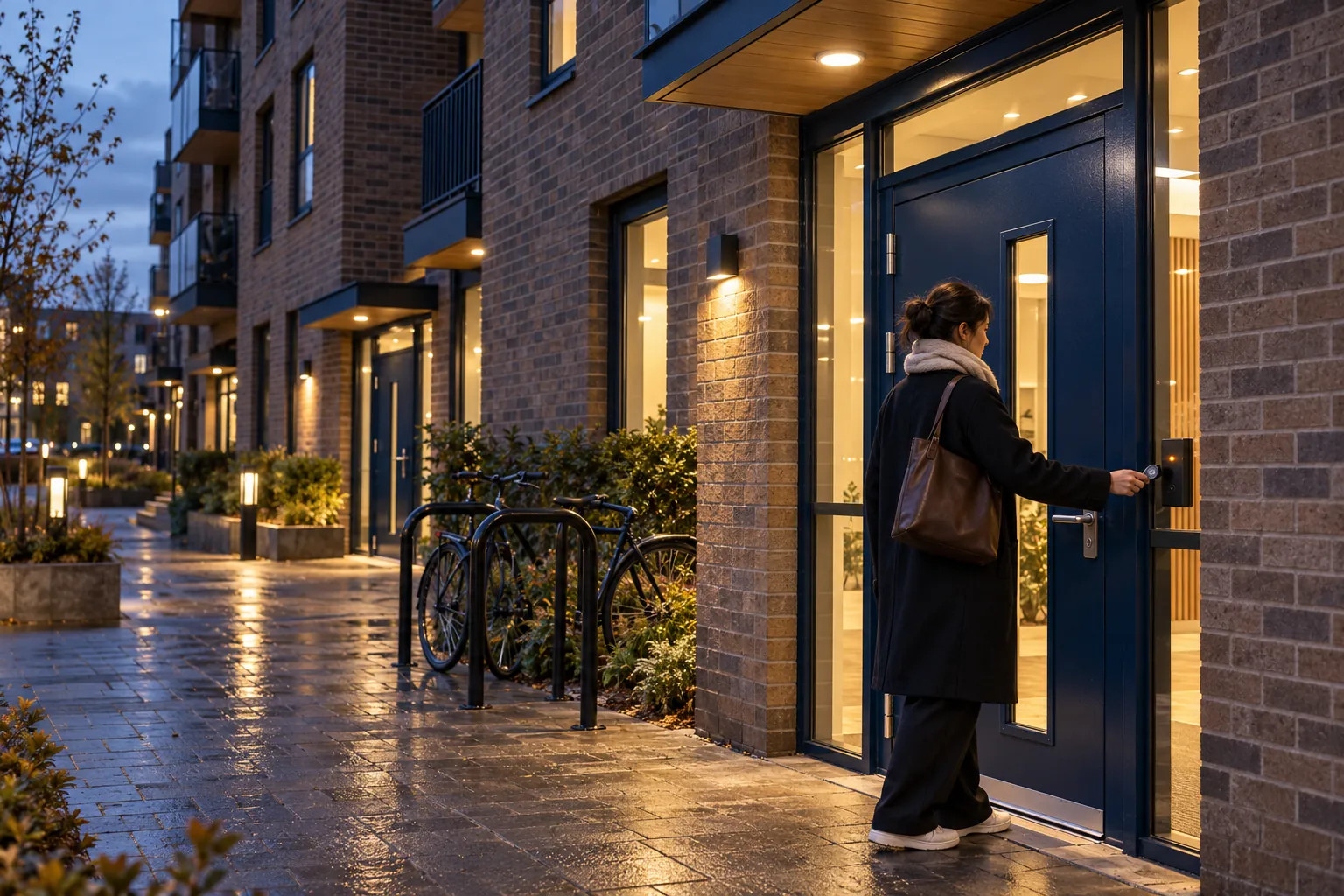
The door is only as good as its entry system. A door entry panel with audio or video lets residents check visitors before releasing the lock, and encrypted fobs or tokens give residents keyless access that can be cancelled when lost. Every release, fob use and forced entry should log to the management system so misuse can be traced.
The trade button gives timed access for postal and delivery workers during agreed hours. It must be programmable, so the time window can be changed, and it should never compromise the locked status outside those hours. Make sure the release hardware fails safe or fails secure exactly as the fire strategy requires, and that the choice is documented.
Fob management decides whether the system stays trustworthy. Issue fobs against named flats, collect them on tenancy changes, and audit the active list regularly. A lost fob that still works is an open door with extra steps, so the cancellation procedure must be as quick as the issuing one.
Fire performance and means of escape
A communal entrance is part of the escape route, so the doorset must satisfy the fire strategy as well as the security schedule. Fire ratings to EN 1634-1 use E for integrity, EW for integrity with limited radiation, and EI for integrity with insulation, over 30, 60, 90 or 120 minutes. The required period comes from the fire risk assessment, not from the security rating.
Escape and security pull in opposite directions: residents must get out quickly while intruders must be kept out. Panic or emergency exit hardware on the inside face, combined with a secure locking side outside, resolves the conflict. Whatever the combination, it must be tested as one doorset, since locks and exit devices change both performances. Fire rated steel doors built for communal use follow this pattern.
Accessibility and the Equality Act
Communal entrances are used by everyone, including wheelchair users and people with limited strength or vision. The Equality Act requires reasonable adjustments, which in practice means manageable opening forces, clear widths, visible manifestation on glazing, and entry controls mounted at reachable heights.
Power-assisted or automatic operation is often the answer where a heavy rated door would otherwise defeat some residents. If automation is fitted, its safety devices and manual override need the same maintenance regime as the lock. Accessibility is not an optional extra on a communal door; it is part of the legal baseline for residential buildings.
Thermal, acoustic and vandal resistance
Communal doors sit on heated corridors, so heat loss through the doorset shows up on the service charge. A thermally broken frame and an insulated leaf keep the U-value down, as explained in our thermally broken security doors guide, and the same seals that stop draughts help the acoustic rating, which matters where the entrance opens near bedrooms.
Vandal resistance is a daily reality: kicks, graffiti, forced entry attempts and constant slamming. Steel doorsets with tamper-proof fixings, protected glazing and heavy-duty hinges are built for this treatment. Specify finishes that can be cleaned and hardware that can be replaced without removing the door.
Who maintains the door
A communal door without a maintainer is a communal door that will fail. Name the responsible party at handover: the housing association, the managing agent or a maintenance contractor. The schedule should list service intervals for locks, closers, seals and entry systems, plus a response time for security-critical faults. Our data centre physical security guide makes the same point for a different building type: hardware without a routine is a risk. See all our guides for more specification topics.
Plan replacement cycles before the door fails. A communal doorset in a busy block typically needs major component renewal, closers, seals and lock cases, well before the frame wears out. Budgeting for that cycle keeps the rating valid for the life of the building instead of letting it decay unnoticed.
Keep the test certificates, the ironmongery schedule and the access control credentials register with the building records. When the door is eventually replaced, the next specifier will need to know what rating the opening was built to achieve.
Evidence before brand. A door is only as secure as its certificate proves. Ask for the test evidence first and the brochure second.
Is PAS 24 enough for a communal entrance?
For most general-needs blocks, yes, provided the door carries genuine test evidence. Higher-risk sites step up to LPS 1175 SR2.
When is LPS 1175 SR2 specified instead of PAS 24?
Where the threat assessment shows a determined attacker with hand tools, or where the block has no concierge and the door is the only barrier.
What is a trade button?
A timed release for postal and delivery staff during agreed hours. It must be programmable and must not leave the door unsecured outside those hours.
Who is responsible for maintaining the door?
The party named at handover, usually the housing association or managing agent, working to a written service schedule.
Can the door be fire rated and security rated at once?
Yes, if the exact combination has been tested to EN 1634-1 and the security standard on the same doorset construction.
Get a free quote
Related
More in guides for specifiers
Products
One supplier for the whole building envelope
Ready to specify your project?
Free assessment, written specification and test evidence. Reply within one working day.