
ArxBridge
Roller shutter regulations in the UK: safety and maintenance
Roller shutter regulations in the UK: powered shutters are machinery under the 2008 regulations, need UKCA or CE marking, and must be maintained under PUWER.
- ✓Third-party test evidence with every product
- ✓Written specification you can issue to tender
- ✓Supplied and installed across the UK
Get a free project quote
Rating, written specification and budget range within one working day.
Confidential. No cost, no obligation.
Third-party tested
Evidence with every quote
UK manufactured
Made to your sizes
One accountable team
Specify, supply, install
Confidential handling
Details never shared
A powered roller shutter on UK premises is legally a machine. That means it must be safe when it is supplied, carry UKCA or CE marking, meet the product and safe-use standards for power operated doors, and be kept in safe working order under PUWER. Here is what each of those rules asks of you, and who is responsible.
- A machine in lawPowered shutters fall under the Supply of Machinery (Safety) Regulations 2008
- UKCA or CEEither marking is accepted for machinery in Great Britain
- Two key standardsBS EN 13241 for the product, BS EN 12453 for the safe use
- PUWER 1998Work equipment must be maintained and inspected
Why a powered shutter counts as machinery
The Machinery Regulations define machinery as an assembly of linked parts, at least one of which moves, joined together for a specific application. A roller shutter with an electric motor fits exactly.
The legal duties follow the definition. A powered shutter is not just a building fitting; it is a machine placed on the market or put into service, and the 2008 Regulations set the conditions for both. A hand chain or manually lifted shutter is not machinery under these Regulations, but if used at work it is still work equipment under PUWER.
The distinction decides the paperwork you should hold. For a new powered shutter, expect a Declaration of Conformity and user instructions from the responsible person. For a manual shutter the questions are simpler: suitable, safe and maintained. Our security shutters and high performance roller doors pages describe the powered options.
What the Supply of Machinery (Safety) Regulations 2008 requires
Regulation 7 is the core duty: no responsible person shall place machinery on the market or put it into service unless it is safe. The Regulations were made on 19 June 2008 and came into force on 29 December 2009, and they remain the UK law for machinery safety (legislation.gov.uk).
Before a powered shutter is supplied or first used, the responsible person must meet the essential health and safety requirements, compile a technical file, provide the information needed to use it safely, carry out the right conformity assessment, and draw up a Declaration of Conformity that accompanies the shutter.
The responsible person is usually the manufacturer. But HSE guidance on powered gates makes a point that applies to shutters: where an installer assembles partly completed machinery on site to form a new powered product, the person doing that final assembly becomes the responsible person. A manual shutter motorised in place is a new machine, so ask who the responsible person is and get the Declaration of Conformity in their name. An installer who plans for this avoids paperwork gaps.
UKCA and CE marking on new shutters
For machinery placed on the Great Britain market, businesses may use either the CE marking or the UKCA marking. The government’s machinery call for evidence, updated 25 February 2026, confirms that machinery complying with the EU Machinery Directive 2006/42/EC and carrying the CE marking may continue to be placed on the GB market, across 21 product regulations.
Either mark must be legitimate. HSE guidance states the UKCA marking must be clearly visible, legible and indelible, and both marks can sit on one product as long as neither obscures the other. A shutter with no marking, or one that looks added as an afterthought, is a warning sign.
The EU’s Machinery Regulation 2023/1230 applies in the EU from January 2027; the UK is consulting on whether to follow. For now, either marking is acceptable in Great Britain.
BS EN 13241 and BS EN 12453: the two standards that matter
BS EN 13241 is the product standard for industrial, commercial and garage doors and gates, covering performance characteristics such as resistance to wind load. Since July 2013, doors in its scope must be type tested before being placed on the market. The shutter should carry a label or plate showing the manufacturer’s name and address, the wind load class, the approved test body and the designated standard, and the manufacturer should be able to supply a Declaration of Performance.
BS EN 12453 covers safety in use of power operated doors: the requirements and test methods. DHF guidance puts it plainly: manufacturers doing type testing for serial production and UKCA or CE marking should follow EN 13241 for the Construction Products Regulations and EN 12453 for the Supply of Machinery (Safety) Regulations. One standard proves the product performs; the other proves it operates safely.
Ask for both standards by name when you buy. A supplier who can point to the standards, the test body and the paperwork shows the shutter was assessed, not just assembled. More door and shutter guidance is in the guides hub.
The safety devices a powered shutter must carry
A powered roller shutter is machinery, not a door, so the law treats it as a machine from the day it is fitted. The Supply of Machinery (Safety) Regulations 2008 set what a new shutter must carry, and the person who puts it on the market must show it meets them.
A new shutter placed on the market in Great Britain carries a UKCA mark, and the declaration of conformity behind the mark names the standards it was assessed against. The declaration stays with the shutter for its life, and the file behind the declaration is what the next reader asks for.
BS EN 13241 sets the safety and performance requirements for powered doors, gates and barriers, including roller shutters, and BS EN 12453 sets the safety in use of power operated doors, so the two standards sit beside each other on the schedule. A shutter proved to one without the other leaves half the job unproved.
The safety devices on a powered shutter stop it from hurting a person in its path. A safety edge on the bottom bar stops the leaf when it meets an obstruction, and a photocell across the opening stops it before it meets one. The force the leaf may exert is capped, and the devices are tested on the shutter as fitted, not on a bench.
A shutter that closes on a person or a vehicle has failed its safety devices, so the devices are tested at handover and on every service visit. The test record names the device, the result and the date, and a device that no longer stops the leaf is repaired before the shutter is used again. How a powered gate is driven is covered in our gate automation guide.
Who keeps the records: maintenance, inspection and the file
The Provision and Use of Work Equipment Regulations 1998, known as PUWER, ask the owner to keep work equipment safe, and a powered shutter in a workplace is work equipment. Maintenance follows the maker’s instructions, inspection follows the risk, and the records show both were done.
The service visit checks the leaf, the guides, the motor, the safety edge and the photocells, and the visit record names what was checked, what was found and what was fixed. A shutter that has missed its service has no record to show, and the record is what the next reader asks for. What each check looks for is set out in the fire door inspection checklist.
A fire shutter is a different job from a security shutter, and the two must not be confused on one order. The fire shutter holds a fire period proved to EN 1634-1, and the security shutter holds a forced entry rating, and a shutter that must do both needs a proof for each job on the same assembly. Our fire rated roller shutters guide covers the fire side in full.
A shopfront shutter may need planning permission, and the permission is a matter for the local planning authority, not for the shutter maker. The order should name the shutter and the permission separately, so one does not wait on the other. Bay doors in full are covered in our loading bay doors guide.
| Item | What the rule asks | What to file |
|---|---|---|
| New shutter | UKCA mark and declaration | Declaration of conformity |
| Safety devices | Edge and photocells tested | Test record |
| Maintenance | Maker’s service schedule | Service records |
| Fire shutter | EN 1634-1 period | Fire test report |
Ask for the declaration, the test reports and the service records with the shutter, and file them the day it is fitted, so the next reader can see what was proved and what keeps it safe.
Safety devices: what a compliant powered shutter carries
The standards expect the hazards of a moving curtain to be controlled. On a typical powered shutter that means a safety edge that stops or reverses the curtain if it meets an obstruction, and presence detection such as photo cells or a light curtain across the opening.
Heavy curtains need a safety brake: a device that arrests the curtain if the drive fails so it cannot free-fall. Add an emergency stop within reach and a manual override for power failure. These are not optional extras; they are part of what makes the machine safe under the Regulations.
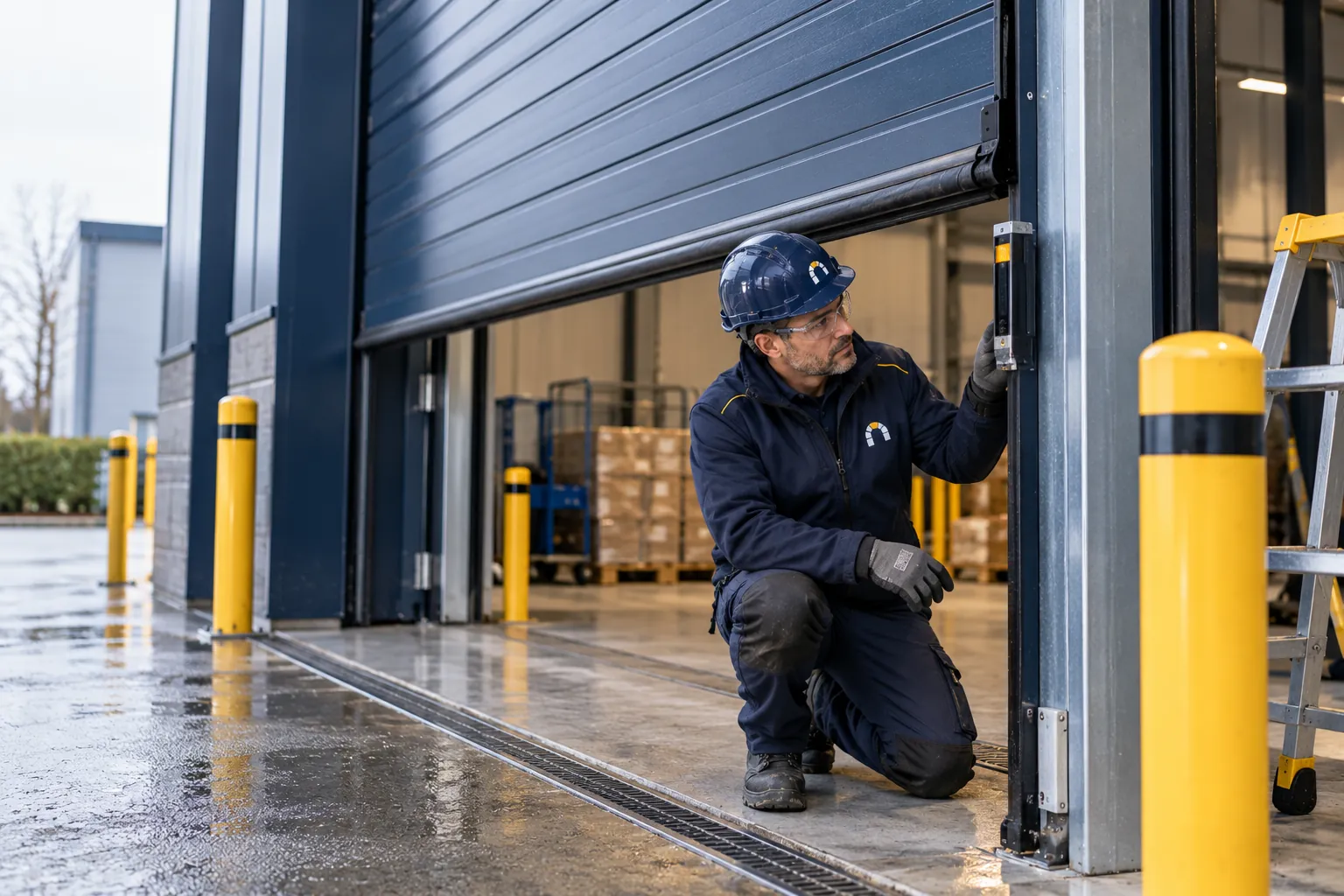
Check the devices at every service, not only at handover: a misaligned photo cell or a damaged safety edge cable leaves the shutter unprotected. Record each check in the maintenance log. Where the opening must stop intruders rather than accidents, see security shutters vs grilles and our security shutter vs roller door guide.
Maintenance, inspection and records under PUWER
Once the shutter is in use, the Provision and Use of Work Equipment Regulations 1998 (PUWER) take over. The duties are straightforward: work equipment must be suitable for its intended use, maintained in an efficient state and in efficient working order and in good repair, and inspected where deterioration could cause a danger. Where the shutter has a maintenance log, the log must be kept up to date (HSE).
PUWER sets no fixed service interval in law. The right frequency comes from the manufacturer’s instructions, how often the shutter cycles and the environment it works in. A loading bay shutter cycling dozens of times a day needs a different rhythm from one that opens once each morning.
Keep written records of every inspection, service and repair: date, what was checked, what was found, what was replaced, and who did it. Those records are your evidence, and insurers and enforcing authorities will ask for them. Inspections must be done by someone competent, with the knowledge to spot what is wrong. The maintenance page covers planned servicing and records.
Planning permission for shopfront shutters
Safety law and planning law are separate. A shutter can meet every machinery and PUWER duty and still need planning permission, because planning controls how the shopfront looks and how the shutter affects the street.
Whether permission is needed depends on the building, the area and the type of shutter. Listed buildings and conservation areas have stricter controls, and some local authorities restrict solid shutters on high streets in favour of grilles or perforated curtains that keep the shopfront visible at night. There is no single national rule to quote, so check with the local planning authority before you order.
A shutter ordered and manufactured before planning is refused is an expensive mistake. If the premises are in a sensitive area, talk to the planning authority at the same time as you talk to the shutter supplier. For retail options and their appearance, see our retail sector page and retractable security grilles, which often suit shopfronts better than solid curtains.
Fire shutters: one short note
Where a shutter forms part of the building’s fire strategy, a second set of duties applies. The shutter must have the right fire performance for its position, close reliably on alarm, and be tested and serviced so it works on the day it is needed. Fire performance is a separate claim from security or machinery compliance: a shutter that resists attack is not automatically a fire shutter.
Keep the fire shutter’s testing evidence and service records with the fire safety records for the building, and make sure the fire risk assessment names who checks it and how often. See the fire range for doorsets where fire performance is the main requirement, and read how to specify security doors before writing the enquiry.
| Rule | What it requires | Who it applies to |
|---|---|---|
| Supply of Machinery (Safety) Regulations 2008 | Only safe machinery may be placed on the market or put into service; essential health and safety requirements, technical file, instructions, conformity assessment, Declaration of Conformity | Manufacturer, or the installer who assembles or motorises the shutter on site |
| BS EN 13241 | Product standard for industrial, commercial and garage doors and gates; type testing before placing on the market; label and Declaration of Performance | Manufacturer |
| BS EN 12453 | Safety in use of power operated doors; requirements and test methods | Manufacturer and installer |
| PUWER 1998 | Work equipment suitable for use, maintained in efficient working order, inspected where deterioration could cause danger; maintenance log kept up to date | Employer and premises owner |
| Planning law | Appearance and fitting of shutters may need permission; check with the local planning authority | Premises owner |
Keep the paperwork with the shutter. The Declaration of Conformity and the user instructions are part of the machine, not extras. File them with the maintenance log so the next inspector, insurer or buyer finds them in one place.
Does a manual roller shutter need UKCA or CE marking?
No. The Supply of Machinery (Safety) Regulations 2008 applies to powered machinery, so a hand chain or manually lifted shutter is outside it. But if the shutter is used at work, PUWER still applies: it must be suitable, safe and maintained.
How often must a roller shutter be serviced by law?
The law sets no fixed interval. PUWER requires the shutter to be kept in efficient working order, and the manufacturer sets the service schedule. How often the shutter cycles and the conditions it works in decide the rhythm. Whatever you choose, keep written records of every visit.
Who is the responsible person when a manual shutter is motorised on site?
The person who puts the powered shutter into service. HSE guidance on powered gates states that the person who assembles partly completed machinery on site to form a new powered product becomes the responsible person. Ask for the Declaration of Conformity in the installer’s name.
Do I need planning permission for a shopfront shutter?
Possibly, and it depends on the building and the area rather than on safety law. Listed buildings and conservation areas have stricter controls, and some authorities prefer grilles or perforated curtains on high streets. Check with the local planning authority before ordering.
Can one shutter be both a fire shutter and a security shutter?
Only if it is tested and certified for both performances. Fire performance and attack resistance are proved by different tests against different standards. Ask for the test evidence for each performance you need.
What should I check before buying a new powered shutter?
The marking on the shutter (UKCA or CE), a Declaration of Conformity from the responsible person, user instructions in English, and safety devices suited to the use: safety edge, presence detection, safety brake on heavy curtains, and a manual override. Then set the PUWER maintenance schedule from day one.
Get a free quote
Related
More in guides for specifiers
Products
One supplier for the whole building envelope
Ready to specify your project?
Free assessment, written specification and test evidence. Reply within one working day.