
ArxBridge
Bullet resistant vs bulletproof glass: what the difference means
No glass is bulletproof: bullet resistant glass is tested to EN 1063 classes BR1 to BR7. This UK guide explains the terms, spall ratings, and frame matching.
- ✓Third-party test evidence with every product
- ✓Written specification you can issue to tender
- ✓Supplied and installed across the UK
Get a free project quote
Rating, written specification and budget range within one working day.
Confidential. No cost, no obligation.
Third-party tested
Evidence with every quote
UK manufactured
Made to your sizes
One accountable team
Specify, supply, install
Confidential handling
Details never shared
Bullet resistant is the correct term. Glass is tested against defined weapons fired from defined distances, and rated BR1 to BR7 under EN 1063. Bulletproof suggests the glass stops anything, which no product does. This guide explains the classes, the spall ratings and why the frame must match.
- Correct termBullet resistant, with a stated class. Bulletproof promises what no glass delivers.
- StandardEN 1063 rates glazing BR1 to BR7, plus SG1 and SG2 for shotguns.
- SpallS means splinters on the protected side; NS means no splinters.
- SystemThe frame must match the glass. A BR6 pane in an unrated frame is not a BR6 window.
Why bullet resistant is the correct term
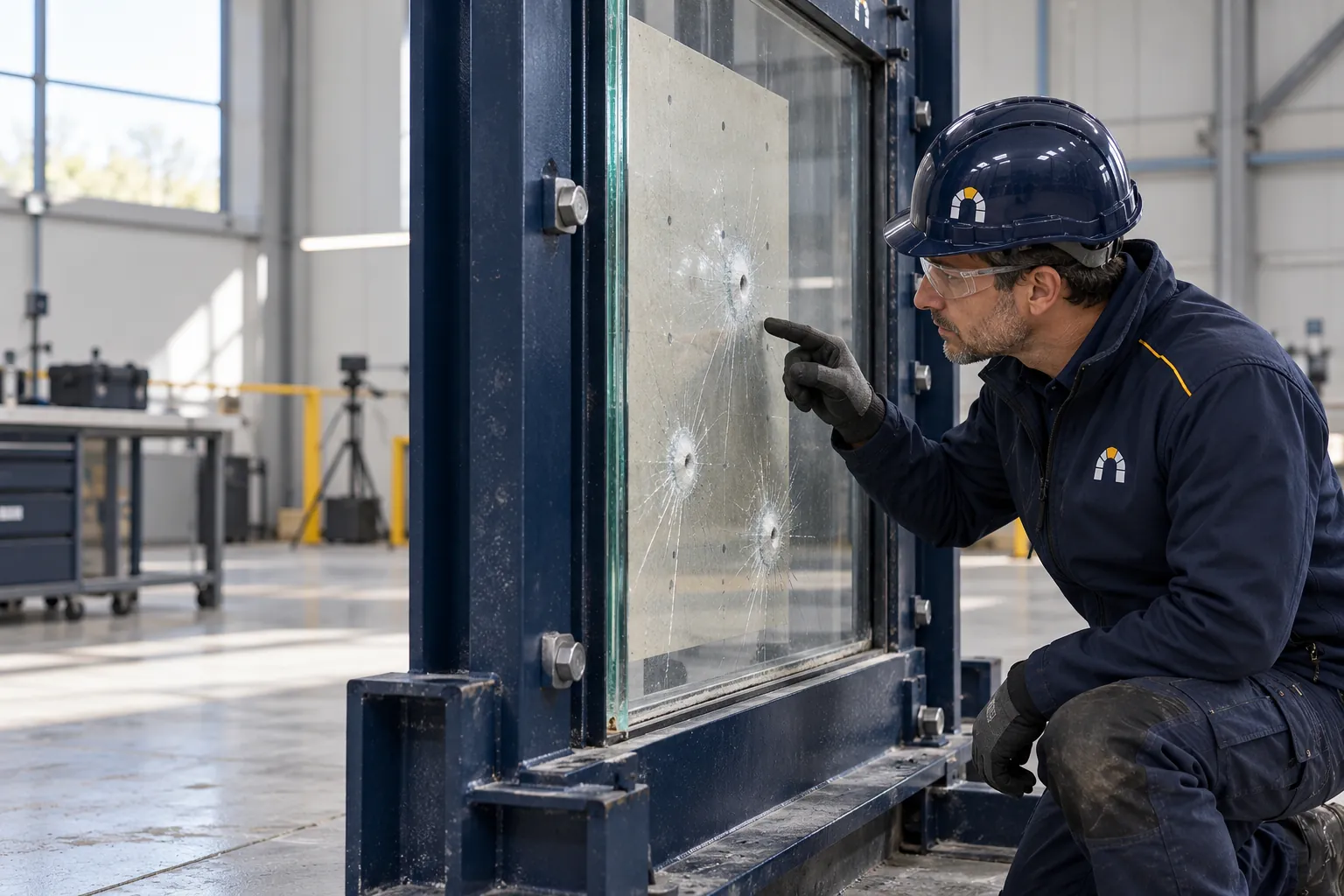
Bulletproof suggests a material that stops every bullet, and no such material exists. Every ballistic product is tested against specific weapons, specific ammunition, fired from a specific distance, for a specific number of shots. Outside those conditions, its behaviour is unknown. Bullet resistant says exactly what the test proved, and the rating says which test. Our ballistic ratings guide sets out the standards behind these terms.
This matters when you write or read a specification. Bulletproof glass on a schedule means nothing testable. BR4 NS under EN 1063 means a defined thing: glazing that stopped the BR4 threat with no splinters on the protected side. Always ask for the class, the standard and the spall suffix, and treat any quote that omits them with suspicion.
Marketing language often blurs this. Brochures say bulletproof because it sounds stronger, then the small print names a BR class. Read the class and ignore the adjective. The class is the promise; the adjective is just noise.
How the laminated construction works
Bullet resistant glass is a laminate: layers of glass bonded with tough interlayers, sometimes with a polycarbonate backing. Each layer slows and spreads the bullet’s energy, and the interlayers hold the broken pieces together so the pane stays in the frame after the shot. More layers mean a higher class, and a higher class means a thicker, heavier pane.
The make-up is tuned to the threat. A BR2 pane for handguns is far slimmer than a BR6 pane for rifles, because a rifle round carries far more energy. There is no universal recipe. The manufacturer designs the laminate, tests it, and the test result becomes the rating. Our bullet resistant glass range follows this principle across the classes.
After the test, the pane must stay in one piece and stay in the frame. A laminate that stops the bullet but falls out of the frame has failed, because the opening is no longer protected. Retention after impact is part of what the interlayers are for, and it is why the test looks at the whole sample rather than just the point of impact.
EN 1063 BR classes at a glance
EN 1063 sorts glazing into seven ballistic classes plus two shotgun classes. Each class names the weapon and ammunition the glazing must stop. A higher class covers the threats below it, except that the shotgun classes stand apart from the BR series.
| Class | Threat |
|---|---|
| BR1 | .22 LR |
| BR2 | 9mm handgun |
| BR3 | .357 Magnum |
| BR4 | .357 Magnum and .44 Magnum |
| BR5 | 5.56x45mm rifle |
| BR6 | 5.56x45mm and 7.62x51mm rifle |
| BR7 | 7.62x51mm hard core (armour piercing) |
| SG1 / SG2 | Shotgun |
Most commercial work sits between BR2 and BR4: handgun threats at counters, receptions and cash handling points. Rifle classes BR5 to BR7 appear on higher risk sites, where the weight and thickness start to reshape the whole window design. Our government and defence sector page shows where the higher classes are specified, and bullet resistant windows carry them as complete assemblies.
Spall and no-spall: S and NS
Stopping the bullet is only half the test. When a round hits, the back face of the glass can throw off sharp splinters, called spall, towards the people the glass is meant to protect. The EN 1063 suffix records what happened: S means splinters were produced on the protected side, NS means no splinters.
Where people stand behind the glass, NS is the rating to specify. A bank counter, a reception screen or a control room with staff behind it should be NS, because a stopped bullet that still showers the room with glass has failed the people it was bought to protect. S has its place where nobody stands on the protected side, but check the risk assessment before accepting it.
Weight and thickness trade-offs
Every step up the BR scale adds layers, and layers add weight and thickness. A BR6 or BR7 unit is a heavy piece of engineering: the frame, the fixings, the surrounding wall and even the handling on site must all be sized for it. This is why ballistic glazing is designed as a system, never as a pane ordered in isolation.
Thickness brings its own detailing problems. Deep rebates, heavier beads, adjusted sightlines and bigger tolerances all follow from a thicker unit. Discuss the make-up with the supplier before the openings are built, because a frame ordered for standard double glazing cannot simply take a BR4 unit later.
Retrofits need the most care. An existing opening built for standard glazing rarely suits a ballistic unit without structural work. Survey the opening, the lintel and the fixing points before promising a class, not after the glass arrives.
Why the frame must match the glass
EN 1063 rates the glazing. The complete window or door, frame included, is rated under EN 1522. A BR6 pane in an ordinary aluminium frame is not a BR6 window. Under attack the frame fails first and the pane’s rating never comes into play. The system rating is only as high as its weakest part, and the frame is very often that part.
Specify both: the glazing and the frame. BR ratings apply to the glass; the complete window or door takes its rating from EN 1522. This drop explains the split, why it matters and how to read a supplier’s certificate.
- Glass ratingBR classes come from EN 1063, and they rate the glazing only.
- Assembly ratingEN 1522 rates the complete window or door: glass, frame and fixings.
- Weak linkThe assembly is only as strong as its weakest part, which is often the frame.
- EvidenceAsk for the certificate that names the assembly, not just the glass.
BR1 to BR7 on one line: naming the class beside the threat
Bulletproof is not a term any standard uses, because no glass stops every round, so the correct term is bullet resistant, and the class names what the glass was proved to stop. EN 1063 grades glass from BR1 to BR7, with each class naming the weapon and the round it was tested against, and SG1 and SG2 name the same test run on a shotgun.
The glass alone is only half the proof. EN 1522 and EN 1523 grade the finished assembly, the glass set in its frame with its fixings, from FB1 to FB7, with FSG for the shotgun test, so a pane proved to BR6 set in a frame that was never tested with it has no proven rating as a window.
A pane that stops the round can still throw splinters off its safe face, so the spall mark sits beside the class on the order. NS tells the reader no splinters reach the safe side, while S tells them some do, and a window that guards people standing behind it needs NS on the line. A window ordered without the mark may hold the round and still leave the room unproved.
UL 752 grades ballistic resistance from Level 1 to Level 10, and the levels are not steps on one ladder, so a higher level does not cover a lower one by itself. Each level names its own weapon and round, and the order should name the level the threat needs, not the highest one on the list. The scales sit side by side on the ballistic ratings page.
Impact resistance is a separate proof from ballistic resistance. EN 356 grades a pane from P1A to P8B, with the top three classes set by axe blows: 30 to 50 for P6B, 51 to 70 for P7B, and 70 or more for P8B. A window that must resist both a bullet and an axe needs both test reports, one for each job. The classes in full are in our bullet resistant glass ratings guide.
The frame that must hold the glass: one assembly, one proof
The frame carries the rating as much as the glass does, because a bullet that passes the pane still meets the frame, and a frame that was never tested with the glass has no proof at all. The frame, the beads and the fixings belong on the same line as the glass, so the window that arrives is the window that was tested.
Weight and thickness grow with the class, and the frame must carry both. A pane proved to a higher class is thicker and heavier, so the frame and the wall behind it must take the weight, or the pane holds a rating the opening cannot. What each step up the scale adds to the build is worked through in our bullet resistant glass cost guide.
Ask for the test report on the whole window before the order is placed, with the class, the size, the frame and the spall mark named on the same line. The order should name the class the threat needs and the proof that backs it, so the next reader can see what was proved and what holds it. How to pick the class for the threat is set out in our choosing a ballistic rating guide.
| Part | Standard | Classes |
|---|---|---|
| Glass alone | EN 1063 | BR1 to BR7, SG1 and SG2 |
| Finished assembly | EN 1522 and EN 1523 | FB1 to FB7, FSG |
| Spall | EN 1063 | S or NS beside the class |
| Impact | EN 356 | P1A to P8B by axe blows |
Keep the test reports with the order, so whoever reads the file next can see the class, the assembly and the proof behind each.
The split between glass and assembly
EN 1063 tests glazing. EN 1522 tests the whole window or door: glass, frame, beads, seals and fixings, fired at from the attack side. The two standards exist because the two things fail differently. Glass stops the bullet; the assembly keeps the opening closed. You need both.
The numbers track each other. An FB4 window under EN 1522 resists the same BR4 threat as BR4 glazing under EN 1063. The FB prefix tells you the rating belongs to the assembly. When a quote names BR4 glass but claims a secure window, ask which EN 1522 rating the finished assembly holds.
Certificates should name the exact assembly: the frame system, the glass make-up, the fixing method and the tested size range. A certificate for one combination does not cover a different frame, a thinner laminate or a larger light. Check the details, not just the headline class. Our bullet resistant glass page covers the glazing side, while bullet resistant windows are supplied as certified assemblies.
Why the frame is the weak link
Frames fail first more often than glass does. An aluminium frame sized for standard double glazing flexes under impact, its beads pop out, and the ballistic pane drops free. Even if the glass would have stopped the round, the opening is no longer protected. The test result that matters is the assembly’s, not the pane’s.
Fixings matter just as much. A certified window screwed into a weak surround fails at the surround. The structural opening, the lintel and the fixing points must all suit the threat class. A security window is a system that starts at the wall, not at the glass.
Retrofits exaggerate the problem. Existing openings were built for ordinary windows, and their surrounds may never have been designed for ballistic loads. Survey before specifying, and be honest when the honest answer is a new opening rather than a swap.
What to ask for in a specification
Name the standard for each part. The glazing needs an EN 1063 class with its spall suffix, and the finished assembly needs an EN 1522 rating. Writing both into the schedule removes the ambiguity that weak quotes rely on.
Ask for the certificate. A supplier should produce a test certificate or assessment that names the assembly as tested, including the frame system and the glass make-up. Vague phrases like “designed to resist” or “engineered for security” are not evidence. Only the certificate is.
Check the size range. Certificates cover a range of tested sizes, and a window outside that range is outside the certification. Large screens and tall doors need their own evidence. If the project pushes past the tested sizes, say so early and get an assessment rather than assuming the rating scales. For background on how ratings work, our ballistic ratings guide explains the full framework.
Polycarbonate and glass-clad polycarbonate
All-glass laminates are heavy because glass does most of the stopping work. Glass-clad polycarbonate puts a polycarbonate core behind the glass layers. The glass breaks up the bullet and the polycarbonate absorbs the energy and holds the fragments, which can cut weight for the same EN 1063 class and is a common route to a no-spall (NS) result.
The trade-offs are real. Polycarbonate scratches more easily, yellows over time when the edges or faces are exposed to UV, and moves more with temperature than glass, so the frame rebate and edge seals must allow for it. Solid polycarbonate on its own suits lower handgun threats and vandal-prone locations, but it is not the default choice for rifle classes.
Check the build-up, not the brochure. Two panels with the same BR class can have very different thickness, weight and spall behaviour. Ask for the test report for the exact build-up you are buying, and confirm whether it is S or NS.
Frequently asked questions
Is there such a thing as bulletproof glass?
No glass stops every round. Glass is tested and classified as bullet resistant against a named weapon and ammunition, for example BR4 against .44 Magnum under EN 1063. A higher weapon class can defeat a lower rated panel.
What does NS mean on a bullet resistant glass rating?
NS means no splinters: in the test, no fragments came off the protected face. S means splinters were released. For glazing next to desks, counters or seating, NS is the safer specification.
Can I fit bullet resistant glass into my existing window frame?
Usually not with a valid result. The rating applies to the glass, and the window only resists the same threat if the frame, glazing beads and fixings were tested with it. Ask for a complete bullet resistant window tested as an assembly to EN 1522.
How thick is bullet resistant glass?
It depends on the class and on whether the build-up is all glass or glass-clad polycarbonate. Thickness and weight rise steeply from handgun classes to rifle classes, which affects frame design, hinges and lifting on site.
Does bullet resistant glass also stop forced entry?
Not automatically. Ballistic and forced-entry resistance are tested separately. If the opening must resist both, specify an assembly with an EN 1522 class and an LPS 1175 rating on the same construction.
Get a free quote
Related
More in guides for specifiers
Products
One supplier for the whole building envelope
Ready to specify your project?
Free assessment, written specification and test evidence. Reply within one working day.