
ArxBridge
LPS 1175 vs PAS 24: which security standard does your door need?
LPS 1175 vs PAS 24 explained for UK specifiers: threat levels, who tests each standard, where they are accepted, and when one doorset needs both ratings.
- ✓Third-party test evidence with every product
- ✓Written specification you can issue to tender
- ✓Supplied and installed across the UK
Get a free project quote
Rating, written specification and budget range within one working day.
Confidential. No cost, no obligation.
Third-party tested
Evidence with every quote
UK manufactured
Made to your sizes
One accountable team
Specify, supply, install
Confidential handling
Details never shared
LPS 1175 tests how long a doorset resists a defined toolkit, from one minute at A1 to twenty minutes at H20. PAS 24 is a pass or fail test for residential doors and windows against opportunistic burglary. Choose PAS 24 for homes and LPS 1175 where the threat is planned or the asset value is higher.
- LPS 1175Timed forced-entry ratings, A1 to H20
- PAS 24Pass or fail, residential doors and windows
- Core differencePlanned attack versus opportunistic burglary
- BothTested as complete doorsets, not parts
The threat each standard is built for
PAS 24 assumes an opportunist. The test recreates common burglary methods: kicking, shoulder barging and levering with simple hand tools. It answers one question: will this doorset stop a casual intruder long enough for them to give up?
LPS 1175 assumes someone who came prepared. Issue 8 grades products from A1 to H20, pairing a tool category letter with a minimum delay in minutes. Category A covers basic hand tools and category H covers extreme toolkits, so the rating states exactly which tools and how much time the doorset held off. Our LPS 1175 guide sets out the full table.
That difference in assumed attacker is the whole story. A standard written for opportunistic burglary cannot answer questions about planned attack, and a timed forced-entry rating is more than most homes will ever need.
This is why the two standards are rarely interchangeable in a specification. Swapping PAS 24 for an LPS 1175 rating, or the reverse, changes the assumed attacker, the test evidence and usually the price. Get the standard right first; the rating within it comes second.
Who tests the doorset and how
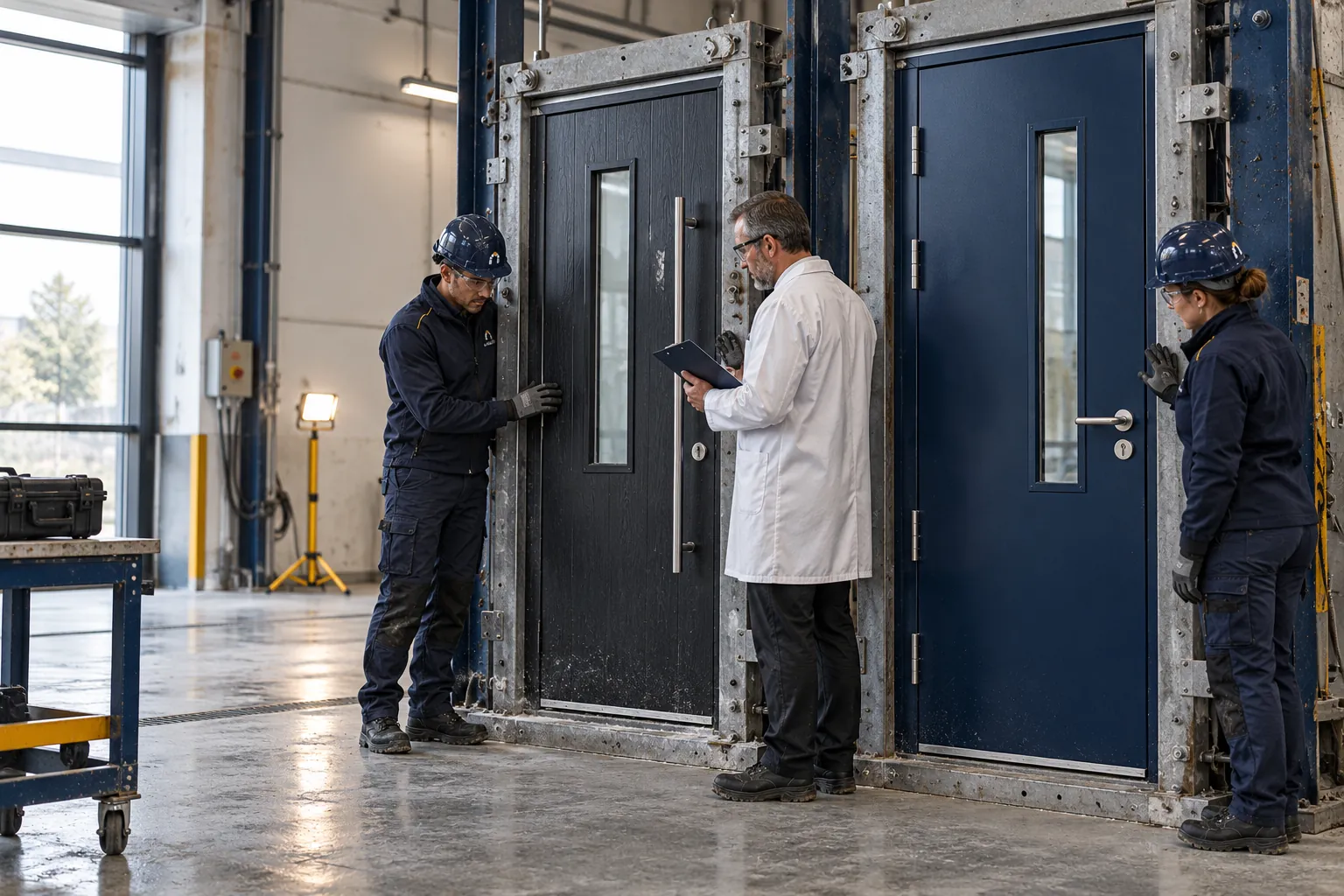
The Loss Prevention Certification Board publishes LPS 1175. Independent laboratories test the complete doorset, frame, locks, hinges and glazing together, against the toolkit for the rating claimed. The result is a two-part rating such as B3 or D10: the letter names the tool category and the number the minimum delay in minutes.
BSI publishes PAS 24, and accredited test houses carry out the assessment. The doorset faces a sequence of manual and mechanical attacks drawn from real burglary methods, including attacks on the locking, the hinges and the fixing into the wall. There is no grading and no timed delay to quote: the doorset passes or it fails.
One detail matters for glazed doors. The PAS 24 attack sequence does not include breaking the glass panes, which reflects its residential focus. LPS 1175 tests the glazing as part of the doorset, so a rated security door with glass has proven the glass too.
Where each standard is accepted
PAS 24 is the housing sector’s default. Developers, housing associations and local authorities routinely specify it for new homes and refurbishments, and it is the route most flat entrance doors take into residential schemes. The police-backed Secured by Design scheme lists products certified to recognised standards, and PAS 24 doorsets are among them.
LPS 1175 is the commercial and high-risk default. Data centres, utilities, banks, government buildings and cash-handling sites specify it because the rating states the threat in plain terms: tools and minutes. Insurers writing loss-prevention requirements for commercial property point to the same scale, and Secured by Design also accepts LPS 1175 products.
Neither standard is law. Both are ways of proving a claim about security, and the right one is the one your risk assessment, your insurer or your client actually asks for.
Where a project mixes homes and commercial space, the two standards often appear side by side in the same door schedule. Name the standard against each doorset rather than applying one across the whole building.
LPS 1175 and PAS 24 side by side
| Aspect | PAS 24 | LPS 1175 |
|---|---|---|
| Scope | Residential doors and windows | Doors, windows, shutters, grilles, barriers |
| Result | Pass or fail | Timed rating, A1 to H20 |
| Attacker | Opportunist burglar | Defined toolkit, categories A to H |
| Delay stated | None | 1 to 20 minutes, depending on rating |
| Glass attacked in test | No | Yes, as part of the doorset |
| Typical use | Homes, flats, housing schemes | Commercial, infrastructure, high-risk sites |
Read the table as a decision aid, not a ranking. A higher LPS 1175 rating is not better than PAS 24 in any absolute sense; it answers a different question about a different attacker.
Is there a mapping between SR2 and PAS 24?
No official mapping exists, and you should be wary of anyone who offers one. PAS 24 has no timed delay and no tool categories, so there is nothing to convert. In practice it sits below the LPS 1175 scale: the entry rating B3, formerly SR2, already demands three minutes against category B tools such as screwdrivers, pliers and hand saws.
The closest practical comparison is with the bottom of the LPS 1175 scale. An A1 rating, formerly SR1, covers one minute against basic hand tools, which is nearer the PAS 24 threat picture than any higher rating. Even then the tests differ enough that the two should not be treated as equivalent. Our SR2 vs SR3 vs SR4 guide explains what each step up the scale adds.
No conversion table. Treat PAS 24 as the residential baseline and LPS 1175 as the rated scale above it, and specify the one your risk assessment names.
When one doorset needs both ratings
A doorset can be tested to both standards, and some projects genuinely need that.
Mixed-use buildings are the other common case: retail or office space at ground level with residential floors above. The ground floor doorsets follow the commercial risk assessment while the flats follow the residential one, and dual-rated products keep the ironmongery and appearance consistent across both.
Dual testing costs more and takes longer, so confirm the requirement is real before specifying it. If only one standard is named in the brief, the second rating buys you nothing. Send your drawings through the quote form and we will tell you which ratings each doorset needs; our Issue 8 guide helps you read the ratings on existing certificates, and all our guides are listed in one place.
If you need the detail behind PAS 24 itself, our guide to PAS 24 requirements covers the test, certification and what to ask a supplier.
The order that names LPS 1175: where the higher threat sits
The order names LPS 1175 where the threat behind the door is a planned attack with tools, because LPS 1175 proves the doorset against the tool set for its category. Under Issue 8.2, dated September 2024, B3 resists for three minutes, C5 for five and D10 for ten. The category on the order is set by what sits behind the leaf, not by how wide the leaf is.
The old names SR2, SR3 and SR4 mean the same categories, and the category on the order is the one the product was proved to. A door that guards cash, records or servers takes a higher category than a door that guards a store, because the rooms behind them hold what the building runs on. The leaf, the frame, the fixings and the lock faced the test as one doorset.
PAS 24 proves a doorset for a dwelling, and it answers a different question from LPS 1175. PAS 24 tests the doorset against the attack a dwelling faces, with the leaf, the frame, the lock and the hardware proved together as one doorset. The standard fits the front door of a flat, where the threat is an opportunist with hand tools and the door must also shut quietly every day.
The two standards are tested by different hands, and the test report behind each one names the standard, the product and the result. A report that names the rating and not the product leaves the buyer guessing, and a guess is not proof. The proof of the doorset is the report that names both, and the report lives with the building file.
The order that names PAS 24: where the dwelling standard fits
The order names PAS 24 where the doorset guards a dwelling, because the standard was written for the doors of homes. A flat entrance door takes PAS 24, and the leaf, the frame and the lock were proved together for that use. The door must also shut on its own every time, because a leaf that stands open holds nothing back, and the smallest closer power on a fire door is EN 3 to BS EN 1154.
The order names LPS 1175 where the doorset guards a room that holds something worth taking, because the category follows the risk behind the leaf. A server room, a finance office and a records store take LPS 1175, and the category follows the room, not the floor. The ground floor entrance carries the higher grade, because it is the door an intruder reaches first.
Where one doorset needs both ratings, the leaf, the frame and the seals were proved together for both, because a leaf proved to one standard and fitted to the other carries no proof at all. The order names both ratings beside the same doorset, and the test report names both, so the door that arrives is the door that was proved.
| Standard | What it proves | Where it fits | What to ask for |
|---|---|---|---|
| LPS 1175 B3 | Three minutes against tools | Rooms an intruder tries first | The category beside the product |
| LPS 1175 C5 | Five minutes against tools | Rooms that hold something worth taking | The category beside the product |
| LPS 1175 D10 | Ten minutes against tools | Rooms that must hold longest | The category beside the product |
| PAS 24 | A dwelling doorset against attack | Flat entrance doors | The standard beside the doorset |
The standard in full is set out in the LPS 1175 standards page, and the dwelling standard is covered in the PAS 24 requirements guide. The two ratings side by side are covered in the LPS 1175 versus EN 1627 guide, and what breaks a rating once a door is fitted is set out in keeping an LPS 1175 rating valid guide.
What the comparison does not tell you
The comparison tells you which attacker each standard assumes and how each test is run. It does not tell you whether the door will hold fire. Neither PAS 24 nor LPS 1175 tests fire performance, and a doorset that carries either rating has not shown anything about fire unless it was also tested to EN 1634-1 on the same construction.
The comparison does not tell you about the wall. Both tests attack the doorset as a tested assembly, frame included, but neither proves the partition around it. A rated door in a weak surround protects a doorway that an intruder can walk around.
The comparison does not tell you how long a PAS 24 door will hold. PAS 24 is pass or fail, with no timed delay and no tool categories to quote. Anyone who offers a conversion from PAS 24 to an LPS 1175 rating is guessing, because there is nothing to convert.
The comparison does not tell you about maintenance. A rating describes the doorset as tested, not the doorset after five years of use. Locks wear, seals harden, and a replacement part that differs from the tested make-up needs its own evidence before the rating can be relied on again.
The comparison also does not tell you which standard your insurer wants. For homes, insurers generally accept PAS 24 as evidence of reasonable security. For commercial property, loss-prevention requirements usually name an LPS 1175 rating with the tool category and minutes stated. Check the policy wording before you specify, because a rating the insurer does not recognise is a rating that buys nothing.
Mistakes when choosing between the two
The two standards answer different questions, so most mistakes come from treating them as two rungs on one ladder. The table below sets out the errors that appear most often.
| Mistake | Why it fails | What to do instead |
|---|---|---|
| Specifying PAS 24 for a commercial entrance | The test assumes an opportunist burglar, not a planned attack | Name the LPS 1175 rating the risk assessment calls for |
| Treating B3 as “PAS 24 plus a bit” | B3 states 3 minutes against category B tools; PAS 24 states no delay at all | Read the rating as tools and minutes, not as a grade above PAS 24 |
| Assuming a glazed PAS 24 door proves the glass | The PAS 24 attack sequence does not include breaking glass panes | Specify rated glazing in a rated doorset where the glass must resist attack |
| Applying one standard across a mixed-use building | Flats and commercial floors face different threats | Name the standard against each doorset in the schedule |
| Ordering dual rating nobody asked for | Dual testing costs more and takes longer, and buys nothing the brief does not name | Confirm the requirement is real before specifying both ratings |
Get the standard right first, and the rating within it comes second. A specification that names the threat, the standard that answers it, and the evidence that proves it leaves nothing to interpret. For how to read the ratings on a certificate, see the LPS 1175 Issue 8 guide, and for the changes that void a rating after installation, see the guide to keeping an LPS 1175 rating valid. The PAS 24 requirements guide covers the residential route in full.
Frequently asked questions
Is PAS 24 enough for a commercial building?
Usually not. PAS 24 was written for homes, and most commercial risk assessments name an LPS 1175 rating instead. If the brief or the insurer names PAS 24 explicitly, follow the brief; otherwise step up to a rated SR2 security door as the minimum.
Can one doorset hold both PAS 24 and LPS 1175?
Yes. The doorset goes through both test programmes and carries both results. This suits mixed-use schemes where the residential floors and the commercial ground floor follow different standards.
Does the PAS 24 test break the glass?
No. The attack sequence does not include breaking glass panes, which is one reason glazed PAS 24 doorsets should not be assumed equivalent to an LPS 1175 rating. Where the glass itself must resist attack, specify rated glazing in a rated doorset.
Which standard do insurers ask for?
For homes, insurers generally accept PAS 24 as evidence of reasonable security. For commercial property, loss-prevention requirements usually name an LPS 1175 rating with the tool category and minutes stated. Check the policy wording before you specify.
Do I need LPS 1175 for a block of flats?
Flat entrance doors usually need PAS 24. The communal entrances, plant rooms and bin stores in the same block often justify an LPS 1175 rating because they face a different threat. Our residential security doors page covers how the two sit together.
Get a free quote
Related
More in guides for specifiers
Products
One supplier for the whole building envelope
Ready to specify your project?
Free assessment, written specification and test evidence. Reply within one working day.