
ArxBridge
Fire Door Cost Factors
Fire door costs follow the period, the leaf, the hardware and the fitting: what moves the price of a proved doorset, and how to read the quotation.
- ✓Third-party test evidence with every product
- ✓Written specification you can issue to tender
- ✓Supplied and installed across the UK
Get a free project quote
Rating, written specification and budget range within one working day.
Confidential. No cost, no obligation.
Third-party tested
Evidence with every quote
UK manufactured
Made to your sizes
One accountable team
Specify, supply, install
Confidential handling
Details never shared
A fire door is priced as a doorset, not as a leaf. The leaf, the frame, the seals, the hardware and the fitting arrive as one price, because the proof covers the doorset as one. A leaf bought on its own carries no proof, and a frame bought to fit another leaf leaves the door different from the one tested.
The price follows the period, the leaf and the hardware beside it. A door that must hold fire back for 60 minutes takes a different leaf from one that must hold for 30, and a door on an escape route takes hardware a store door never needs. The order names the period, the leaf and the hardware together, so the price that comes back is the price of the door that was asked for.
The doors that guard a building against forced entry are priced another way, and the security door cost factors guide works through the grades and the proof a security door carries. A fire door and a security door can share one leaf, and the dual proof carries its own price. The fire and security doors dual certification guide covers how two proofs share one leaf.
- FD30 / FD60Fire periods to EN 1634-1
- E / EW / EI 30-120What the letters beside the period mean
- EN 3 minimumCloser power on a fire door
- One scheduleEvery fire door on one line
The price follows the doorset: what a fire door cost is made of
The price of a fire door starts with the doorset, because the test proves the leaf, the frame and the seals together. A leaf tested in one frame carries no proof in another, so the order names the doorset the test report names, and the price follows the doorset, not the leaf alone.
The frame takes its share of the price, because a frame that must hold a heavy leaf through a fire needs the fixings and the depth the test proved. A frame ordered thin to save money leaves the leaf without the support the test gave it, and the door that arrives is not the door that was proved.
The seals take a smaller share but decide the proof, because the gap round the leaf must close when the heat rises. Intumescent seals expand at around 200 to 250 degrees, and the seal, the bead and the fixings travel with the leaf. A seal left off the order still has to be bought, and fitting it after the door is hung costs more than ordering it with the door.
The period on the leaf: FD30, FD60 and the letters beside them
The period on a fire door follows the fire load behind the opening, not the size of the leaf. A door that guards a store takes the period the fire load behind it demands, while a door on a stair core takes the period the escape route needs, and the period on each door matches the opening it guards.
Under EN 1634-1 the period runs from 30 to 120 minutes, and the letters E, EW and EI say what the doorset held back. E stops the flames, EW stops the flames and some of the heat, and EI stops the flames and the heat, so the letters sit on the order beside the period.
A longer period takes a heavier leaf, a deeper frame and seals that hold longer, so the price climbs with the period. A door proved for 30 minutes on an opening that must hold 60 runs out before the wall beside it does, because the door and the wall were never proved together for the longer period. The periods for the shared parts of a public building are set out in the fire door regulations commercial buildings guide.
The leaf, the frame and the seals: what the material does to the price
The leaf material sets the shape of the price. A steel leaf takes a different build from a timber leaf, and the choice between them follows the opening, the period and the look the building needs. The choice between leaf materials is worked through in the steel versus timber fire doors guide.
Glazing in the leaf adds its own price, because a vision panel takes a pane, a bead and fixings that were proved with the leaf. A pane that holds fire in one frame can fail in another, so the glass, the bead and the fixings go to the test with the leaf, and the report names them all.
The gap round the leaf stays at 4 mm so the door can swing, and the seals that close the gap take the fixing the test report names. The seals are checked on the round, because a seal painted over cannot swell and a gap that has opened lets smoke through before the flames arrive.
The hardware beside the leaf: closers, locks and panic bars
The closer takes the power the leaf needs, and a fire door takes no less than EN 3 to BS EN 1154. A closer that has lost its power leaves the leaf ajar, and a seal in a groove does nothing while the leaf stands open. The fire door closers guide covers the sizes and the fitting of closers.
The lock on a fire door must hold the leaf shut against the fire and still let people out when the alarm sounds. A lock that needs a key to open from inside traps the people behind it, so the leaf takes a release that opens with one action and still holds the leaf shut against the heat. The lock the key turns is covered in the fire door hardware guide.
Panic bars to BS EN 1125 sit on the doors of an escape route, and each bar must work with the lock beside it, not against it, so the leaf opens for a crowd even when the power has gone. The bar takes at least 60 percent of the leaf width, and the price of the bar belongs on the order beside the leaf.
The fitting that holds the proof: why the install is part of the price
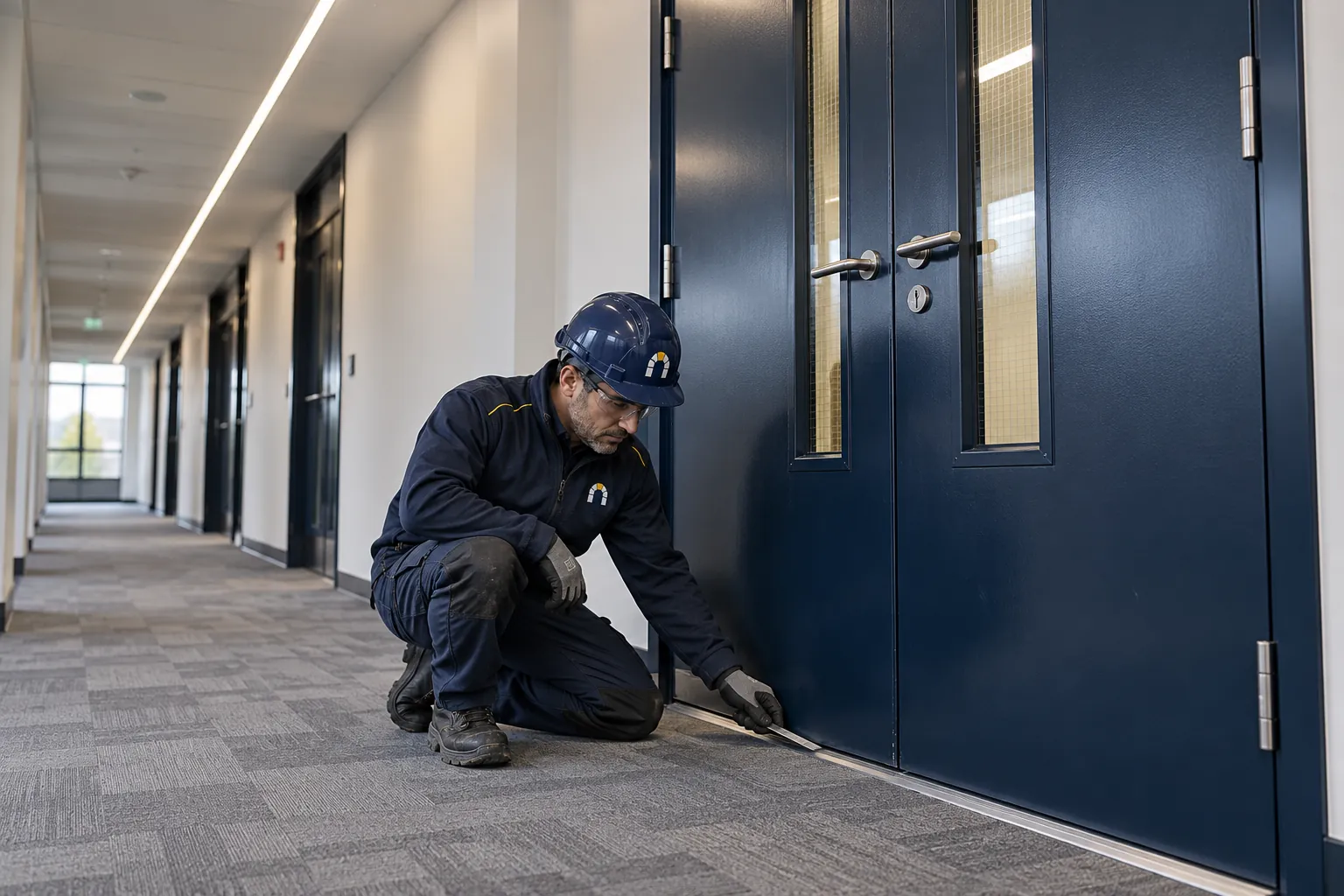
A fire door is only as good as its fitting, because the proof covers the doorset as it was fitted, not as it left the factory. A leaf hung in a frame that is out of square drags on its seals, and a frame fixed without the packers the test used leaves the door different from the one tested.
The fitting takes the time the doorset demands, and the price of the fitting follows the number of doors and the state of the openings they go into. An opening that needs making good before the frame goes in takes longer than an opening that is square and true, and the time belongs on the quotation beside the doors.
The record after the fitting names every door, the proof it carries and the day it was fitted, so the next person knows which doors hold their proof and which do not. What each visit should look for is named in the fire door inspection checklist, and the door that was fitted without a record carries no proof at all.
When the opening is not square: the remedial work the fitter finds
The schedule names every door, and the order goes out against it, but the fitter works with the building as it stands. An opening can sit out of square, plaster beside it can have blown, or the floor can stand higher than the drawing showed, and each asks for work before a frame can be set. A frame fixed out of true leaves the door out of true with it, so the gap will not sit even at 4 mm all round. Putting the opening right is remedial work, and its figure sits beside the figure for the doors.
Packers take the time an opening out of square asks for, and they must match those the test report lists, set in the same places, or the door on the wall is no longer the door the furnace proved. Plaster that has blown must be cut back and made good first, because a frame fixed to plaster with no key behind it will shift as the door is used. Where the floor stands higher than the drawing, the frame is cut or the floor is eased, and the work is finished before the door is hung. The gap is checked on each side once the frame is set, and the guide on fire door gaps states the size it must hold, while the guide on fire door closers lists the power the closer needs to pull the door shut.
| What the fitter finds | What it asks for | What goes on the variation |
|---|---|---|
| Opening out of square | Packers and time to set the frame true | Packers as tested, time, date agreed |
| Plaster blown beside the opening | Cut back and made good before fixing | Area made good, fixings checked |
| Floor higher than the drawing | Frame cut or floor eased | Work named, gap rechecked at 4 mm |
| Old frame left in the opening | Frame checked against the test report | Frame kept or replaced, proof noted |
A variation priced after the order still belongs on the schedule
Work the order never named is a variation, and it is priced and agreed in writing before it starts, while the fitter is still on site. Agreed after the event, the same work is harder to price, because the opening is already made good and the hours are already spent. A line is added to the schedule beside the door it belongs to, naming the work, the date and the person who agreed it, so the record shows the door as it stands and the work that went into it.
The proof must hold through the variation, because a door that has been made good must still hold fire for its period. The packers, the fixings and the seals stay the ones the test report lists, and the closer still takes at least EN 3 to BS EN 1154, so the door handed over is the door that was proved. The parts a working fire door depends on are listed in the fire door hardware guide, and the fire door maintenance guide holds the round that keeps the door as it was proved. Once the schedule carries the doors, the variations and the proof beside each one, the enquiry can go out with the security door enquiry checklist beside it, and the columns a schedule should hold are carried in the guide on how to specify security doors.
The doors beside the fire door: security, glazing and the second proof
One leaf can carry two proofs, because the door on an office floor must hold fire back and hold an intruder out at the same time. The fire proof is measured in E, EW and EI from 30 to 120 minutes under EN 1634-1, and the forced entry proof is LPS 1175, with B3, C5 and D10 holding three, five and ten minutes. Both proofs cover the leaf, the frame and the seals as one doorset.
The glass beside the leaf takes the same proof as the leaf beside it, because a door that holds fire can still be reached through the pane beside it. The fire rated windows guide covers the windows that share the same wall, and the fire rated glass cost guide works through the cost of the glass itself.
A door that guards a flat entrance takes a different proof from a door that guards a warehouse, and the flat entrance doors guide covers the doors on the entrance to a flat. The proof on each door follows the room behind it, not the size of the opening, so the price follows the room too.
The quotation beside the schedule: reading the price before the order
A quotation is read beside the schedule, line by line, so every leaf, frame, seal, closer and lock is priced before the order goes out. A part left off the quotation still has to be bought, and fitting it after the door is hung costs more than ordering it with the door.
The quotation should name the period, the leaf, the hardware and the fitting on each line, because a price that names only the leaf leaves the rest to be guessed. A guess is not a proof, and a door ordered on a guess arrives as a different door from the one the building needs.
The schedule that names every door in the building, with the period and the hardware beside each one, is the list the quotation is read against. The columns the schedule needs are set out in the how to specify security doors guide, and the 10 steps to specify an LPS 1175 door guide walks through the order for a security door.
Why two quotes for one schedule can disagree
Two quotes can arrive for one schedule and disagree, and the disagreement is worth reading before the order goes out. A quote that lists leaf, frame, seals and hardware line by line can be checked against the schedule, while a quote that lists only the leaf leaves the rest to guesswork. The period sits beside each door on the schedule, and a quote that prices a shorter period than the schedule names is not a cheaper door, it is a different door. The schedule names the position of every door, so a quote read against it shows which opening takes which leaf, and a quote that prices one leaf for the whole building leaves the fitter to guess.
The leaf material is the first place the figures part company. Steel and timber leaves are built in different ways, and which one suits the opening depends on the period it must hold, the frame it sits in and the finish the room asks for. The leaf, the frame and the seals were proved together to EN 1634-1, so a quote that swaps one leaf for another without naming the frame and the seals beside it has priced a doorset the test never saw. Steel or timber: the steel versus timber fire doors guide weighs the two leaf materials, and the fire door regulations commercial buildings guide gives the periods the shared parts of a public building need.
| Quote line | What to compare | What the gap means |
|---|---|---|
| Leaf and period | FD30 or FD60, E, EW or EI | A shorter period is a different door |
| Frame and seals | Frame depth, seal and bead | A frame left off the quote still has to be fitted |
| Hardware | Closer power, lock, panic bar | Hardware that does not match the leaf breaks the proof |
| Seals and beads | Strip, bead and fixings | A seal left off the order still has to be bought |
| Fitting | Openings made good, packers, time | An opening out of square takes longer to fit |
The line a quote leaves out is the line the fitter finds later
The fitting is the line most often left short. Making an opening good before the frame goes in adds time that a square and true opening never asks for, and that time belongs on the quotation beside the doors. A frame fixed without the packers the test used leaves the door different from the one tested, so the fitting that holds the proof belongs on the quote with the doorset, not beside it as an afterthought. After the fitting, the record should list each door with the proof it carries and the day it went in, so anyone who reads it later can tell which doors still hold their proof.
Read every quote line by line against the schedule, and ask for the lines that are missing before the order goes out. When a closer loses its power the leaf sits ajar, and a seal in its groove cannot work while the leaf stands open, so order the hardware beside the leaf. For closers, the fire door closers guide lists the sizes and the fitting; for hardware, the fire door hardware guide lists the grades and the parts that keep a fire door working; for the schedule itself, the how to specify security doors guide names the columns it needs. Once the schedule is complete and every line is priced, the security door enquiry checklist tells you what to send with it.
One schedule for the whole building: every fire door on one line
Put the fire door order together as one list, with a line for every door on the building and the period, the leaf, the hardware and the fitting beside each one, so the door that arrives matches the door that was proved. A schedule that names one door for the whole building leaves the fitter to guess which opening takes which leaf, and a guess is not a proof.
The round that looks after fire doors walks the building in turn and looks at the leaf, the gaps, the seals, the closer and the lock on each door. Each fault is written against the door it belongs to on the same day, so the repair follows the fault and the door never stands open. The checks that keep a doorset honest through its life are named in the security door maintenance checklist.
Keeping the rating valid after the doors are fitted takes the same care as ordering them, because a lock changed, a closer swapped or a seal painted breaks the evidence the test left behind. What breaks a rating once a door is fitted is covered in the keeping an LPS 1175 rating valid guide.
| Position | Door | Period | What moves the price |
|---|---|---|---|
| Stair core | Fire leaf | FD60 | Leaf, closer, seals |
| Corridor | Fire leaf | FD30 | Leaf, seals, gap |
| Store | Fire leaf | FD60 | Leaf, frame, seals |
| Flat entrance | Fire leaf | FD30 | Leaf, lock, glazing |
| Plant room | Fire leaf | FD60 | Leaf, seals, fitting |
A fire door costs what its proof costs, so the period, the leaf, the hardware and the fitting must all sit on the same schedule.
What decides the price of a fire door?
The period, the leaf, the hardware and the fitting, proved together as one doorset.
Is a longer period always dearer?
A longer period takes a heavier leaf, a deeper frame and seals that hold longer, so the price climbs with the period.
Does the hardware change the price?
Yes. The closer, the lock and the panic bar each take the power and the proof the leaf needs, and each belongs on the order beside the leaf.
Can one leaf hold fire and forced entry?
Yes, when the leaf, the frame and the seals went to the test together for both proofs, fire to EN 1634-1 and forced entry to LPS 1175.
Who checks the doors once fitted?
The person who runs the building checks them on the round that covers every door, and a fault is written against the door it belongs to the same day it is found.
Get a free quote
Related
More in guides for specifiers
Products
One supplier for the whole building envelope
Ready to specify your project?
Free assessment, written specification and test evidence. Reply within one working day.