
ArxBridge
Fire and security doors: how dual certification works
Fire and security doors dual certification explained: EI and E classes, the LPS 1056 and EN 1634-1 fire tests, LPS 1175 attack ratings and escape hardware.
- ✓Third-party test evidence with every product
- ✓Written specification you can issue to tender
- ✓Supplied and installed across the UK
Get a free project quote
Rating, written specification and budget range within one working day.
Confidential. No cost, no obligation.
Third-party tested
Evidence with every quote
UK manufactured
Made to your sizes
One accountable team
Specify, supply, install
Confidential handling
Details never shared
A dual-certified door carries test evidence for fire and forced entry on the same construction. Fire performance is tested to EN 1634-1, giving E, EW or EI classes from 30 to 120 minutes. Security is tested to LPS 1175, from A1 to H20. One certificate cannot cover both.
- Fire classesE integrity, EW radiation, EI insulation
- Fire periods30, 60, 90 and 120 minutes
- Security ratingsLPS 1175, from A1 to H20
- Fire schemeLPS 1056, the LPCB fire door scheme
What E, EW and EI actually mean
EN 1634-1 is the fire resistance test for doorsets. It defines three classes. E means integrity: flames and hot gases do not pass through the doorset for the stated period. EW adds a limit on radiated heat: the heat passing through stays below the threshold. EI adds insulation: the temperature on the unexposed face stays below the threshold as well.
The period follows the class: 30, 60, 90 or 120 minutes. An EI60 doorset therefore holds integrity and insulation for 60 minutes. The class and the period together describe what the door does in a fire, and the fire strategy for the building decides which combination each opening needs.
The fire strategy assigns these classes opening by opening. A stairwell door protecting the escape route may need EI60, while a door between two low-risk rooms may only need E30. The strategy sets the requirement, not the door supplier, and the doorset schedule should record the class and period for every opening.
| Class | What it limits | Where it is often specified |
|---|---|---|
| E30, E60 | Flames and hot gases passing through | Corridor and compartment walls |
| EW30, EW60 | As E, plus radiated heat | Glazed screens near escape routes |
| EI30, EI60, EI90, EI120 | As E, plus temperature rise on the safe side | Stairwells, risers and high-risk compartments |
LPS 1056 and the EN 1634-1 fire test
LPS 1056 is the LPCB certification scheme for fire doorsets. EN 1634-1 is the test method the doorset goes through: one face of the doorset is exposed to a furnace, and integrity, radiation and insulation are measured against the clock.
Certification goes further than a single furnace test. The scheme covers the construction, the manufacturing controls and the hardware schedule, so the doorset leaving the factory matches the doorset that passed the test. Our fire ratings guide explains the classes in detail.
The LPS 1175 attack test, in brief
LPS 1175 tests forced entry resistance. The rating combines a tool category letter, from A for opportunist hand tools to H for extreme tools, with the attack time in minutes. B3 means 3 minutes against screwdrivers, pliers and hand saws. C5 means 5 minutes against crowbars, drills and chisels. D10 means 10 minutes against sledgehammers, disc cutters and jigsaws.
The test attacks the complete doorset: leaf, frame, locks, hinges and any glazing or louvres. A rating therefore describes the assembly as built, not the steel in the leaf alone.
Steel doorsets can combine fire and security ratings in ways timber cannot match. Our guide to steel vs timber fire doors explains how that difference affects the specification.
Why both ratings must be tested on the same doorset
Fire and security pull the construction in opposite directions. Security wants mass, reinforcement and multi-point locking. Fire wants controlled gaps, intumescent seals and hardware that does not conduct heat through the leaf. A change that helps one test can fail the other.
That is why dual certification means two sets of test evidence on the same construction. A doorset with an LPS 1175 certificate and a separate fire test on a different build is not dual certified. Ask for both certificates against the identical specification: same leaf, same frame, same seals and same hardware schedule.
Plan the testing early in the programme. A doorset that needs both ratings should be designed around the two test methods from the start, with the hardware schedule agreed before manufacture. Adding security hardware to a fire-tested door afterwards, or fire seals to a security door, almost always means building the evidence from scratch.
Check the scope, not just the badge. A certificate only covers what was tested. If the size, glazing, louvre or lock differs from the tested doorset, the rating does not transfer to your door.
Escape hardware versus forced entry resistance
Escape routes need doors that open easily from the inside, often with panic hardware, while the same door must resist forced entry from the outside. These two demands meet in the hardware schedule.
The answer is hardware tested as part of the doorset for both jobs. Panic hardware must release freely under load from the escape side and still leave the doorset’s attack resistance intact from the attack side. Specify the exact panic device from the test evidence, because swapping it for a lookalike voids both ratings.
Self-closing devices need the same treatment. A fire doorset must close reliably every time, and the closer in the schedule is the one that was furnace tested with the door.
Intumescent seals and the tested specification
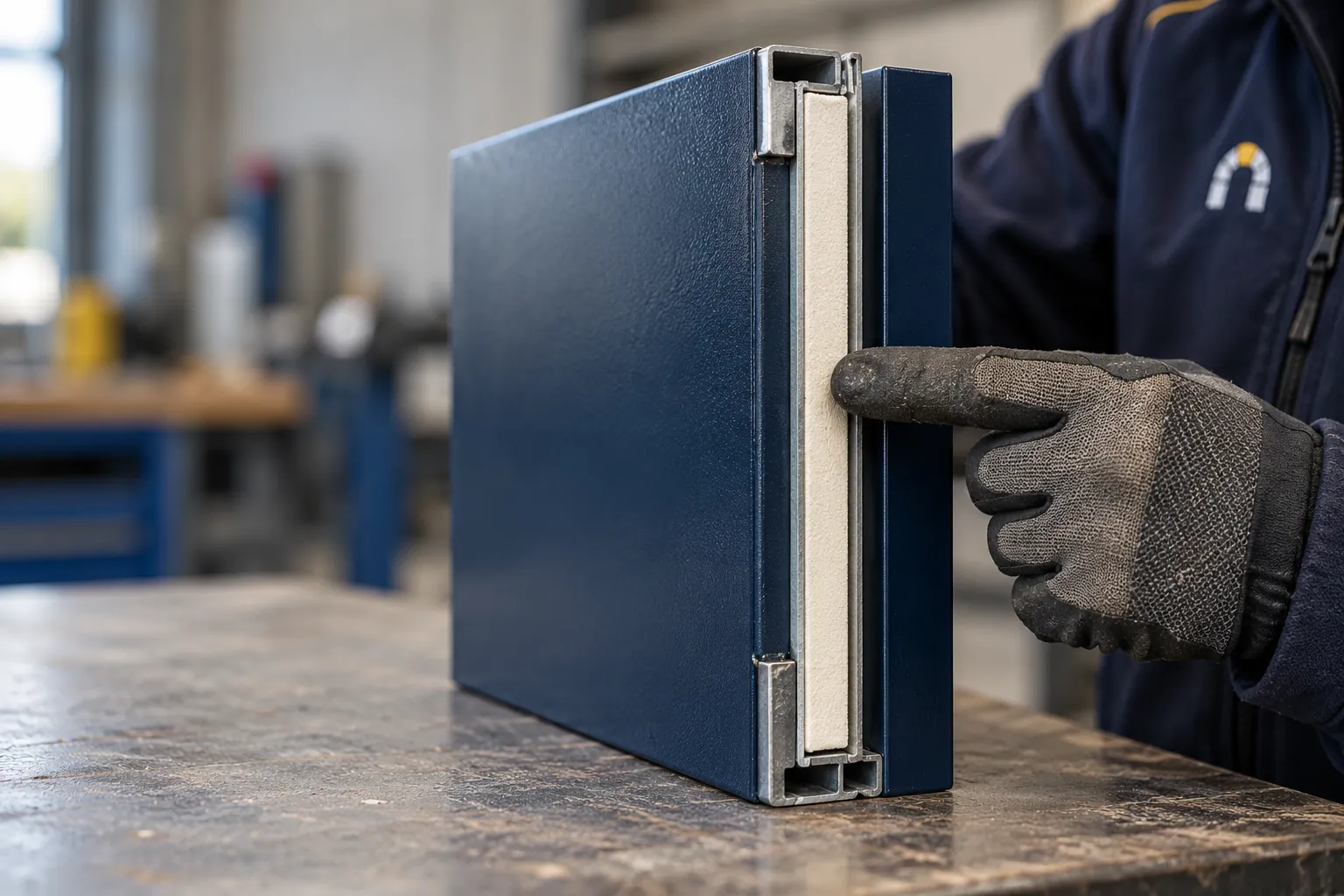
Intumescent seals expand in heat and close the gap between leaf and frame, which is what holds the E and EI performance at the edges of the door. They are part of the tested specification, not an accessory.
Do not paint over them, trim them for a tighter fit or swap them for a different brand. Any of those changes takes the doorset outside its test evidence. The same applies to glazing beads, fixings and the frame: the certificate describes one exact build, and the door on site must match it.
Certificates, labels and what to check before you buy
Ask for both certificates and read the scope pages. Check the sizes, the hardware schedule, the glazing and louvre options and the seal specification all match what you are buying. Look for the third-party certification label on the doorset itself, applied under the scheme rules.
Keep the paperwork with the building. At handover, the operations team needs the certificates, the hardware schedule and the maintenance limits, because a fire doorset is inspected and maintained against its test evidence for the life of the building. A lost certificate is a common reason a compliant door gets replaced for no reason.
Where a project needs the combined performance, start with fire and security doors and fire rated steel doors. Healthcare estates often need this combination; see the healthcare sector notes. Related reading: PAS 68 vs IWA 14 vs ISO 22343 and how to choose HVM bollards. Browse all guides.
What dual certification does not prove
Dual certification proves two performances on one tested construction: fire to EN 1634-1 and forced entry to LPS 1175. It proves nothing else. It does not prove the door stops bullets, resists blast or keeps out smoke, because each of those needs its own test on the same construction. A doorset with fire and security evidence and no blast evidence has shown nothing about blast.
It does not prove the installation. The certificates describe the doorset as tested in the laboratory, in a tested wall, with tested fixings. A door fitted into a weak wall, with fixings that miss the structure, or with a frame packed out to fit a larger opening, is outside the evidence. The rating follows the installation, not the delivery note.
It does not prove the door will stay certified. A dual-certified doorset that is changed after handover, a closer swapped, a lock changed, a vision panel cut in, has left both sets of evidence behind. The certificates describe the doorset as supplied, and every change needs to be checked against both of them before it is made.
It does not prove the rest of the building. A dual-certified door at the entrance, beside a window that opens with a screwdriver, is a strong door in a weak line. The fire strategy and the security survey must treat the opening as part of the wall, not as a product on its own.
And it does not prove the door is right for the opening. Two ratings on one doorset do not make it the right doorset. A corridor that needs only fire performance, or a plant room that needs only security, does not need both. Match the ratings to the opening, not to the brochure.
Mistakes that break a dual-certified order
Most broken orders are decided at specification stage, not on site. The table below sets out the errors that appear most often.
| Mistake | Why it fails | What to do instead |
|---|---|---|
| Ordering fire and security on different builds | The two certificates describe different doorsets, so neither applies to the door on site | Ask for both certificates against one identical specification |
| Swapping the panic hardware | The escape device in the schedule is the one that was tested for both jobs | Name the exact device from the test evidence |
| Cutting a vision panel after the test | The glazing, bead and aperture size are part of both tests | Size the panel inside the tested scope for both ratings |
| Painting over the intumescent seals | The seals are part of the fire evidence, and paint stops them working | Leave seals unpainted and undamaged |
| Losing the certificates at handover | The next inspection has nothing to check the door against | File both certificates with the building records |
Get both ratings right first, and the order follows from them. For how the ratings sit together, see the fire ratings page and the guide to specifying security doors. For keeping both ratings valid after handover, see keeping an LPS 1175 rating valid, and for the swing doorset side, see our fire rated steel doors.
Frequently asked questions
Can any fire door be upgraded with security hardware?
No. Changing the hardware takes the doorset outside its fire test evidence. Both ratings must be earned by testing the same construction.
What is the difference between E and EI?
E is integrity: flames and hot gases do not pass through for the stated period. EI adds insulation: the temperature on the unexposed face also stays below the limit for the period. EW sits between the two, limiting radiated heat without the full insulation requirement.
Does panic hardware weaken the security rating?
Not if it is the device named in the test evidence. The doorset is attacked and furnace tested with its exact hardware schedule in place.
Can a dual-certified door have a vision panel?
Only if the glazing system and its size sit inside the tested scope for both the fire test and the security test. The bead, the glass and the aperture size are all part of the evidence, so a larger or different vision panel needs its own test coverage.
What is LPS 1056?
It is the LPCB certification scheme for fire doorsets, covering the EN 1634-1 test, the construction and the manufacturing controls.
Get a free quote
Related
More in guides for specifiers
Products
One supplier for the whole building envelope
Ready to specify your project?
Free assessment, written specification and test evidence. Reply within one working day.