
ArxBridge
Plant Room Fire Doors
Plant room fire door rules: FD30 and FD60 periods, closers, hinges and seals for boiler, switchgear and pump rooms, on one schedule for the whole building.
- ✓Third-party test evidence with every product
- ✓Written specification you can issue to tender
- ✓Supplied and installed across the UK
Get a free project quote
Rating, written specification and budget range within one working day.
Confidential. No cost, no obligation.
Third-party tested
Evidence with every quote
UK manufactured
Made to your sizes
One accountable team
Specify, supply, install
Confidential handling
Details never shared
A plant room holds the boilers, the switchgear and the pumps that keep a building working, and the fire load behind its door decides the period that door must carry. A boiler room burns fuel, a switch room carries current, and a pump room holds oil, and each one asks a different question of the door that closes it.
The doors are ordered by the team that runs the building services, and the order names the period, the hardware and the seals for every room. A plant room door is opened by engineers, not by the public, so it must shut by itself every time and hold when nobody is watching.
The period, the closer, the hinges, the seals and the records all sit inside one schedule, and an order that names them plainly gets the right doors on the right rooms. Our plant room door requirements guide covers the doors in full, and the fire door regulations for commercial buildings guide covers the same duties across the building.
- FD30 / FD60Fire resistance periods tested to EN 1634-1
- BS EN 1154Closer power sizes EN 1 to EN 7
- BS EN 1935Hinge grades 13 and 14
- 4 mmGap round the leaf, held by the seals
Boilers, switchgear and pumps: what sits behind a plant room door
A plant room divides by what it holds, and each room puts its fire door in a different place. The boiler room holds the burners and the fuel, the switch room holds the boards and the current, the pump room holds the pumps and the oil, and the lift motor room holds the machine that moves the lift.
Each room holds a different fire load, and the period follows the load, not the room name. A boiler room with fuel behind the door asks for more than a pump room with water behind it, so the fire strategy names the period for each room by what sits behind the door.
A door between a plant room and an escape route carries the highest duty in the building services. The route out runs past the plant room door, so the door must hold fire and smoke off the route while people pass it, and a door that fails there fills the one way out.
FD30 and FD60 in a plant room: matching the period to the fire load
EN 1634-1 times a doorset in a furnace to set its period: a leaf that holds for 30 minutes earns FD30, and one that holds for 60 minutes earns FD60. The letters name what the furnace measured, E for integrity, EW for integrity with limited radiation and EI for integrity with insulation, and the EI limit keeps the heat on the safe side below 140 degrees Celsius on average and 180 at the hottest point.
A boiler room usually takes FD60 for the fuel behind it, and a switch room takes FD60 for the current behind it. A pump room takes FD30 or FD60 by the load behind the door, and a door in a compartment wall between two plant rooms usually takes FD60, because the fire on either side can reach it. The fire ratings guide sets out what each letter and number means.
One leaf can hold fire and resist attack at once, but only where the test evidence covers both, on the one assembly that will be fitted. Our dual certification guide works through how the two proofs sit on one doorset.
The door that must shut against the draught: closers on a heavy leaf
Plant rooms draw air, and the draught pulls at the leaf every time the door is opened. The closer has to pull a heavy leaf shut against the air the plant draws through the room, and a closer that cannot do it leaves the door standing open. A fire door standing open is a hole in the compartment wall, and the hole sits on the escape route.
Closer power sizes come from BS EN 1154: EN 1 suits a 750 mm leaf at 20 kg, EN 7 suits a 1,600 mm leaf at 160 kg, and no fire door takes less than EN 3. A closer set too weak leaves the door standing open, and a closer set too strong breaks the access rules. What each power size suits, and how to adjust it, is listed in our fire door closers guide.
Opening force is capped by BS 8300 and Approved Document M, at below 30 N through the first 30 degrees and below 22.5 N beyond that. An engineer carrying tools must still be able to open the door, so the closer power size belongs on the schedule beside the period, because the two are set together.
Hinges, seals and gaps: the parts a plant room wears first
Heat, dust and vibration wear the small parts of a plant room door first, and the hinge grade decides how long the door keeps working. A hinge proved to BS EN 1935 carries a grade for cycles and load: grade 13 is proved for 200,000 cycles at 120 kg, and grade 14 for the same cycles at 160 kg. A heavy leaf hung on a hinge that cannot carry it sinks on its hinges, and a leaf that sinks drags on the floor and stops latching.
Seals and gaps are the parts a busy plant room damages first. Keep the gap round the leaf at 4 mm, and intumescent seals swell with the heat, closing the gap at around 200 to 250 degrees. A seal that is missing, painted over or cut short leaves a gap the fire can pass through, and a gap wider than 4 mm lets smoke past the seal whatever the seal itself can do. The fire door hardware guide covers the grades and the parts that make a fire door work.
The heavy leaf that must shut against the draught: closers on a plant room door
A plant room door is a heavy leaf that must shut against the draught from the corridor, and the closer is the part that does that work. No fire door takes less than EN 3 to BS EN 1154, with the power size chosen for the leaf that is fitted, and the closer belongs on the order beside the leaf.
The hinge on a plant room door carries a heavy leaf through every opening, and the weight it carries decides the grade it needs. A hinge proved to BS EN 1935 is tested to 200,000 cycles, with grade 13 taking a leaf of 120 kg and grade 14 taking one of 160 kg, so the grade on the order follows the leaf. When a hinge gives way under the weight, the leaf drops on its hinges and drags on the floor, and a leaf that drags cannot shut on its own.
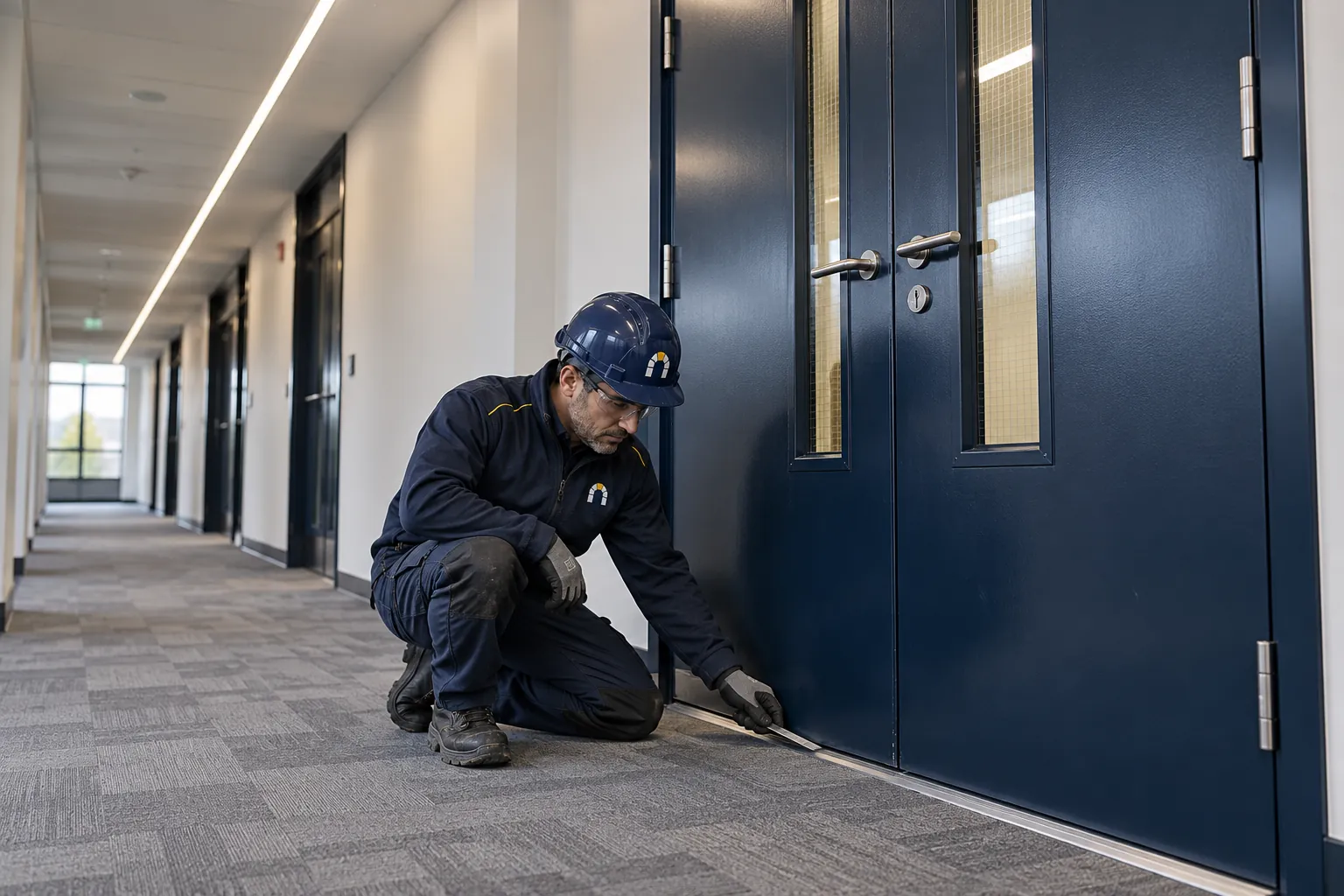
The gap round the leaf must stay at 4 mm, because a wider gap lets fire and smoke past whatever the period on the leaf says. The gap is measured at the top and both sides, and it is checked with a gauge on every round.
Intumescent seals expand at around 200 to 250 degrees, and they sit in the groove in the frame or the edge of the leaf. A seal that has come away, hardened with age or been painted over leaves the gap open.
The lock on the plant room door: keeping the wrong hands out
The period a plant room door takes follows the fire load behind it. Boilers, switchgear and pumps hold the highest fire load in the building, so a plant room door takes FD60 where the load behind it is heaviest, while a store with a lighter load takes FD30, and the period follows the fire load, not the size of the room.
Smoke and dust fill a plant room, so the seal on the door must hold against both. A door on a smoke path takes FD30S, with the seal proved to BS EN 1634-3, to Sa for smoke at room temperature and S200 for smoke at 200 degrees Celsius, and the seal must be the one the test report names.
Access to the plant room must stay with the staff who need it, so the lock on the door keeps the wrong hands out. A TS 007 3-star set, made of a 1-star cylinder with a 2-star handle or escutcheon, keeps the lock proved, and the keyway should be restricted, so blanks are held by the supplier and cut only on the order of the person who runs the building.
The round that looks after plant room doors walks every room in turn and stops at each door. The closer, the hinges, the seals and the gap are checked on every door, and a fault is written against the door it belongs to on the same day, so the repair is ordered before the fault grows into a door that will not shut.
| Part | What fails | What to check | When |
|---|---|---|---|
| Closer | Leaf left open | Power, arm, fixings | Every round |
| Hinge | Leaf drags | Fixings, sag, wear | Every round |
| Seal | Smoke through the gap | Seal intact, unpainted | Every round |
| Lock | Door forced | Cylinder, keyway, keep | Every round |
Put the period, the closer and the lock on the same line as every plant room door on the order, so the leaf that arrives is the leaf that was tested. The sizes and the fitting of closers are set out in our fire door closers guide, and the grades and the parts behind a working fire door are covered in our fire door hardware guide. The doors on the rooms that feed a building are covered in our plant room door requirements guide, and what each visit should look for is set out in our fire door inspection checklist.
Smoke, dust and the seal that must hold: FD30S where the route needs it
Smoke moves along a corridor faster than flame, so a door on a smoke path needs a seal as well as a period. FD30S pairs 30 minutes of integrity with a smoke seal proved to BS EN 1634-3, to Sa for ambient temperature smoke and S200 for smoke at 200 degrees Celsius, and the seal only works where the gap around the leaf is right.
Where a plant room opens onto an escape route, smoke matters as much as fire. A boiler room door that lets smoke onto the route fills the way out while the fire is still in the room, so the seal belongs on the schedule beside the period. Our smoke control doors guide covers the duties of a door on a smoke path.
Dust gets into the parts a plant room door depends on. A closer clogged with dust cannot pull the leaf shut, and a dusty lock will not turn, so the inspection round should look for dust in the closer and the lock first. The security door maintenance checklist sets out what the round looks for.
Access to the plant room: the lock that keeps the wrong hands out
Plant rooms hold equipment worth stealing and machinery worth tampering with, so the lock must resist attack from the corridor side. A thumb turn on the inside lets the engineer leave without a key, and a cylinder that meets TS 007, a 1-star cylinder with a 2-star handle or escutcheon giving a 3-star set, resists attack from the outside.
The lock must let the engineer out without a key, because a door that locks a person in with the plant has failed the duty it was fitted for. The lock on an escape route must still release in one action, without a key, and a door that serves more than 60 people takes panic hardware to BS EN 1125, with the bar across at least 60 percent of the leaf width.
A doorset earns its LPS 1175 rating from the tools it resists and the minutes it holds: category B tools for three minutes gives B3, category C tools for five minutes gives C5, and category D tools for ten minutes gives D10. The current labels come from Issue 8.2, dated September 2024, while drawings made before the change still show the earlier ones, so read SR2 as B3, SR3 as C5 and SR4 as D10. The forced entry ratings are set out in full on our LPS 1175 page, and the two routes are compared in our LPS 1175 versus PAS 24 guide.
Checking plant room doors: the routine that keeps the rating honest
A plant room door holds its rating only while the checks keep coming. The round is set by the responsible person, and it takes in every door on the escape routes and the compartment lines: leaf, gaps, seals, closer, latch, hinges, fixings and signs. A wedged door, a dragging leaf and a seal that has come away all go on the record the day they are found. What each check looks for is set out in our fire door inspection checklist.
Keep the fire strategy, the door schedule, the test reports and the inspection records together in one file, so the next contractor can see which door carries which period and which check each door has passed.
The changes that void a rating are set out in our keeping an LPS 1175 rating valid guide. A leaf that sags, a hinge that drops or a closer that cannot shut the leaf all break the rating the doorset was given, and the door needs repair or replacement, not a note in the file.
The plant room order: one schedule for every room
Set the enquiry out as a specification, one line for every plant room door. Each line names the room and the position, the fire period, the smoke seal and the security rating where one is needed, and the leaf, frame, glass, beads, seals and hardware as one doorset. Where a door must also resist attack, ask for the rating on the whole doorset, a rating to LPS 1175 or PAS 24, and not on the leaf alone. The how to specify security doors guide sets the columns for the same discipline.
File the evidence with the doors on the day they arrive. The test report, the classification and the hardware schedule should travel with each doorset, and the handover pack should name the inspection routine the building will follow.
| Room | Period | Hardware | What to check |
|---|---|---|---|
| Boiler room | FD60 | Closer, latch, seals | Seals, gaps, self-closing |
| Switch room | FD60 | Closer, lock, seals | Seals, gaps, latch |
| Pump room | FD30 or FD60 | Closer, hinges grade 13 or 14 | Closer, seals, opening force |
| Lift motor room | FD60 | Closer, hold-open to BS EN 1155 | Closer, seals, release on alarm |
| Plant room on escape route | FD30S or FD60S | Closer, smoke seals | Seals, gaps, self-closing |
A plant room door guards the fire load behind it, so the period, the closer and the seal must all sit on the same schedule.
What fire rating should a plant room door carry?
The fire strategy decides, by the load behind the door. A boiler room or a switch room usually takes FD60, and a pump room takes FD30 or FD60 by the load.
Can one plant room doorset hold a fire rating and a security rating?
Yes, where one doorset is tested for both jobs. The fire proof is a classification to EN 1634-1 and the forced entry proof a rating to LPS 1175 or PAS 24, and both must name the doorset that will be fitted.
Do plant room doors need panic hardware?
Yes, on any door more than 60 people use. The bar must run across at least 60 percent of the leaf, to BS EN 1125, so a crowd can push it open in one movement.
How often should plant room fire doors be checked?
The routine is set by the responsible person, and the record names the door, the fault and the fix for each check. The inspection checklist guide shows what each check looks for.
How do I order doors for every plant room?
Put one schedule together with one line for every room, naming the position, the fire period, the smoke seal, the security rating and the whole doorset.
Get a free quote
Related
More in guides for specifiers
Products
One supplier for the whole building envelope
Ready to specify your project?
Free assessment, written specification and test evidence. Reply within one working day.