
ArxBridge
Plant room doors: fire, security and ventilation requirements
Plant room door regulations for the UK: fire separation, louvred ventilation, LPS 1175 security ratings, locking and a specification checklist.
- ✓Third-party test evidence with every product
- ✓Written specification you can issue to tender
- ✓Supplied and installed across the UK
Get a free project quote
Rating, written specification and budget range within one working day.
Confidential. No cost, no obligation.
Third-party tested
Evidence with every quote
UK manufactured
Made to your sizes
One accountable team
Specify, supply, install
Confidential handling
Details never shared
A plant room door in the UK must do three jobs at once: hold back fire as part of the building’s compartmentation, ventilate heat and fumes, and resist theft of copper, batteries and equipment. Specify a steel doorset with the fire classification your fire strategy needs and an LPS 1175 rating matched to the theft risk.
- Fire ratingE, EW or EI to EN 1634-1, 30 to 120 minutes
- Forced entryLPS 1175 B3 or C5 for theft risk plant
- VentilationLouvres inside the tested door design
- AccessLocked and keyed, authorised staff only
Fire separation: the first requirement
A plant room holds equipment that can start a fire, boilers, switchgear, batteries, generators, and equipment a fire must not reach: the same switchgear, the same batteries. That is why the door is usually part of the building’s fire compartmentation, and why it needs a tested fire classification rather than an ordinary steel door.
In England, fire safety for building work is covered by Approved Document B, the building regulation guidance for fire safety within and around buildings. The fire strategy for the individual building decides which openings need rated doors and which classification each one needs. Scotland and Wales have their own building rules, so confirm the local position where the building stands.
Fire classifications for doorsets are tested to EN 1634-1 and written as E, EW or EI with minutes of 30, 60, 90 or 120. E means the door keeps its integrity, so flames and hot gases do not pass. EW adds limits on radiated heat. EI adds insulation, so the unexposed face stays below set temperatures. Our fire ratings guide explains the three classes in full.
The classification belongs to the tested doorset, not to the leaf alone. The leaf, frame, seals, threshold and hardware are tested together as one assembly. Our fire rated steel doors are supplied on that basis: the certificate names the exact construction that passed, and anything outside that construction is not covered.
Ventilation: louvres without breaking the rating
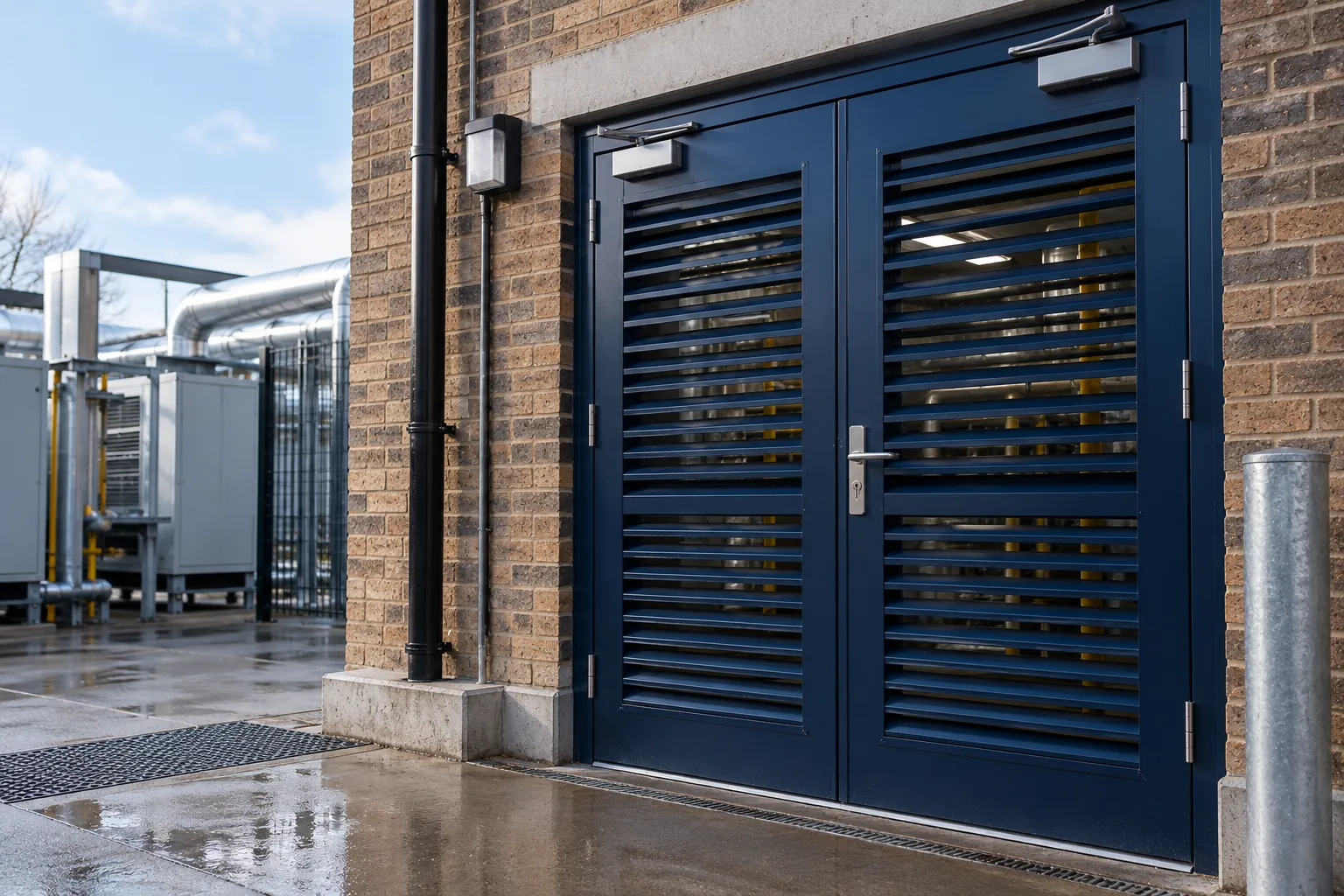
Plant rooms generate heat, and boiler rooms produce combustion products. Ventilation is a safety requirement, so the door often has to admit air. The standard answer is a louvred door: angled blades that let air through while keeping out driven rain, with a mesh behind them that keeps out birds and vermin.
A louvre is a hole in the door, and a fire rated door must hold back flames and hot gases. The two requirements are only compatible when the louvre is part of the tested design. Where no fire rating is needed at the opening, steel louvred doors give ventilation with security. Where a fire rating is needed, the louvre must close in heat: intumescent inserts in the louvre expand at high temperatures and seal the airflow path, so the door ventilates in normal use and blocks fire in an emergency.
Never add a vent to a door that is already fitted. Cutting the leaf or drilling the frame moves the door outside its test evidence and voids the rating. If the room needs more air than the door can safely give, ventilate through ducted openings with dampers instead, sized by the building services engineer.
Keep the airflow path clear for the life of the building. Vents blocked with boxes or clogged with dust do not ventilate, and a plant room that cannot breathe overheats. Check vents at every service visit.
The ventilation rule. Louvres and fire ratings only mix inside a tested design. A site-cut vent in a rated door is a hole in the compartment, whatever the certificate once said.
Forced entry ratings for plant that attracts theft
Plant rooms attract thieves. Copper cable and pipework, batteries, tools and fuel have resale value, and an unmanned plant room at night is an easy target. A plain steel door keeps out the opportunist; it does not keep out a planned attack with proper tools.
This is where forced entry ratings come in. Under LPS 1175 Issue 8, B3 (SR2) means the doorset resisted 3 minutes of attack with category B tools such as screwdrivers, pliers and hand saws. C5 (SR3) means 5 minutes against category C tools such as crowbars, drills and chisels. D10 (SR4) means 10 minutes against category D tools such as sledgehammers, disc cutters and jigsaws. The LPS 1175 standard page sets out the full scale.
Match the rating to the assessed threat: a plant room inside an occupied building faces a lower threat than a remote compound full of batteries and copper. Where both fire and forced entry matter, specify one doorset tested to both standards; our dual certification guide explains how the two test programmes relate.
The louvre and the leaf: air through a door that must still hold
A plant room door has two jobs that pull against each other: it must shut the room off from fire and from thieves, and it must let air move through the room so the plant can breathe. The leaf, the frame and the louvre have to be proved as one doorset, because a louvre fitted after the test was never proved with the leaf.
Most plant room doors carry FD60 where the wall is a compartment wall, and FD30 where the door sits on an escape route, with the period set by the fire load behind the door.
The louvre lets air through and must not open a hole in the fire proof. A louvre proved with the doorset keeps its rating when the leaf is shut, and the intumescent seal around it swells as the heat builds, closing the gap at around 200 to 250 degrees. The gap round the leaf is held at 4 mm.
Copper, tools and switchgear make a plant room worth breaking into, so the door carries a forced entry rating from LPS 1175: B3, C5 and D10, for three, five and ten minutes against the category B, C and D tool sets. The current labels come from Issue 8.2, dated September 2024, while older drawings still show SR2, SR3 and SR4.
Staff need a way in that a thief cannot copy, and a way out that needs no key. A keyed cylinder outside and a thumb turn inside does both, and the cylinder should meet TS 007, with a 1-star cylinder and a 2-star handle or escutcheon making a 3-star set.
The closer has to shut a heavy leaf against the draught the plant draws through the room, so its power size comes from BS EN 1154, and no fire door takes less than EN 3. Hinges to BS EN 1935 are proved for cycles and load, grade 13 at 200,000 cycles carrying 120 kg and grade 14 at the same cycles carrying 160 kg. The grades are covered in our fire door hardware guide.
The door that lets a boiler out: clear width and the replacement day
The clear width of a plant room door is set by the largest item that must pass through it, not by the person who walks through it every day. A boiler, a pump or a switchgear panel needs a wider opening than a member of staff, so the schedule names the clear width beside the leaf size.
When a boiler is replaced, the door is the way out and the way in. A double leaf door gives the width without a leaf too heavy for one closer, and the meeting stile needs its own proof, because a double leaf tested as a single leaf has no rating.
A plant room door that stands open is no fire door, so the closer, the self-closing and the sign on the leaf all belong on the inspection round. The round looks for the door that no longer shuts on its own, the seal that has come away, the hinge that drops, and the lock that no longer turns, and each fault goes on the record the day it is found.
An outside plant room door meets rain, wind and frost, so the finish is part of the order, and a galvanised or powder coated leaf outlasts a painted one that no one maintains. The leaf is metal, so it is earthed with the rest of the installation. The forced entry ratings are on our LPS 1175 page, and the schedule columns are in our how to specify security doors guide.
| Position | Rating | What to check |
|---|---|---|
| Compartment wall door | FD60 | Closer, seals, louvre |
| Escape route door | FD30 | Self-closing, gaps, latch |
| External plant room | B3 to D10, finish | Lock, hinges, earthing |
| Equipment door | Double leaf | Clear width, stile, hardware |
Put the fire period, the forced entry rating, the louvre, the lock and the clear width on one schedule line, with the test report behind each, so the next reader can see what was proved and what holds it.
Locking and keyed access for staff and contractors
A plant room door stays locked. Access is restricted to the people who need it: maintenance staff and servicing engineers. Keep a spare key or access credential with the building’s responsible person, so the room can be reached in an emergency when the usual keyholder is away.
Plan the keying with the facilities team before the doors are ordered: keyed alike suites for a group of plant rooms, master key systems for larger estates, or electronic access control where entries need a log. The cylinders, hinges and any dog bolts must be the tested items in the tested positions, or the forced entry rating does not apply to the door as fitted.
Contractors need access without the security going soft. Arrange timed access through the facilities team rather than leaving keys on site or wedging doors open. A door wedged open for a service visit is an unrated door for as long as it stands open. Security doorsets keep their rating only when they are closed, locked and undamaged.
Escape from inside
Doors on escape routes must open easily from the inside, even when the room is locked from the outside. A plant room with a single exit is exactly the place this matters: an engineer inside must be able to get out fast without a key. The answer is escape hardware: panic or emergency devices fitted to the tested design. The schedule names the exact device that keeps both the fire and the forced entry rating, so raise escape at specification stage, not after the door is made.
Clear width and planning for equipment replacement
Plant does not last forever. Boilers, chillers, air handling units and switchgear all get replaced, and the replacement usually arrives larger than the original. If the door opening cannot pass the new unit on its handling gear, the building pays for a new opening instead of a new boiler.
Measure the largest foreseeable item, add clearance for trolleys and lifting gear, and specify the door size from that. Double doorsets and removable centre posts exist for wide plant, but only inside tested designs: an untested centre post is a weak point, not a feature. Keep the threshold detail as tested too, and low or driveable where wheeled equipment must cross.
Signage, self-closing and day to day housekeeping
A plant room door should carry identification of the room, a notice restricting access to authorised persons, and the fire door signage the fire strategy requires, such as keep shut or keep locked as appropriate. Do not rely on signs alone: a sign does not lock a door.
Fit a self-closing device where the door sits on a compartment line or an escape route. The closer must shut the door fully without slamming, and it must be the tested closer for that doorset. A fire door propped open for convenience protects nothing.
Keep the room itself in order. Do not use the plant room as a store: flammable materials, paint, gas cylinders and general clutter have no place there. Keep vents clear and check the door, seals and hardware on the maintenance schedule, with the findings recorded against the building’s fire safety records.
External plant rooms: weather and corrosion
External plant rooms face weather the internal ones never see: rain, frost, sun and, near the coast or industry, salt and pollutants. A steel door that would last decades inside can corrode in years outside if the finish is wrong.
Protect external doorsets from the start: galvanised steel under a powder coated finish is the usual answer, with the preparation sequence confirmed in writing. Where the plant room forms part of the heated envelope, thermally broken doors stop the door becoming a cold bridge. Check weather seals and threshold drainage at handover: water sitting against the base of the door is what kills it first.
Plant room door specification checklist
Write the specification around the tested doorset and send the same wording to every bidder:
| Item | What to state | Why it matters |
|---|---|---|
| Fire classification | E, EW or EI with the minutes the fire strategy sets | Decides the compartmentation performance |
| Forced entry rating | LPS 1175 rating, B3 or C5, matched to the theft risk | Copper and batteries attract planned attack |
| Ventilation | Louvre type and the airflow the room needs, with intumescent closure where fire rated | Heat must leave, fire must not spread |
| Size and clear width | Largest equipment plus handling clearance | Avoids cutting the structure later |
| Locking | Keying system, cylinders, hinges and dog bolts as tested | Contractors in, intruders out |
| Escape hardware | Tested panic or emergency device, opening from inside | People inside must get out fast |
| Seals and threshold | Intumescent and smoke seals, tested threshold detail | Small parts decide whether the rating holds |
| Finish | Powder coating, galvanising for external exposure | Corrosion kills a door early |
| Self-closing and signage | Tested closer, signage as the fire strategy requires | A propped door protects nothing |
| Test evidence | Third-party certificates for fire and forced entry, naming the tested doorset | No certificate, no rating |
Our guide to specifying security doors sets out the same discipline for security doorsets, and the substation doors guide covers the stricter end of unmanned plant. Similar thinking applies across the utilities and data centres sectors, where plant rooms hold equipment the site cannot run without. More background on doors and standards is in the guides hub, and our guide to keeping an LPS 1175 rating valid explains what site changes void a rating.
Does a plant room door have to be a fire door?
Where the room is a fire compartment, yes: the door needs the classification the fire strategy sets. Not every plant room sits on a compartment line, so confirm with the fire strategy rather than guessing.
Can a louvred door carry a fire rating?
Only if the louvre was part of the tested design: intumescent inserts close the airflow path in heat. A vent cut into a rated door on site voids the rating.
What LPS 1175 rating suits a plant room?
Match it to the assessed threat. B3 (SR2) suits plant inside occupied buildings. C5 (SR3) suits plant holding copper, batteries or fuel where a planned attack is likely. The rating belongs to the tested doorset, not to the leaf alone.
Who should hold keys to a plant room?
Authorised maintenance staff and servicing engineers, with a spare held by the building’s responsible person. Never leave keys on site and never wedge the door open for a visit; arrange access through the facilities team.
How often should a plant room door be inspected?
The frequency is set by the fire risk assessment and the manufacturer’s guidance. Check the leaf, frame, seals, closer, locks and vents at every service visit and record the findings. Our fire door inspection checklist works through the same checks.
Can an existing plant room door be upgraded?
Only within its test evidence. New seals, a new closer or new hardware are fine where the certificate covers them. Anything that changes the tested construction, such as cutting a vent or changing the lock type, needs a new doorset or new test evidence.
Get a free quote
Related
More in guides for specifiers
Products
One supplier for the whole building envelope
Ready to specify your project?
Free assessment, written specification and test evidence. Reply within one working day.