
ArxBridge
Keeping a Dual-Certified Fire and Security Door Valid in Service
Two certificates, one door: how to keep a dual-certified fire and security door valid in service, which change voids which rating, and what the record holds.
- ✓Third-party test evidence with every product
- ✓Written specification you can issue to tender
- ✓Supplied and installed across the UK
Get a free project quote
Rating, written specification and budget range within one working day.
Confidential. No cost, no obligation.
Third-party tested
Evidence with every quote
UK manufactured
Made to your sizes
One accountable team
Specify, supply, install
Confidential handling
Details never shared
A dual-certified door carries two proofs on one build: fire under EN 1634-1 and forced entry under LPS 1175. This guide sets out how to keep both proofs alive once the door is in service.
- Two certificatesFire and security, one build
- LPS 1056The fire doorset scheme
- Issue 8.2Current LPS 1175 issue
- Regulation 10The routine fire door checks
What the two certificates cover
Each certificate describes one exact build. The fire certificate lists the build as it stood in the furnace: leaf, frame, seals, hinges, lock and closer, and the period the doorset held back the fire. The security certificate names the same parts as they stood in the attack test, and the grade the doorset earned.
The fire evidence comes through LPS 1056, the LPCB scheme for fire doorsets, which tests the doorset to EN 1634-1 and checks the build and the factory controls behind it. LPS 1175 is the forced entry rating, graded A1 to H20: the letter stands for the tool set, the number for the delay in minutes. The current issue is Issue 8.2, dated September 2024.
Keep both certificates with the building, beside the schedule line for the door. How the two ratings are earned on one construction is the subject of the dual certification guide, and the fire door certification guide explains what each paper in the file proves.
The fire side of the round
Under Regulation 10, the checks in the Fire Safety (England) Regulations 2022 fire door guidance run on a simple pattern. In a block of flats where the top storey stands above 11 metres, the Responsible Person checks the fire doors in the common parts at least every three months, and uses best endeavours to check the flat entrance doors at least every twelve months. The checks are simple and visual, and need no tools.
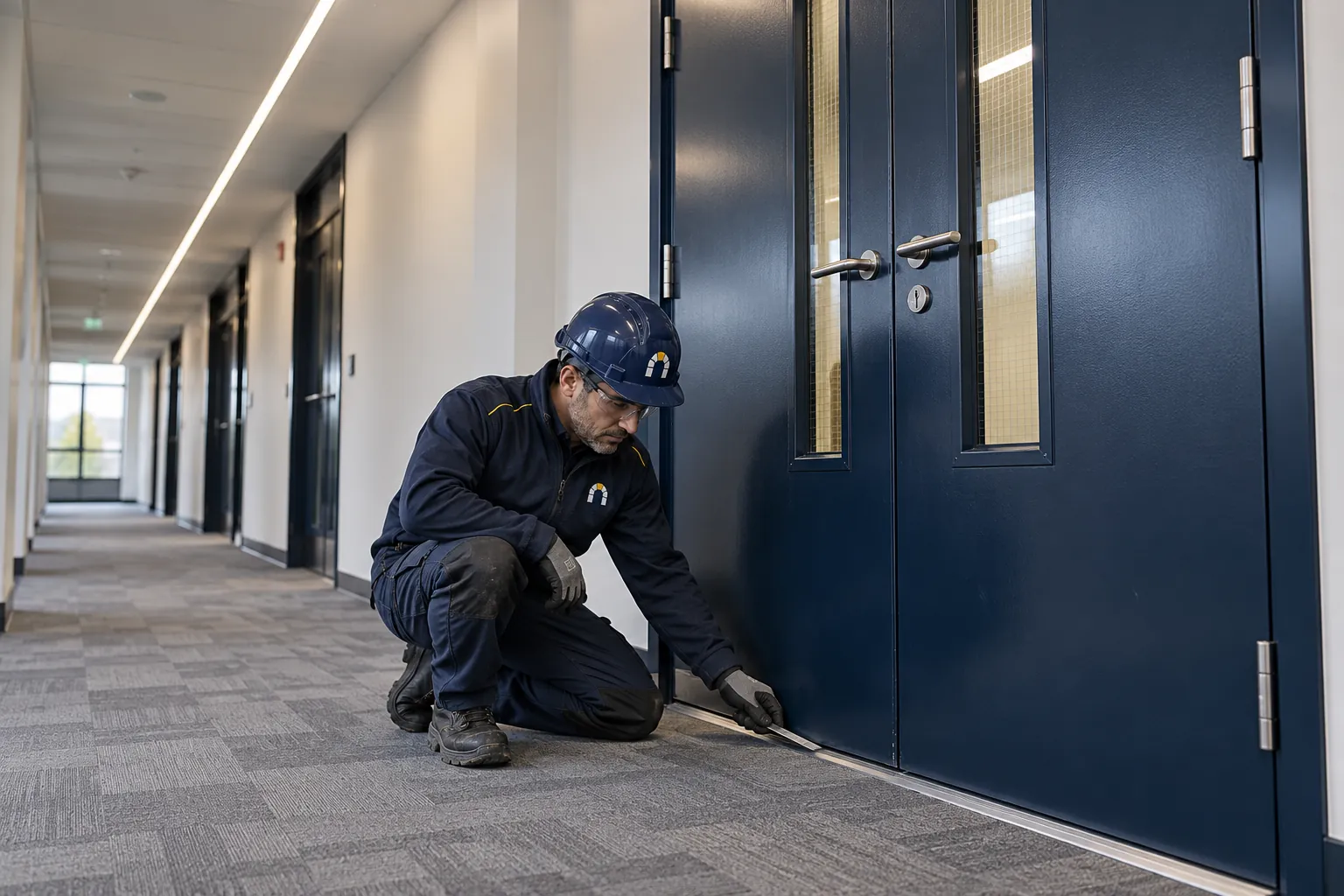
Check the leaf and frame for damage, the glazing for cracks, the hinges and ironmongery for loose or missing fixings, and the intumescent strips and smoke seals for damage. The seals must be undamaged, must make contact with the leaf or frame, and must not have been painted over. The gap round the leaf must never be more than 4 millimetres, except at the bottom, where it should be kept as small as the floor allows.
Test the self-closer from fully open and from around 15 degrees: the leaf should shut fully into the frame from any angle. Where a door is held open on a magnetic device, use the test button to close it rather than pulling it from the magnet. The same round is listed in full in the fire door inspection checklist.
The security side of the round
The security check asks a different question: does the door still match the build the certificate describes? Compare the leaf, the frame, the lock, the cylinder, the hinges and the fixings with the hardware schedule on the certificate.
Check the fixings into the wall, the frame for movement, and the leaf for cuts or holes made since handover. A cable route cut through the leaf, a new vision panel, or a closer fitted in place of the tested one all take the doorset away from the build that was tested. The rating covers the assembly as tested, not the steel in the leaf alone.
Check the label on the leaf as well. A label painted over or planed off breaks the link between the door on site and the papers on file. The same rule for security doors is in the rating maintenance guide; the LPS 1175 certificate guide walks through a listing check on Red Book Live.
Paint, seals and gaps: the fire-only failures
Some changes void the fire rating and leave the security rating standing. Painting over the intumescent strips is the commonest: the strips expand in heat to seal the gap round the leaf, and paint stops them working. The security test never looks at the seals, so the LPS 1175 grade is untouched, but the fire evidence is gone.
A gap that has grown past 4 millimetres is a fire failure on its own. The leaf may still resist attack exactly as tested, yet smoke and flame pass through a gap the furnace test never saw. A closer that no longer shuts the leaf fully is the same: the attack rating stands, and the fire rating does not, because an open leaf holds back no fire, whatever its papers say.
Record each of these as a fire fault, with the date and a photograph, and have it put right by a competent contractor as soon as the work can be arranged. The fire door maintenance guide covers the parts that wear first.
Locks, cylinders and hinges: the security-only failures
Other changes void the security rating and leave the fire rating standing. Swapping the lock or the cylinder for a different model changes the hardware schedule the attack test was run with, so the grade no longer describes the door on site.
A hinge swapped for a lighter one, or a fixing changed for a shorter screw, is the same kind of failure. The leaf still shuts, the seals still meet, and the closer still works, so every fire check passes, yet the doorset no longer matches the build the security certificate names.
Record each of these as a security fault, and do not wait for the next round to act on it. A door whose lock no longer matches its certificate is an unproved door from the day the part changed. The installation handover guide lists the checks that catch these changes on the day the product arrives.
Cutting the leaf: the change that voids both
A few changes void both ratings at once. Cutting a vision panel into the leaf after the tests changes the glazing, the bead and the aperture size, and both tests cover those parts. The fire test measures the glass and its surround; the attack test attacks the panel as part of the leaf. A panel outside the tested scope for either test leaves the door with neither proof.
Trimming the leaf to clear a new floor is the same. The trim changes the gap at the bottom, the seals at the edge, and the leaf the attack test was run on. A hole drilled for a cable route or a new device does the same damage in a smaller opening.
Never cut, trim or drill a dual-certified leaf without written confirmation first. Ask for the evidence that covers the changed build before the work starts, not after it is done. Put the scope into the order before the work starts: the security doors specification guide names what belongs in it, so the leaf ordered is the leaf the tests cover.
| Change | Fire rating | Security rating |
|---|---|---|
| Seals painted over | Void | Stands |
| Gap past 4 mm | Void | Stands |
| Closer no longer shuts leaf | Void | Stands |
| Lock or cylinder swapped | Stands | Void |
| Hinge or fixing changed | Stands | Void |
| Vision panel cut in | Void | Void |
| Leaf trimmed or drilled | Void | Void |
The two-certificate record
Keep one record for both ratings, and write each check against both certificates. Note the date, the person who walked the round, each door checked, each fault found, and which rating the fault touches. A record that names the rating as well as the fault serves the next person; one that says only “checked” proves nothing about either proof.
File the record with both certificates, the test reports, the hardware schedule and the handover papers. For a higher-risk building, the same file feeds the golden thread: a digital record, guarded against unauthorised access, with versions tracked so every change can be traced. The fire door records inside the thread are listed in the golden thread records guide.
Sign the round off only when both ratings stand or every fault carries a date for its fix. The traffic calming guide applies the same discipline outside the building, and what the record should hold from the first day is the subject of the acceptance and snagging guide.
A dual-certified door is proved twice, and it must be kept twice: one fault can take one rating, and one cut can take both.
Does painting the seals affect the security rating?
No. Paint stops the intumescent strips working, so the fire rating is void, but the seals are not part of the attack test, so the LPS 1175 grade stands.
Can a lock be swapped on a dual-certified door?
Only for the lock the certificate names. A different lock changes the tested hardware schedule, so the security rating no longer describes the door.
How often should a dual-certified door be checked?
Check the fire side on the Regulation 10 round: communal doors every three months, flat entrance doors every twelve months on a best-endeavours basis, in a block whose top storey stands above 11 metres. Check the security side on the same round, against the certificate scope.
What voids both ratings at once?
Any change to the leaf itself: cutting a vision panel, trimming the leaf, or drilling it for a cable route. Both tests cover the leaf as built, so a changed leaf matches neither.
What should the record hold?
Date, checker, door, fault, and which rating the fault touches, filed with both certificates, the test reports and the hardware schedule.
Contact us for a free quote
Related
More in guides for specifiers
Products
One supplier for the whole building envelope
Ready to specify your project?
Free assessment, written specification and test evidence. Reply within one working day.