
ArxBridge
RF shielding standards and how shielded rooms are tested
RF shielding standards explained for UK buyers: IEEE 299 and EN 50147-1 test methods, how shielded rooms are tested, and what a test report must show.
- ✓Third-party test evidence with every product
- ✓Written specification you can issue to tender
- ✓Supplied and installed across the UK
Get a free project quote
Rating, written specification and budget range within one working day.
Confidential. No cost, no obligation.
Third-party tested
Evidence with every quote
UK manufactured
Made to your sizes
One accountable team
Specify, supply, install
Confidential handling
Details never shared
Two standards define how RF shielded rooms are tested: IEEE 299 and EN 50147-1. Both are measurement methods, not pass marks. They describe how to measure shielding effectiveness in dB across a frequency range, so a buyer can compare rooms and check a room still performs after it is built.
- IEEE 299Measures shielding effectiveness, 9 kHz to 18 GHz
- EN 50147-1European shield attenuation method, 9 kHz to 40 GHz
- BS EN 50147-1:1997The UK adoption of the European method
- Results in dBAttenuation across a frequency range, limits set by the owner
The two standards that measure shielding effectiveness
IEEE 299 is the IEEE standard method for measuring the effectiveness of electromagnetic shielding enclosures. The 2006 edition sets uniform test procedures covering 9 kHz to 18 GHz, with the option to extend the range down to 50 Hz and up to 100 GHz. The procedures apply to enclosures whose smallest linear dimension is 2.0 m or more; smaller enclosures use separate methods. IEEE’s own overview describes the standard as the uniform method for room level shielding measurement, with shielding effectiveness expressed in dB as the ratio of field strength without the shield to field strength with the shield in place.
EN 50147-1 is the European method. Published by CENELEC, its full title is “Anechoic chambers, Part 1: Shield attenuation measurement”. Its object is to establish a common measurement procedure for validating the shielding effectiveness of shielded enclosures, chambers and rooms, across the frequency range 9 kHz to 40 GHz. In the UK it was adopted as BS EN 50147-1:1997, the English language version prepared by BSI Technical Committee GEL/210.
The point both standards share matters more than their differences. Neither one grades the room. IEEE 299 recommends a set of test frequencies and describes how to measure, but the owner of the enclosure provides the frequencies to test and the shielding effectiveness limits for pass or fail. EN 50147-1 likewise provides the common procedure and leaves the expected attenuation levels to the enclosure specification.
| Standard | Published by | What it covers | Frequency range |
|---|---|---|---|
| IEEE 299 | IEEE | Uniform procedures for measuring the effectiveness of electromagnetic shielding enclosures | 9 kHz to 18 GHz, extendable |
| EN 50147-1 | CENELEC; BS EN 50147-1:1997 in the UK | Common procedure for validating shielding effectiveness of shielded enclosures | 9 kHz to 40 GHz |
How a shielded room test is run
The principle is the same under both standards. A signal is measured without the shield, then with the shield in place, and the difference is the shielding effectiveness. Shielding effectiveness is defined as the ratio of the signal received from an unshielded transmitter to the signal received inside the shield when the shield sits between the transmitting antenna and the receiving antenna. An RF shielded room is specified by its attenuation in dB over a frequency range, so the test must cover the frequencies the room is sold to protect.
- Measure the reference. With no shield between the antennas, record the signal at each agreed frequency. This is the baseline the room is judged against, and it sets the dynamic range of the whole measurement.
- Place the shield in the path. Repeat the measurement with the transmitter outside the room and the receiver inside, so the signal must cross the shielded boundary. The same generator level is used as in the reference measurement.
- Work through the frequencies. Repeat both measurements at every frequency in the test plan, from the low kilohertz range up through the gigahertz range named in the specification. Both standards use recommended sets of test frequencies that give high confidence in the result.
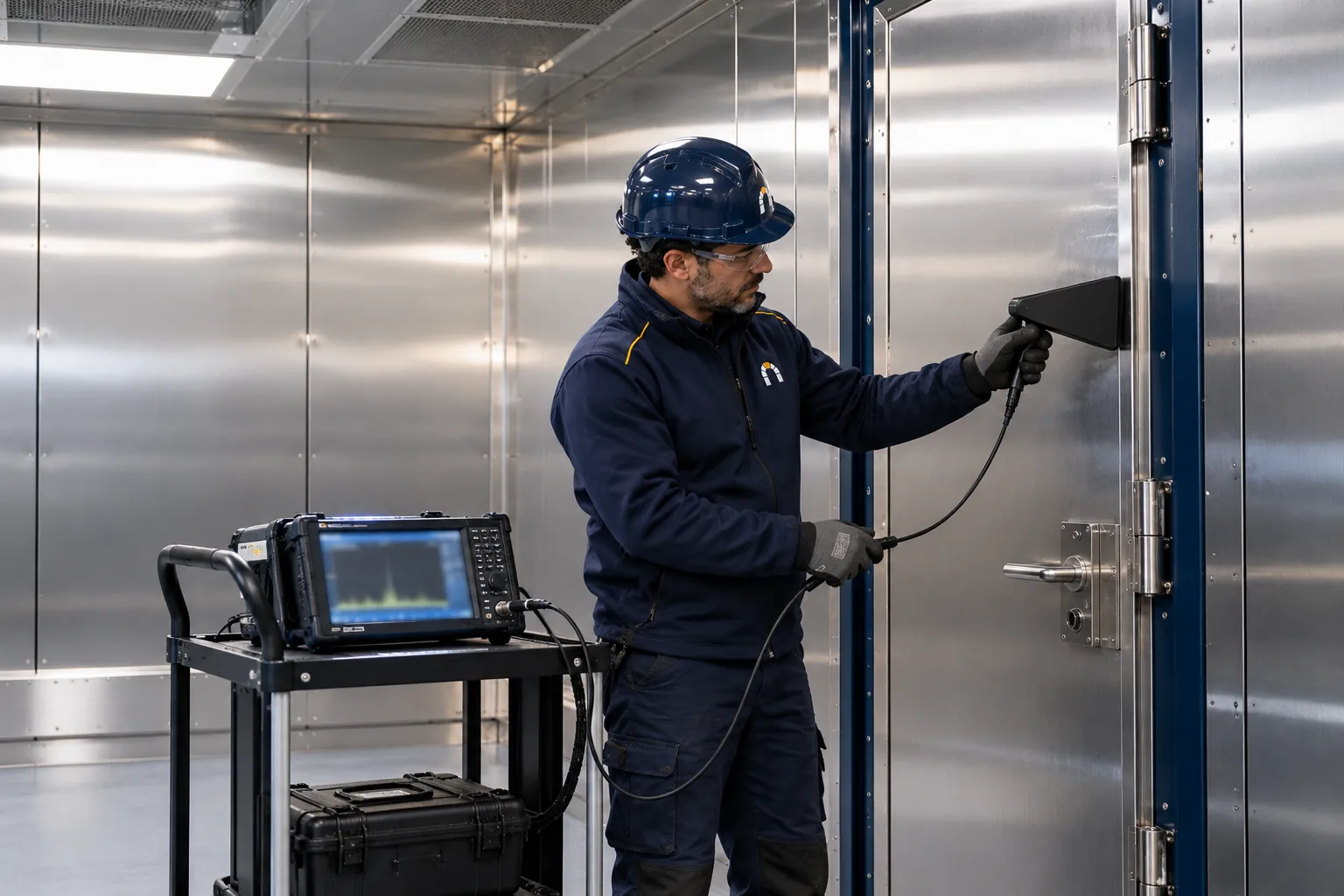
- Move the antennas. Test several positions around the room: walls, floor, ceiling, door seams and every penetration for cables, vents and pipes. The evaluation takes the lowest performance found across the measured locations, because leakage decides the room’s real rating.
- Compare against the limits. The measured attenuation in dB at each frequency is set against the pass or fail limits the owner named before the test. A room passes because it met its own specification, not because a standard stamped it.
The room is tested after installation is finished, with all panels, doors, vents and filters in place. Testing a half built room proves nothing, because every missing panel is a hole the test will not see twice.
What a test report should show
A report that only says “tested to IEEE 299” proves nothing. Ask for the full report and check it contains the standard and edition used, the exact frequencies tested, the measured shielding effectiveness in dB at each frequency, the positions tested named one by one (which wall, the door seam, each penetration), the equipment used and its calibration, the reference level and the noise floor so you can see the measurement had enough dynamic range, the pass or fail limits applied and who set them, and the date and who carried out the test.
Keep the report with the room’s records. When the room is changed or retested, the new report is compared against this baseline, and any fall in attenuation points to what moved or wore. Independent verification of a room is arranged through our testing and surveys service, which follows the same measurement methods described on this page.
The RF door is usually the weakest point
A shielded room is a continuous conductive shell, and the door is the one part of the shell that moves. Hinges, latches and contact strips work every time the door opens, and every cycle wears the contact surfaces slightly. The measurement methods expect continuous electrical contact between adjacent panels, including doors, which is exactly what a hard used door struggles to keep.
This is why testers give the door extra attention and why the door reading is often the room’s lowest. The evaluation takes the lowest performance across the measured locations, so one worn contact strip can decide the result for the whole room. A door that is opened dozens of times a day needs a heavier duty contact design than a door that opens once a week, and the specification should say which it is.
Plan maintenance around the door. Inspect contact strips and gaskets, keep contact surfaces clean and free of paint, and replace worn seals before they fail a test. A planned maintenance routine costs far less than an emergency retest after a failed one.
What the standards do not do
Neither IEEE 299 nor EN 50147-1 tells you what attenuation a room must reach. They are measurement methods, not product specifications and not law. If a supplier answers “tested to IEEE 299” when you ask for the target attenuation, you have not been given an answer.
The limits come from your specification: the frequencies that matter for your work and the dB figure you need at each one. An EMC test laboratory, an MRI suite and a secure meeting room need different numbers, which is why both standards leave the limits to the owner. MRI suites are a good example of why the application sets the target: the room needs RF shielding to protect the scan, and often magnetic shielding too, which is a different thing measured in a different way. Our guide to MRI and RF shielded rooms explains that split.
EMP protection is a related but different need. A room that must ride out an electromagnetic pulse needs filtered power and signal entries as well as a conductive shell, so an ordinary RF shielding specification does not cover it. See our EMP shielding page for that requirement.
When to retest a shielded room
A test report describes the room on the day it was tested. Anything that changes the conductive shell can change the result: a new cable penetration, a replaced door gasket, building work next to the room, or the room being moved or rebuilt. Retest after any of those changes, before the room goes back into critical use.
Put the room on a regular schedule the owner sets. Rooms that protect regulated work, such as MRI suites in healthcare buildings and EMC test laboratories, are usually retested on a fixed cycle agreed with the facility’s quality or compliance team. Neither standard sets that interval; the facility does.
Compare each new report with the original baseline. A slow fall in the door reading across two reports is the normal early warning that the contact strips are wearing out, and it is cheaper to replace them on a plan than after a failure.
What to put in a specification
Write the specification before the room is built or bought, and put six items in it. Name the standard to test to, IEEE 299 or EN 50147-1, with the edition. State the frequency range and the exact test frequencies. Set the target attenuation in dB at each frequency. List the test positions, including the door seams and every penetration. Define the contents of the test report. Require a retest after any change to the room.
Send the same specification to every bidder. Two rooms tested to different frequencies and different limits cannot be compared, and a common specification is what makes competing quotes comparable. For help choosing between a simple enclosure and a fully specified room, read our Faraday cage vs RF shielded room guide and the RF shielding product page, then browse the wider guides hub for related standards.
The standard measures; the specification grades. Name IEEE 299 or EN 50147-1 for the method, then write your own frequencies and dB limits. A test without limits is a measurement, not a pass.
Which standard should I name, IEEE 299 or EN 50147-1?
IEEE 299 is the US published method, widely used internationally, covering 9 kHz to 18 GHz. EN 50147-1 is the European method, covering 9 kHz to 40 GHz, adopted in the UK as BS EN 50147-1:1997. For UK procurement the BS EN version is the natural reference, but either works if you name it in the specification.
Does IEEE 299 say what attenuation a room must reach?
No. The standard provides the measurement procedure and recommends test frequencies, but the owner of the enclosure provides the frequencies to test and the shielding effectiveness limits for pass or fail. A report that shows measurements with no limits has no pass or fail to read from it.
Can I check a room myself with a mobile phone or a handheld radio?
A phone’s signal bars are not a measurement and cannot prove a room meets a specification. A quick check can reveal an obvious leak, such as a door left ajar, but it cannot replace a calibrated test with a reference measurement, agreed frequencies and a written report. If the room matters, have it tested properly.
Why does the door usually give the lowest reading?
The door is the only part of the conductive shell that moves. Hinges, latches and contact strips wear with every cycle, and the test evaluates the lowest performance across all measured locations, so the door often decides the room’s result. Regular inspection of the door seals is the cheapest way to protect the rating.
How often should a shielded room be retested?
Neither standard sets a retest interval. Retest after any change to the room, such as a new penetration or a replaced gasket, and put the room on a schedule the owner sets. Rooms used for regulated work, such as MRI suites or EMC testing, are usually retested on a cycle agreed with the facility’s quality team.
Do the floor and ceiling need testing too?
Yes. Test positions should cover all six faces of the room plus the door seams and every penetration. Leakage finds any gap, and the evaluation takes the lowest reading, so an untested face is an unknown risk.
Get a free quote
Related
More in guides for specifiers
Products
One supplier for the whole building envelope
Ready to specify your project?
Free assessment, written specification and test evidence. Reply within one working day.