
ArxBridge
Faraday cage vs RF shielded room: what a business needs
Faraday cage vs RF shielded room: what UK businesses must specify, from attenuation in dB and frequency range to doors, vents, filters and testing.
- ✓Third-party test evidence with every product
- ✓Written specification you can issue to tender
- ✓Supplied and installed across the UK
Get a free project quote
Rating, written specification and budget range within one working day.
Confidential. No cost, no obligation.
Third-party tested
Evidence with every quote
UK manufactured
Made to your sizes
One accountable team
Specify, supply, install
Confidential handling
Details never shared
A Faraday cage is any conductive enclosure that blocks radio signals. An RF shielded room is a Faraday cage with measured performance: a stated attenuation in dB across a stated frequency range, covering the door, vents, filters and cable entries too. A business that must prove its shielding needs the room; the word cage alone guarantees nothing.
- Attenuation in dBStated across a frequency range, never as one number
- Doors decide performanceThe RF door is the weakest point of any room
- MRI needs two shieldsRF shielding and magnetic shielding are different things
- EMP is a separate needEMP protection also needs filtered power and signal entries
How shielding works in plain words
A radio wave is an electric field travelling through space. When it meets a conductive surface such as steel or copper sheet, it drives tiny currents in the metal. Those currents create their own field, and the two cancel each other out on the far side. The wave never reaches the inside. The effect works in both directions: signals from outside stay out, and signals generated inside stay in.
A continuous metal box shields best. Mesh and perforated sheet also work, and the rule is simple: the smaller the holes relative to the wavelength, the higher the frequency that stays blocked. This is why a microwave oven door can have a visible mesh and still contain microwaves. It is also why a room built from steel panels can still leak like a sieve if the panels are not joined into one continuous conductive boundary.
Continuity is the whole game. Every seam, joint and fixing must keep the metal electrically connected around the full enclosure. A gap is an antenna. That single idea explains why the door, the vents and the cable entries matter more than the walls, covered below.
The specification is the product: attenuation in dB over a frequency range
Two suppliers can both sell you a “Faraday cage room” and deliver very different things. The difference is the specification. A specified RF shielded room states its attenuation in decibels across a stated frequency range, and that pair of numbers is the product you are buying. Our RF shielding range is built around this principle: no stated performance, no proven room.
The decibel is a ratio, not an absolute unit. A shield rated at 60 dB lets through one millionth of the incident power. At 80 dB it is one hundred-millionth. The number only means something with the range beside it, because shielding performance changes with frequency. Low frequencies, and magnetic fields in particular, are the hardest to stop. A room that performs strongly at mobile phone frequencies may do far less at mains frequencies unless the design addresses them.
So never accept a single headline number. “100 dB” without a frequency range is not a specification; it is advertising. Ask for attenuation stated across the range your application cares about, and ask how it was measured. The answer should be a table or a curve, taken on a finished room, not a brochure figure for the panel material.
| What differs | Basic Faraday cage | Specified RF shielded room |
|---|---|---|
| Definition | Any conductive enclosure that blocks radio signals | An enclosure with stated attenuation in dB across a stated frequency range |
| Evidence | None beyond the physics of the construction | A test report measured on the finished room |
| Doors and penetrations | Often untreated, so performance is unknown | Each door, vent, filter and entry is part of the specified design |
| When it is enough | Rough screening where nothing needs proving | Labs, secure rooms, MRI and data uses where the result must be shown |
Ask for the curve, not the headline. A meaningful specification states attenuation in dB across your frequency range of interest, measured on the finished room with its door, vents and filters in place.
Doors, vents, filters and cable entries decide the result
Walls are the easy part. Flat conductive panels, correctly joined, give predictable shielding. The performance of the finished room is decided by everything that breaks the wall: the door, the ventilation openings, the power and data cables, the pipes. Each penetration is a signal path unless the design treats it as part of the shield.
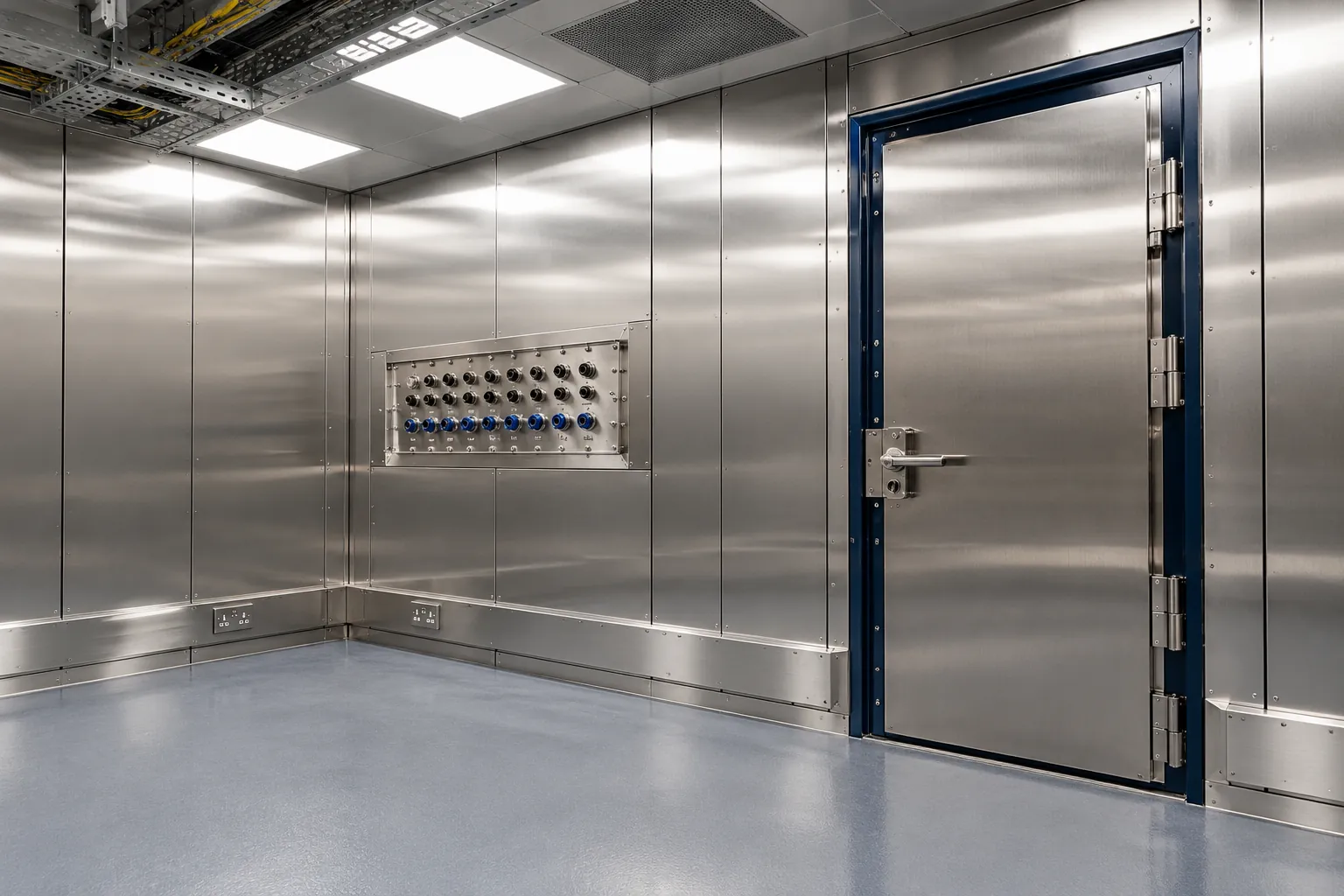
The door is the weakest point of any shielded room. It must close against conductive gaskets that keep the metal boundary continuous around the frame, and it must latch with even pressure all round. Hinges, handles and locks all sit in that boundary. Gaskets wear with use, doors drop on their hinges, and a door that no longer seals evenly no longer shields evenly. This is why the door deserves its own line in the specification and its own checks in the maintenance plan.
Ventilation and cabling need the same discipline. Air must move without opening a radio path, so vent openings are built as shielded assemblies within the design. Every cable that crosses the boundary, power, data or signal, must pass through treatment matched to the performance target, because an untreated cable carries interference straight through the wall it pierces. If a change is needed later, a new cable, a replaced seal, a different lock, the room should be retested, since the certificate describes the room as built, not the room as altered.
Where businesses actually use shielded rooms
Testing laboratories use them to create a quiet electromagnetic environment. Product teams check emissions and immunity without the city’s radio noise getting in, and the room keeps the device under test from disturbing neighbouring benches. The target here is set by the measurements being made, which is why the frequency range in the specification matters so much to a lab buyer.
Secure meeting rooms use them the other way round. The point is to keep signals in: mobile phones, recorders and laptops inside the room cannot leak useful RF to a receiver outside it. Government and defence buyers specify these rooms around a threat model rather than a measurement, and our government and defence sector page covers that way of buying. The door discipline matters most here, because a room whose door is propped open for comfort is not a shielded room at all.
Hospitals use them around MRI scanners. An MRI machine listens for faint radio signals from the patient, so outside interference ruins images. This is the classic “Faraday cage room” that most people picture, but note the trap: an MRI suite needs RF shielding and often magnetic shielding as well, and the two are different things. Our guide to MRI and RF shielded rooms separates them, and healthcare projects can start from our MRI shielded rooms range.
Data rooms use them where equipment must neither emit nor receive interference, from timing laboratories to facilities handling sensitive processing. The common thread across all four uses is proof: each buyer needs a measured result, not a promise. A basic conductive enclosure is a Faraday cage in the physics sense; only the specified, tested room is one in the commercial sense.
EMP protection is a related but different need
An electromagnetic pulse is a different threat from everyday radio interference. It is a single high-energy event, and a room designed for quiet RF testing is not automatically protected against it. Treating the two as the same requirement is one of the common mistakes in this market, and expensive to discover late.
EMP protection starts where RF shielding leaves off. The enclosure still matters, but the entries matter more: power and signal lines need filtering that can handle the pulse, and every penetration must be part of the protected design. The rule is blunt and worth repeating: EMP protection also needs filtered power and signal entries. If your requirement mentions EMP, say so at the start, because it changes the design of the entries and the way the room is verified. See our EMP shielding range for how that requirement is handled as its own discipline.
Cost drivers and testing after installation
No prices belong in a guide, but the cost drivers are worth knowing so that quotes can be compared fairly. Size is the obvious one: more area means more panels, more seams and more labour. The attenuation target and its frequency range come next, since higher performance at low frequencies needs more material and more careful jointing. Then the penetrations: each RF door, each filtered entry and each vent assembly adds design and hardware. Finishes, site access and the state of the building add the rest. Two quotes for “a shielded room” cannot be compared unless both state the same performance target in dB across the same range.
Testing after installation is what turns the build into evidence. The room is measured across its specified range with the door, vents, filters and entries in place, and the report records what was found. Keep that report with the building records. Retest after any change to the boundary, a new cable route, a replaced gasket, a swapped lock, because the result describes the room as tested. Build the door checks into maintenance: gaskets, latching pressure and seal condition, on a schedule. Our testing and surveys service covers both the first measurement and repeat visits, and how shielded rooms are tested describes the process in detail.
What to put in the enquiry
A short, written enquiry gets comparable quotes and avoids the vague “Faraday cage room” trap. State the attenuation you need in dB across your frequency range. List every penetration: doors, vents, cable entries, pipes, and what each must carry. Name the use, because a test lab, a secure meeting room and an MRI suite are specified differently. Say whether EMP is in scope. Ask how the finished room will be measured and what the test report will show. Anything the supplier cannot answer in writing is a gap you will own later.
Browse the wider guides collection for the neighbouring topics, from MRI suites to shielding standards.
Will lining a room with metal sheet give me a Faraday cage?
It will block some signals, but a metal-lined room is not a proven shield. Unless the sheets form one continuous conductive boundary, every penetration is treated in the design, and the result is measured, you have a metal-lined room with unknown performance. Doors, vents and cable entries are where most of the leakage happens.
How much attenuation does my application need?
It depends on what you are keeping out or in. A test lab starts from the sensitivity of its measurements, a secure meeting room starts from its threat model, and an MRI suite starts from the scanner maker’s requirement. Whatever the number, write it as attenuation in dB across a stated frequency range, and make every supplier quote against that pair of numbers.
Can a shielded room have windows and ventilation?
Only as part of the specified design. Every opening in the conductive boundary is a penetration, and each one must be treated in the design and covered by the test result. An untreated window or a plain vent grille leaves a hole in the shield, whatever the walls achieve.
Is an RF shielded room the same as EMP protection?
No. EMP is a separate, higher-energy threat, and a room built for quiet RF testing is not automatically protected against it. EMP protection needs filtered power and signal entries and its own specification, so name the threat at the start of the enquiry.
How do I know the room still performs in five years?
Retest it after any change to the boundary and on a schedule that suits the use. Door gaskets wear, fixings loosen and new cable routes appear. Keep the original test report so later results can be compared against it, and put the door and seal checks into the maintenance plan.
Get a free quote
Related
More in guides for specifiers
Products
One supplier for the whole building envelope
Ready to specify your project?
Free assessment, written specification and test evidence. Reply within one working day.