
ArxBridge
Steel vs timber fire doors: which suits your building?
Steel vs timber fire doors: how each is tested to EN 1634-1, where steel wins on security and weather, and where timber wins on looks and cost for UK buildings.
- ✓Third-party test evidence with every product
- ✓Written specification you can issue to tender
- ✓Supplied and installed across the UK
Get a free project quote
Rating, written specification and budget range within one working day.
Confidential. No cost, no obligation.
Third-party tested
Evidence with every quote
UK manufactured
Made to your sizes
One accountable team
Specify, supply, install
Confidential handling
Details never shared
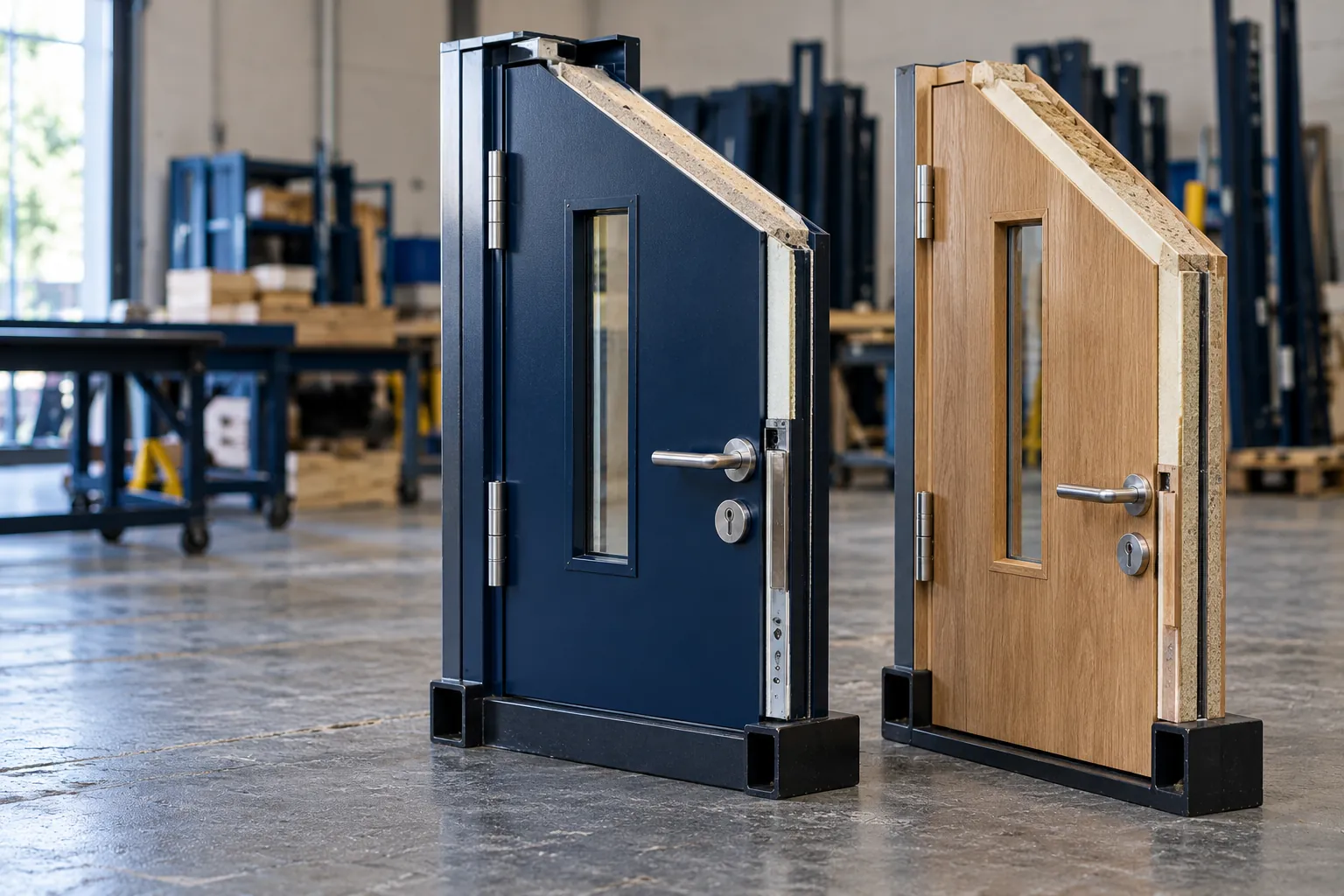
Choose steel where the door faces abuse, weather or a security threat, and timber where it sits inside a finished interior and looks matter. Both pass the same EN 1634-1 fire test. The material changes durability, security options and maintenance, not the fire test itself.
- Same fire testEN 1634-1, classed E, EW or EI with minutes
- Steel rangeCommonly FD30 to FD120, plus LPS 1175 security ratings
- Timber rangeFD30 and FD60 most common, some reach FD120
- The doorset ruleThe rating belongs to the tested assembly, not the leaf
Tested the same way, built very differently
Steel and timber fire doors go through the same furnace test, EN 1634-1. The test exposes the whole doorset to fire and measures how long it holds. The result is a classification: E for integrity, EW for integrity and radiation, or EI for integrity and insulation, with minutes of 30, 60, 90 or 120. In the UK these are usually written as FD30, FD60, FD90 or FD120, which simply means the integrity result held for that many minutes. Our fire ratings guide explains what each class proves.
The certificate names a doorset, not a material. The leaf, frame, intumescent seals, glazing and hardware are tested together as one assembly, and only that exact construction carries the rating. A steel leaf hung in an ordinary timber frame is not a fire doorset. A timber leaf with seals added on site is not a fire doorset. Change any tested part and the evidence no longer covers the door.
How each material passes differs. A timber door relies on a dense core and intumescent seals that swell in heat to close the gaps around the leaf. A steel door relies on a non-combustible leaf and core that do not burn at all. Both routes reach the same classifications. The rating you need comes from the building’s fire risk assessment, not from the material, so confirm the required minutes before you compare anything else.
Ask for test evidence and third-party certification covering the exact configuration you are buying: size, frame, seals and hardware. A certificate for a different size or hardware set is not evidence for your door.
Durability, abuse and maintenance
Steel wins where doors take punishment. Trolleys, pallets, keys and boots all mark a door, and a steel leaf shrugs off knocks that would dent a timber leaf. That is why plant rooms, loading bays and school corridors, see our education sector page, so often use steel. Steel does not warp or swell in damp air, so the gaps around the leaf stay as tested.
Steel has its own failure modes. Damage the coating and moisture reaches the steel, so corrosion starts where the finish is broken. A dented steel leaf is hard to repair on site; badly damaged leaves are usually replaced rather than filled. Hinges, closers and locks work harder on a heavy leaf, so the hardware must be the tested type and the fixings must suit the wall behind the frame.
Timber asks for a different kind of care. Moisture makes timber swell, which closes the gaps the seals need and can stop the closer working. Edge damage exposes the core, and planing or cutting the leaf can remove the intumescent groove and void the rating. A scuffed timber door can be filled, sanded and refinished by any competent joiner.
A planned maintenance routine suits both materials: check seals, gaps, closer action and fixings, and keep a record for the building’s fire safety file. Steel needs its coating and hardware checked; timber needs its seals, gaps and finish checked. The fire door inspection checklist shows what a basic visual check covers for either material.
Security ratings: where steel pulls ahead
This is the single biggest difference between the two materials. A steel doorset can carry a fire rating and a forced entry rating at the same time. Tested to LPS 1175, a steel fire door can reach SR2 (B3, 3 minutes against tools such as screwdrivers, pliers and hand saws), SR3 (C5, 5 minutes against crowbars, drills and chisels) or SR4 (D10, 10 minutes against sledgehammers, disc cutters and jigsaws). The LPS 1175 standard sets out the full scale from A1 to H20.
That dual rating matters where the opening faces both threats: plant and riser rooms, back of house retail areas, server rooms and external fire exits that are reachable from outside. Our SR2 fire doors page shows how the two ratings sit on one doorset, and the dual certification guide explains the testing in more depth.
Timber fire doors rarely carry forced entry ratings; the certified fire plus attack combinations on the UK market are overwhelmingly steel. If the threat assessment names forced entry, steel is the practical answer. If it does not, the security option adds weight and cost for no benefit.
Appearance and finishes
Timber wins on warmth. Veneers, stains and paint finishes let a timber fire door match the joinery around it, which is why hotels, offices and apartments choose timber for guest corridors. Heritage buildings often need timber to satisfy the conservation officer.
Steel has closed the looks gap without closing it fully. Powder coating gives a hard, even colour finish in any RAL or BS shade, and fine texture finishes hide fingerprints. Steel suits modern industrial interiors and anywhere the door is a working part of the building. It will never look like oak.
Fire rated glazing can be fitted in steel and timber doors alike, but only the exact glazing in the tested position keeps the rating. Glass swapped on site voids the fire evidence. For entrance doors where the choice is between frame materials, see the steel vs aluminium security doors guide.
Weight, frames and installation
A steel doorset is heavy, and the weight shapes the whole installation. The frame, the wall it fixes into, the hinges and the closer must all suit the load, and existing openings sometimes need the frame area rebuilt first. The upside is a frame that is part of the tested assembly.
Timber doorsets are lighter and easier to handle, which helps on refurbishments where the existing frame can stay, provided the certified scope covers that frame type. Never assume an old frame will do; check the certificate first.
A closer sized for a light timber leaf will not control a heavy steel leaf, and hinges rated for one will fail early on the other. The tested hardware schedule was proven with the weight of the actual leaf.
External positions and weather
External fire exits belong to steel. Rain, frost and sun punish timber, and a swollen timber leaf on a fire exit fails at both fire safety and escape. Steel doorsets made for external use carry protective coatings, and thermally broken doors handle exposed elevations without the cold bridging that causes condensation inside.
Timber can work in sheltered external positions, such as a door under a deep canopy, but it needs a protected finish and regular recoating. For most external openings the honest answer is steel, and repeated recoating usually erases any upfront saving.
Where timber is honestly the better choice
Timber is the better choice for most internal doors in finished buildings. Offices, hotels, healthcare wards and apartments need doors that look right and do not dominate the corridor. A timber FD30 door in a hotel corridor does exactly what the fire strategy asks, at lower weight and usually lower cost than steel. The healthcare sector page shows how ward doors balance fire performance with a calm interior.
Timber also suits rooms where sound matters. Meeting rooms and consulting rooms often need sound separation alongside fire separation, and timber doorsets are routinely supplied with acoustic seals for that. Repairs stay simple: fill, sand, repaint. Where the brief is a quiet internal door at FD30 or FD60, timber is usually the sensible buy.
Choose timber with open eyes. Keep it internal, keep it dry, keep the finish maintained, and never cut or plane the leaf without checking the certificate first. In those conditions a timber fire door gives decades of service, and nothing about steel changes that.
What the steel-versus-timber choice does not settle
Choosing between steel and timber answers one question: what the door is made of. It does not settle the rating, the hardware, the seals, the maintenance or the wall. Those decisions still have to be made, and they matter as much as the material.
First, it does not settle the fire rating. Steel and timber doors are tested the same way, to EN 1634-1, and both can reach E, EW and EI ratings from 30 to 120 minutes. Neither material fixes the duration on its own. The rating comes from the tested assembly, and the specification must state the full classification.
Second, it does not settle the hardware. Closers to BS EN 1154 and BS EN 1155, hinges to BS EN 1935, handles to BS EN 1906 and panic hardware to BS EN 1125 or BS EN 179 follow the same rules on either material. A closer that suits a light timber leaf may not suit a heavy steel leaf, and the hardware must be listed for the doorset it is fitted to. The guide to how to specify security doors covers the same point: hardware is chosen with the doorset, not after it.
Third, it does not settle the seals or the gaps. Both materials need intumescent seals that expand at roughly 200 to 250 degrees, and both need the same 4 mm gap around the leaf. A steel door with painted seals or a timber door with wide gaps will both fail, whatever the material. Smoke control is a separate question again, and needs a smoke rating to EN 1634-3, Sa or S200, on either material.
Fourth, it does not settle the security rating. A steel door is not automatically a security door, and a timber door is not automatically a weak one. Security comes from a separate test, LPS 1175 or PAS 24, on the whole doorset. A steel leaf in a weak frame with poor locks is no stronger than the frame and locks that hold it.
Fifth, it does not settle the opening. The material choice says nothing about the wall beside the door, the head detail, or the floor the frame stands on. A steel door fitted into a partition that cannot carry its weight, or a timber door in a damp opening, will both give trouble. The fire rated steel doors page sets out what a steel doorset needs from its opening, and the same thinking applies to timber.
Mistakes that weaken a steel or timber order
Most problems with steel and timber orders are the same problems: the order was incomplete. Check each point before the order is placed.
- Accepting a leaf only quote, with no frame, seals or hardware listed.
- Ordering hardware that is not listed for the doorset it will be fitted to.
- Painting over intumescent seals, which stops them expanding in a fire.
- Fitting a steel leaf into a timber frame, or the reverse, with no test evidence.
- Ordering without the test report number and the full fire classification.
- No plan for inspection and upkeep after fitting.
Keep the evidence with the order. The test report, the classification and the hardware schedule should travel with the doorset, so the fitter and the inspector can check what was bought against what was tested.
Steel vs timber fire doors at a glance
| Point | Steel fire doors | Timber fire doors |
|---|---|---|
| Fire test | EN 1634-1, classed E, EW or EI | EN 1634-1, classed E, EW or EI |
| Common ratings | FD30 to FD120 | FD30 and FD60 most common |
| Forced entry rating | Can add LPS 1175 SR2 to SR4 | Rarely available |
| Abuse and impact | Very high resistance to knocks | Dents and chips, needs refinishing |
| External use | Yes, with the right coating | Only sheltered, needs maintenance |
| Appearance | Powder coated, industrial to modern | Veneer, stain or paint, warm |
| Weight | Heavy, needs tested frame and fixings | Lighter, easier on refurbishments |
| Maintenance | Check coating and hardware yearly | Check seals, gaps and finish regularly |
| Cost driver | Rating, size, finish and hardware | Rating and veneer; usually cheaper at FD30 |
Decide by position. If the opening needs forced entry resistance, steel is the answer. External or wet means steel. A finished corridor or a heritage wall points to timber. Most buildings end up with both materials, each where it earns its place. Start from our fire rated steel doors range when the answer is steel, and browse the guides hub for the wider comparisons.
The doorset rule decides. Whichever material you choose, ask for the certificate naming your exact configuration: leaf, frame, seals, glazing and hardware. A certificate for a different configuration is not evidence for your door.
Is a steel fire door better than a timber fire door?
At the same fire rating, both hold back fire equally well. Steel is better where the door faces abuse, weather or a security threat, and where a forced entry rating is needed. Timber is better for finished interiors where appearance, weight and cost matter most.
Can I hang a steel fire door in an existing timber frame?
Only if the tested doorset covers that combination, which is rare. Fire ratings belong to the tested assembly of leaf, frame, seals and hardware together. In practice a steel fire door needs its tested steel frame, and the opening may need preparation first.
Do steel fire doors rust?
They can where the coating is damaged and moisture reaches the steel. Doors made for the job carry protective coatings, often over galvanised steel, and a yearly check of the coating, edges and bottom rail keeps corrosion from starting. Touch up damage before it spreads.
Which is cheaper, steel or timber fire doors?
Timber is usually the cheaper option at FD30 for internal doors. Steel costs more upfront but can cost less over its life in hard-use areas because it needs less repair. The real cost drivers are the rating, the size, the finish and the hardware, not the material alone.
Can a fire door also resist forced entry?
A steel fire door can, when the same doorset is tested to LPS 1175 as well as EN 1634-1. SR2, SR3 and SR4 fire doors combine both ratings on one certificate schedule. Timber fire doors with a forced entry rating are rare on the UK market.
How long does each type last?
A well maintained door of either material serves for decades. Steel usually lasts longer in hard-use areas. Timber lasts just as long in dry internal positions where its finish is kept up. Maintenance, not material alone, decides the lifespan.
Get a free quote
Related
More in guides for specifiers
Products
One supplier for the whole building envelope
Ready to specify your project?
Free assessment, written specification and test evidence. Reply within one working day.