
ArxBridge
Anti-ram gates and barriers: protecting vehicle entrances
Anti-ram gates stop a vehicle at a site entrance: how crash-tested gates, bollards and road blockers are rated, and how to choose in the UK.
- ✓Third-party test evidence with every product
- ✓Written specification you can issue to tender
- ✓Supplied and installed across the UK
Get a free project quote
Rating, written specification and budget range within one working day.
Confidential. No cost, no obligation.
Third-party tested
Evidence with every quote
UK manufactured
Made to your sizes
One accountable team
Specify, supply, install
Confidential handling
Details never shared
An anti-ram gate is a vehicle gate crash tested to stop a vehicle. The gate, posts and foundations are tested as one system to a vehicle impact standard such as PAS 68 or ISO 22343-1, and the rating states the vehicle mass, impact speed and how far it travelled after impact. A standard electric gate cannot do this job.
- Rated vehicle barrierTested to PAS 68, IWA 14-1 or ISO 22343-1
- Test vehicles1,500 kg car up to 30,000 kg truck
- Test speeds48, 64 and 80 km/h
- Rating statesVehicle, speed, angle, penetration distance
What anti-ram means: a test result, not a label
Anti-ram is a word sellers use. What matters is the crash test behind it. A genuine anti-ram gate has been hit by a real vehicle at a test house, and the certificate records the vehicle type and mass, the impact speed, the angle and the penetration distance. Without that test result for the exact gate, posts and foundations you would buy, you are looking at an access control gate, not an anti-ram gate.
The vehicle impact standards used in the UK are PAS 68, the international IWA 14-1 and ISO 22343-1:2023, which supersedes both. Each test ends with a rating naming the vehicle, the speed and the penetration. A heavier vehicle or a higher speed makes the test harder, and a shorter penetration distance means the barrier stopped the vehicle sooner.
The NPSA recommends that any barrier used to counter terrorism is a rated vehicle security barrier, tested to a recognised standard at an independent test house. That advice sits in the NPSA hostile vehicle mitigation guidance. The rating belongs to the whole assembly: change the foundations, posts or fixings and it no longer applies.
Sliding anti-ram gates: how they stop a vehicle
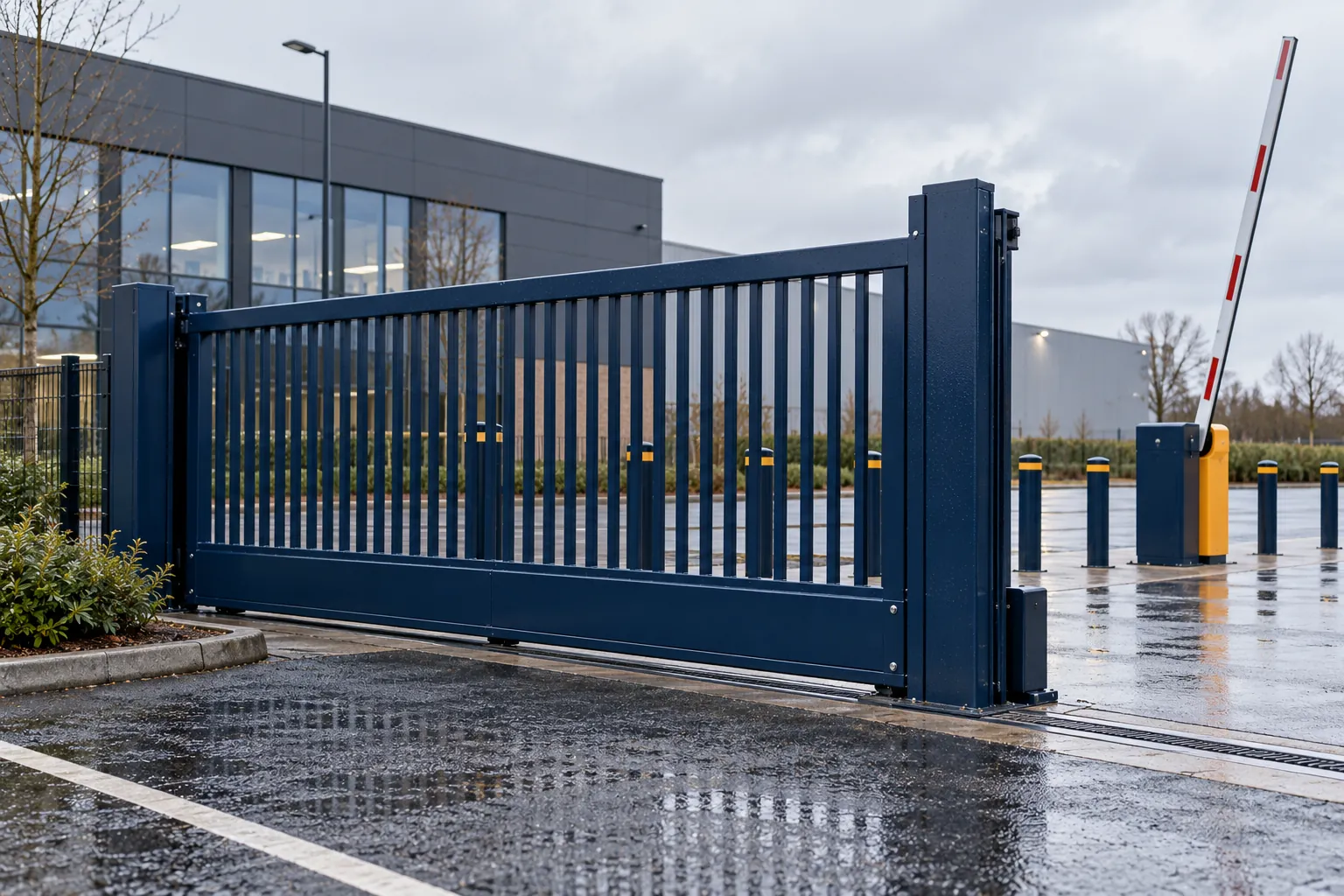
A sliding anti-ram gate moves sideways across the opening on a track or as a cantilever. The leaf is a heavy steel structure, and the posts and foundations are sized to take the impact load into the ground. On impact the gate engages with its posts or a catch so the leaf cannot be pushed through. Sliding vehicle gates of this type suit wide openings where a long run of fence meets a road.
The sliding layout keeps the gate in the line of the perimeter at all times. When closed, the opening is protected to the same rating as the gate itself, and it can span openings of several metres that would be awkward for two swing leaves: the usual choice for depots and logistics sites with a steady flow of lorries.
The limits are physical. A sliding gate needs clear run-back space beside the opening, at least the width of the leaf plus the posts, kept clear of parking and stored pallets. The heavy leaf cycles slower than a domestic sliding gate, the gear and motor need scheduled servicing, and the deep reinforced foundations are part of the tested design, which makes installation slower and more disruptive than hanging a standard gate.
Swing anti-ram gates and where they suit
A swing anti-ram gate uses one or two leaves on heavy duty hinges. The hinges, locking posts and foundations take the full impact load. Security gates in swing form are simpler than sliding gates: fewer moving parts, no track to keep clear, and a shorter build time on site. They suit smaller openings and sites with no room for a run-back, typically a single leaf of two or three metres on utility compounds and small yards.
The honest limits: a swing gate cycles slower than a road blocker, high wind on a large solid leaf adds load to the hinges and operator, and the civil work is still the expensive part because the tested foundations are mandatory. Where the entrance must handle constant traffic, look at the alternatives above before committing to swing leaves.
Bollards and road blockers: protection that does not open
Not every vehicle entrance needs to open. If a route can be closed to vehicles permanently, fixed security bollards give the same impact rating as a gate with no motor, no power supply and nothing to fail. They cost less, need almost no maintenance, and cannot be left open by mistake. They suit pedestrianised approaches and emergency-only routes; the bollard regulations guide sets out UK spacing and foundation guidance.
A road blocker is the opposite choice: a rising block that stops traffic when raised and drops flush to let vehicles pass. Blockers give the fastest cycle time of any anti-ram option, which is why they guard entrances with constant vehicle flow. The price is complexity: a pit or shallow structure, drainage, power and hydraulics, plus regular servicing of the moving parts.
The trade-off is simple. Bollards are cheap and certain but block the route. Blockers keep the route open but cost more and need looking after. A gate sits between the two: it opens for legitimate vehicles and costs less to run than a blocker, but cycles slower.
Sliding, swing, bollards or blockers: a comparison
| Option | Opening and closing | Footprint and foundations | Servicing needs |
|---|---|---|---|
| Sliding anti-ram gate | Moderate cycle time, steady vehicle flow | Clear run-back beside the opening, deep reinforced post foundations | Track or cantilever gear, motor and safety devices need scheduled servicing |
| Swing anti-ram gate | Moderate cycle time, lower traffic | Clear swing arc, deep foundations for posts and hinges | Hinges, locks and operators need regular checks |
| Fixed bollards | No opening, the route stays closed | Small footprint, foundations sized to the rating | Very little, check for damage and corrosion |
| Road blocker | Fastest cycle time, constant vehicle flow | Pit or shallow structure, drainage essential | Hydraulics or electrics need regular servicing |
Choose by three things: how often vehicles pass, how much space the site gives you, and the rating the threat demands. Match the gate rating to the fence line rating, so the entrance is not the soft point.
The foundation rule. A vehicle impact rating covers the gate, posts and foundations tested together as one system. Change the foundation design and the rating no longer applies, whatever the gate leaf can do on its own.
The gap problem at every vehicle entrance
The gate is the weak point in any hostile vehicle mitigation line. The fence is fixed and continuous; the gate must move, which creates a gap every time it opens. NPSA lists tailgating through a vehicle access point and slow encroachment through gaps among the exploits attackers use. Keep the gap as small as the rating allows and think about the whole entrance, not the gate leaf alone.
Start with the rating. If the fence line is rated for a 7,500 kg truck at 48 km/h, the gate should carry the same rating. Then look at the sides of the gate: the posts, the pedestrian gate beside it and the fence connections must all be part of the tested system. A rated gate bolted to an unrated fence post is not a rated entrance.
Pedestrian movement needs its own route. People should not walk through the vehicle gate while it cycles. A separate pedestrian gate with its own access control keeps foot traffic away from moving steel and stops an attacker walking in behind a delivery lorry. The HVM standards guide explains how PAS 68, IWA 14-1 and ISO 22343-1 ratings compare.
Power failure, manual release and access control
A powered anti-ram gate must have a planned answer for power failure. The two choices are fail secure, where the gate stays closed without power, and fail safe, where it can be opened. Fail secure protects the asset but can trap vehicles inside and block emergency access. Fail safe keeps routes open but leaves the entrance unprotected until power returns. Make the decision during design and write it into the operating procedure.
Manual release decides whether the design works. If release is too easy, it becomes an attack route. If it is too hard, staff cannot operate it during a real emergency. Keyed release mechanisms with a clear procedure for holding the key are the usual answer, and staff must be trained on it before handover, not after the first power cut.
Access control sits on top of the gate, never in place of the rating. Card readers, intercoms, number plate recognition and remote operation decide who may enter, but they do nothing to stop a vehicle that ignores them. Plan the installation so cabling and readers are protected from weather and tampering. Planned maintenance then keeps the whole entrance working: NPSA notes that poor maintenance creates vulnerabilities that attackers can exploit.
Surveying the approach before you specify
The rating you need depends on the speed a vehicle can actually reach at the gate, not the speed limit on the sign. A straight, flat approach of a few hundred metres lets a van or lorry build up real speed, while bends, gradients and chicanes take speed away. NPSA publishes a checklist for clients commissioning a Vehicle Dynamics Assessment, the formal study of what a threat vehicle can do on the roads around a site. Ask for one before you fix the rating.
The survey should also map the ground. Deep foundations need room to dig and somewhere for the spoil to go, and buried services, high water tables and tree roots all complicate the civil work. Get ground conditions checked early, because a foundation redesign after the gate is ordered wastes time and money.
Finally, involve the people who will run the entrance. Security staff, facilities managers and the local counter terrorism security adviser can all spot problems a drawing cannot show: delivery patterns, shift changes and the way visitors actually arrive. Sites such as transport hubs and government and defence estates design their entrances as part of a wider plan. For premises with new protective security duties, our Martyn’s Law guide sets out what the law asks. Browse the full set of guides in the guides hub.
Can a normal electric gate stop a car?
No. A standard electric gate is built for access control, not impact. Its leaf, posts and motor are not designed to take the load of a moving vehicle, and its shallow foundations will not hold it on impact. Only a crash tested gate with its tested posts and foundations can stop a determined driver.
What do the numbers in a vehicle impact rating mean?
The rating states four things: the vehicle type and mass, the impact speed, the impact angle and the penetration distance, which is how far the vehicle travelled past the barrier line. Test vehicles run from a 1,500 kg car to a 30,000 kg truck, and test speeds are 48, 64 and 80 km/h. Compare two products on all four numbers.
Do I need planning permission for an anti-ram gate?
It depends on the site. Check with the local planning authority before you order, and get highway authority approval if any part of the works touches public land. Listed buildings and conservation areas add extra steps. Start the planning early, because it runs separately from the security design.
How fast do anti-ram gates open?
Slower than ordinary electric gates. The heavy leaf limits safe cycle speed, and rushing the cycle wears the gear out. If the entrance must handle constant traffic, a road blocker cycles faster than any gate, or two gates can work in sequence so one is always closed. State the vehicle flow in the enquiry so the operator is sized correctly.
Can pedestrians walk through the vehicle gate?
They should not. Pedestrians need a separate route with its own gate and access control, kept clear of the moving vehicle leaf. Walking through the vehicle gate exposes people to moving steel and lets an attacker tailgate a legitimate vehicle. A turnstile lane beside the gate handles foot traffic without opening the vehicle route.
What an anti-ram rating does not prove
An anti-ram rating proves one thing: the tested gate, barrier or bollard stopped the test vehicle within the stated penetration. It proves nothing else. Treat the certificate as a narrow statement.
It does not prove the entrance is closed. A gate stops a vehicle where the gate stands, and a vehicle that can drive around the gate, through a gap wider than 1,200 mm, or over a kerb has not been stopped. ProtectUK guidance sets 1,200 mm as the maximum clear gap between HVM elements and 500 mm as the minimum height, so check the whole frontage, not one product. Our choosing HVM bollards guide sets out how a line is put together.
It does not prove the gate will open when it must. A sliding gate that loses power, a swing gate with a failed operator, or an access control system that locks out the fire service, all leave the entrance shut when it needs to open. Safety in use of power operated doors is covered by EN 12453, and the manual release must work without power. Check the release at every inspection.
It does not prove the gate suits the traffic. A gate rated for occasional use will wear fast on an entrance that opens fifty times a day, and a gate sized for cars will not stop a truck. The rating names a test vehicle, a speed and an angle, and traffic heavier or faster than the test is outside the rating. Match the rating to the traffic, not to the gate that looks strongest.
It does not prove the approach. A gate at the bottom of a slope, a gate with a blind approach, or a gate that opens onto a public footpath all ask more of the operator and the access control than a gate on flat ground with a clear view. Survey the approach before the specification is fixed.
Mistakes that leave a vehicle entrance open
Most vehicle entrances fail in small ways. Each mistake below has the same result: an entrance that looks secure and lets a vehicle through.
| Mistake | Why it fails | What to do instead |
|---|---|---|
| Gate ordered without the approach survey | A gate that suits flat ground may not suit a slope or a blind bend. | Survey the approach and write the findings into the order. |
| Gap beside the gate wider than 1,200 mm | A vehicle passes through the gap beside the gate. | Close every gap to 1,200 mm or below. |
| No manual release tested | A release that was never tripped may not work when power fails. | Test the release at every inspection. |
| Access control with no fire service override | The fire service cannot open the gate when it must get in. | Fit an override the fire service can use. |
| No record of the rating | Nobody can check the entrance against what was tested. | File the test report with the building records. |
Keep the evidence with the entrance. The test report, the rating and the operator schedule should travel with the installation, so the fitter and the inspector can check what was fitted against what was tested. For the HVM context the gate sits in, see our hostile vehicle mitigation page.
Get a free quote
Related
More in guides for specifiers
Products
One supplier for the whole building envelope
Ready to specify your project?
Free assessment, written specification and test evidence. Reply within one working day.