
Areas we cover
Physical security in Portsmouth
Rated doors, glazing, fire separation and vehicle barriers for the harbour, the Historic Dockyard, the ferry port and the hospitals of Portsmouth.
- ✓Third-party test evidence with every product
- ✓Written specification you can issue to tender
- ✓Supplied and installed in Portsmouth
Get a free quote in Portsmouth
Rating, written specification and budget range within one working day.
Confidential. No cost, no obligation.
Third-party tested
Evidence with every quote
UK manufactured
Made to your sizes
One accountable team
Specify, supply, install
Confidential handling
Details never shared
Supplied and installed in Portsmouth
What we supply in Portsmouth
Services in Portsmouth
Portsmouth is a naval city before it is anything else, and the water shapes every security decision here. The Historic Dockyard and the naval base stand beside Portsmouth Harbour station, the ferry port at Portsmouth International Port moves passengers and vehicles through the day, and Gunwharf Quays mixes retail, leisure and apartments on the waterfront. Crowds, vehicles and glazing sit close together on all three sites.
Inland, the pattern turns to campuses and hospitals. The University of Portsmouth holds a city centre campus, Queen Alexandra Hospital serves a wide area from Cosham, and the commercial quarters around the harbour mix offices, retail and student accommodation. This page follows that line from the water inward, starting at the dockyard and the ferry port.
The dockyard, the naval base and the ferry port
Portsmouth Harbour station, the Historic Dockyard and the naval base form one busy waterfront, with passengers, staff and service vehicles moving through controlled points all day. Security gates and sliding vehicle gates manage vehicle entry, turnstiles handle pedestrian flow, and LPS 1175 doorsets protect the substations, control rooms and stores, most often rated SR3, a five minute attack using crowbars, drills and chisels.
On sailing days, drop off lanes and forecourts at Portsmouth International Port gather passengers, crew and vehicles in one place. The usual combination there pairs hostile vehicle mitigation on the drop off lanes with security bollards tested to PAS 68 and blast resistant glass set into its frame on the glazed concourses. The transport hub requirements guide shows how port and station forecourts zone the same measures, and fire door guidance for ports covers the compartmentation side.
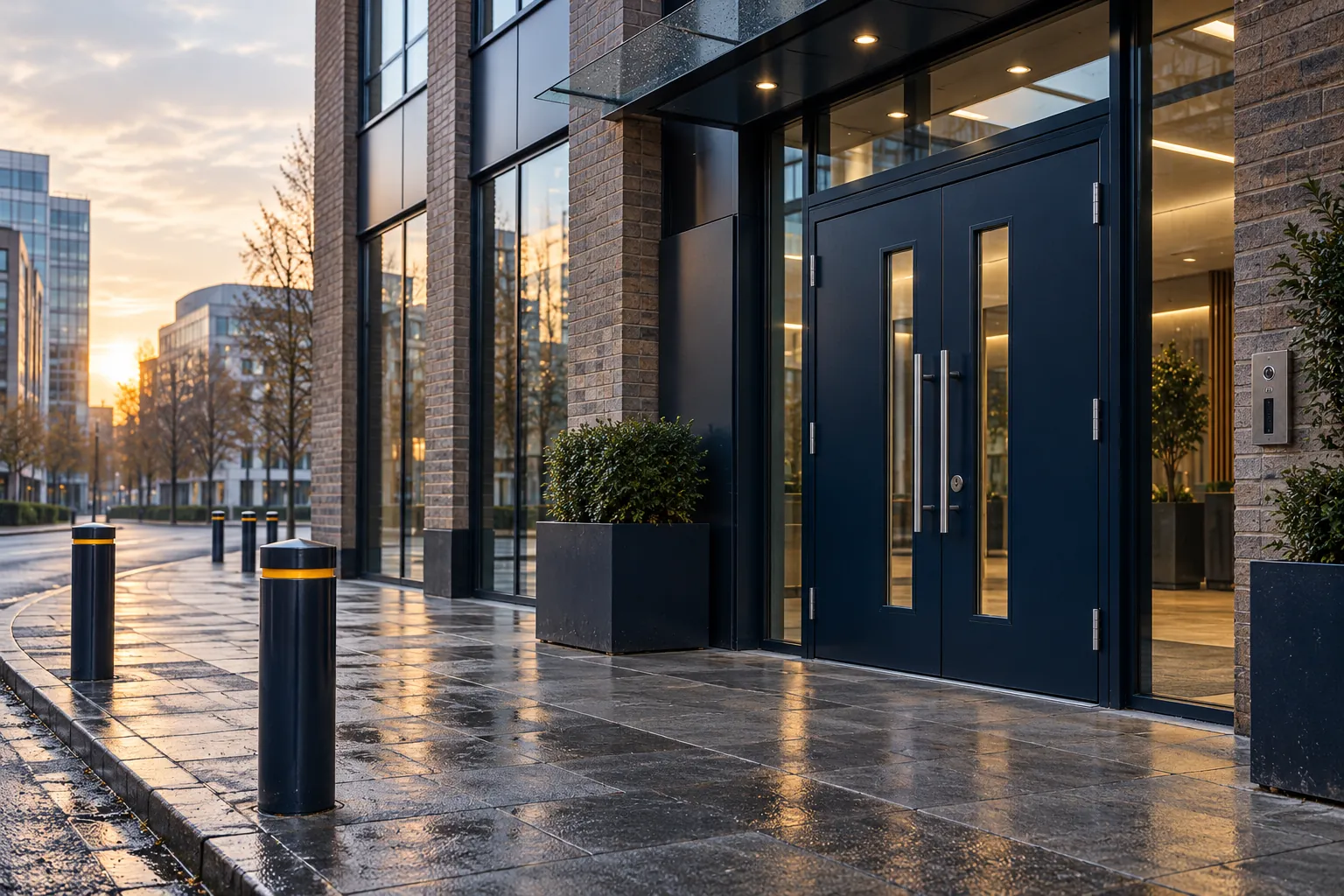
This paragraph is the only one on doors. Doorsets, glazing and entrance control for the harbour and the city centre are on the security doors in Portsmouth. What follows covers the other groups, the ratings and the way a project is scheduled around sailing days.
Gunwharf Quays, the campus and the hospital at Cosham
By day Gunwharf Quays shows full height glazing on retail, leisure and apartments along the waterfront, and by night the streets are quiet. After trading, security shutters and roller doors close retail frontages, glazed display fronts keep their glass behind LPS 1175 rated security windows, and retractable security grilles suit units where the frontage has to disappear by day. Retail guidance covers the stock room and service corridor mix behind those frontages.
The University of Portsmouth campus sits in the city centre, mixing teaching buildings, laboratories, libraries and student accommodation. Teaching blocks take rated doorsets on plant rooms and stores, research spaces step up where equipment sits behind the door, and accommodation stairs take doorsets that carry fire and security ratings together. Each education estate gets its rating building by building. The university doors guidance walks through the usual hall, laboratory and accommodation mix.
At Cosham, Queen Alexandra Hospital plans around fire separation: steel fire doors rated EI 30 to EI 120 sit on corridors, stairs and service risers, rated to BS EN 1634-1. Pharmacies, plant rooms and records stores take security doors, and hospital doors guidance shows the order fitting follows around wards that stay open. An MRI suite needs both RF shielding and magnetic shielding, which are different disciplines, checked by testing after fitting.
What each of the six groups does at the harbour
Where a brief writes a ballistic class in for a control room or a cash handling area, Portsmouth takes doors, windows and glass from the Ballistic range, FB1 to FB7 under BS EN 1522.
Harbour buildings, ferry port facilities, university blocks and retail frontages draw on Security for LPS 1175 doorsets and windows, glazing and entrance control, SR2 to SR5.
Where the brief includes a blast assessment, glazed concourses at the ferry port use Blast doors and glazing, tested to ISO 16933, in EXV and SB.
Hospital corridors and student accommodation stairs suit a dual rated unit from Fire, EI 30 to EI 120 steel doorsets, where compartmentation and forced entry resistance meet in one opening.
Drop off lanes, harbour routes and port forecourts take Perimeter crash rated gates, barriers and bollards to ISO 22343-1:2023 and PAS 68.
Hospital imaging in Portsmouth uses Shielding for EMP and RF shielded rooms and MRI suites, set as a dB value across a frequency range and confirmed by testing after the room is built.
Where the harbour needs rated products
| Area | Risk | Rating | Product |
|---|---|---|---|
| Retail frontages | Forced entry out of hours | SR2 to LPS 1175 | Security shutters |
| Glazed concourses | Blast | EXV to ISO 16933 | Blast resistant glass |
| Historic Dockyard | Controlled access | LPS 1175 SR3 | Security doors |
| Terminal forecourts | Vehicle attack, crowds | PAS 68 | Hostile vehicle mitigation |
| Naval base gates | Vehicle and pedestrian flows | PAS 68 | Sliding vehicle gates |
Read the table as a first pass only. A threat assessment, together with a survey of the vehicle approaches, fixes the rating for every opening, so a gatehouse on a busy port road ends up with a different rating from the same gatehouse on a quiet service road.
Sailing days set the programme. Work around the harbour and the ferry port is timed to the sailing calendar, so the port stays in use while barriers go in.
Ratings, crowded places and the written specification
For forced entry, Portsmouth specifiers work from LPS 1175, whose Issue 8.2, dated September 2024, remains the version in force, and its five classes, SR1 to SR5, step up in attack time and in the tools an intruder may use. Stealth attack sits under the LPS 2081, which gives SRA one minute and SRB three minutes. Attack rated glazing falls under LPS 1270, Issue 1.1 of 2014, and the LPS 1175 standard page sets out each class in turn.
The Terrorism (Protection of Premises) Act 2025, known as Martyn’s Law, puts crowded places in two tiers: standard where 200 to 799 people may be present, enhanced at 800 or more. It names no product for any opening. Which physical measures suit a terminal or a concourse comes from the risk assessment. The Martyn’s Law guide for premises walks through both tiers. Vehicle impact ratings put PAS 68 and IWA 14-1 alongside ISO 22343-1:2023. Ballistic ratings run FB1 to FB7, blast ratings run EXV and SB, and fire ratings run EI 30 to EI 120.
How work is scheduled around a working port
Work starts with a survey of the site: every opening, the wall construction and the way vehicles approach. Once your team agrees the ratings, doorsets, shutters and barriers are made to the surveyed sizes, and fitting follows sailing schedules and shift patterns. The agreed ratings become drawings at design, and installation fits the products to the details as tested.
Once handed over, planned maintenance visits keep closers, locks and seals working. Give us the building type and the rating needed and the answer comes back within one working day, carrying a rating and a written specification, with a budget range, and test evidence from a third party to follow.
Questions about physical security in Portsmouth
Does the 2025 Act cover a ferry terminal?
A ferry terminal falls in scope when 200 or more people may be present at any one time, with the enhanced tier starting at 800 or more. Terminal operators should work out which tier covers them and leave time to put physical measures in place ahead of enforcement.
Can barriers go in while a terminal keeps sailing?
Yes. The barrier lines are set by the vehicle and pedestrian flows, work is timed to sailing schedules so the terminal stays in use. The survey checks the foundations first.
Which rating fits a port control room?
A port control room usually takes SR3 to LPS 1175, an attack lasting five minutes, using crowbars, drills and chisels. A room that also needs fire integrity takes one doorset carrying both ratings.
How are shopfronts at Gunwharf Quays secured after hours?
Shutters and roller doors close retail frontages after trading hours, and retractable grilles suit units where the frontage has to disappear by day.
Working on a harbour, dockyard or campus scheme in Portsmouth? Tell us what the building is and which openings need cover, and we reply within one working day, giving a rating and a budget range, and test evidence from a third party to follow.
Ready to specify your project?
Free assessment, written specification and test evidence. Reply within one working day.