
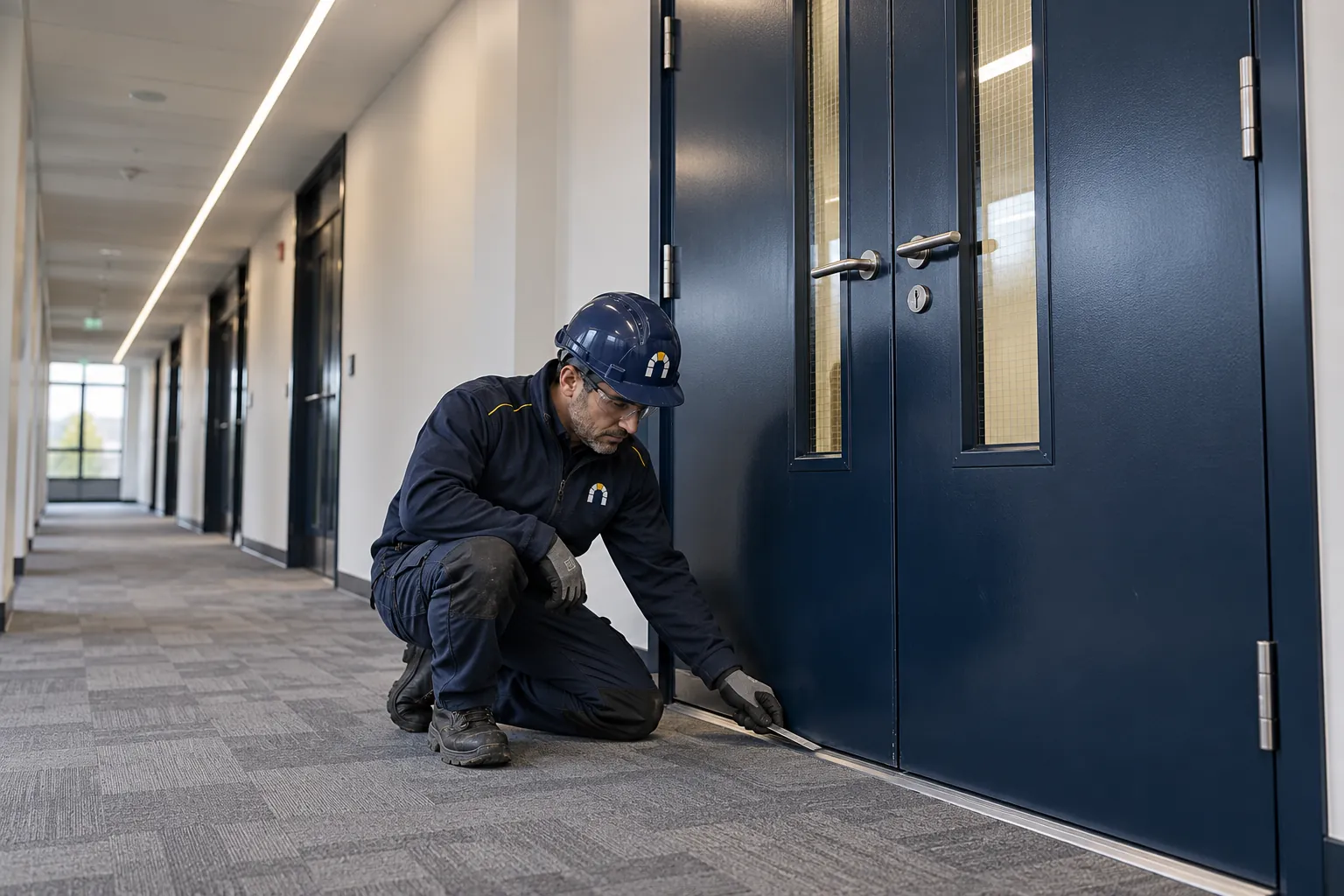
Fire · EI 30 to EI 120
Fire rated steel doors
Fire rated steel doors from EI 30 to EI 120, tested to EN 1634-1 under the LPS 1056 scheme. Supplied and installed across the UK for any sector.
- ✓Third-party test evidence with every product
- ✓Written specification you can issue to tender
- ✓Supplied and installed across the UK
Get a free project quote
Rating, written specification and budget range within one working day.
Confidential. No cost, no obligation.
Third-party tested
Evidence with every quote
UK manufactured
Made to your sizes
One accountable team
Specify, supply, install
Confidential handling
Details never shared
Fire rated steel doors are the workhorses of compartmentation: steel doorsets that hold an EI rating from 30 to 120 minutes. ArxBridge supplies and installs them across the UK for corridors, stairwells, plant rooms and any opening in a fire compartment wall.
- EI 30 to EI 120Integrity and insulation ratings
- EN 1634-1Fire resistance test standard
- LPS 1056LPCB certification scheme
- Single and double leafDoorsets for any opening width
Fire rated steel doors explained
A fire rated steel door is a complete doorset, leaf, frame, seals and ironmongery, tested to EN 1634-1 as one assembly. The leaf is a steel shell with an insulating core; in a fire the core slows heat transfer while intumescent seals around the leaf expand to close the gaps. The door holds its E or EI classification for the stated minutes. The Fire range overview sets out the related louvred, dual-rated and thermally broken products.
Steel suits the hard-working openings: plant rooms, risers, corridors and service areas where lighter doors would be punished by daily traffic. The doors take ironmongery for access control, panic exit and master keying, provided every item is covered by the fire test evidence.
Every doorset should arrive with its rating on a permanent label and certification under a scheme such as LPS 1056. The label is what building control and the fire risk assessor check; a door without one is a decoration, not a fire door.
Choosing the right rating for fire rated steel doors
| Classification | What it holds | Asked for where |
|---|---|---|
| EI 30 | Integrity and insulation, 30 minutes | Corridors and escape routes |
| EI 60 | Integrity and insulation, 60 minutes | Stairwells and compartment walls |
| EI 90 | Integrity and insulation, 90 minutes | High fire load plant and storage |
| EI 120 | Integrity and insulation, 120 minutes | Severe fire load compartments |
E only ratings suit risers and service shafts where insulation is not required. The fire strategy sets the rating for each opening; the door schedule turns it into an order. Do not upgrade or downgrade ratings on site without the fire engineer’s agreement: the rating must match the wall, and the fire ratings guide explains the classifications.
Ironmongery is part of the test. Locks, closers, hinges and seals must be the tested items. Swapping any of them for an untested equivalent voids the rating.
Inside fire rated steel doors
The leaf is folded steel over an insulating core, with internal stiffeners. Intumescent strips sit in the leaf edges or the frame rebate; in heat they expand many times their size and seal the perimeter against smoke and flame. Smoke seals, usually brush or blade type, handle the cold smoke before the intumescent activates.
The frame is a folded steel section, grouted or bolted into the structural opening. A fire door in a weak frame is a failed door: the frame must hold the leaf in the opening for the full rating period. Self-closing devices are standard on most fire doors, because a fire door wedged open is the oldest failure in the book.
Finish is powder coat in standard colours; stainless steel suits hygiene and corrosive environments. Vision panels are allowed where the test evidence covers them, in fire rated glass matched to the door rating.
Fire rated steel doors with combined ratings
Fire doors often need forced entry resistance as well: a compartment door in a secure area must resist both fire and attack. Fire and security doors carry both performances in one assembly. The security doors range covers the LPS 1175 classes that pair with fire ratings.
Blast is another pairing for high-risk sites: a fire door on a threatened elevation may need blast performance too, and blast resistant doors can be fire rated where the evidence covers both. Acoustic performance is commonly added in healthcare and education; it rides in the seals and the core.
Each performance needs its own test evidence on the same doorset. Name every required rating in the specification and require a report for each.
Typical uses for fire rated steel doors
Healthcare estates use them on ward corridors, stairwells and plant rooms, where evacuation is slow and compartmentation does the heavy lifting. Education buildings use them on stair enclosures and between teaching blocks.
Data centres fit them to electrical rooms and generator enclosures with high fire loads. High-value retail uses them on stock rooms and service corridors. Where the plant room also needs air, the fire rated louvre doors range covers ventilated openings.
What affects the cost and lead time of fire rated steel doors
The rating is the main driver: EI 120 needs more core and deeper sections than EI 30. Size matters next, with double leaf doorsets and oversized openings adding material and fabrication time. Ironmongery schedules, access control and special finishes add their own cost.
Certification adds value and a little time: doors under LPS 1056 are audited in manufacture, which the programme should allow for. Large, identical runs are efficient; a schedule of one-offs is slower per door.
The structural opening must be ready: frames go in early, before finishes. Late builder’s work around the frame is the classic cause of a delayed handover.
Specifying fire rated steel doors
- Take the rating from the strategy. The fire engineer sets E or EI and the minutes for each opening.
- Schedule the ironmongery. List locks, closers, panic hardware and access control per door, all from the tested range.
- Demand certification. Require LPS 1056 or equivalent scheme cover, with the rating labelled on every door.
- Check the wall. Confirm the compartment wall rating matches the door going into it.
- Sequence the install. Book installation for frames before finishes, with final adjustment at handover.
How long does a fire door last?
The doorset is a long-life product, but seals, closers and ironmongery wear. The maintenance plan should include the checks the fire risk assessment expects.
Can a fire door be held open?
Only with a hold-open device that releases on the fire alarm. Wedges and hook-backs are not permitted on fire doors and will fail an inspection.
What is the label on the door?
The certification label or plug records the rating, the manufacturer and the scheme. It must stay legible for the life of the door; painting over it is a common and avoidable failure.
Do fire doors need smoke seals?
Where the strategy calls for cold smoke control, yes: brush or blade seals handle smoke before the intumescent activates in heat. The door schedule should state it.
Can I cut a fire door on site?
Only within the small tolerances the certification allows. Fire doors are made to measure; the survey must be exact.
Get a free quote
Related
More in fire rated doors
Ready to specify your project?
Free assessment, written specification and test evidence. Reply within one working day.