
ArxBridge
Data centre physical security: doors, glazing, HVM and shielding by zone
Data centre physical security by zone: boundary HVM, envelope doors and glazing, lobby control, data hall ratings, shielding, and the standards behind each one.
- ✓Third-party test evidence with every product
- ✓Written specification you can issue to tender
- ✓Supplied and installed across the UK
Get a free project quote
Rating, written specification and budget range within one working day.
Confidential. No cost, no obligation.
Third-party tested
Evidence with every quote
UK manufactured
Made to your sizes
One accountable team
Specify, supply, install
Confidential handling
Details never shared
Data centre physical security works in zones: boundary, building envelope, lobby, corridors, data hall and plant. Each zone earns the rating its contents justify, with hostile vehicle mitigation outside, access control at entries and rated doors and glazing deeper in. Specify per zone, never one rating for the whole site.
- Zoning principleProtection rises towards the data hall, like the layers of an onion
- BoundaryHVM barriers and fencing rated to ISO 22343-1
- EnvelopeLPS 1175 doors and LPS 1270 glazing at the penetrations
- Data hallThe highest door ratings, with logged and supervised access
The zone model: why one rating never fits the whole site
A data centre holds assets of very different value in different rooms. The boundary keeps vehicles and intruders at distance, the envelope resists entry to the building, and the data hall protects the servers themselves. Giving every door the highest rating wastes budget where the threat is low and can slow daily operations for staff who need to move.
The zone model matches the product to the room. Approach roads get vehicle mitigation, the lobby gets entrance control, corridors get rated doors that slow movement, and the data hall gets the strongest doorsets with full audit trails. Each layer buys time, and each layer is specified for what it guards rather than for the site as a whole.
Existing buildings can adopt the same model in stages. A common sequence starts with the boundary and the lobby, where the gains are largest, then works inward to corridors and plant rooms as budgets allow. Each stage should leave the next one possible: cable routes for future readers, frame sizes that accept deeper doors, and a lodge layout with room for another gate.
Zone by zone: what each area needs
Start at the boundary and work inward. The table below sets out the six zones and the products that typically guard each one. Treat it as a starting point: the threat assessment for the site decides the final ratings, and the data centres sector page gives the wider threat picture.
| Zone | Main products | Rating references to consider |
|---|---|---|
| Boundary and approach roads | HVM barriers, bollards, fencing, gates | ISO 22343-1 vehicle impact ratings |
| Building envelope | Rated doors, security glazing, louvres | LPS 1175, LPS 1270, EN 1627 |
| Lobby and security lodge | Speed gates, turnstiles, interlocked portals | Access control with anti-tailgating |
| Corridors | Rated internal doors | LPS 1175 SR2 or above |
| Data hall | High-security doorsets, cages | LPS 1175 SR3 and above, logged access |
| Plant rooms | Rated doors, louvred doors | LPS 1175 and fire ratings |
Rating zone by zone: the door that fits each area
A data centre never takes one rating for the whole site, because each zone faces a different risk. The boundary meets vehicles, the lobby meets visitors, the corridors move staff between rooms, and the server halls hold the equipment that cannot be replaced, so each zone takes its own rating, and the schedule carries one line per zone, with the building, the position and the rating named on it.
The rating for a zone comes from the tools the door must hold against and the minutes it must hold for. Category B tools are the light hand tools, screwdrivers, pliers and hand saws, and three minutes against them gives B3. Category C tools are the heavier hand tools, crowbars, drills and chisels, and five minutes against them gives C5. Category D tools are the heavy tools, sledgehammers, disc cutters and jigsaws, and ten minutes against them gives D10. LPS 1175 Issue 8.2, dated September 2024, is the current issue, and the labels it carries are B3, C5 and D10, which replace the earlier SR2, SR3 and SR4 on older drawings.
Stealth is a separate threat from forced entry, and a zone that faces it needs a rating for it beside the forced entry rating. LPS 2081 tests a doorset against an attack that stays quiet, with SRA at one minute and SRB at three, and the minutes follow the zone: a guarded lobby spots the attempt quickly, while an unwatched plant room gives the attack longer to work. A doorset proved to LPS 2081 alone has said nothing about hand tools, so the forced entry rating sits beside it on the same line.
The evidence for each zone: one file, one schedule
The boundary takes the vehicle rating, and the rating belongs on the barrier, not on the door behind it. ISO 22343-1 tests a barrier against a moving vehicle, and the rating names the vehicle mass, the speed, the angle and how far the vehicle travels past the line, from a 1,500 kg car to a 30,000 kg truck at 48, 64 or 80 km/h. ProtectUK guidance caps the clear gap beside a barrier at 1,200 mm and sets the minimum height at 500 mm, so the gap and the height belong on the schedule beside the rating. Our HVM planters and street furniture guide covers the boundary line, and the server room doors guide covers the halls inside.
Inside the building, the rating follows the room. A server hall door takes the highest rating on the site, because the equipment behind it cannot be replaced, while a staffed lobby takes a lower one, because the people beside it spot the attempt quickly. PAS 24 covers the enhanced security doorset, and EN 1627 sets its own classes, RC1 to RC6, each with its own test report behind it. LPS 1175 and EN 1627 are separate scales, each with its own test, so a schedule that asks for one by naming the other has asked for a proof that does not exist. Our LPS 1175 vs EN 1627 guide compares the two scales, and the plant room door requirements guide covers the rooms between the lobby and the halls.
| Zone | Rating | What to check |
|---|---|---|
| Boundary and approach roads | ISO 22343-1 | Vehicle mass, speed, gap 1,200 mm, height 500 mm |
| Lobby and entrance control | B3 or PAS 24 | Access control, release on alarm |
| Corridors and plant rooms | B3 or C5 | Rating by zone, seals and closers |
| Server halls | C5 or D10, SRB where needed | Highest rating, evidence on the whole doorset |
File the evidence zone by zone, with the test report, the rating and the position on the same line, so the next reader can see why each door carries the rating it does.
HVM at the boundary and approach roads
Vehicles are both a delivery method and a weapon. Approach roads, drop-off points and service yards need barriers rated to ISO 22343-1, which states the vehicle mass, speed, angle and penetration in the rating. PAS 68 and IWA 14-1 describe the same test idea, and the current ISO standard supersedes both. Our vehicle impact ratings guide explains how to read these ratings.
Place the vehicle line before the pedestrian line. Security bollards and barriers should force hostile vehicles to stop while staff and visitors pass through a separate controlled entrance. Coordinate the hostile vehicle mitigation layout with the landscape so the protection is continuous, with no gap a vehicle could use.
The lobby, security lodge and entrance control
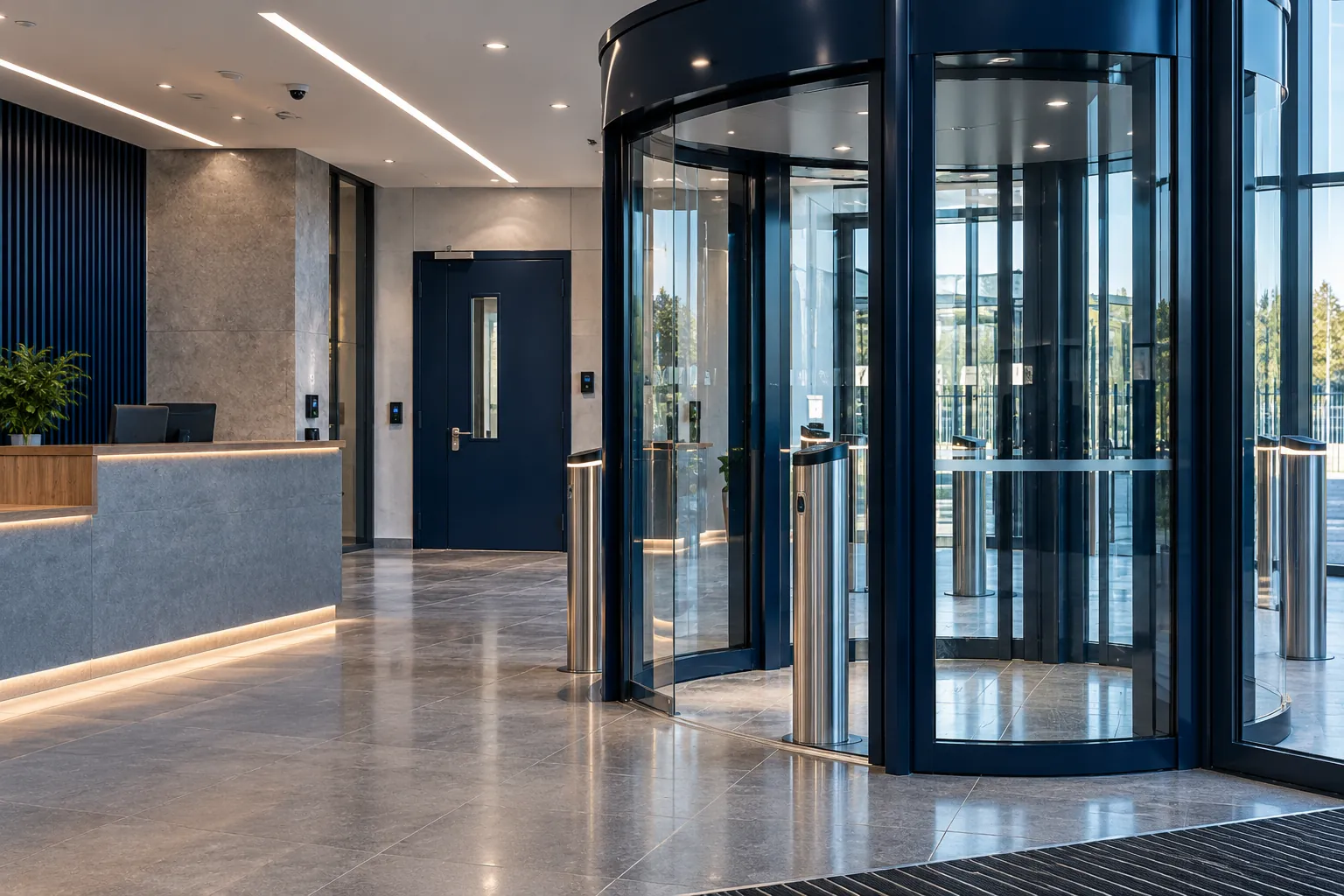
The lobby is where identity is checked. Pedestrian speed gates and turnstiles manage the flow of staff, interlocked security portals handle visitors one at a time, and the security lodge watches both. The doors here need to work with the access control, not against it: held-open alarms, forced-door detection and integration with the entry system matter as much as the physical rating.
Tailgating is the main failure at this layer. A rated door propped open for convenience protects nothing. Specify doors with monitored status and make the procedure for escorted visitors part of the handover, so the hardware and the routine reinforce each other.
Corridors, plant rooms and the secondary envelope
Inside the building, corridors divide the site into compartments. Rated doors on corridor crossings slow an intruder who has passed the lobby and give response teams time to act. Plant rooms deserve the same attention: power and cooling are single points of failure, and their doors and louvres should carry forced-entry and fire ratings that match their importance.
Do not forget the roof and the service penetrations. A data centre is entered through its weakest opening, which is often a louvred vent or an unrated roof hatch rather than the front door. Every penetration of the envelope should have a rated product or a compensating measure, and LPS 1175 doors are the usual answer for personnel openings.
Generator and UPS rooms sit between plant and data hall in importance. Their doors need the forced-entry rating of a plant room and the access logging of a data hall, because a failure here stops the whole site. Treat fuel deliveries as a vehicle movement too, and route them through the HVM line rather than around it.
Shielding, EMP and RF considerations
Some data centres need electromagnetic protection as well as physical protection. EMP shielding and shielded rooms limit RF emissions and incoming interference, and EMP-rated construction addresses electromagnetic pulse threats for the most critical sites. These are specialist builds with their own test regimes, specified alongside the forced-entry ratings rather than instead of them.
Shielding and forced-entry ratings can live in one doorset, but only if the combination has been tested. A shielded door without a security rating, or a security door with untested shielding added, leaves a gap in the evidence. Specify the combination and ask for test evidence that covers both performances on the same construction.
Standards context: NPSA guidance, EN 50600 and ISO 27001
The NPSA publishes data centre security guidance that works through seven areas of risk, from the physical perimeter and the buildings to the data hall, the meet-me rooms, people, the supply chain and cyber security. It is guidance for owners and operators, not a product standard, and it helps to structure the threat assessment that the product schedule answers.
EN 50600 is the European standard series for data centre facilities, and part 2-5 addresses security systems, including protection classes for different areas of the site. ISO 27001 is an information security management standard: it requires physical security controls as part of the management system but does not rate doors or barriers. Use each document for what it is: NPSA for the risk picture, EN 50600 for the facility design, ISO 27001 for the management system, and the product standards for the hardware. See all our guides for more.
Seven areas, one schedule. NPSA guidance names seven areas of risk for data centres. Check that the product schedule answers each of them before it is issued.
Which LPS 1175 rating suits a data hall door?
It depends on the threat assessment, but data hall doors commonly sit at SR3 or above, with logged access control. The rating must appear on the doorset’s own certificate.
Do we need HVM if the site is low profile?
Approach roads and service yards still take vehicle traffic. Even where the hostile vehicle threat is low, rated barriers manage accidents and unauthorised access.
What does EN 50600-2-5 cover?
Security systems for data centres, including protection classes for site areas. It guides facility design rather than rating individual products.
Is ISO 27001 a product standard?
No. It is a management system standard for information security. It calls for physical controls, but the doors and barriers are rated to their own product standards.
How should the meet-me room be handled?
As a high-risk shared space with strictly controlled access, rated doors and full logging, since third-party engineers work there.
Can one doorset carry security, fire and blast ratings?
Yes, if the combination has been tested. Ask for evidence covering each claimed performance on the same construction.
Get a free quote
Related
More in guides for specifiers
Products
One supplier for the whole building envelope
Ready to specify your project?
Free assessment, written specification and test evidence. Reply within one working day.