
ArxBridge
Fire Door Regulations for Student Accommodation
Fire door rules for student halls: FD30 and FD60 periods, flat entrance doors, corridor and stair core doors, and the routine that keeps them working.
- ✓Third-party test evidence with every product
- ✓Written specification you can issue to tender
- ✓Supplied and installed across the UK
Get a free project quote
Rating, written specification and budget range within one working day.
Confidential. No cost, no obligation.
Third-party tested
Evidence with every quote
UK manufactured
Made to your sizes
One accountable team
Specify, supply, install
Confidential handling
Details never shared
A student block holds hundreds of residents behind fire doors on corridors and stair cores. The flat entrance door holds fire back from the room itself, the corridor door holds it back from the escape route, and the stair core door keeps the stair clear for everyone above and below.
Put the order on one schedule for the whole block, a row for every opening. Each row names the position, the fire period, the smoke seal, the security rating where one is needed, and the leaf, frame, glass, seals and hardware as one tested doorset. Our fire door regulations for schools guide covers the same duties for classrooms and corridors, and our education sector page covers the buildings that hold students and researchers.
- FD30 / FD60Fire resistance periods tested to EN 1634-1
- BS EN 1634-1Fire resistance test for doorsets
- BS EN 1125Panic hardware for escape doors
- Martyn’s LawDuties for premises that hold crowds
Halls, corridors and stair cores: the doors that hold the line
Corridors and stair cores are the escape routes of a student block, and the doors on them are the line that holds fire and smoke back from those routes. A corridor door that lets smoke through fills the route out, and a stair core door that fails lets smoke into the stair that serves every floor.
Compartment lines run through the same doors. A fire that starts in one flat must stay in that flat, so the doors on the compartment lines take the period the fire strategy names for the wall they sit in.
Every door on an escape route must shut by itself after every use. A closer that cannot pull the leaf shut leaves the door standing open, and an open fire door is no fire door at all. The power sizes in BS EN 1154 are covered in our fire door closers guide, and smoke control on a corridor is covered in our smoke control doors guide.
Flat entrance doors in a student block: the door between the room and the corridor
Each study bedroom door in a student block is a flat entrance door, and it does two jobs at once. It holds fire inside the room and keeps strangers out while the resident is away. The fire side is proved by a classification to EN 1634-1 and the security side by a rating to LPS 1175 or PAS 24, each proved on the same doorset. Our flat entrance doors guide covers the door in full, and our dual certification guide works through how the two proofs sit on one doorset.
Rate the flat entrance door for the attack it could face. A ground floor room beside a public path faces more risk than a room on the fourth floor. Where a flat entrance door must also resist attack, LPS 2081 grades the doorset, SRA for one minute and SRB for three. The old labels still turn up on drawings: SR2 means B3, SR3 means C5 and SR4 means D10.
The lock must work from both sides without trapping the resident inside. A thumb turn on the inside lets the resident leave without a key, and a cylinder that meets TS 007, a 1-star cylinder with a 2-star handle or escutcheon giving a 3-star set, resists attack from the corridor side. The grades and the parts that make a fire door work are covered in our fire door hardware guide.
FD30 and FD60 in a student block: which period each door needs
The fire period comes from the EN 1634-1 furnace test, and the number after FD is the minutes of protection: 30 for FD30 and 60 for FD60. The test grades integrity, insulation and radiation as E, EW and EI, from 30 minutes up to 120, and the EI figure caps the heat on the safe side at 140 degrees Celsius on average and 180 at the hottest point. Our fire ratings guide sets out what each figure covers.
Smoke control joins the 30 minute period as FD30S, with the smoke seal proved to BS EN 1634-3, to Sa for ambient temperature smoke and S200 for smoke at 200 degrees Celsius. A door that holds fire but lets smoke through fails the residents, because smoke reaches people before fire does. The gap around the leaf must stay at 4 mm, because a wider gap lets smoke past the seal whatever the seal itself can do.
The fire strategy names the period for every door in the block. Flat entrance doors in student blocks are most often FD30S doorsets, while doors on compartment lines and stair cores take the longer period the strategy names, often FD60. Ask for the classification that names the exact doorset before the order is placed.
Escape routes for hundreds of residents: panic hardware and opening force
A door that serves more than 60 people takes panic hardware to BS EN 1125, with the bar running across at least 60 percent of the leaf width. A corridor door at the end of a floor serves every resident on that floor, so it takes panic hardware, and a stair core door that releases a crowd takes it too. The bar must work in one push, in the direction of escape, without a key.
Opening force is capped by BS 8300 and Approved Document M: below 30 N through the first 30 degrees and below 22.5 N beyond that. A closer set too strong for the leaf puts the door outside those limits. BS EN 1154 sets the closer power sizes, and the minimum power size on a fire door is EN 3. A hold-open device that keeps a corridor door open during the day must release on the alarm, to BS EN 1155.
Crowds bring duties with them. Martyn’s Law works in tiers for premises that hold 200 or more people, with the standard tier for premises holding 200 to 799 people and the enhanced tier for premises holding 800 or more. Royal Assent came in April 2025 and go-live is expected in spring 2027. The tiers and what they ask of a building are covered in our Martyn’s Law guide, and the same problem in wards that hold people overnight is covered in our fire door regulations for hospitals guide.
Communal areas, kitchens and laundry rooms: doors that see daily use
Communal areas in a student block take more use than any other doors in the building. A kitchen door opens and closes through the day, a laundry door takes trolleys and baskets, and a common room door takes a crowd in the evening. A door wedged open because the closer is too strong has failed, and the answer is a closer set to the right power size, not a wedge.
Glazing lets staff see into a communal room before they open the door, and a rated screen behind the glass holds if the room catches fire. Glass, frame, beads and fixings are tested as one assembly, so a rated pane in an untested frame is not a rated entrance. How glass, frame and beads are tested together is covered in our fire rated windows guide. The doors that guard a shared entrance are covered in our communal entrance doors guide.
Daily use wears the small parts first, and the hinge grade decides how long a door lasts. BS EN 1935 grades hinges by cycles and load, and grade 13 covers 200,000 cycles at 120 kg while grade 14 covers 200,000 cycles at 160 kg. A heavy leaf on a hinge grade that cannot carry it drops on its hinges, and a dropped leaf drags on the floor and stops latching.
Closers, hinges and seals: the small parts that keep a hall door working
A closer that is too strong for the leaf makes the door fail the access rules, and a closer that is too weak leaves the door standing open. The closer power size belongs on the schedule beside the fire period, because the two are set together: the period names what the door must hold and the closer names what shuts it.
Intumescent seals expand at roughly 200 to 250 degrees, closing the gap around the leaf as the fire heats the door. A seal that is missing, painted over or cut short leaves a gap the fire can pass through, and a smoke seal that has hardened lets smoke past the leaf. Check the seals on the same visit as the closer, because a door with a working closer and a failed seal still fails its job.
The closer that shuts a hall door: power size and the daily cycle
A hall door in a student block is opened and shut hundreds of times a day, and the closer is the part that must keep up. No fire door takes less than EN 3 to BS EN 1154, with the power size chosen for the leaf that is fitted, and a closer fitted to a heavy leaf with too little power never shuts the door. The power belongs on the order beside the leaf, and it should be checked on the round by watching the leaf shut from fully open.
Hinges carry the leaf through the same daily cycle, and they must match the weight they carry. Hinges to BS EN 1935 carry the leaf through 200,000 cycles, with grade 13 rated for 120 kg and grade 14 for 160 kg, so the hinge should be chosen for the weight of the leaf it carries. A hinge that sags leaves the leaf dragging on the floor, and a leaf that drags never shuts on its own.
The seal is the part that does the work against smoke, and it must be checked on every round. Intumescent seals expand at around 200 to 250 degrees, and the gap round a fire door leaf must stay at 4 mm, because a wider gap lets fire and smoke past the leaf. A seal that has come away or been painted over leaves the gap open.
Flat entrance doors in a student block sit between the room and the corridor, so they guard the escape route for the whole floor. They take FD30 where the corridor is the escape route, with a closer that pulls the leaf shut every time and a latch that catches as the door closes. The doors on the flats are covered in our flat entrance doors guide.
Flat entrance doors and the corridor: the line between the room and the escape route
Communal areas, kitchens and laundry rooms see the hardest daily use, so the doors on them must take the knocks and still shut. A kitchen door takes FD60 where the fire load behind it is heaviest, while a laundry door takes FD30, and each needs a closer that pulls the leaf shut against the draught from the corridor.
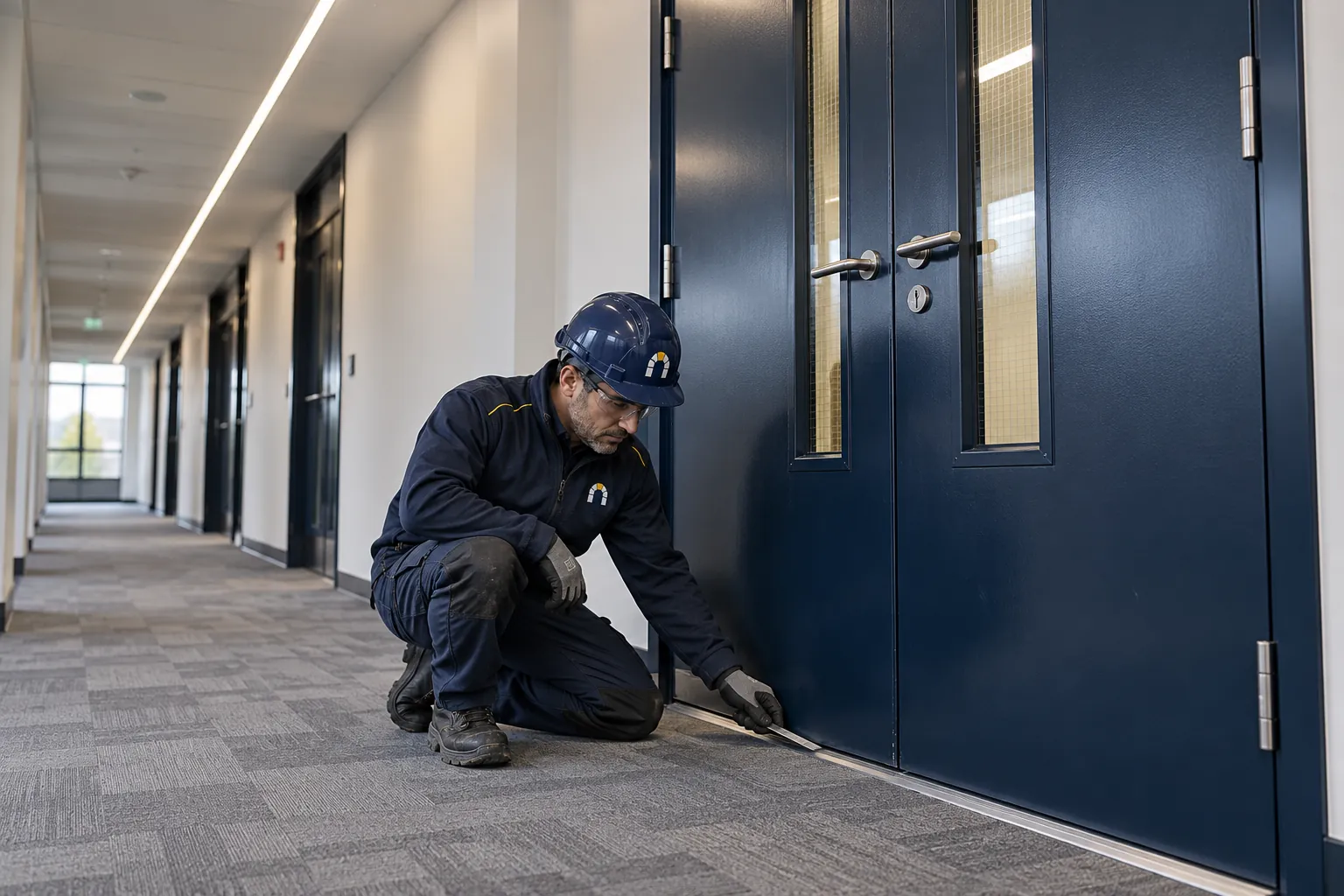
Inspection keeps the hall doors working through the year, and it falls to the person who runs the estate. Each visit walks the halls and looks at the closers, the hinges, the seals and the gaps in turn, and anything found wrong is written down before the visit ends, with the door and the fault beside it. The file should hold the record for every door in the block, so the next visit begins with what the last one found.
A door keeps its proof only while it stays as it was tested. Swap the closer for a lighter one, paint over the seal, or fit a different hinge, and the leaf no longer matches the test report, so the proof is gone. The file should hold the test report for every door in the block, and the report should name the leaf, the frame and the hardware as fitted. What each visit should look for is set out in our fire door inspection checklist.
| Part | What fails | What to check | When |
|---|---|---|---|
| Closer | Leaf left open | Power, arm, fixings | Every round |
| Hinge | Leaf drags | Fixings, sag, wear | Every round |
| Seal | Smoke through the gap | Seal intact, unpainted | Every round |
| Gap | Fire past the leaf | Gap at 4 mm | Every round |
Name the closer, the hinge and the seal beside each hall door on the order, so the door that arrives is the door that was tested. The sizes and the fitting are covered in our fire door closers guide, and the grades and the parts behind a working fire door are covered in our fire door hardware guide.
Management and inspection: the routine that keeps the doors working
A fire door is only as good as its last check. The responsible person for the block sets the routine, and the routine covers every door on the escape routes and the compartment lines. The check looks at the leaf, the gaps, the seals, the closer and the latch, the hinges and the fixings, and the signs on the door. A door that is wedged open, a leaf that drags, a seal that has come away, each one goes on the record. Our fire door inspection checklist covers what each check looks for.
Student blocks change hands often, and a new operator inherits the doors left behind. The fire strategy, the door schedule, the test reports and the inspection records belong together in one file, so the next operator can see which door carries which period and which check each door has passed. The same routine for workplaces is covered in our fire door regulations for offices guide, and the doors a campus needs most are covered in our university security doors guide.
The student block enquiry: what the schedule must carry
Write the enquiry as a specification. It should name the building and the position, the fire period and the smoke seal, the security rating where one is needed, and the leaf, frame, glass, beads, seals and hardware as one doorset. Where a flat entrance door must also resist attack, ask for the rating on the whole doorset, a rating to LPS 1175 or PAS 24, and not on the leaf alone. Our how to specify security doors guide sets the columns for the same discipline.
Keep the evidence with the doors from the day they arrive. The test report, the classification and the hardware schedule travel with the doorset, and the handover pack names the inspection routine the site will follow, so the operator holds a record for the whole life of the building.
| Door position | Period | Hardware | What to check |
|---|---|---|---|
| Flat entrance door | FD30S | Thumb turn, TS 007 cylinder | Seals, gaps, latch, self-closing |
| Corridor door | FD30 or FD60 | Panic hardware, closer EN 3 or above | Closer, seals, opening force |
| Stair core door | FD60 | Panic hardware, hold-open to BS EN 1155 | Closer, seals, smoke control |
| Communal area door | FD30 | Closer, hinges grade 13 or 14 | Hinges, latch, daily wear |
| Plant room door | FD60 | Closer, latch, seals | Seals, gaps, self-closing |
One failed closer on a stair core door puts the whole escape route at risk, so the routine matters as much as the rating.
What fire rating should a student flat entrance door carry?
Most often an FD30S doorset, 30 minutes of integrity with a smoke seal proved to BS EN 1634-3. The fire strategy for the block names the period for each door.
Can one student block door hold a fire rating and a security rating?
Yes, where one doorset is tested for both jobs. The fire side is proved to EN 1634-1 and the security side to LPS 1175 or PAS 24, and both pieces of evidence must name the doorset being fitted.
Do student block doors need panic hardware?
Where a door serves more than 60 people, panic hardware to BS EN 1125 belongs on it, with a bar across at least 60 percent of the leaf width.
How often should student block fire doors be checked?
The fire strategy and the responsible person set the routine, and every check goes on the record with the door, the fault and the fix. The inspection checklist guide covers what each check looks for.
How do I order doors for a whole student block?
Write one schedule with one line for every opening, naming the position, the fire period, the smoke seal, the security rating and the whole doorset.
Get a free quote
Related
More in guides for specifiers
Products
One supplier for the whole building envelope
Ready to specify your project?
Free assessment, written specification and test evidence. Reply within one working day.