
ArxBridge
Types of security doors for commercial buildings
Types of security doors for UK commercial buildings: steel swing, sliding, louvred, fire, ballistic, blast, glazed and roller doors, with honest limits.
- ✓Third-party test evidence with every product
- ✓Written specification you can issue to tender
- ✓Supplied and installed across the UK
Get a free project quote
Rating, written specification and budget range within one working day.
Confidential. No cost, no obligation.
Third-party tested
Evidence with every quote
UK manufactured
Made to your sizes
One accountable team
Specify, supply, install
Confidential handling
Details never shared
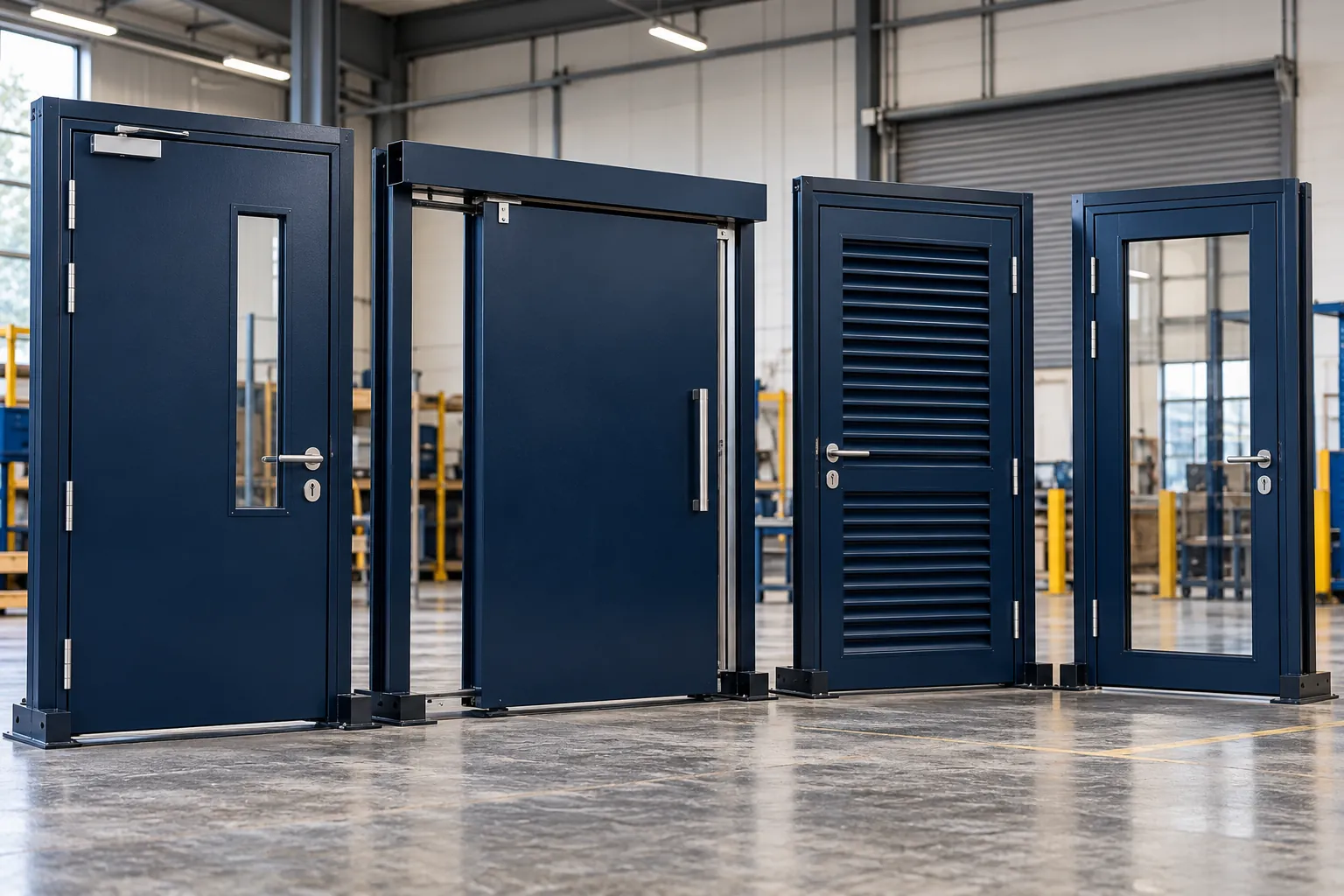
Commercial security doors fall into nine types, from steel swing doorsets rated to LPS 1175 for forced entry to bullet resistant and blast resistant doors for high threat sites. Each type answers a different threat. Match the door to the threat, the rating and the way the opening is used, and check the honest limits of each type.
- 9 main typesFrom steel doorsets to shutters
- LPS 1175Forced entry ratings B3 to H20
- FB1 to FB7Ballistic classes to EN 1522
- E, EW, EIFire classes at 30 to 120 minutes
The main types at a glance
No single door answers every threat. A door that stops a crowbar may not stop fire, and a door that stops fire may not stop a bullet. The table below groups the nine types by the threat they answer, the standard that tests them and the opening they suit best.
| Type | What it protects against | Tested to | Best for |
|---|---|---|---|
| Steel swing doorset | Forced entry with hand tools | LPS 1175 | Staff entrances, back doors |
| Sliding security door | Forced entry, saves swing space | LPS 1175 | Wide openings, loading bays |
| Louvred steel door | Forced entry plus ventilation | LPS 1175 rated design | Plant rooms, substations |
| Fire and security door | Fire and forced entry together | EN 1634-1 and LPS 1175 | Compartment walls, escape routes |
| Bullet resistant door | Gunfire | EN 1522, FB1 to FB7 | Cash rooms, control rooms |
| Blast resistant door | Blast pressure and fragments | EN 13123, EPR or EXR | Critical infrastructure |
| Glazed steel door | Forced entry with visibility | LPS 1175 | Reception entrances, offices |
| Revolving door or portal | Tailgating, unauthorised access | Access control | Lobbies, headquarters |
| Roller door, shutter, grille | Forced entry, large openings | LPS 1175 where tested | Warehouses, shopfronts |
Read the table by threat first. Name what the opening must resist, then check the standard in the third column, then confirm the type suits the opening’s daily use. A loading bay and a reception on the same site need different answers. The guides hub holds deeper pages on each rating and type.
Forced entry rated steel doors: swing, sliding and louvred
The workhorse of commercial security is the steel swing doorset tested to LPS 1175. Under Issue 8 the ratings run from B3, which is SR2, at 3 minutes against tools such as screwdrivers, pliers and hand saws, through C5 (SR3) at 5 minutes against crowbars, drills and chisels, to D10 (SR4) at 10 minutes against sledgehammers, disc cutters and jigsaws. The rating belongs to the tested doorset, leaf, frame, seals and hardware together, not to the steel alone. Our security doors range and the LPS 1175 swinging security doors page follow this principle, and the SR2 security doors page covers the entry level rating.
Sliding security doors carry the same forced entry logic where a swing leaf would eat floor space or clash with traffic. They suit wide openings, loading areas and internal routes where a hinged leaf is impractical. The honest limit is the track. A sliding door is only as strong as its rail, rollers and anti-lift detail, so the track construction matters as much as the leaf, and the wall beside the opening must take the load of a door parked open.
Louvred steel doors add ventilation to the package. Plant rooms, substations and refuse stores need airflow, and a louvred leaf moves air without a separate grille that would weaken the opening. The honest limit is that ventilation and security pull in opposite directions. Only a louvred door tested as a complete rated design should be trusted where attack is a real risk, because louvres added to an ordinary door afterwards create a ready made weak point.
Fire and security doors: two ratings, one doorset
Some openings sit on a fire compartment line and face an attack risk at the same time. A fire and security door carries both ratings on one doorset: a fire classification to EN 1634-1, E for integrity, EW for integrity and radiation, or EI for integrity and insulation, at 30, 60, 90 or 120 minutes, plus a forced entry rating to LPS 1175. The fire rated steel doors range covers the fire side, and the fire ratings guide explains what each class proves.
The honest limit is the tested construction rule. Both certificates must name the same doorset reference, and any change to the leaf, frame, seals or hardware can void one or both ratings. These doors are also heavier and cost more than a plain fire door, so they belong on openings where both threats are real rather than as a default choice. See the fire doors hub for the full range.
Bullet resistant and blast resistant doors
Bullet resistant doors are tested to EN 1522 and classed FB1 to FB7. FB4 stops .357 and .44 Magnum, FB6 stops 5.56 x 45 and 7.62 x 51 rifle rounds, and FB7 stops 7.62 x 51 armour piercing. The rating covers the whole doorset including any glazing, which is classed BR1 to BR7 to EN 1063. Typical uses are cash handling rooms, control rooms and guard posts. The ballistic ratings guide sets out the full scale.
Blast resistant doors answer a different threat: the pressure wave and fragments from an explosion. They are classified to EN 13123, EPR1 to EPR4 by shock tube test or EXR1 to EXR5 by range test. The blast ratings guide explains the classes. The honest limit of both types is the system around them. A ballistic door in an ordinary stud wall, or a blast door in a weak frame, protects nothing. The frame, fixings and surrounding wall are part of the rated system and need an engineer’s eye before you order.
Neither type suits ordinary commercial risk. They are heavy, need specialist installation and cost far more than a forced entry door. Do not specify them unless the threat assessment names firearms or blast as a real risk. For most commercial sites the money is better spent on a higher forced entry rating and good access control.
Glazed steel doors: visibility with protection
Where an entrance needs both security and sightlines, glazed steel doors use slim steel profiles with security glazing in a tested doorset. They suit receptions, offices and retail entrances where staff need to see who is outside before the door opens. Jansen steel doors are the slim profile option for this kind of entrance, and the steel versus aluminium guide compares frame materials in more detail.
The honest limit is the glass. However strong the frame, glazing is the weaker element against a sustained attack, and large glass areas trade strength for visibility. Glazed doors also cost more per square metre than a solid leaf and offer no privacy. Where nobody needs to see through the door, a solid steel doorset gives more protection for less money.
Revolving entrances, portals and turnstiles
Some entrances need to control people rather than stop tools. Revolving security doors and security portals pass one person at a time and cut tailgating at lobbies and headquarters entrances. They pair with access control and present an orderly face to visitors while keeping unauthorised people out of the secure zone.
The honest limit is throughput and escape. A portal moves people slowly, so a busy site needs several lanes or a separate fast lane beside it. Fire escape rules mean a powered entrance must fail safe or sit beside a compliant escape route, and step free access needs a wide lane. These products stop unauthorised entry, not a determined forced attack on the building fabric. The turnstile versus speed gate versus portal guide compares the entrance control options, and turnstiles cover the perimeter end of the same job.
Roller doors, shutters and grilles
Wide openings, loading bays and shopfronts need a door that covers metres of width. High performance roller doors do that at speed for openings used through the day, while security shutters and retractable security grilles secure the opening out of hours. Shutters can carry LPS 1175 ratings where the curtain, guides and locking are tested together as one assembly.
The honest limit is the trade between daily use and security. A standard shutter is slow and noisy for an opening used dozens of times a day, while a high speed door is built for cycles rather than attack. Grilles keep visibility for a retail frontage but let a thief see the stock. None of them replaces a pedestrian security door on a staff entrance. The shutter versus roller door guide works through this choice in full.
How to choose by threat, rating and use
Choose in this order. First, name the threat: opportunist theft, targeted burglary, armed attack, fire, blast or unauthorised entry. Second, pick the rating that answers it: LPS 1175 for forced entry, EN 1522 for ballistic, EN 13123 for blast, EN 1634-1 for fire. Third, check the opening itself: swing space, width, ventilation, escape and daily traffic. The door that survives all three filters is the right type.
Then check the evidence. Ask for the certificate or test report for the exact doorset, including the size range and the hardware, and confirm the rating matches the standard’s current issue. A rating claim without paperwork is only a claim. The guide to specifying security doors and the specification mistakes guide show what to ask for and what to avoid.
Start from the threat, not the product. A higher rating is not always better. An FB6 door in a timber stud wall, or an LPS 1175 doorset with the wrong seals on a fire compartment line, wastes money and still fails.
What the nine types do not cover
A type is a shape, not a rating. Nine types sit on one list, and the rating belongs to the tested doorset, not to the type. A steel swing doorset with no test evidence has no rating, whatever type it is, and a type name in a brochure is not evidence of anything.
The list says nothing about the wall. A ballistic door in an ordinary stud wall, or a blast door in a weak frame, protects nothing. The frame, fixings and surrounding wall are part of the rated system, and they need an engineer to look at them before the order is placed.
The list says nothing about daily use. A sliding door saves swing space but is only as strong as its track, rollers and anti-lift detail. A louvred door gives ventilation but weakens security unless it was tested as a complete rated design, because louvres added to an ordinary door afterwards create a ready made weak point. A revolving door controls tailgating but is not a forced-entry door, and it answers a different question from the rest of the list.
The list says nothing about combined threats. Fire plus forced entry needs both ratings on the same doorset, with both certificates naming the same construction. A fire rating says nothing about attack, an LPS 1175 rating says nothing about fire, and a ballistic rating says nothing about either. Each performance needs its own test on the same doorset.
The list says nothing about escape. A doorset that resists attack from outside must still release freely from the escape side, and panic hardware must be the device named in the test evidence, not a device added afterwards. A door that holds an attacker out and traps the people inside has failed its second job, and the escape hardware needs the same attention as the lock.
Mistakes when a type is chosen for the wrong opening
Most wrong choices come from picking the type first and the threat second. The six checks below catch the errors that appear most often.
- Naming the threat before the type, so the opening is specified from the risk, not from the catalogue.
- Checking the certificate names the exact doorset, sizes and hardware, not a similar model.
- Matching the wall and frame to the door rating, so the opening is only as strong as its weakest part.
- Testing louvres as part of the rated design, never adding them to an ordinary door afterwards.
- Naming both ratings where the opening needs fire and security, with evidence for each.
- Planning for weight: heavy doorsets need the right hinges, closers and structure to carry them.
A type chosen from the threat, with a certificate to prove it and a wall to carry it, is the whole job. Anything shorter is a guess dressed as a specification. For the specification process itself, see how to specify security doors, and for how fire and security sit together on one doorset, see the dual certification guide. The LPS 1175 page sets out the forced-entry ratings in full.
What is the most common type of security door for commercial buildings?
The steel swing doorset rated to LPS 1175, usually at B3 (SR2) or C5 (SR3). It fits staff entrances, back doors and service openings, and it is the type most insurers and specifiers recognise. Sliding and louvred variants cover the openings where a swing leaf does not work.
Can one door be both a fire door and a security door?
Yes, if the same doorset has passed both test programmes: a fire classification to EN 1634-1 and a forced entry rating to LPS 1175. Both certificates must name the same doorset reference. A fire certificate for one construction and a security certificate for another does not make a dual rated door.
What is the difference between LPS 1175 and PAS 24?
PAS 24 is an enhanced security standard for residential doors and windows, a lower threat level than LPS 1175. For commercial buildings LPS 1175 is the usual forced entry standard because it covers higher tool categories and longer attack times. The LPS 1175 versus PAS 24 guide compares them in detail.
Do I need a bullet resistant door for my shop?
Almost certainly not. Bullet resistant doors suit cash handling rooms, control rooms and sites where the threat assessment names firearms. For a shop the realistic threats are burglary and ram raid, which call for LPS 1175 rated doors and shutters plus good access control, not ballistic protection.
Are sliding security doors as strong as swing doors?
They can be, if the sliding doorset was tested to the same LPS 1175 rating. The track is the difference: the rail, rollers and anti-lift detail must be part of the tested design. A sliding door on a light track is easy to lift out, whatever the leaf is made of.
Get a free quote
Related
More in guides for specifiers
Products
One supplier for the whole building envelope
Ready to specify your project?
Free assessment, written specification and test evidence. Reply within one working day.