
ArxBridge
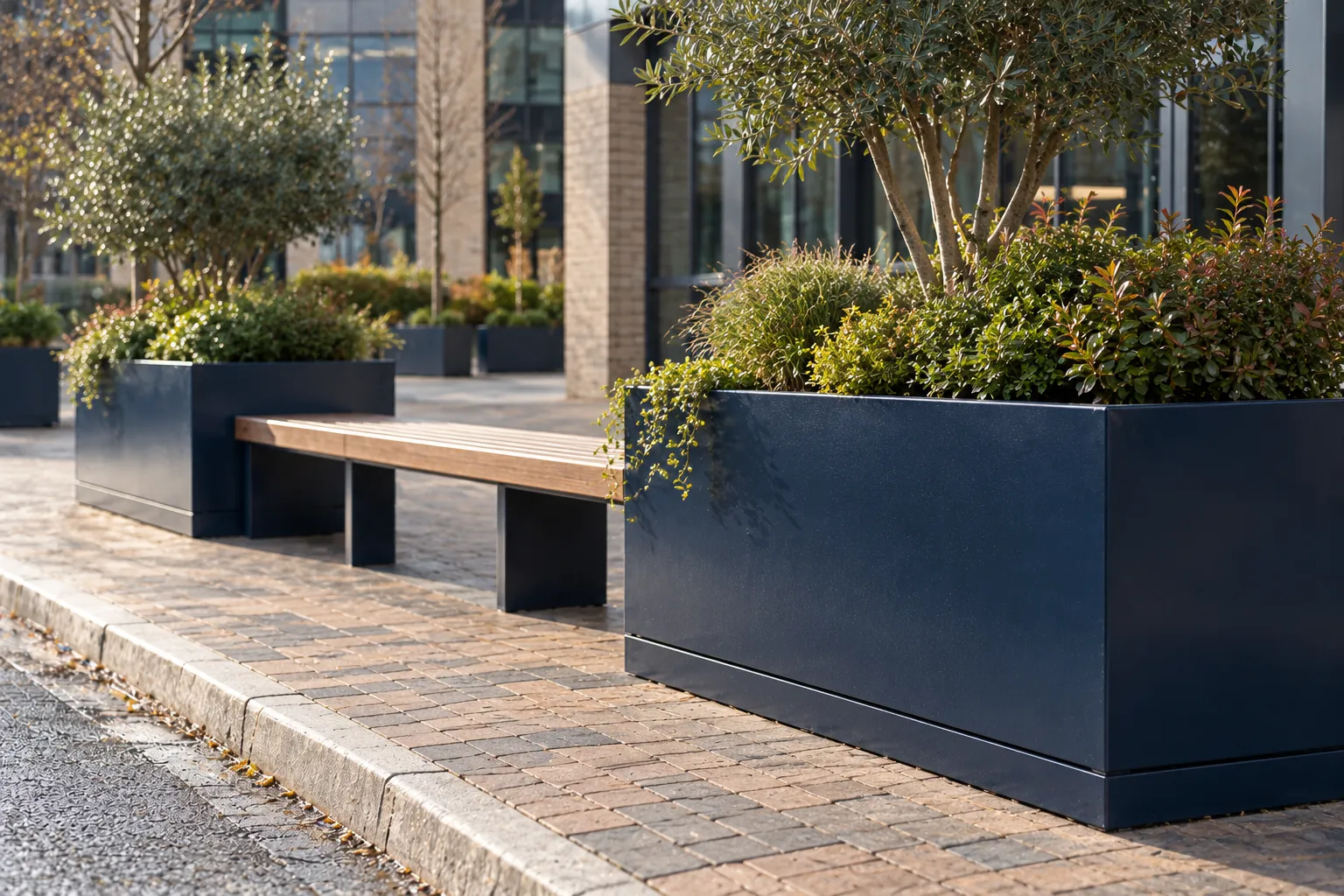
HVM planters and street furniture: protection that blends in
Hostile vehicle mitigation planters hide crash-tested cores inside street landscaping. UK buyer checks: rating, tested foundation, spacing and maintenance.
- ✓Third-party test evidence with every product
- ✓Written specification you can issue to tender
- ✓Supplied and installed across the UK
Get a free project quote
Rating, written specification and budget range within one working day.
Confidential. No cost, no obligation.
Third-party tested
Evidence with every quote
UK manufactured
Made to your sizes
One accountable team
Specify, supply, install
Confidential handling
Details never shared
A hostile vehicle mitigation planter looks like ordinary street landscaping. Under the planting sits a crash-tested steel core, anchored to a tested foundation, rated to stop a vehicle of a stated mass at a stated speed. For the buyer, the rating, the foundation and the spacing matter far more than the plants.
- Tested, not just heavyOnly a crash-tested unit with its tested foundation counts
- PAS 68, IWA 14-1, ISO 22343-1The impact standards behind a vehicle rating
- 7,500 kg at 80 km/hA common test: truck mass and impact speed
- Four things in a ratingVehicle mass, speed, impact angle, penetration distance
Why protection hides inside street furniture
Bollards and steel barriers work, but they look defensive. Few clients want a shopping street, a station forecourt or a university campus to feel like a checkpoint. A planter answers that problem by doing two jobs at once: it holds the planting that softens the street scene, and inside it a structural frame anchored to the ground stops a vehicle.
This design-led approach is now normal practice in the UK. Police guidance lists rated streetscape products, planters and benches among the permanent vehicle security barriers for public spaces.
There is an honest limit. Where the assessed threat is a high-speed approach on an open road, a line of planters is the wrong tool. That job belongs to dedicated barriers or road blockers on a properly engineered line. Planters suit forecourts, footways, plazas and building perimeters where approach speeds are low and the look of the place matters.
Which items can carry a vehicle impact rating
Planters are the best known, but they are not the only option. The same principle covers benches and long seats, cycle stands and racks, litter bins and short lengths of raised seating wall. Each one hides a structural core that has been crash tested as a complete unit.
What matters is the core, not the cladding. Timber, concrete, stone, brick and stainless steel are all finishes. The rating lives in the steelwork inside and in the foundation beneath it. Two planters that look identical can have completely different performance if only one has the tested core.
The whole line must be rated, not one piece of it. An unrated bench placed between two rated planters leaves a gap a vehicle can use. When you plan a run of street furniture, check the rating of every item in the line, including the bins and the cycle stands at the ends. Our HVM street furniture range follows this principle: every item in the line carries its own tested rating.
Why the tested unit and the tested foundation count as one
A vehicle impact rating is never a property of the planter alone. The test strikes the unit exactly as it will be installed: the frame, the fixings and the foundation it sits in. Change any part of that assembly and the rating no longer applies.
This is the most common failure in real projects. The planter is correct, but the groundworks are not. A unit tested in a deep concrete foundation will not perform the same on a shallow slab laid over buried services. If the site has shallow ground, basements below the paving or a forest of utilities, say so at the start and ask whether a shallow-mount tested option exists for that unit.
Ask the supplier two questions before you order. First, which foundation was the rating tested with. Second, what the installer must build on site to match it. Get both answers in writing and keep them with the project records. Installation to the tested detail is part of the protection, not an afterthought.
Ask for the test report. A planter described as heavy duty or security style, without a test report to a recognised standard, is landscaping. Only the report proves what the unit stopped and how it was founded.
How to read a vehicle impact rating
Vehicle impact ratings come from three standards. PAS 68 is the UK specification. IWA 14-1 is the international workshop agreement. ISO 22343-1:2023 is the current international standard, and it supersedes both of the earlier ones. A rating to any of them states the same four things about the test.
| Part of the rating | What it tells you | Example |
|---|---|---|
| Test standard | Which method the unit was tested to | ISO 22343-1:2023 |
| Vehicle type and mass | What struck the barrier | 7,500 kg truck |
| Impact speed | How fast it was travelling | 80 km/h |
| Impact angle and penetration | The angle of the strike and how far the vehicle travelled past the barrier | 90 degrees, stated penetration distance |
Read the penetration distance carefully. It is measured from a defined point and tells you how far past the line the vehicle, or its debris, can travel. A unit that stops the vehicle but throws debris deep into a crowded area may still fail the design. Match the rating to the threat assessment for the site, and keep a margin between the tested speed and the speed a vehicle could actually reach on the approach.
For lower-speed sites such as car parks and retail service yards, a lighter standard exists. PAS 170-1 covers low-speed trolley impact testing of bollards, using a 2,500 kg trolley at low speed, for accidental impacts and criminality rather than the terrorist vehicle-borne threat. Do not specify a PAS 170 unit where the threat assessment calls for a full vehicle impact rating. The vehicle impact ratings guide explains the standards in full.
The tested unit and the tested foundation: one proof, not two
A planter, a bench, a cycle stand and a litter bin can each carry a vehicle impact rating, and the rating belongs to the unit as it was tested, with the foundation it stood in. A planter that stops a vehicle in a test pit and fails in a shallow bed on site was never proved for the bed, because the foundation is part of the proof, not an extra.
A vehicle is driven at the unit in a live test, and the rating string records what happened: the vehicle class, the speed, the angle and how far the vehicle got past the line. The current standard is ISO 22343-1:2023, which took over from PAS 68:2013, so a schedule that still names the old standard asks for a rating no test house issues now. The vehicles in the test run from a 1,500 kg car to a 30,000 kg truck, at 48, 64 or 80 km/h.
Each step up the rating adds weight, depth and foundation to the unit, because a heavier vehicle at a higher speed needs more to stop it. A rating above the threat adds concrete and cost without adding safety, so the rating on the order should match the vehicle the street faces. The ratings in full are in our ISO 22343 vehicle security barriers guide.
A unit that looks like street furniture and acts like a barrier must be ordered as a barrier, with the rating, the foundation and the fixings on the same line. A planter ordered as planting, with no rating on the line, is planting, and no one should stand behind it as if it were tested. The options for the line are worked through in our choosing HVM bollards guide.
The foundation depth follows the rating, and the ground under the street decides what the foundation can be built into. A unit on ground with services under it needs a survey before the dig, because a foundation that strikes a service stops the job and the quote with it. The rules the line must meet are set out in our bollard regulations guide.
Spacing and the pedestrian: the line that still lets people through
The gap beside a unit and the height of the unit both belong on the schedule, because ProtectUK guidance puts a 1,200 mm cap on the clear gap and a 500 mm floor under the height. Leave a wider gap and a vehicle slips past the line, and fit a lower unit and a vehicle climbs it.
Spacing must leave room for people, not just stop vehicles. A line of planters that blocks a wheelchair, a pushchair or a delivery trolley has failed the street, so the gaps belong on the plan beside the rating, with the pedestrian route drawn through them.
Temporary units and permanent units are different jobs. A temporary unit can be moved for an event and moved back, while a permanent unit is fixed into the ground with a foundation that holds the rating, so the order should name which one it is, because a temporary unit has no foundation to prove. The blockers that rise from the road are covered in our road blockers guide, and the bollards that stand beside them are covered in our PAS 68 bollards guide.
| Item | What it must carry | What the order names |
|---|---|---|
| Planter | Vehicle impact rating | Rating, foundation, fixings |
| Bench | Vehicle impact rating | Rating, foundation, fixings |
| Cycle stand | Vehicle impact rating | Rating, foundation, fixings |
| Spacing | ProtectUK gap and height | 1,200 mm gap, 500 mm height |
Put the rating, the unit and the foundation on one schedule line, so whoever reads the file next can see what was tested and what holds it.
Spacing, gaps and pedestrian flow
Protection fails at the gaps, not at the planters. The clear distance between units must be small enough that a vehicle cannot pass through, yet the line must still let pedestrians, pushchairs and wheelchair users move freely.
The vehicle dynamics assessment sets the approach speed a hostile driver could reach. The spacing follows from that, together with the width of the narrowest vehicle the line must stop. Bring the security designer in before the paving layout is fixed, because planters added after the paving is laid often end up in the wrong line or at the wrong spacing.
Think about the ends of the line too. A run of planters that stops short of a wall, a gate or a kerb leaves a gap at each end. Extend the rated line into the building face or tie it into the rest of the hostile vehicle mitigation scheme, so there is no weak point where the furniture stops. For the numbers behind spacing and clear gaps, see our bollard regulations guide and the guide to choosing HVM bollards.
Temporary units versus permanent ones
Not every site needs protection all year. Event venues, seasonal markets and temporary fan zones use surface-mounted units that can be deployed and removed. These trade some stopping power for speed of deployment, which is a fair exchange for a short-term threat, but they are not a substitute for a permanent rated line at a site with a standing threat.
For one-off events, temporary barriers can also be hired, and police hold a national stock of temporary vehicle barriers that public and private sites can request. Plan this early. Temporary protection arranged the week before an event is often the wrong product in the wrong place.
Where the threat is permanent, a fixed unit on its tested foundation is the right answer. Match the unit to the duration of the need.
Planning and public realm approval
On public land, the highway authority approves anything placed on the footway, and the design must keep pedestrian routes clear. In conservation areas and around listed buildings, the cladding, the planting and the colour need to suit the setting. This is exactly where planters earn their place: a stone-clad or timber planter can pass a heritage officer where a row of steel bollards would not.
Start the conversation with the authority and the planning team before the design is fixed. A late objection to the look, the position or the pedestrian impact of the line can force a redesign of the whole scheme.
For sites that fall under the Terrorism (Protection of Premises) Act 2025, physical measures such as rated street furniture are among the things enhanced tier premises must consider. The standard tier covers premises where 200 to 799 people may be present, and the enhanced tier covers 800 or more. Our Martyn’s Law guide for premises and the Martyn’s Law standards page set out what each tier means.
Looking after the plants and the finish
A neglected planter undermines the reason for choosing one. Plants die, soil compacts, timber weathers grey, stainless steel dulls and fixings loosen. A protection line that looks abandoned also signals that nobody is watching, which is the opposite of the message you want to send.
Set the maintenance schedule before the units are installed, not after. Watering and replanting, cleaning the finish, checking the fixings and inspecting the foundation edge all need an owner and a date. In harsh street environments, choose planting that survives neglect between visits and finishes that clean easily. A maintenance plan that covers the street furniture alongside the doors and gates keeps the whole scheme working.
Check the structural core as well as the plants. Impact damage, vehicle scrapes and corroded fixings can all reduce what the unit will do next time. Any unit that has been struck should be inspected by someone competent and repaired or replaced to the tested design.
Can any large heavy planter stop a vehicle?
No. Weight alone means little in a vehicle impact. Only a unit with a crash-tested structural core, installed on its tested foundation, has proven what it can stop. An ordinary heavy planter may slow a car, but it has no rating and no evidence behind it.
What does a PAS 68 rating mean on a planter?
It means that exact unit, on its tested foundation, was struck by a vehicle of a stated mass at a stated speed under the PAS 68 method, and the result was recorded as a rating. The rating states the vehicle mass, the speed, the impact angle and the penetration distance. ISO 22343-1:2023 is the current international standard that supersedes PAS 68.
Do HVM planters need planning permission?
It depends on the site. On the public highway, the highway authority must approve anything placed on the footway. In conservation areas or near listed buildings, the design and materials may need planning consent. Check with the local authority before the design is fixed.
How far apart should protective planters be?
Close enough that no vehicle the line must stop can pass between them, while keeping clear routes for pedestrians and wheelchair users. The spacing follows from the vehicle dynamics assessment for the site, not from a rule of thumb. Our bollard regulations guide covers the guidance behind the numbers, and the guides hub collects all our HVM topics.
Can HVM planters be moved for events or roadworks?
Permanent rated units cannot be moved without losing their rating, because the rating includes the foundation. If a site needs to open a gap for events or works, plan for it with rated gates or with temporary units matched to the threat, and close the gap properly afterwards.
Who looks after the planting and the finish?
The site owner or facilities team, on a written schedule set before installation. Watering, replanting, cleaning and fixing checks all need an owner and a date.
The planter that must still stop a vehicle: what wear takes away
A planter that stops a vehicle in a test must still stop one years later, and wear takes away what the test proved. The soil settles, the fixings loosen and the finish wears thin, so the unit should be checked against the proof it was ordered with, not against how it looks from the street.
The foundation is the first thing wear reaches, because the ground under the street moves with the seasons and the traffic beside it. A unit that has sunk or tilted has lost the foundation the rating was proved with, and a unit that leans is a unit whose rating no longer stands.
The fixings are the next thing to check, because the bolts that hold the unit to its foundation work loose under the vibration of the traffic beside them. A bolt that has worked loose should be tightened before the unit moves, and a bolt that has rusted through should be replaced, because a unit held by rust is a unit held by nothing.
The planting itself can hide what wear has done, because a planter full of shrubs hides the cracks in its walls and the gaps at its base. The plants should be cut back before the check, so the unit can be seen all round, and a unit that cannot be seen cannot be checked.
The finish that hides the rating: paint, planting and the inspection round
The finish on a unit should be checked with the unit, because paint laid over a crack hides the crack, and a finish that has peeled away leaves the steel beneath it to rust. A unit whose finish has failed should be stripped and refinished, not painted over again, because paint over rust hides the rust and leaves the steel to fail beneath it.
The inspection round should cover every unit in the line, because a line is only as strong as its weakest unit, and a unit missed from the round is a unit whose wear goes unseen. The round should name each unit, the fault found and the day it was found, so the repair is booked while the fault is still small.
Each repair should be written into the street file on the day it is made, with the unit named and the fault beside it, so the file shows the state of the whole line. A file that holds the repairs holds the proof the line still stands, and a line with no file behind it has nothing to show when it is asked about.
| Part | What to check | What breaks it | When |
|---|---|---|---|
| Foundation | Sunk or tilted | Rating no longer stands | Each check |
| Fixings | Bolts loose or rusted | Tighten or replace | Each check |
| Planting | Cut back before the check | Unit seen all round | Each check |
| Finish | Paint peeled, steel rusting | Strip and refinish | Each check |
| Record | Unit, fault, day | Note on the day | On the day |
The ratings in full are set out in the ISO 22343 vehicle security barriers guide, and the options for the line are worked through in the choosing HVM bollards guide. The rules the line must meet are set out in the bollard regulations guide, and the fences that stand beside the line are covered in the crash rated fences and HVM fencing guide.
Get a free quote
Related
More in guides for specifiers
Products
One supplier for the whole building envelope
Ready to specify your project?
Free assessment, written specification and test evidence. Reply within one working day.