
Standards explained
LPS 1175 security ratings
LPS 1175 explained: the LPCB forced entry standard from A1 to H20. Rating tables, how the test works, how to read a rating and how to specify it.
- ✓Third-party test evidence with every product
- ✓Written specification you can issue to tender
- ✓Supplied and installed across the UK
Get a free project quote
Rating, written specification and budget range within one working day.
Confidential. No cost, no obligation.
Third-party tested
Evidence with every quote
UK manufactured
Made to your sizes
One accountable team
Specify, supply, install
Confidential handling
Details never shared
LPS 1175 is the UK standard for rating resistance to forced entry. Published by LPCB, it grades doors, windows, shutters and grilles from A1 to H20 by the tools an attacker may use and the minutes the product must resist them. Match the letter and number to the attack time in your risk assessment.
- 8 ratingsFrom A1 (SR1) to H20 (SR8)
- Issue 8The current issue of the standard
- LPCBThe publisher and test body
- 1 to 20 minutesDelay time under test
What LPS 1175 is and who publishes it
LPS 1175 is a Loss Prevention Standard published by LPCB, the UK certification body for fire and security products. It rates building components for resistance to forced entry: doors, windows, shutters, grilles, hatches and access panels.
Every rating has two parts. The letter names the tool category, from A for opportunist attack with basic hand tools up to H for extreme tools. The number names the minutes of attack time the product must resist. Alongside the letter-number ratings, the industry still uses the older SR1 to SR8 names, and both appear on test evidence.
It is a product standard, not a company accreditation. The rating belongs to the tested product design, and the test evidence names the exact product, its configuration and its options. ArxBridge supplies LPS 1175 rated products with third-party test evidence for each one.
Issue 8 is the current issue of the standard. Name it in every specification so that designers, bidders and checkers are all working to the same edition.
The full rating table
| Rating | Old name | Tool category | Attack time |
|---|---|---|---|
| A1 | SR1 | A: opportunist, basic hand tools | 1 minute |
| B3 | SR2 | B: hand tools such as screwdrivers, pliers and hand saws | 3 minutes |
| C5 | SR3 | C: tools such as crowbars, drills and chisels | 5 minutes |
| D10 | SR4 | D: tools such as sledgehammers, disc cutters and jigsaws | 10 minutes |
| E10 | SR5 | E: tool sets above category D | 10 minutes |
| F10 | SR6 | F: tool sets above category E | 10 minutes |
| G10 | SR7 | G: tool sets above category F | 10 minutes |
| H20 | SR8 | H: extreme tools | 20 minutes |
The standard defines the exact tool set for each category; the descriptions above are summaries. Note that from D10 upward the attack time stays at 10 minutes while the tool sets get heavier, and only H20 extends the time to 20 minutes.
The letter is the tools, the number is the minutes. C5 means five minutes against category C tools. Read both halves together: a long time against light tools is not the same as a short time against heavy ones.
How the test works
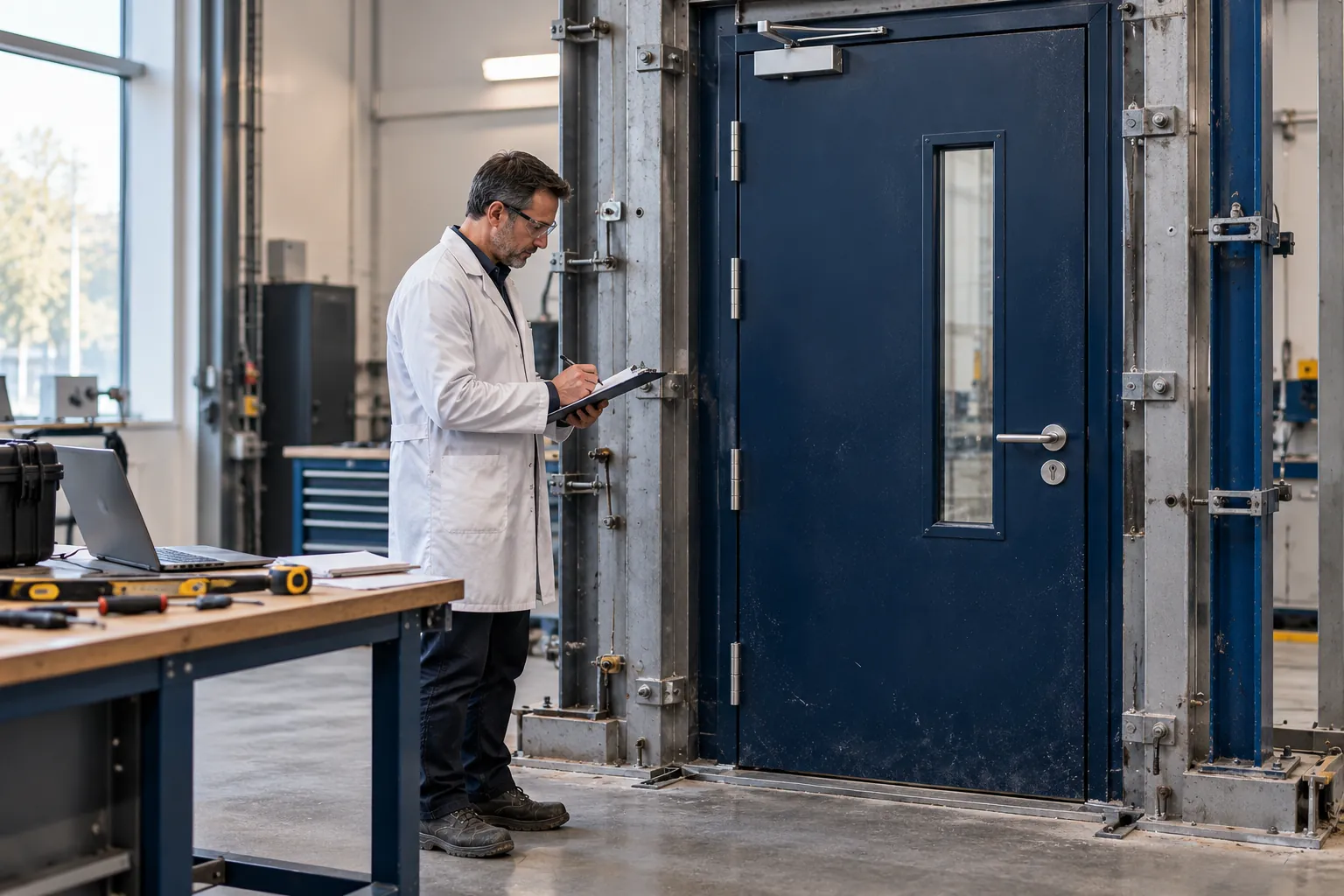
Independent test teams attack the product using only the tools permitted for its category, for the stated number of minutes. The product must resist for the full time. The minutes are attack time under controlled test conditions, not a promise of how long a real attack lasts; what the rating proves is a measured delay, which is what buys time for a response.
The team may attack any part of the product: the leaf, the frame, the glazing, the locks, the hinges, the fixings. A rating therefore covers the complete assembly exactly as tested. Change the lock, the glazing or the frame, and the rating may no longer apply to what is actually supplied.
Testing is carried out by LPCB-approved test houses and the rating is granted on the basis of the test report. Because the attack covers the whole assembly, the evidence always names the precise configuration: sizes, options, glazing types and ironmongery included in the test.
How to read a rating
On test evidence the rating appears in forms such as “LPS 1175: Issue 8, Security Rating C5 (SR3)”. The C is the tool category, the 5 is the minutes of attack time, and the SR3 in brackets is the old name for the same rating. Both names describe one result.
When you check evidence, confirm three things. First, the issue number: Issue 8 is current, and older evidence may describe a different product. Second, the product name: it must match what is being supplied, not a similar model. Third, the scope: the evidence states which sizes, configurations and options the rating covers.
Products can carry more than one rating. A doorset may hold an LPS 1175 rating alongside a fire classification or a ballistic class. Each rating is tested separately and proved by its own evidence; one does not imply the other.
How LPS 1175 compares with related standards
EN 1627 is the European standard for burglar resistance, with classes RC1 to RC6. It uses a different test method and a different scale, so RC classes and LPS 1175 ratings are not directly convertible. UK specifications commonly name LPS 1175; projects on the continent commonly name EN 1627.
PAS 24 is the enhanced security standard for residential doors and windows. It tests to a lower threat level than LPS 1175 and is the usual baseline for new UK homes. Higher-risk residential work steps up from PAS 24 to LPS 1175 SR2 or SR3.
LPS 2081 rates resistance to stealth attack with quiet tools, at SRA for one minute and SRB for three minutes. Where the attacker may use force and noise, specify LPS 1175; where the attacker must not be heard, specify LPS 2081. A product can hold both ratings.
LPS 1270 rates security glazing for hand hole, arm hole and body passage resistance. It is the companion standard where the glass itself is the barrier, and it is often specified alongside LPS 1175 for the framing. See the LPS 1270 guide for the full detail.
How to specify it
- Name the threat. Write down the attack you are designing against: opportunist burglary, targeted forced entry, or a specific tool set from the threat assessment.
- Choose the rating. Match the rating to the threat. SR2 suits general commercial work; SR3 and SR4 suit higher-risk sites; SR5 and above are for the most demanding applications.
- Name the issue. Write “LPS 1175 Issue 8” in the specification so every bidder prices to the current edition.
- Demand named evidence. Ask for third-party test evidence naming the exact product, configuration and rating. A rating claimed without evidence naming the product is not a specification.
- Specify the whole assembly. Frame, leaf, glazing, locks, hinges and fixings as one tested doorset, installed to the manufacturer’s instructions. Site changes to any part can void the rating.
- Coordinate with fire. Where compartmentation applies, specify a dual fire and security rating such as EI 60 with SR3, and check that locks and access control release correctly on alarm.
Products rated to LPS 1175
The LPS 1175 range covers the full building envelope. Security doors span the complete ratings range, with SR2 security doors for general commercial use and SR3 and SR4 security doors for higher-risk sites. Security windows and security shutters and roller doors protect glazed areas, retractable security grilles guard openings after hours, and security hatches keep service openings at the same rating as the walls around them. Communal entrance doors bring LPS 1175 ratings to blocks of flats.
Frequently asked questions
What is the difference between SR3 and C5?
Nothing. They are the old and new names for the same rating: five minutes against category C tools under LPS 1175. Test evidence often shows both, written as C5 (SR3). The SR names survive because the industry used them for a long time.
How long does SR4 actually delay an attacker?
SR4, which is rating D10, proved ten minutes of resistance against tools including sledgehammers, disc cutters and jigsaws under test conditions. A real attack may be shorter or longer depending on the attacker, the tools and whether anyone responds. Treat the rating as a measured minimum delay, not a timetable.
Does LPS 1175 cover windows as well as doors?
Yes. The standard rates doors, windows, shutters, grilles, hatches and access panels. The rating always applies to the complete assembly as tested, so a rated window includes its frame, glazing and fixings, not just the glass.
Can I upgrade an existing door to SR3 with better locks?
No. The rating belongs to the tested assembly, and fitting high-security locks to an untested door does not create an SR3 doorset. If the threat needs SR3, the door, frame and ironmongery must be replaced with a tested and evidenced assembly.
Which test evidence should I request?
Ask for third-party evidence, usually from LPCB, that names the exact product, its configuration and options, the rating achieved and the issue of the standard. The product name on the evidence should match what is supplied, including sizes and glazing options.
Do I need the same rating on every opening?
Yes, against the same threat. Attackers use the weakest opening, so an SR4 front door with an unrated side window is an SR0 building in practice. Rate every accessible opening to the threat assessment, or accept and record the gap.
Get a free quote
Related
More in security standards explained
Products
One supplier for the whole building envelope
Ready to specify your project?
Free assessment, written specification and test evidence. Reply within one working day.