
ArxBridge
LPS 1175 vs EN 1627: how UK and European burglar resistance ratings compare
LPS 1175 and EN 1627 rate forced entry differently, so no conversion exists. This UK guide compares the test methods and shows what to write in a specification.
- ✓Third-party test evidence with every product
- ✓Written specification you can issue to tender
- ✓Supplied and installed across the UK
Get a free project quote
Rating, written specification and budget range within one working day.
Confidential. No cost, no obligation.
Third-party tested
Evidence with every quote
UK manufactured
Made to your sizes
One accountable team
Specify, supply, install
Confidential handling
Details never shared
LPS 1175 and EN 1627 measure different things in different ways, so there is no exact conversion between them. LPS 1175 rates forced entry by tool category and attack minutes. EN 1627 assigns resistance classes from RC1 to RC6 based on defined burglary tests. A product rated under one standard is not automatically rated under the other.
- LPS 1175UK forced entry standard. Each rating pairs a tool category letter with attack minutes.
- EN 1627European burglary resistance standard. Six classes, RC1 to RC6, lowest to highest.
- ConversionThere is none. Different test methods mean a rating in one standard is not a rating in the other.
- What to doName the exact rating in the specification and ask for the test evidence that matches it.
How each standard tests
LPS 1175 is the LPCB forced entry standard, published as Issue 8.2. A rating is written as a tool category letter followed by attack minutes, for example C5 or D10. The letter runs from A to H and describes the tool set the product must resist, from basic hand tools in the hands of an opportunist up to extreme tools. The number is the attack time in minutes. Our LPS 1175 guide sets out the full rating table and how to read it.
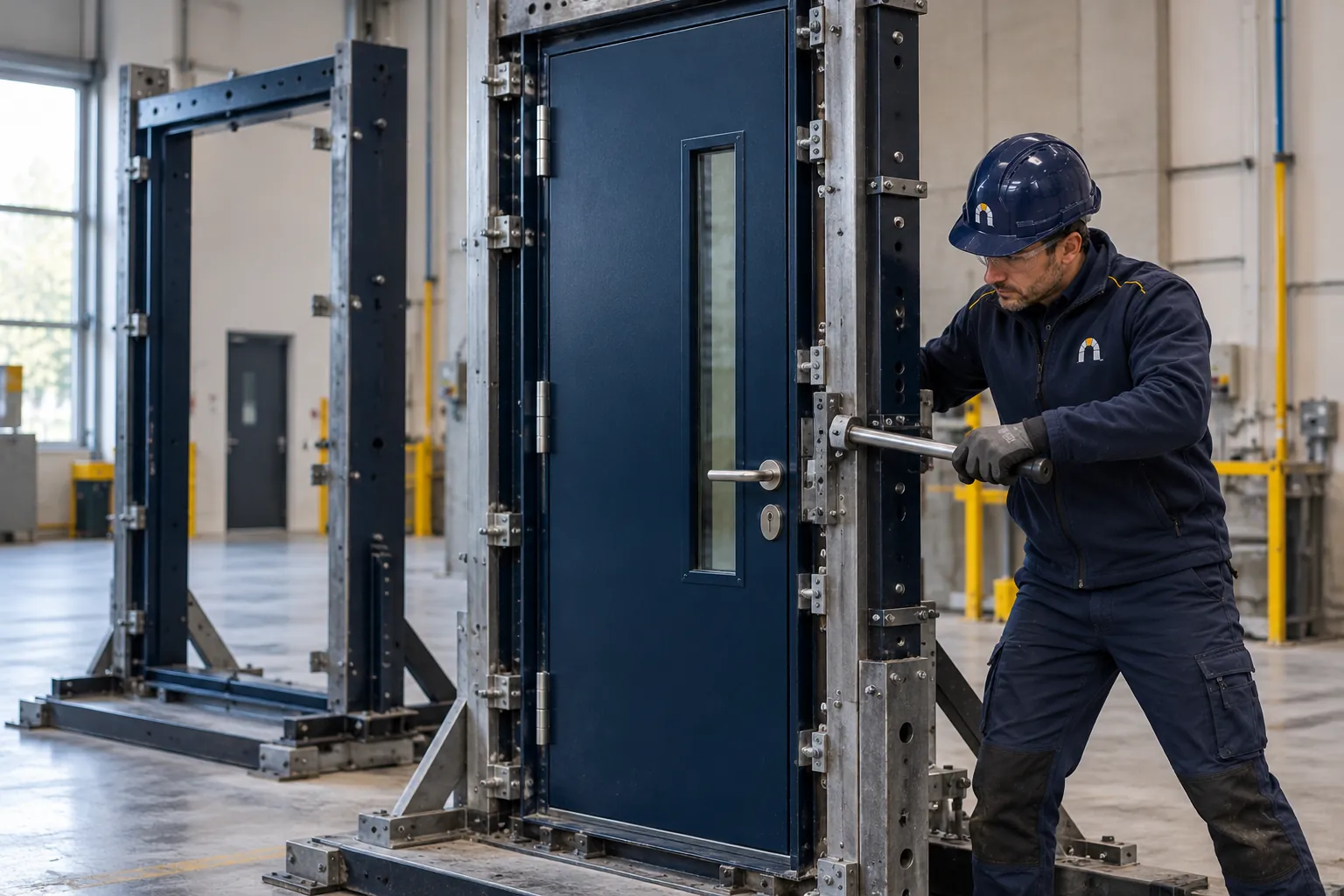
The test attacks the complete product as installed, using the tool set for that category, for the full attack time. Tool category A covers opportunist attack with basic hand tools. B3 means three minutes against screwdrivers, pliers and hand saws. C5 means five minutes against crowbars, drills and chisels. D10 means ten minutes against sledgehammers, disc cutters and jigsaws. Higher categories bring heavier tool sets defined by the standard.
EN 1627 is the European standard for burglary resistance. It places doors and windows into resistance classes from RC1 to RC6, with RC1 the lowest and RC6 the highest. Each class is defined by its own attack tests. The standard is common on specifications written in Europe, and it is the rating many continental manufacturers quote first.
Both standards test the product as a whole, not the parts in isolation. A strong leaf in a weak frame fails as a weak door, whichever standard you use. This assembly thinking runs through both test methods, and it is why test evidence always names the complete build rather than a single component.
The LPS 1175 ratings at a glance
The table below shows the Issue 8 ratings with their old security rating names, which many schedules still use. Old and new names describe the same level: A1 is the old SR1, B3 is SR2, C5 is SR3, D10 is SR4, E10 is SR5, F10 is SR6, G10 is SR7 and H20 is SR8.
| Rating | Old name | Attack minutes | Tool set |
|---|---|---|---|
| A1 | SR1 | 1 | Basic hand tools, opportunist attack |
| B3 | SR2 | 3 | Screwdrivers, pliers, hand saws |
| C5 | SR3 | 5 | Crowbars, drills, chisels |
| D10 | SR4 | 10 | Sledgehammers, disc cutters, jigsaws |
| E10 | SR5 | 10 | Tool category E set |
| F10 | SR6 | 10 | Tool category F set |
| G10 | SR7 | 10 | Tool category G set |
| H20 | SR8 | 20 | Extreme tools |
Most commercial specifications land between B3 and D10. Banks and similar premises often ask for C5 or D10 on entry doors, with the exact choice set by the risk assessment. Our banking sector page shows where these ratings sit in a branch or office, and our security doors range covers the ratings in the table.
The EN 1627 classes from RC1 to RC6
EN 1627 sorts products into six resistance classes. RC1 is the entry level and RC6 the highest. The classes form one ladder: each class up is tested against a harder defined attack than the one below. The standard covers doors, windows and similar building components, and it is written around the burglary threat rather than the wider forced entry threat.
Because EN 1627 is a European standard, it appears most often on projects specified to European norms or supplied from the continent. A UK schedule that names an RC class is asking for European test evidence, just as one that names C5 is asking for LPS 1175 evidence. The class on its own does not describe the threat in full; the schedule and the risk assessment do that, and the class is the shorthand they agree on.
Reading a schedule: a worked example
Take two tender lines. The first reads: entrance doorset, LPS 1175 Issue 8.2 (September 2024), rating C5, complete with frame, locks and glazing, third-party test evidence required. That line is complete. It names the standard, the issue, the rating, the scope and the evidence, so every bidder prices the same thing.
The second reads: entrance doorset, RC4. That line is incomplete for a UK buyer. It names a European class with no standard cited, no scope and no evidence required. The fix is simple: name EN 1627, define the assembly the class applies to, and require the matching evidence. If the project wants LPS 1175 as well, write a separate line for it. Two clear lines beat one line that tries to mean both.
Why there is no exact equivalence
The two standards do not measure the same thing in the same way. LPS 1175 grades a product by tool category and attack minutes under a forced entry test. EN 1627 grades it by resistance class under its own defined burglary tests. Different tool sets, different attack methods and different pass criteria produce results that cannot be converted with a chart, however neatly the chart is drawn.
Online tables that claim SR3 equals a particular RC class are not authoritative. A product rated RC4 under EN 1627 has not been shown to reach any LPS 1175 rating, and the reverse is equally true. If a project needs both ratings, the product needs test evidence for both. Anything else is guesswork dressed up as a conversion, and it will not survive a dispute.
No conversion chart. Treat the two standards as separate languages. Specify the rating in the language your schedule uses, and ask for test evidence in the same language.
How the test reads the attack: tools, time and the tool set
LPS 1175 proves a doorset against a planned attack with a named tool set for its category. Under Issue 8.2, dated September 2024, B3 resists for three minutes, C5 for five and D10 for ten, and the tool set grows with the category. The leaf, the frame, the fixings and the lock face the test as one doorset, and the report names each one.
The letters changed, but the categories did not: SR2, SR3 and SR4 are the names the same three categories carried before Issue 8, and the name on the order is the name the product was proved under. A room that holds cash, records or servers takes a higher category than a store, because the rooms behind the leaves hold what the building runs on, and the category follows the room, not the floor. The entrance at street level takes the highest grade of all, since it is the first leaf an intruder meets.
EN 1627 proves a doorset against resistance classes that run from RC1 to RC6. RC1 meets the opportunist with simple tools, and the classes climb through the attacker with hand tools to RC6, the experienced attacker with power tools. The class on the order follows the attack the building faces, and the test runs the attack the class names against the leaf, the frame and the hardware as one doorset.
What to put on the order: the rating, the product and the report
The two standards measure different attacks in different ways, so no table turns one rating into the other. No published equivalence table exists between LPS 1175 and EN 1627, and a schedule that writes one rating as equal to the other invents a claim no test stands behind. Where a client names EN 1627 and the product holds LPS 1175, the order names the standard the client asked for and the product proved to it, or the product changes to one proved to the standard named.
What to put on the order is the rating beside the product and the report behind both. The test report names the standard, the product and the result, and the report lives with the building file, where the next person can find it. A report that names the rating and not the product leaves the buyer guessing, and a guess is not proof. A leaf proved to one standard and fitted to the other carries no proof at all, so the order names both ratings beside the same doorset where one doorset needs both.
UK insurers and clients treat each standard on its own terms, and the standard a policy names is the standard the doorset must carry. A schedule that names LPS 1175 where the policy names EN 1627 leaves the building unproved on paper, even where the leaf itself would hold. The specification is written with the standard the client asked for, the category or class beside the product, and the test report behind the pair, so the door that arrives is the door that was proved.
| Standard | What it proves | Where it fits | What to ask for |
|---|---|---|---|
| LPS 1175 B3 | Three minutes against tools | Rooms an intruder tries first | The category beside the product |
| LPS 1175 C5 | Five minutes against tools | Rooms that hold something worth taking | The category beside the product |
| LPS 1175 D10 | Ten minutes against tools | Rooms that must hold longest | The category beside the product |
| EN 1627 RC2 | A doorset against an opportunist | Dwellings and low-risk doors | The class beside the doorset |
| EN 1627 RC4 | A doorset against an experienced attacker | High-risk commercial doors | The class beside the doorset |
The standard in full is set out on the LPS 1175 standards page, and the issue behind the categories is explained in the LPS 1175 Issue 8 explained guide. The two ratings side by side are covered in the LPS 1175 versus PAS 24 guide, and what breaks a rating once a door is fitted is set out in keeping an LPS 1175 rating valid guide.
The test that decides the class: tools and time against a hand
LPS 1175 and EN 1627 both grade a doorset by attack, but each one runs its own test, so the two letters on a schedule name two different proofs. LPS 1175, under Issue 8.2, dated September 2024, grades a doorset from A1 to H20 by the tools it resists and the minutes it holds, and the grades most orders name are B3, C5 and D10: three minutes against the category B tool set, five minutes against category C, and ten minutes against category D.
EN 1627 grades a doorset from RC1 to RC6 by burglary resistance, with each class naming the tools an attacker may use and the time the doorset must hold against them. The lower classes cover an opportunist with hand tools, and the higher classes cover a planned attack with power tools, so the class follows the attack the building faces.
The two tests do not measure the same thing in the same way. LPS 1175 counts the minutes a doorset holds while a tester works through a named tool set, and EN 1627 counts resistance against a different set of tools and a different attack pattern, so a class from one standard cannot be read as a class from the other. The full LPS 1175 scale is set out on our LPS 1175 page.
An insurer in the UK usually asks for LPS 1175, because the Loss Prevention Certification Board scheme is the one UK insurers know and write into their conditions. A client who works across Europe may ask for EN 1627 instead, because the RC classes travel with the European standard, so the order should name the standard the reader will check, not the one that sounds stronger.
Where a building needs both proofs, the doorset must be tested to each standard on its own, because one test report cannot prove both. The two routes are compared in our LPS 1175 versus PAS 24 guide, and the change from the old SR names to the current labels is explained in our LPS 1175 Issue 8 guide.
Two letters, two tests: what to put on the order
Write the standard beside the class on every line, so no one reads B3 as RC3 or RC4 as C5. A line that names only a class, with no standard beside it, leaves the reader to guess which test the doorset passed, and a guess is not a proof.
Ask for the test report on the whole doorset before the order is placed, with the leaf, the frame, the lock and the fixings named on the same line, because a report that names the leaf alone leaves the frame and the hardware unproved. The columns such a schedule needs are set out in our how to specify security doors guide.
There is no published table that maps LPS 1175 grades to EN 1627 classes, and no order should claim one exists. A supplier who offers a conversion is offering an opinion, not a test result, so treat the two scales as separate and name each one where it belongs.
| Standard | Grades | What the test proves |
|---|---|---|
| LPS 1175 | A1 to H20 | Minutes held against a named tool set |
| LPS 1175 B3 / C5 / D10 | 3, 5, 10 minutes | Category B, C and D tool sets |
| EN 1627 | RC1 to RC6 | Burglary resistance by class |
| EN 1627 RC1 to RC6 | RC1 to RC6 | Hand tools up to power tools |
Put the standard, the class and the test report on one schedule line, so whoever reads the file next can see which test was run and what it proved.
How UK insurers and clients treat each standard
On UK projects, insurers and clients usually name LPS 1175 ratings and ask for the matching test evidence. It is the standard their risk assessors know, and it states the threat plainly in tool categories and minutes. A schedule that reads C5 tells everyone in the chain exactly what attack the door must survive.
EN 1627 appears where the project follows European norms: a continental design team, a European supply chain, or a client standard written around RC classes. Neither standard is wrong in its own context. The mistake is mixing them, naming an RC class in one line of the schedule and expecting LPS 1175 evidence in the next, or the other way round. Our SR3 and SR4 doors are a common answer where the UK side of that decision lands.
If the schedule names both, treat LPS 1175 as the deciding rating on UK soil and make the RC class a supporting requirement, or ask the security consultant to pick one. Clarity at specification stage costs nothing. Disputes after installation cost a great deal, and they always arrive at the worst moment.
What to write in a specification
Write the standard, the issue and the exact rating: LPS 1175 Issue 8.2, rating C5, for the complete doorset including frame, locks and glazing. Name the product type as tested, not just the leaf. Then require third-party test evidence for that exact assembly. Vague wording such as rated to a high standard invites whatever the supplier prefers to offer, and that is rarely what the risk assessment intended.
If the project genuinely needs EN 1627, write the RC class the same way: EN 1627, RC4, for the complete assembly, with matching test evidence. Never write or equivalent without defining what equivalence means and who judges it. Keep a copy of the evidence with the project file, because a rating is only as useful as the paper that proves it. For the other half of the job, our guide to keeping an LPS 1175 rating valid explains how the rating survives after installation, and our bullet resistant glass guide covers the ballistic side. SR2 doors suit the lower end of commercial schedules. Browse all our guides for related specification topics.
Frequently asked questions
Is SR3 the same as RC3?
No. SR3 is the old name for the LPS 1175 rating C5, a forced entry rating with defined tools and attack time. RC3 is a European burglary resistance class under EN 1627. The names look similar and the numbers match by coincidence. They are not interchangeable.
Can one product hold both ratings?
Yes, if it has been tested to both standards and carries test evidence for each. One rating never implies the other. Ask for both sets of evidence by name and check that each names the same product build.
Which rating should a UK commercial schedule name?
LPS 1175, with the exact rating the risk assessment calls for. It is the standard UK insurers and clients recognise, and it states the threat in tool categories and minutes. Name EN 1627 only where the project genuinely follows European norms.
What does the letter in an LPS 1175 rating mean?
The tool category, from A to H. A covers opportunist attack with basic hand tools, and each letter up brings a more capable tool set. The number after the letter is the attack time in minutes.
Does the rating cover installation?
The rating describes the tested product, and the test assumes correct installation to the manufacturer’s method. Poor fixing or a weak surrounding wall can undo a good rating, so the schedule should name the installation method as well as the product.
What is Issue 8?
Issue 8.2 is the current issue of LPS 1175. Always name the issue in the specification, because tool sets and requirements can change between issues of a standard.
Get a free quote
Related
More in guides for specifiers
Products
One supplier for the whole building envelope
Ready to specify your project?
Free assessment, written specification and test evidence. Reply within one working day.