
ArxBridge
Fire door inspection checklist for steel and timber doors
Fire door inspection checklist for UK buildings: a visual check of steel and timber fire doors, how often to inspect them, and when a specialist is needed.
- ✓Third-party test evidence with every product
- ✓Written specification you can issue to tender
- ✓Supplied and installed across the UK
Get a free project quote
Rating, written specification and budget range within one working day.
Confidential. No cost, no obligation.
Third-party tested
Evidence with every quote
UK manufactured
Made to your sizes
One accountable team
Specify, supply, install
Confidential handling
Details never shared
A fire door inspection checklist is a visual check of the doorset: leaf, frame, seals, gaps, hinges, closer and glazing. It confirms the door can still hold back fire and smoke. In England, where the top storey of a block of flats is above 11 m, the Fire Safety (England) Regulations 2022 set how often these checks must happen.
- Regulation 10 checksCommunal doors every 3 months, flat entrances every 12 months (best endeavours) in blocks above 11 m
- Simple visual checksNo specialist or tools needed for the routine regulation checks
- 4 mm gap ruleGaps at the sides and top should never be more than 4 mm
- Competent repairsRepairs or replacement by a competent contractor, as soon as reasonably practicable
What a fire door inspection covers
A fire door is not just a leaf. It is a doorset: leaf, frame, seals, hardware and fixings, working as one tested assembly. An inspection checks that assembly as it stands today, not as it was on installation day. Wear, damage, decoration and bad alterations can all take it below its tested performance.
Start by confirming the door’s job. Flat entrance doors stop fire and smoke spreading from a flat into the common parts. Stairway and lobby doors keep escape routes clear. Plant room doors protect the services other systems depend on. Note the location first, because it decides how serious a defect is. The fire ratings guide explains the E, EW and EI classes, and our fire rated steel doors page shows how a tested doorset is built.
A visual inspection looks for things you can see: damage, gaps, missing parts, painted seals, wedged doors and failed closers. It does not strip the door down or test the materials. Judging whether a door is adequate for its location is a separate job for a competent person, usually within the fire risk assessment.
The numbered fire door inspection checklist
- Identify the door. Check the label or plug on the top edge or side of the leaf. It should name the fire resistance, for example FD30 or FD60. If the label is missing, do not assume the door is unfit; note it and check the building records.
- Look at the leaf. Check both faces for splits in timber, dents or corrosion in steel, warping, and holes where locks or handles were removed. A damaged leaf may not give its rated minutes.
- Check the frame. The frame should be secure, straight and free of damage. Check the joint with the wall. A loose frame is a defect, whatever the leaf looks like.
- Check for unauthorised alterations. Cat flaps, non fire rated air transfer grilles, new letterboxes, extra locks and drilled cable holes all change the tested construction. Where a letterbox was added after the door was made, the resident should confirm it is suitable and was fitted by a specialist contractor.
- Check the hinges. No missing or loose screws and no visible wear. Fire doors usually have at least three hinges, with screws biting into solid material.
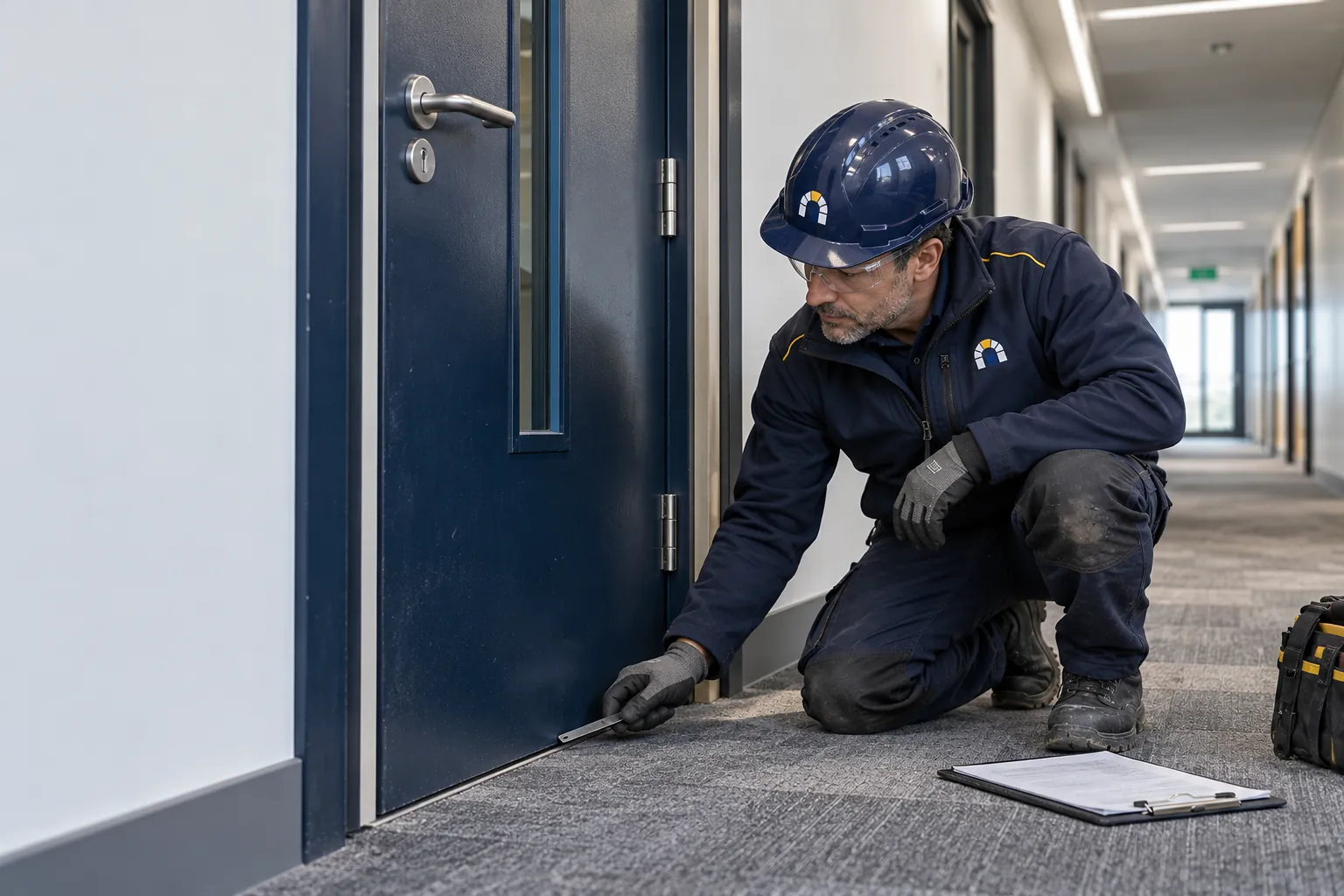
- Check the gaps. Run a gap gauge or card around the sides and top. Gaps should never be more than 4 mm. The bottom gap should be as small as practicable while still clearing the floor.
- Check the intumescent and smoke seals. These strips sit in the leaf edge or frame and expand in heat to close the gaps. They must be present where the tested design includes them, undamaged, making contact and not painted over. Smoke seals look like draught seals and stop smoke at lower temperatures.
- Check the self-closing device. Open the door fully and let go. It should close fully into its frame and latch from any angle without sticking. Try several positions. A door that stays ajar is a failed door.
- Check the glazing. Vision panels should be free of cracks, firmly held by their beads and liners, and obviously fire resisting. If it looks like ordinary glass, record it; confirming it may need the records or a specialist.
- Check the signage. Signs should be present, legible and correct for the door: “Fire door keep shut” on doors that must stay closed, the right wording where a hold-open device is fitted. Missing signs are a common miss on stair doors.
The government guidance says these checks should be simple and basic, with no specialist needed. Caretakers, managing agents, housing officers and maintenance staff can do them with simple instruction, because they are visual and do not use tools. Anything needing repair or replacement is different. See maintenance and the guides hub.
Gaps, seals and the self-closing device
Three parts cause most failures. Wide gaps let fire and smoke through before the rated minutes are up. Painted or damaged seals cannot expand to close the gap. A closer that cannot pull the door fully shut leaves the compartment open, whatever the certificate says.
| Check | What to look for | Pass | Fail |
|---|---|---|---|
| Side and top gaps | Even gap between leaf and frame | Never more than 4 mm | Gap visibly wider than 4 mm or uneven |
| Bottom gap | Clearance under the leaf | As small as practicable, clears the floor | Large enough to see through easily |
| Intumescent seals | Strips in leaf edge or frame | Undamaged, touching, unpainted | Missing, damaged or painted over |
| Smoke seals | Brush or blade seals where fitted | Intact and continuous | Torn, flattened or missing sections |
| Self-closer | Release from several angles | Closes fully and latches every time | Sticks, slams, or stops short of the latch |
| Signage | Legible on both faces | Correct wording, firmly fixed | Missing, faded or wrong wording |
The 4 mm figure is the industry standard in the official guidance, and it applies at the sides and top. The bottom gap is judged differently: as small as practicable, while ensuring the door will not snag on the floor if it drops on its hinges. Gap tester cards are available for the job.
The closer test. Open the door to five degrees, then to 45, then to 90, and release it each time. If it fails to close and latch from any of those positions, the door fails the check and needs attention before the next scheduled round.
Extra checks for steel doors and dual rated doors
Steel doors follow the same checklist, with two extras. Check the bottom of the leaf, the bottom rail and cut edges for rust, and check the coating is intact. Corrosion that has thinned the leaf or lifted the seals changes the doorset. Also check the leaf has not been cut or drilled for new hardware since installation.
Dual rated doors need one more discipline. The security certificate and the fire certificate cover the same tested construction, so changes that are harmless on a plain fire door can void the attack rating: a different lock, a new cylinder, drilled holes for cables, a letterbox never tested in that leaf. Our SR2 fire doors page explains how the two ratings sit on one doorset, and the guide to keeping an LPS 1175 rating valid lists which site changes are allowed.
If you are not sure whether a change has voided a rating, treat the door as failed and ask a competent inspector. Never guess.
How often fire doors must be inspected
State only what the law says, and set everything else by the fire risk assessment. In England, regulation 10 of the Fire Safety (England) Regulations 2022 sets fixed frequencies for blocks of flats where the top storey is more than 11 m above ground level, typically more than four storeys. The Responsible Person must check communal fire doors at least every 3 months, and use best endeavours to check all flat entrance fire doors at least every 12 months. This is confirmed in the government fire door guidance (checked 19 October 2026).
Every other building follows the fire risk assessment. High traffic escape-route doors in a school, hospital or shopping centre may need monthly checks. A quiet office corridor door may need less. The risk assessment sets the frequency in writing. Our companion guide on fire door regulations for commercial buildings covers which laws apply outside the residential block.
One warning from the same guidance: the routine checks are not an audit of the door’s type or its original installation. Questions about whether the door type suits its location belong to the fire risk assessment and the Fire Safety Order, not to regulation 10. Do not condemn a door in a routine check just because it has no label or no intumescent seals; the guidance is explicit that the absence of seals or certification does not of itself mean the door is unfit.
What to do when a door fails, and the records to keep
A failed door is a recorded defect, not a matter of opinion. Log the defect, the door’s location, the date and what you found, then act in proportion to the risk. A failed closer on a busy stair door needs fixing faster than a faded sign on a store cupboard.
Repairs and replacements must be done by a competent contractor, as soon as reasonably practicable. Hardware swaps need the right fire rated part fitted correctly; a warped, split or corroded leaf usually needs a full replacement doorset. While you wait for the repair, consider whether the door’s failure leaves a compartment line open and whether a temporary measure is needed. Our security doors range covers doorsets that carry both fire and forced entry ratings where the location needs them.
Keep records of everything: the schedule, each door’s result, defects, repairs ordered and completed, and the steps taken to gain access to flat entrance doors where access was refused. Regulation 10 specifically requires a record of the steps taken over each 12 month period, including cases where access was not granted. Records feed the next fire risk assessment.
The second round: what a fresh pair of eyes catches
The first inspection finds the faults that stand out, and the second round finds the faults the first visit missed. A leaf that shut on the first visit may drag on the second, because the frame has moved with the season, and a closer that pulled the leaf home in summer may lose its power in winter. The second round is run with the first record open, so each door is checked against what the last visit found.
A fresh pair of eyes catches what the first inspector walked past, because the same person looks at the same doors the same way each time. The second inspector checks the gaps round the leaf with the gauge, and a gap wider than 4 mm is written down against the door before the visit ends. A gap that has widened since the last visit goes into the record beside the door it belongs to.
Seals are the part the second round catches most, because a seal that looked sound on the first visit may have hardened, come away or been painted over since. An intumescent seal needs heat of around 200 to 250 degrees to swell, and a coat of paint over it holds it flat, so the seal cannot close the gap when the fire comes. The bead that holds the pane must hold it when the furnace runs, and the bead takes the fixing the test report names.
Closers are the part that fails first, and a closer that has lost its pull leaves the leaf standing open. The smallest closer power on a fire door is EN 3 to BS EN 1154, and the closer is tested by opening the leaf and watching it shut on its own. A closer that keeps the leaf open once the visitor has passed leaves the door standing open.
The faults that grow between visits: what to watch for next time
The faults that grow between visits start small, and the visit that walks the building door by door catches them while the repair is still cheap. A hinge that has worked loose lets the leaf drop a little each month, and a leaf that drops drags on the floor until the gap at the top opens wide enough for smoke to pass. The hinges are checked on every visit, because the leaf hangs on them.
The lock is tried with the key that belongs to it on every visit, because a lock that turns on the first visit may stick on the next. A panic bar to BS EN 1125 releases the latch at a push, and it must work with the lock beside it, not against it, so the leaf opens for a crowd even when the power has gone.
The record that holds the faults lives with the building file, in one place, and it is kept current. Each fault is noted on the day it is found, with the door, the part and the date beside it, so the repair follows the fault and no door stands open. A record kept current tells the next inspector which doors were fixed and which still wait.
| Part | First round | Second round | What to check |
|---|---|---|---|
| Leaf | Shuts and latches | Drags or drops | Leaf, hinges, gap |
| Gaps and seals | Gap at 4 mm | Gap widened, seal painted | Gauge, seal, bead |
| Closer | Pulls the leaf home | Power lost, leaf open | Power, shut, release |
| Lock | Turns with its key | Sticks or will not turn | Key, latch, bar |
| Hinges | Leaf hangs true | Leaf dropped, drags | Hinges, fixings, gap |
The periods for the shared parts of a public building are set out in the commercial buildings fire door regulations guide, and what breaks a rating once a door is fitted is set out in keeping an LPS 1175 rating valid guide. The doors that must hold both fire and forced entry are covered in the security door maintenance checklist, and the lock the key turns is covered in the fire door hardware guide.
What a routine inspection cannot prove
A routine inspection checks the doorset as it stands today: leaf, frame, seals, hardware and fixings, working as one tested assembly. It does not strip the door down, and it does not test the materials. A door can pass every visual check and still be the wrong door for its location, and that question belongs to the fire risk assessment, not to the checklist.
A pass does not prove the wall. The inspection looks at the doorset, not at the partition around it, and a rated door in an unrated wall protects a line that fire can walk around. The compartment line needs its own check.
A pass does not prove the door will hold for its rated minutes. Only the furnace test to EN 1634-1 proves that, and only where the door on site matches the tested construction: same leaf, same frame, same seals, same hardware. A certificate for a leaf alone does not cover the door on site.
A pass does not prove the closer will work in a fire. The closer test shows the door shuts and latches today, in still air, at normal temperature. Heat, smoke and pressure change how a door moves, and only the tested construction carries the rating through those conditions. The closer test is a check on maintenance, not a substitute for test evidence.
A missing label does not prove the door is unfit. The official guidance is explicit: the absence of seals or certification does not of itself mean the door is unfit. Record the gap in the evidence, check the building records, and let a competent person judge the door in its location.
Mistakes that make inspection records useless
Records feed the next fire risk assessment, so a record that cannot be read back is worse than no record at all. The table below sets out the errors that appear most often and what to do instead.
| Mistake | What goes wrong | What to do instead |
|---|---|---|
| “Checked” with no door named | Nobody can tell which door was checked, or whether it was checked at all | Record the door location and a door number for every entry |
| No date or no name | The record cannot prove when the check happened or who did it | Date and sign every round, and keep the schedule with the results |
| Defects noted but no action | The same defect appears at the next round, still unfixed | Log the repair ordered, the date it was done, and who signed it off |
| Access refused and not recorded | The 12 month record for flat entrance doors is incomplete | Record every refused visit and the steps taken to gain access |
| Records kept on one person’s laptop | The next responsible person starts from nothing | Store records where a successor can find them, with the risk assessment |
A record that names the door, the date, the finding and the fix is the one that stands up. Anything shorter is a note, not evidence. For which laws set the inspection duties, see the fire door regulations guide, and for the changes that void a dual rating, see the guide to keeping an LPS 1175 rating valid. The fire ratings page explains the E, EW and EI classes behind the labels.
Can a caretaker or site manager inspect fire doors?
Yes. The official guidance says routine checks under regulation 10 should be simple and basic, with no specialist needed. Caretakers, managing agents, housing officers and maintenance staff can do them with simple instruction, because they are visual and do not use tools. A competent inspector is still needed for a detailed assessment, such as a full fire door survey.
How often do fire doors need to be checked?
In England, blocks of flats with a top storey above 11 m: communal fire doors at least every 3 months, flat entrance doors at least every 12 months using best endeavours. All other buildings: as often as the fire risk assessment says. Busy escape-route doors may need monthly checks.
An old door has no intumescent seals and no label. Is it a fail?
Not necessarily. The official guidance says the absence of seals or certification does not of itself mean the door is unfit. Whether the door is adequate for its location is for the fire risk assessment to decide. Record what you found.
What changes void a fire door’s rating?
Anything outside the tested construction: cutting or trimming the leaf, drilling new holes, swapping the lock or hinges for untested parts, painting over intumescent seals, fitting non fire rated glazing or letterboxes, and wedging the door open. On dual rated doors, these changes can also void the forced entry rating.
What records must be kept?
The result for every door, defects and the action taken, repairs with who did them and when, and the steps taken to gain access to flat entrance doors where it was refused. Keep them with the fire safety records.
Get a free quote
Related
More in guides for specifiers
Products
One supplier for the whole building envelope
Ready to specify your project?
Free assessment, written specification and test evidence. Reply within one working day.