
ArxBridge
Substation doors: security, ventilation and specification
Substation doors for UK sites: security, ventilation and escape in one steel doorset, plus ratings, ironmongery and how to specify with your operator.
- ✓Third-party test evidence with every product
- ✓Written specification you can issue to tender
- ✓Supplied and installed across the UK
Get a free project quote
Rating, written specification and budget range within one working day.
Confidential. No cost, no obligation.
Third-party tested
Evidence with every quote
UK manufactured
Made to your sizes
One accountable team
Specify, supply, install
Confidential handling
Details never shared
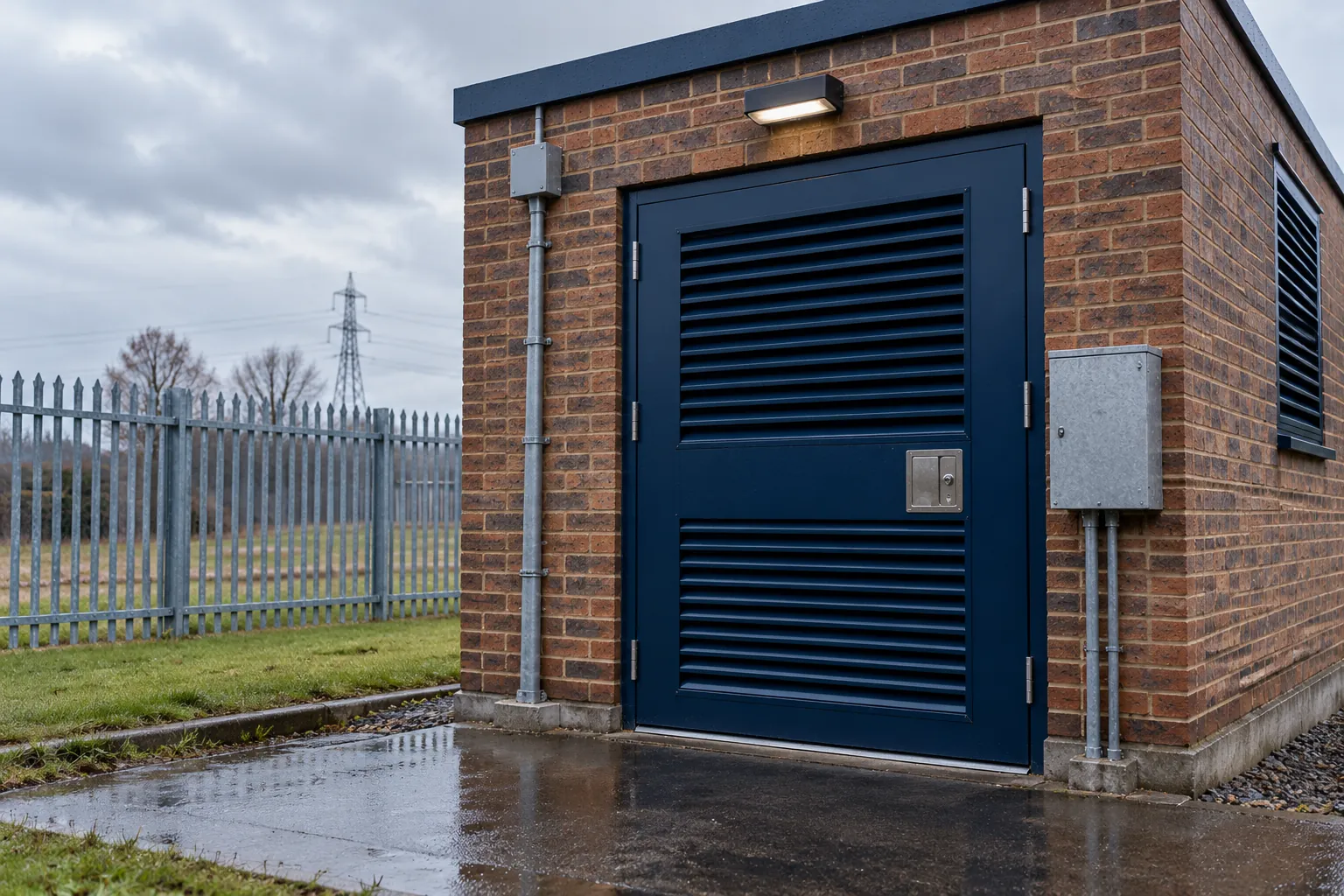
A substation door is a steel doorset that locks intruders out, lets cooling air in and opens outwards for escape. Louvred panels ventilate the plant while steel bars, dog bolts and anti-jemmy strips keep the opening secure. On unmanned UK sites the usual specification is a tested doorset, often LPS 1175 SR3, with ironmongery the network operator has approved.
- LPS 1175 SR2 to SR4Tested forced entry ratings for unmanned sites
- Louvred and secureVentilation with bars, dog bolts and anti-jemmy strips
- Opens outwardsEscape first, with operator-approved ironmongery
- Earthed steelworkDoors and frames bonded to the substation earth
Why substations are broken into
Substations hold metal that thieves can sell. Copper busbars, cabling and earthing conductors make these buildings a target for metal theft, and the same sites attract vandalism and trespass. Many sit in remote spots or at the edge of industrial estates, unmanned for weeks at a time, which gives an intruder time to work undisturbed. Our utilities sector page sets out the wider threat picture for power and water sites.
The door also protects the intruder. Anyone who forces their way into a live switch room faces a lethal electric shock, so the door is part of the site’s electrical safety as well as its security. A door that is easy to defeat fails on both counts. That is why substation doors are specified harder than ordinary plant room doors, and why network operators take a close interest in the ironmongery.
One door, three jobs
A substation door must do three things at once. It must resist forced entry from outside. It must ventilate the plant inside, because transformers shed heat that convection has to carry away. And it must open outwards from the inside so anyone working in the room can get out fast in an emergency.
Those jobs pull in different directions. Security wants the door locked and sealed. Ventilation wants openings in the leaf. Escape wants the door to open with a push. The specification resolves the tension in one tested doorset: a louvred leaf with security bars, hinges and frames built to resist attack, and ironmongery that releases from inside while staying locked from outside. Our security doors range follows the same principle of one tested assembly doing the whole job.
Which LPS 1175 rating suits an unmanned site
LPS 1175 Issue 8 grades forced entry resistance by tool category and attack time. The ratings that matter for substations are:
| Rating | Attack resisted | Where it fits |
|---|---|---|
| B3 (SR2) | 3 minutes with screwdrivers, pliers and hand saws | Low risk sites with frequent visits and good lighting |
| C5 (SR3) | 5 minutes with crowbars, drills and chisels | The common choice for unmanned substations |
| D10 (SR4) | 10 minutes with sledgehammers, disc cutters and jigsaws | High risk or remote sites, or where guidance demands more |
C5 is the workhorse rating for this sector. It covers the tools a metal thief or vandal typically carries, and it holds long enough for the delay to matter. Where a security risk assessment or national guidance points to a higher threat, D10 adds delay against power tools. The LPS 1175 standard page explains the full scale, and the LPS 1175 Issue 8 guide works through what each rating proves.
Be honest about what a rating cannot do. No doorset stops a team that has all night and no fear of being caught. The door is one layer. Perimeter fencing, lighting and vehicle barriers such as the HVM bollards chosen for the approach slow the attacker before they reach the door. Specify the door as part of that layered plan, not as the whole plan.
Check the louvre line. A rating covers the exact doorset that was tested, louvres included. A rated leaf with an untested louvre panel is not a rated door. Ask for the certificate schedule and read what it covers.
Ventilation that stays rated: air in, attack out
A substation door guards an unmanned site, so it must hold on its own between visits. Nobody is there to hear an attack start, so the rating, the lock and the hinges have to carry the whole job.
The rating follows the exposure of the site, not the door. A remote site with no one watching takes a higher rating than a site beside a staffed building, because the attack has longer to work before anyone arrives.
A doorset earns its LPS 1175 rating from the tools it resists and the minutes it holds. Three minutes against category B tools, the light hand tools such as screwdrivers, pliers and hand saws, gives B3. Five minutes against category C tools, the heavier hand tools such as crowbars, drills and chisels, gives C5. Ten minutes against category D tools, the heavy tools such as sledgehammers, disc cutters and jigsaws, gives D10. The current labels come from Issue 8.2, dated September 2024, while drawings made before the change still show the earlier ones, so read SR2 as B3, SR3 as C5 and SR4 as D10. The full set of forced entry ratings is on our LPS 1175 page.
A quiet attack needs its own rating beside the forced entry one. LPS 2081 tests a doorset against an attack that stays quiet, with SRA at one minute and SRB at three. The minutes follow the site: a guarded compound spots the attempt quickly, while an unwatched yard gives the attack longer to work, and a doorset proved to LPS 2081 alone has said nothing about hand tools, so the order names the forced entry rating on the same line as the stealth rating.
A substation needs air, and the vent must not become the way in. The vent is part of the doorset proof, so the order should name the ventilation with the door, and ask for the test report on the assembly that will be fitted, not on the leaf alone. A rated leaf with an unproved vent leaves the rating on the door and the opening beside it unproved.
The remote door: hinges, locks and the visit that finds the fault
The door opens outward, so the operator can leave quickly and the leaf does not swing into the equipment. Hinges on the outside of an outward opening door need protection, and a hinge proved to BS EN 1935 carries a grade for cycles and load: grade 13 is proved for 200,000 cycles at 120 kg, and grade 14 for the same cycles at 160 kg. A heavy leaf on a hinge that cannot carry it sinks, drags on the floor and stops latching.
The lock must resist attack from the outside and let the operator out without a key. A thumb turn on the inside lets the operator leave without a key, and a cylinder that meets TS 007, a 1-star cylinder with a 2-star handle or escutcheon giving a 3-star set, resists attack from the outside. Our LPS 1175 versus PAS 24 guide compares the two routes, and the how to specify security doors guide sets the columns for the same discipline.
Finishes and earthing decide how long a remote door lasts. A galvanised or powder coated finish suits a site that sees rain and no daily care, and the metal door needs earthing with the rest of the installation. The inspection round should look for the fault before the next visit finds it: hinges, seals, lock, fixings and the finish, with each fault written on the record the day it is found. The security door maintenance checklist sets out what the round looks for.
| Part | Rating or grade | What the order names |
|---|---|---|
| Leaf and frame | B3, C5 or D10 | Rating, vent, test report |
| Ventilation | Part of the doorset proof | Vent, assembly tested |
| Hinges | BS EN 1935 grade 13 or 14 | Grade, cycles, load |
| Lock and finish | TS 007 3-star set | Cylinder, handle, finish, earthing |
Put the rating, the vent, the hinges and the lock on one schedule line, with the test report behind each, so the next visit can check the door against the order.
Ventilation inside a rated design
Transformers and switchgear produce heat in normal operation. In most distribution substations that heat leaves by convection: cool air enters low through louvred panels and warm air leaves high. The door often carries part of that ventilation, which is why substation doors are usually louvred rather than solid.
The louvre is the weak point unless the design answers it. In a rated steel louvred door, solid steel bars run through the louvre blades, an anti-jemmy strip guards the locking edge, and dog bolts on the hinge side stop the leaf being lifted off its hinges. Bird and vermin mesh keeps wildlife out of the blades without blocking airflow. Fully louvred leaves give maximum free area; part-louvred leaves trade some airflow for a smaller attacked area. Either is fine if the tested certification covers the configuration you buy, which is exactly what our LPS 1175 swinging security doors are built around.
Do not add louvres to a solid rated door on site. Cutting the leaf for a vent panel sits outside the test evidence and voids the rating. If the design changes, go back to a doorset whose certificate already includes the louvred configuration.
Outward opening, hinges and the operator’s ironmongery
Substation doors open outwards. In an emergency, people inside push the door open and walk out; nothing about the locking should slow them down. That rule is near universal across UK network operators, and it shapes the ironmongery: panic or emergency hardware on the inside, with an external release that still lets authorised staff in, such as a hasp and padlock arrangement that can be overridden from inside.
Hinges and frames deserve the same attention as the leaf. Heavy duty stainless hinges, dog bolts on the hinge side and a frame fixed to resist being prised out of the opening are standard on remote sites, because attackers who cannot beat the leaf will attack the frame instead. Single and double leaf configurations suit different openings; wider plant access needs a double leaf that still latches and seals as one tested unit.
Here is the rule that overrides everything else on this page: the network operator’s specification wins. Every distribution network operator publishes its own door and ironmongery requirements, and they differ in detail. Confirm the exact locks, hinges, opening direction and finishes with the operator before you order, and get the answer in writing. A door that meets every point in this guide but not the operator’s schedule will be rejected on site. The guide to specifying security doors shows how to get that confirmation into the enquiry.
Finishes, earthing and looking after a remote door
A substation door lives outdoors, often for decades, with nobody watching it. Galvanised steel with a polyester powder coat is the usual answer: the zinc protects the steel and the powder coat gives colour and extra weather resistance. On coastal or industrial sites, check that the specified system suits salt or chemical exposure, and keep the colour code on file so repairs match. Our powder coating service covers the finish options for outdoor steelwork.
Electrically, the door is part of the installation. Steel doors and frames are normally bonded to the substation earthing system so the metalwork cannot sit at a dangerous voltage. Include the earth lug and bonding in the specification, not as an afterthought on site.
Plan maintenance for a building nobody visits. Remote doors fail quietly: hinges seize, fixings corrode, seals perish and the finish breaks down at the bottom rail where water sits. A yearly inspection that checks closing action, hinge and fixing condition, seal integrity and the finish takes little time and keeps the door doing its job. Put it in a planned maintenance schedule rather than leaving it to whoever happens to pass, and have the installation team confirm the frame fixings and earth bonding at handover.
Know the limits of this product. A louvred substation door is not a fire door: the ventilation that cools the plant also lets fire and smoke through, so where the fire strategy calls for fire separation, specify a tested fire rated steel door and check the fire ratings it carries. And a substation door is not an entrance door for people: for staffed buildings see the plant room door requirements guide, and for the wider range start at the guides hub.
Do substation doors have to open outwards?
In practice, yes. Outward opening lets people escape quickly, and UK network operators specify it as standard. Check the operator’s own door schedule, since that is the document your door will be judged against.
What security rating should a substation door carry?
There is no single legal requirement, so the risk assessment decides. LPS 1175 C5 (SR3) is the common level for unmanned substations: 5 minutes against crowbars, drills and chisels. Higher risk or very remote sites move to D10 (SR4). Ask the network operator what its specification demands.
Can a louvred door still be a rated security door?
Yes, when the louvre configuration is part of the tested certification. Bars through the blades, anti-jemmy strips and dog bolts are how rated louvred doors answer the attack on the vent. A solid rated door with louvres cut in afterwards is not rated.
What finish lasts on an outdoor substation door?
Galvanised steel with a polyester powder coat is the usual specification for UK outdoor exposure. Coastal and industrial atmospheres are harsher, so check the system suits the site. Inspect the finish yearly and touch up damage before corrosion spreads under the coating.
Who decides the locks, hinges and other ironmongery?
The network operator. Each operator publishes its own door specification covering locks, hinges, opening direction and finishes. Confirm every item with the operator and get it in writing before ordering; a door that ignores the operator’s schedule will be rejected.
Get a free quote
Related
More in guides for specifiers
Products
One supplier for the whole building envelope
Ready to specify your project?
Free assessment, written specification and test evidence. Reply within one working day.