
ArxBridge
Fire Door Regulations for Schools Explained
Building Bulletin 100, FD30 and FD60, compartment doors and inspection duties: what school fire doors must do and who must keep them working.
- ✓Third-party test evidence with every product
- ✓Written specification you can issue to tender
- ✓Supplied and installed across the UK
Get a free project quote
Rating, written specification and budget range within one working day.
Confidential. No cost, no obligation.
Third-party tested
Evidence with every quote
UK manufactured
Made to your sizes
One accountable team
Specify, supply, install
Confidential handling
Details never shared
A school is a building full of people who cannot be relied on to walk calmly to an exit. Children run, staff look after classes, visitors do not know the layout, and some pupils need help to move at all. A fire door in a school has to work for all of them, in the middle of a normal school day, without anyone stopping to think about it. That is why the rules for school fire doors are not the same as the rules for an office or a warehouse, even though the door itself looks much the same. The leaf, the frame, the closer and the seals are tested the same way, but the building around them asks more of them.
The starting point for a school is Building Bulletin 100, the Department for Education guidance on design for fire safety in schools. It is the document designers and estates teams use when a school is built or changed, and it sits beside Approved Document B, which covers fire safety for new and altered work. The Regulatory Reform (Fire Safety) Order 2005 names a responsible person for the premises, and that person carries the duty to keep the doors working after the builders have gone. Our security doors and gates for schools page covers the security side of the same buildings, and our education sector page sets out how school estates are protected as a whole.
The two periods a school meets most often are FD30 and FD60. They are fire resistance periods tested to EN 1634-1, and the number is the minutes the doorset holds its rating in the furnace test. FD30 holds for 30 minutes and FD60 for 60 minutes. The letters in front of the number say what the door holds back: E for integrity, EW for integrity with a limit on radiated heat, and EI for integrity with insulation. A door marked FD30S also carries a smoke rating. Our fire ratings page sets out the three letters and the periods behind them, and our fire door regulations for commercial buildings guide covers the Order, the 2022 regulations and Approved Document B in full, from the commercial side.
- Building Bulletin 100DfE guidance on design for fire safety in schools
- FD30 and FD60Fire resistance periods tested to EN 1634-1
- Compartment doorsDoors that hold a fire inside one part of the building
- Responsible personThe person the Fire Safety Order 2005 names for the premises
Building Bulletin 100: the design guidance schools start from
Building Bulletin 100 is guidance, not law, and that distinction matters when a school is planned. The law is the Regulatory Reform (Fire Safety) Order 2005, which puts duties on the responsible person, and Approved Document B, which gives one way of meeting the building regulations for new and altered work. Building Bulletin 100 is the Department for Education guidance that shows how those duties are met in a school, where the users are children and the building is used in ways no office is used. A designer who follows it has a clear route to a design the fire authority can accept, and a school that departs from it has to show another route that works as well.
The guidance matters most at the design stage, because that is when the fire lines of the building are drawn. Compartment walls, stair cores, corridors and halls are placed on the plan, and the doors in those walls are given their ratings. Once the building is up, changing a compartment line means changing walls and doors together, so a school that gets the design wrong pays for it twice: once in the build and once in the fix. An estates manager who inherits a school should ask for the fire strategy and the door schedule first, because those two documents say which door carries which rating and where it stands.
FD30 and FD60: the two periods a school meets most often
FD30 is the workhorse of a school. Classroom doors, office doors, store doors and doors between teaching spaces commonly carry FD30, which means the doorset held its rating for 30 minutes in the test to EN 1634-1. Thirty minutes is enough for a class to leave the room, reach the corridor and get out, provided the door closes and latches behind them. The period is not a promise that the door survives for exactly 30 minutes in a real fire; it is a tested classification that lets the fire strategy be written with confidence.
FD60 belongs where the fire strategy asks for a longer hold. Compartment walls, doors to stair cores and doors that protect a long escape route commonly carry FD60, because the people behind them need more time. A stair core that serves upper floors needs its doors to hold while classes from several floors come down, and a compartment wall that divides a large building needs its doors to hold while the fire service works on one side. The longer period is not a better door in every position; it is the period the strategy names for that opening.
The letter matters as much as the number. An E door stops flames and hot gases passing through for the stated minutes, but the glass or the leaf on the safe side can still become hot. An EW door adds a limit on radiated heat, so a person can stand near it without being driven back. An EI door adds insulation, so the temperature rise on the safe side is limited and the door can be touched. Escape routes and corridors where children pass close to the door usually need EI, because children escape past the door and may need to put a hand on it. The letter follows the position of the opening, not the preference of the buyer.
Compartment doors: where a school draws its fire lines
Compartmentation is the idea that a building is divided into parts, and a fire in one part is held there long enough for the rest of the building to empty. The walls do the dividing and the doors are the weak points in the walls, so a compartment door has to hold as long as the wall it stands in. A door rated FD60 in a 30 minute wall gives a 30 minute opening, and a door rated FD30 in a 60 minute wall gives a 30 minute opening too. The wall and the door are one decision, and the fire strategy is the place where they meet.
In a school the compartment lines usually run along corridors, around stair cores, and between the hall and the teaching wings. A corridor is a compartment boundary in most schools, because it is the route every class uses to escape, and the doors off it have to hold while the corridor fills with children. A hall is often its own compartment, because it holds more people than any other room and its doors are the widest in the building. A kitchen, a boiler room and a plant room are compartments of their own, because the fire risk inside them is higher than in a classroom.
The door is only as good as the gap around it. A 4 mm gap around the leaf is the usual limit, and a doorset fitted with wider gaps has lost the performance the certificate describes. Intumescent seals close the gap in a fire, expanding at roughly 200 to 250 degrees, and smoke seals close it against cold smoke. Both have to be fitted, intact and unpainted, or the compartment line is broken at the very point it matters most. Paint over an intumescent seal and it cannot expand when heat reaches it, so tell the decorators that the seals are never to be coated.
Classrooms, corridors and halls: doors that must work differently
A classroom door has a different job from a corridor door, and a hall door has a different job from both. The classroom door is opened and closed all day, by children of different ages and strengths, and it has to close and latch every time without being too stiff for the smallest hands. A closer that is too strong for a child is a closer that gets wedged open, and a door that is wedged open has no fire performance at all. Our fire door closers guide sets out the power sizes in BS EN 1154 and how to read them, so the closer can be matched to the leaf and to the people who use it.
Vision panels matter more in a school than in most buildings. A teacher needs to see into a corridor before opening a door, and a corridor needs to see into a classroom. A glazed panel in a fire door has to be the glass the test evidence names, with the beads and seals the evidence names beside it, because the rating belongs to the tested assembly and not to the glass on its own. Our fire rated glazed doors page works through that assembly in full, and our steel versus timber fire doors guide covers how the two leaf materials carry glazing differently.
Corridor doors take the hardest use in the building. Trolleys, bags, sports kit and hundreds of children pass through them every day, and the abuse shows on the leaf, the hinges and the seals. A corridor door needs hinges to BS EN 1935 that carry the leaf for its full life, and seals that survive being knocked. When a corridor door stops latching, the corridor stops being a protected route, and the fault has to be fixed, not lived with. Our fire door hardware guide sets out the hardware set, hinges, seals and latches included, and how each part is graded.
Escape at school hours: doors children can open under pressure
Escape is the part of fire safety that is tested by children, not by adults. A child escaping a fire does not read a sign, does not turn a key and does not push a door in the right direction unless the door makes it easy. Doors on escape routes must open with one action, in the direction of escape, without a key and without a code. Panic hardware to BS EN 1125 is made for exactly this: a bar across the leaf that opens the door when it is pushed, even by a child who is frightened and running.
The conflict in a school is that the same door must keep intruders out and let children out. A door that is locked against intruders and a door that opens freely in a fire are two different doors, and a school needs one door that does both. The answer is hardware that locks from the outside and opens from the inside in one action, so the building is secure from the street and open from the corridor. A door that needs a key from the inside is a door that traps children, and no security reason justifies it. Our dual certification guide works through how fire and security sit on one doorset.
Children who need help to move need doors that help them. A door that is too heavy, a closer that is too strong, a threshold that catches a wheelchair, all slow the escape of the pupils who need the most time. The fire strategy should name the pupils who need assistance and the routes they use, and the doors on those routes should be checked against the people who use them, not against an average adult. A fire drill that is run with the pupils who need assistance, on the routes they actually use, is the only honest test of whether the doors work.
Closers, seals and gaps: the parts that fail first in a school
Most school fire doors fail in small ways, and the small ways are the ones a routine walk will catch. The closer is the part that fails most often. A closer sized to BS EN 1154 for the leaf weight will close the leaf and hold the latch every time, but a closer that has been adjusted by hand, a closer with a leaking body, or a closer taken off because it was too stiff, will leave the leaf standing open. A door that does not close has no fire performance, whatever its certificate says. Check the closer at every inspection, and replace it with one sized for the leaf, not with the cheapest one on the shelf.
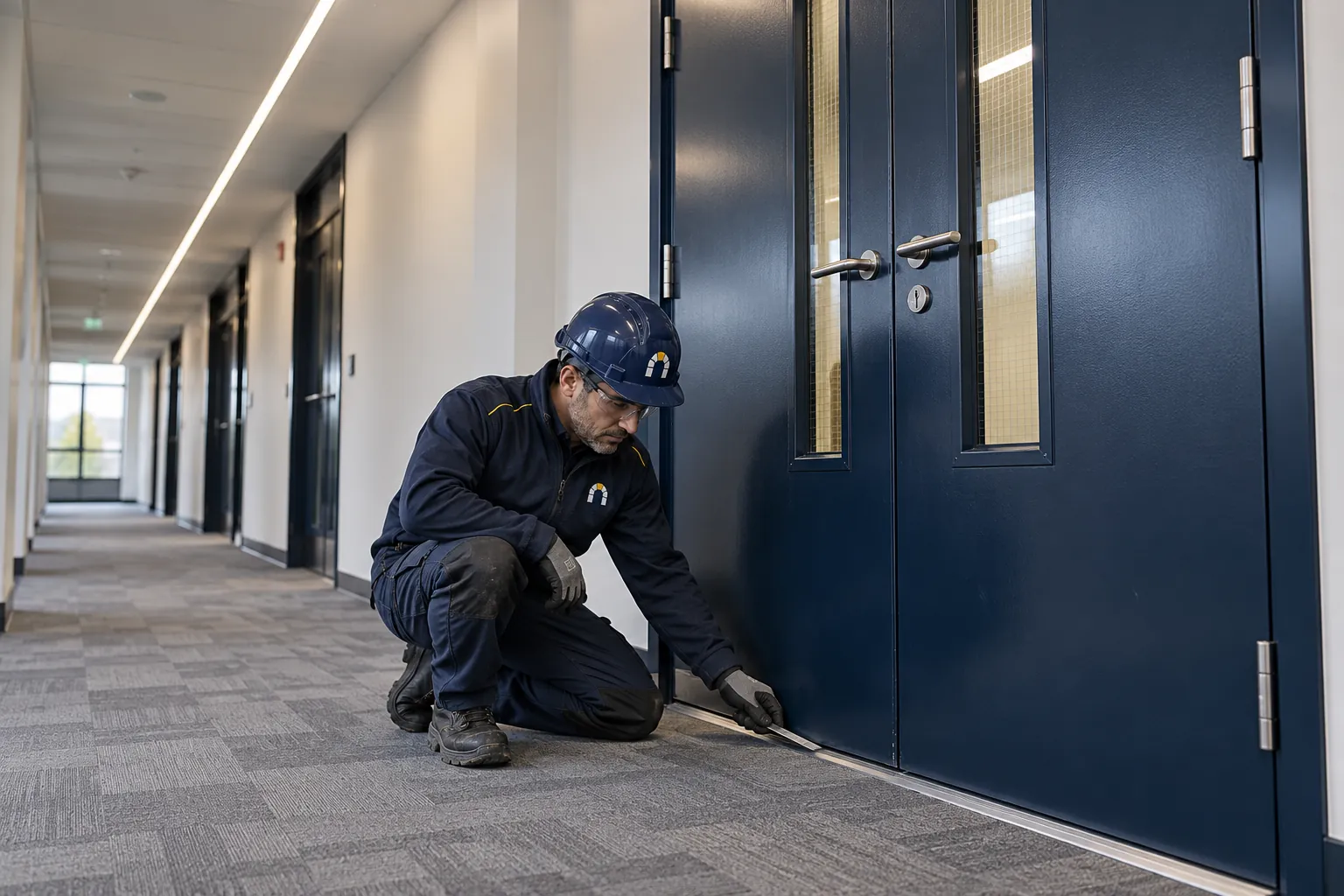
Gaps grow as a building moves. A leaf that was fitted with a 4 mm gap can end the year with a wider one, because the frame has moved, the hinges have worn, or the leaf has swollen in damp. A gap gauge is a small tool and a quick check, and it belongs in the hand of whoever walks the school. A door with a gap wider than the evidence allows is a door that has to be adjusted or rehung, and the adjustment has to be recorded so the next inspection can see it was done.
Who checks the doors, and what the record must show
The Regulatory Reform (Fire Safety) Order 2005 names a responsible person for the premises, and in a school that duty usually sits with the head, the governing body or the trust, depending on how the school is run. The responsible person does not have to check every door personally, but has to make sure the checks happen, the faults are fixed, and the records are kept. A duty that is delegated without a record is a duty that cannot be proved, and a fire door that was never checked is a door nobody can speak for.
Checks should be regular, and the regularity should be written down. The fire risk assessment sets what is checked and how often, and the checks should follow it rather than memory. A walk that looks at every fire door, checks that it closes and latches, looks at the seals and the gaps, and writes down what was found, is the core of it. A door that fails a check should be fixed promptly, and the fix should be written beside the fault, so the record shows the door was put right and not just noted. Our fire door inspection checklist gives the checks that catch a failing leaf before it matters.
The record is the part schools most often neglect. A notebook with dates, doors and faults is better than a memory, and a record that names the door, the fault, the date it was found and the date it was fixed is better still. Keep the test evidence with the building records too, so the next inspection has something to check the door against: the test report, the classification and the hardware schedule should travel with the doorset through its whole life. When a door is replaced, the replacement must match the original build, the same rating, the same glass, the same hardware, with the same evidence behind it.
Ordering for a school: one specification, one set of evidence
Ordering fire doors for a school is a specification exercise, not a shopping exercise. The order should name the rating in full, FD30 or FD60 with the letter and the smoke rating where the strategy asks for it, and it should name the leaf, the frame, the glass, the beads, the seals and the hardware as one doorset. A leaf ordered on its own, with the frame and hardware to follow, is a doorset with no evidence behind it, because the rating belongs to the tested assembly and not to any one part. Our how to specify security doors guide covers the same discipline for rated security doors, and our types of security doors guide sets out the range of doors a school may need.
Finally, order the evidence with the doors. The test report, the classification and the hardware schedule should arrive with the doorset, and the handover pack should name the inspection routine the school will follow. A school that files the evidence on the day the doors arrive has a record it can use for the whole life of the building. A school that loses it has doors it cannot prove, and a responsible person who cannot prove the doors is a responsible person carrying a risk that did not need to be carried.
| Door position | Period | What it must do | What to check |
|---|---|---|---|
| Classroom door | FD30 | Close and latch after every use, let the teacher see the corridor | Closer strength, vision panel glass, latch |
| Corridor door | FD30 or FD60 | Hold the corridor as an escape route, survive daily use | Gaps, seals, hinges, closer |
| Stair core door | FD60 | Protect the stair while classes from several floors come down | Smoke seals, closer, latch |
| Hall doors, pairs | FD30 or FD60 | Open in one action for a hall full of children | Panic hardware, coordinator, meeting stile seals |
| Kitchen and plant room | FD60 | Hold a higher-risk fire inside its own compartment | Seals, gaps, self-closing |
A fire door that stands open, or one with no evidence behind it, has no rating to check.
What is Building Bulletin 100?
Building Bulletin 100 is the Department for Education guidance on design for fire safety in schools. It shows how the duties in the Regulatory Reform (Fire Safety) Order 2005 and Approved Document B are met in a school, where the users are children and the building is used in ways no office is used. It is guidance, not law, and it sits beside the fire risk assessment, which is the live document for the building.
What is the difference between FD30 and FD60?
FD30 and FD60 are fire resistance periods tested to EN 1634-1, and the number is the minutes the doorset holds its rating in the furnace test. FD30 holds for 30 minutes and FD60 for 60 minutes. Classroom doors commonly carry FD30, while compartment walls, stair cores and long escape routes commonly carry FD60, because the people behind them need more time. The fire strategy names the period for each opening.
Do school fire doors need smoke seals?
They need smoke control where the fire strategy asks for it, and corridors and stair cores in a school usually do, because smoke reaches children long before flames do. A door that must control smoke carries a rating to BS EN 1634-3, Sa or S200, and the S in FD30S marks it. A fire rating on its own does not prove smoke control, so ask for the smoke evidence by name.
Can a classroom fire door be held open during the school day?
Only with a hold-open device to BS EN 1155 that releases the door when the alarm sounds. A wedge, a chair or a hook on the wall has no such release, and a door held open by one of those will stand open in a fire. If a classroom door needs to stand open for lessons, fit the right hold-open device and the right closer, so the door can stay open when the building needs it open and still close when it matters.
Who is responsible for fire doors in a school?
The Regulatory Reform (Fire Safety) Order 2005 names a responsible person for the premises, and in a school that duty usually sits with the head, the governing body or the trust, depending on how the school is run. The responsible person must make sure the doors are checked regularly, faults are fixed promptly, and the records are kept, including the test evidence for each doorset.
What a school fire door rating does not prove
A rating on a school fire door proves one thing: the tested doorset held its rating in the test. It proves nothing else. Treat the certificate as a narrow statement, and ask what it leaves out before the order is placed.
It does not prove the door suits the children who use it. A classroom door must close and latch after every use, and be light enough for the smallest hands to open, because a closer that is too strong for a child is a closer that gets wedged open, and a door that is wedged open has no fire performance at all.
It does not prove the corridor is a protected route. A corridor door has to hold while the corridor fills with children, and a door rated FD60 in a 30 minute wall gives a 30 minute opening, just as a door rated FD30 in a 60 minute wall gives a 30 minute opening.
It does not prove the door will open under pressure. Doors on escape routes must open with one action, in the direction of escape, without a key and without a code. Panic hardware to BS EN 1125 is made for exactly this: a bar across the leaf that opens the door when it is pushed, even by a child who is frightened and running. A door that locks from the outside must still open from the inside in one action, or it traps the children behind it.
It does not prove the door is checked. The Regulatory Reform (Fire Safety) Order 2005 names a responsible person for the premises, and in a school that duty usually sits with the head, the governing body or the trust. The responsible person must make sure the checks happen, the faults are fixed, and the records are kept. A door that was never checked is a door nobody can speak for.
Mistakes that leave a school non-compliant
Most school fire door orders fail in small ways. Each mistake below has the same result: a door that looks right and cannot be proved.
| Mistake | Why it fails | What to do instead |
|---|---|---|
| Closer too strong for the leaf | Staff and pupils wedge the door open and the fire performance is lost. | Size the closer to BS EN 1154 for the leaf as built. |
| Paint over the intumescent seals | The seals cannot expand when heat reaches them. | Tell the decorators the seals are never to be coated. |
| Leaf ordered without the frame | The rating belongs to the tested assembly, not the leaf alone. | Order leaf, frame, seals and hardware as one doorset. |
| No record of the checks | A duty that is delegated without a record cannot be proved. | Write the door, the fault, the date found and the date fixed. |
| Door locked from the inside | Children cannot get out under pressure. | Fit hardware that opens from the inside in one action. |
Keep the evidence with the doors. The test report, the classification and the hardware schedule should travel with the doorset. For the closer sizes behind the order, see our fire door closers guide, and for the checks that catch a failing leaf, see our fire door inspection checklist.
Get a free quote
Related
More in guides for specifiers
Products
One supplier for the whole building envelope
Ready to specify your project?
Free assessment, written specification and test evidence. Reply within one working day.