
ArxBridge
Bullet Resistant Glass Cost Factors
What drives the cost of bullet resistant glass in the UK: the BR class, the build-up, spall, size and the frame. Factors only, no invented prices.
- ✓Third-party test evidence with every product
- ✓Written specification you can issue to tender
- ✓Supplied and installed across the UK
Get a free project quote
Rating, written specification and budget range within one working day.
Confidential. No cost, no obligation.
Third-party tested
Evidence with every quote
UK manufactured
Made to your sizes
One accountable team
Specify, supply, install
Confidential handling
Details never shared
Bullet resistant glass has no standard price. The quote turns on the BR class, the layers inside the pane, the spall build, the size and shape, the frame it sits in, any added ratings, and the handling on site. Each factor moves the quote in one direction, and the sections below follow that order, largest movement first. No figures are given here, because a figure without the full specification behind it would mislead; what matters is which factors move the quote and by how much relative to each other.
- BR1 to BR7EN 1063 classes for glazing, plus SG1 and SG2 for shotgun
- NS or SSpall behaviour on the protected side of the pane
- FB classThe finished window or door takes an EN 1522 class
- Test evidenceThe rating comes from the test, not the thickness
The BR class sets the baseline
EN 1063 rates bullet resistant glass from BR1 to BR7, against the same weapon scale used for doors and windows, plus SG1 and SG2 for shotgun. BR1 covers .22 LR, BR4 covers .44 Magnum, BR5 covers the 5.56 x 45 rifle round, and BR7 covers 7.62 x 51 hard core, the armour piercing round. The shotgun classes sit apart: they cover a different threat and do not automatically follow the numbered sequence. The ballistic ratings page sets out the classes in full, and our guide to choosing a ballistic rating works through how to match the class to the threat.
Each step up the scale adds material. Bullet resistant glass is a sandwich of glass layers bonded with interlayers, and a higher class needs more layers in the pane, which makes it thicker and heavier. The class is therefore the largest single step in the quote, before size, shape or frame are considered. A pane ordered a class above the assessed threat carries layers the project does not need, and the extra weight then has to be carried by the frame, the beads and the wall around it.
The step from BR4 to BR5 is where the construction changes most. This is where handguns give way to rifles, and the build-up of the pane changes with it. Read the class as a minimum, not a target: a BR4 pane has defeated everything up to .44 Magnum in the laboratory, which is why higher classes automatically cover lower threats. There is no benefit in buying far above the assessed threat. Banks, embassies and government buildings sit at the top of the scale, and the class should follow the threat assessment, not the highest number. Our BR1 to BR7 ratings guide explains the full class table and how each class is tested.
Thickness, weight and the layers inside
When a projectile strikes, the outer glass layers fracture and spread the load across the interlayers. The interlayers stretch and hold the fragments, absorbing energy that would otherwise pass through. Each step up the BR scale adds layers, so the pane grows thicker and heavier, and the weight is what is felt on site. A high-class pane needs a deeper frame, stronger beads and careful handling, and large sizes may need mechanical lifting and a frame designed for the load from the start.
Never select by thickness alone. Two panes of the same thickness can carry different classes, because the rating comes from the test, not the millimetres. The make-up of the layers decides the class, and the test report is the proof. Buy the test evidence, not the dimension, and ask for the report that states the standard, the class and the suffix for the exact glass build being bought, not a thinner or older version of it.
Polycarbonate layers can be included in the build where weight must be kept down, and the make-up is stated on every pane supplied so replacements match exactly. A lighter build can ease the frame and the handling, but it is still the test evidence that decides the class, and a polycarbonate layer changes the build-up rather than the standard. For how the laminated construction works and why bullet resistant is the correct term, see bullet resistant vs bulletproof glass, and for the glass as a product in its own right, see our bullet resistant glass page.
Spall: what S and NS add to the build
After the shots are fired, the laboratory inspects the protected face. If fragments are ejected toward the people behind the glass, the classification carries the suffix S, for splinters. If the pane holds every fragment, it carries NS, for no splinters. Spall behaviour is designed into the build-up: the layers on the protected face are there to catch fragments, which is why the NS suffix and the class are specified together and never as alternatives.
No-spall builds add a protective inner layer that keeps the rear face whole, shielding the people behind the glass from fragments. That layer adds to the build-up, so an NS pane costs more than the same class in S, and the difference is part of the quote rather than an afterthought. Specify NS wherever people sit or stand behind the glazing: counters, guard posts and any occupied room. An S pane in such a position saves on the glass and fails the people it was meant to protect.
A class without S or NS is incomplete, because two panes at the same class can behave very differently on the protected face. Write the full designation on every order, for example EN 1063 BR6 NS, and mirror it exactly between tender and order: BR6 on the tender and BR6 NS on the order is a mismatch that can fail an audit. Our BR1 to BR7 ratings guide covers S and NS in full, and the ballistic ratings page sets out how the suffix is recorded.
Size, shape and the edges
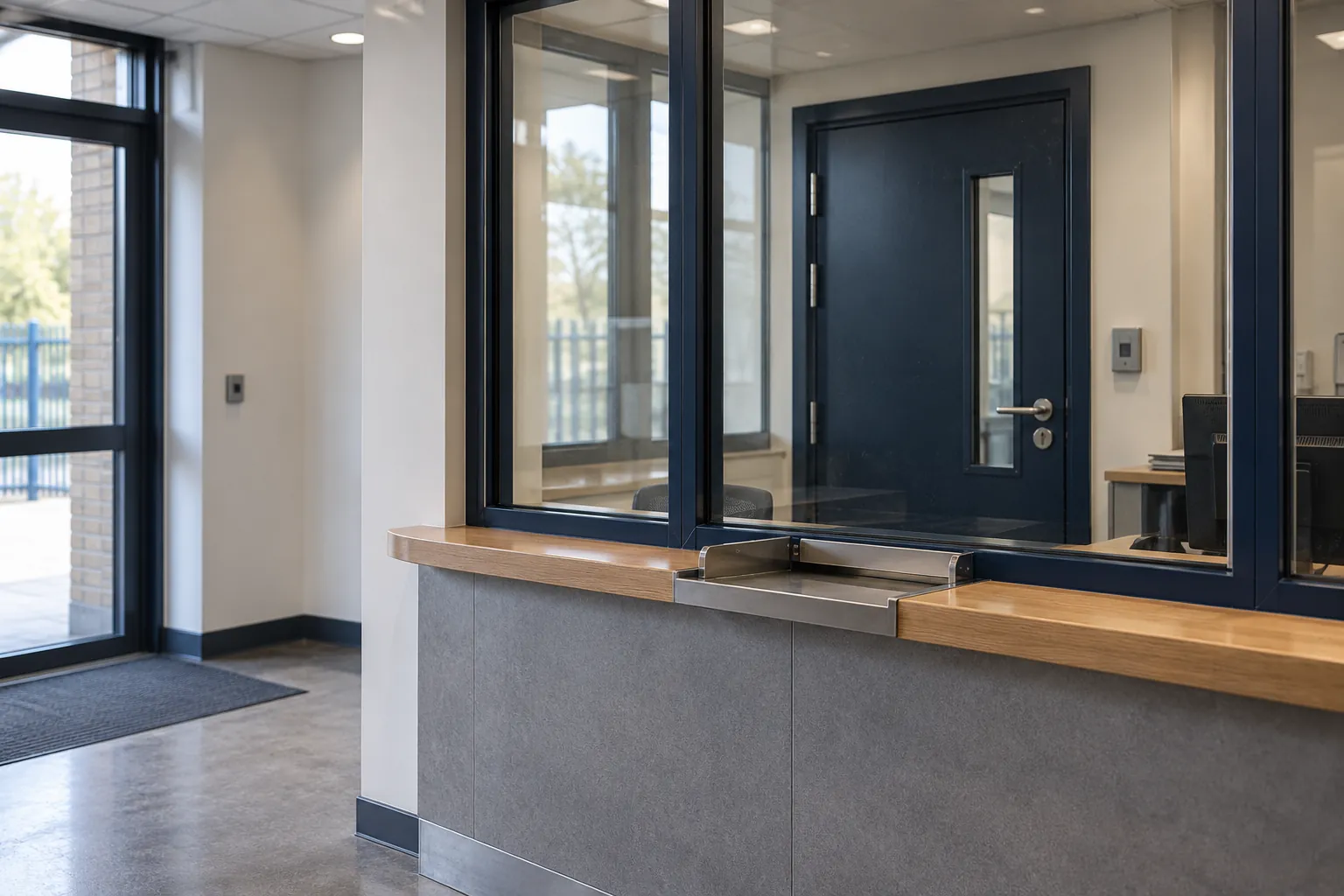
Size moves the quote because every extra area of pane is extra laminated material. A large glazed screen uses far more material than a small vision panel, and the weight grows with the area, so the frame, the beads and the handling all grow with it. Keep the glazed area honest: a window that is mostly glass needs a mostly glazed ballistic design, which behaves differently from a solid leaf with a small vision panel. Our bullet resistant windows page covers glazed elements as products in their own right.
Shape moves the quote too. A rectangular pane cut to a standard size is the simplest order. Curved panes, shaped panes and panes with cut-outs add cutting work and waste, and each one needs its own evidence where the tested range does not reach it. The build-up must still be proven for the shape supplied, and a shape outside the tested range needs fresh evidence before the order is signed.
Edges are the vulnerable zone of any laminate, so panes are sized to sit deep in the frame rebate with the edges fully supported and sealed. The rebate depth and bite must suit the pane thickness, and a pane that is too thin for its rebate or too thick for its frame leaves the edges exposed. The laminate is stable over a long service life when edges are sealed and the glass is maintained, and periodic inspection of seals and edges belongs in the maintenance schedule. For the door side of the same discipline, see our bullet resistant door cost factors guide.
The frame the pane sits in
A BR7 pane sitting in an ordinary frame is not a BR7 window. It is an expensive pane in an untested frame, and the assembly has no rating at all. EN 1063 tests the glazing product itself, the laminated pane, on the assumption of proper fixing. It says nothing about the frame, the beads or the anchorage around it. The finished unit takes an FB class under EN 1522, and the frame, beads and fixings must be tested with the pane to earn it.
The frame must match the pane in two ways: it must be tested to the same class, and it must be built for the weight and thickness of the pane. A high-class pane needs a deeper frame, stronger beads and fixings designed for the load from the start, and a frame changed after the test can void the evidence for the whole unit. The rebate depth, the bite and the bead design are part of the tested assembly, not details to settle on site.
Curtain walling makes the distinction visible. A glazed screen can carry BR6 panes in every light and still have no FB classification until the mullions, transoms and fixings are tested with them. Treat the screen as an assembly from the first sketch, not as glass plus framing, and ask for the EN 1522 evidence for the unit, not just the EN 1063 evidence for the glass. Our bullet resistant doors page covers the doorset as a complete product, and the how to specify security doors guide gives the same discipline for the specification process.
Added ratings: blast, fire and forced entry
Some projects need the glass to do more than stop bullets. A ballistic pane can also carry a blast rating to EN 13123 and EN 13124, a fire rating to EN 1634-1, or a forced entry rating to LPS 1175, but each is a separate test, run against the same construction. Blast rated glazing answers a different threat under a different standard, and laminated builds can be matched to blast where the threat picture calls for it. Each added rating complicates the build and adds its own test evidence, so combined ratings move the quote more than any single factor except the BR class itself. Our blast resistant windows cost and specification guide works through the blast side, and the blast ratings page sets out the classes.
One rule covers all combinations. The added ratings must belong to the same tested assembly as the ballistic rating. A pane with a BR6 rating and blast glass that was never tested in that unit is not a combined rated window. Ask for every certificate against one unit reference, and check that the glass build, the frame and the fixings are the same across all of them. For how two ratings are proved on one construction, see our dual certification guide.
Added performance is not always a rating. A ballistic laminate can form one pane of a double-glazed unit, with a cavity and a second pane for thermal and acoustic performance, and the unit is built to keep the ballistic layer on the attack side. That second pane adds to the build and to the quote, but it is a performance choice rather than a test, and it should be specified as one, with the thermal and acoustic figures stated separately from the BR class. For the acoustic side of glazed units, see our acoustic doors guide, and for the wider cost discipline on combined ratings, see our security door cost factors guide.
Testing, evidence and the order
Ask for the evidence before the order is placed, not after the glass arrives. The test report to EN 1063 should state the standard, the class and the suffix, and it should describe the exact glass build being bought: the layers, the thickness and the make-up. A certificate for a thinner or older build does not cover the pane on site, and a certificate for the glass alone does not cover the window. The finished unit needs its own EN 1522 evidence, with the BR pane as one component of the tested assembly.
Write the class in full everywhere. The tender, the order, the test report and the handover pack should all carry the same designation, for example EN 1063 BR6 NS, with the standard, the class and the suffix together. A mismatch between documents is the error that appears most often in audits, and it is the cheapest to prevent: check the designation line by line before the order is signed, and where the evidence is missing or does not match, the order should wait.
Replacements must match the make-up exactly. The make-up is stated on every pane supplied so that a replacement pane carries the same class, the same suffix and the same build, and a replacement ordered on thickness alone can leave the window with a lower class than the one it replaced. Keep the test evidence with the building records, with the door and window schedule, so the next specifier knows what the opening was built to achieve. For the changes that cause problems after installation, see our guide to keeping an LPS 1175 rating valid, and for the door side of the same evidence discipline, see our bullet resistant door cost factors guide.
The rating first, the size second: the two numbers that set the cost
The cost of bullet resistant glass starts with the rating and the size, and both numbers belong on the enquiry before anything else is priced. A higher BR class means more layers in the build-up, and a larger pane means more of that build-up, so the class and the size together set the baseline, and everything after them adds to it.
Each step up the BR scale adds layers to the pane, and the pane grows thicker and heavier with it. A pane proved to BR7 carries far more glass and interlayer than a pane proved to BR1, and the weight that follows decides the frame, the fixings and the handling on site, so the rating should match the threat the room faces, not the highest class on the list.
Size and shape add their own cost. A large pane needs a thicker build-up to hold its class across the whole sheet, and a curved or shaped pane needs tooling a flat pane does not, so the drawing should show the size and the shape beside the class, and the order should name all three on the same line.
Ordering the glass with the doorset: one schedule, one set of evidence
Spall control adds to the build. S means splinters reach the safe side, and NS means none do, so a pane that guards people standing behind it needs NS beside the class, and the NS mark means a build-up that holds the splinters back, which adds layers and weight to the pane.
The frame the pane sits in must carry the same class as the glass, or the opening has a strong sheet in a weak surround, and the attack takes the surround first. A frame proved to the same BR class costs more than a frame that only holds the pane in place, and the fixings that tie the frame to the wall belong on the same line, because a rated pane set into a wall that cannot take the fixings is a pane with no proven rating. Our ballistic glass ratings guide sets out the BR classes, and our choosing a ballistic rating guide works through how the glass and the frame are proved together.
Added ratings add tests, and each test adds to the cost. A pane that must also hold blast, fire or forced entry needs a proof for each job beside the ballistic proof, and the order should name each class on its own line, with the test report behind it. A pane that must also resist a hand tool takes a second rating, to EN 356, which runs from P1A to P8B and sets its top three classes by axe blows: 30 to 50 for P6B, 51 to 70 for P7B, and 70 or more for P8B, so a pane that needs both proofs needs both test reports.
The evidence belongs on the order as much as the glass does. A test report that names the class, the size and the assembly that was tested is the proof the rating rests on, and a report that names the glass alone leaves the frame and the fixings unproved. Our bullet-resistant versus bulletproof glass guide clears up the names, and the ballistic ratings page sets out the scales the order should name.
| What sets the cost | Why it adds | What the order names |
|---|---|---|
| BR class | More layers at each step | Class, S or NS |
| Pane size and shape | More build-up, more tooling | Size, shape, thickness |
| Frame and fixings | Same class as the glass | Frame class, fixings |
| Added ratings | A test for each job | Each class on its own line |
Ask for the evidence on the whole assembly, not on the pane alone, and the cost that follows will be the cost of a rating that holds.
Delivery, handling and life after fitting
Weight is what is felt on site. A high-class pane needs a deeper frame, stronger beads and careful handling, and large sizes may need mechanical lifting and a frame designed for the load from the start. Edges must be protected in transit, because the edge is the vulnerable zone of a laminate, and a chipped edge on arrival is a pane that should not be fitted. Agree the access, the lifting and the handling before the order, not on the day of delivery, and check that the route to the opening can take the pane at its full size and weight.
Lead time follows the build. Bullet resistant glass is made to size, layer by layer, and a higher class, a larger pane or a shaped pane takes longer than a standard size at a lower class. Custom sizes and added ratings add their own time, because each one needs its own evidence and its own production run. State the sizes, the class and the spall requirement at enquiry stage, so the lead time quoted is the lead time for the glass actually ordered.
Life after fitting is mostly inspection. The laminate is stable over a long service life when edges are sealed and the glass is maintained, and periodic inspection of seals and edges belongs in the maintenance schedule. Replace any pane that has been attacked or damaged, and replace it with the same make-up, so the class and the suffix survive the repair. Our maintenance page gives planned servicing and records, and the roller shutter cost factors guide applies the same factors discipline to a different product family.
| Factor | How it moves the quote | What to check |
|---|---|---|
| BR class | Each step up adds layers, thickness and weight | Test report names the class |
| Spall build, S or NS | A protective inner layer adds to the build | NS written with the class in full |
| Pane size and shape | Larger and shaped panes use more material | Sizes sit inside the tested range |
| Frame and beads | Deeper frame and stronger beads for heavier panes | Frame tested with the pane |
| Added ratings | Each extra test complicates the build | Evidence names the same assembly |
| Handling and delivery | Weight and size decide the lifting and access | Access agreed before the order |
Buy the test evidence, not the dimension. Two panes of the same thickness can hold different classes.
Why do two quotes for the same BR class differ?
Because the scope differs. One quote may be for an S build where the other is NS, a thinner frame, evidence that covers the glass alone rather than the finished unit, or delivery and handling excluded. Ask every bidder for the BR class with its S or NS suffix, the frame evidence and the whole-unit test evidence in writing, then compare.
Is a higher BR class always better?
No. A better pane is one whose class matches the assessed threat. A class far above the threat adds layers, weight and frame work, and buys protection the project does not need. Match the class to the threat assessment, not to the highest number.
Can bullet resistant glass be fitted into my existing frame?
No. The frame must be tested with the pane to the same class, because the finished unit takes an FB class under EN 1522. A BR pane in an unrated frame has no rating as a window, and the frame, beads and fixings must be part of the tested assembly.
What does NS mean and when do I need it?
NS means no splinters: the pane holds every fragment on the protected face. S means splinters may leave the rear face. Specify NS wherever people sit or stand behind the glazing, such as counters, guard posts and occupied rooms.
Does bullet resistant glass stop blast or fire?
Only where it was also tested to those standards on the same construction. Blast is tested to EN 13123 and EN 13124, and fire to EN 1634-1, each with its own evidence. A BR rating on its own proves nothing about blast or fire.
Get a free quote
Related
More in guides for specifiers
Products
One supplier for the whole building envelope
Ready to specify your project?
Free assessment, written specification and test evidence. Reply within one working day.