
ArxBridge
Safe room and panic room doors: specification basics
How to specify a safe room or panic room door: threat-led design, ballistic and forced-entry ratings, locking, ventilation and fire escape across the UK.
- ✓Third-party test evidence with every product
- ✓Written specification you can issue to tender
- ✓Supplied and installed across the UK
Get a free project quote
Rating, written specification and budget range within one working day.
Confidential. No cost, no obligation.
Third-party tested
Evidence with every quote
UK manufactured
Made to your sizes
One accountable team
Specify, supply, install
Confidential handling
Details never shared
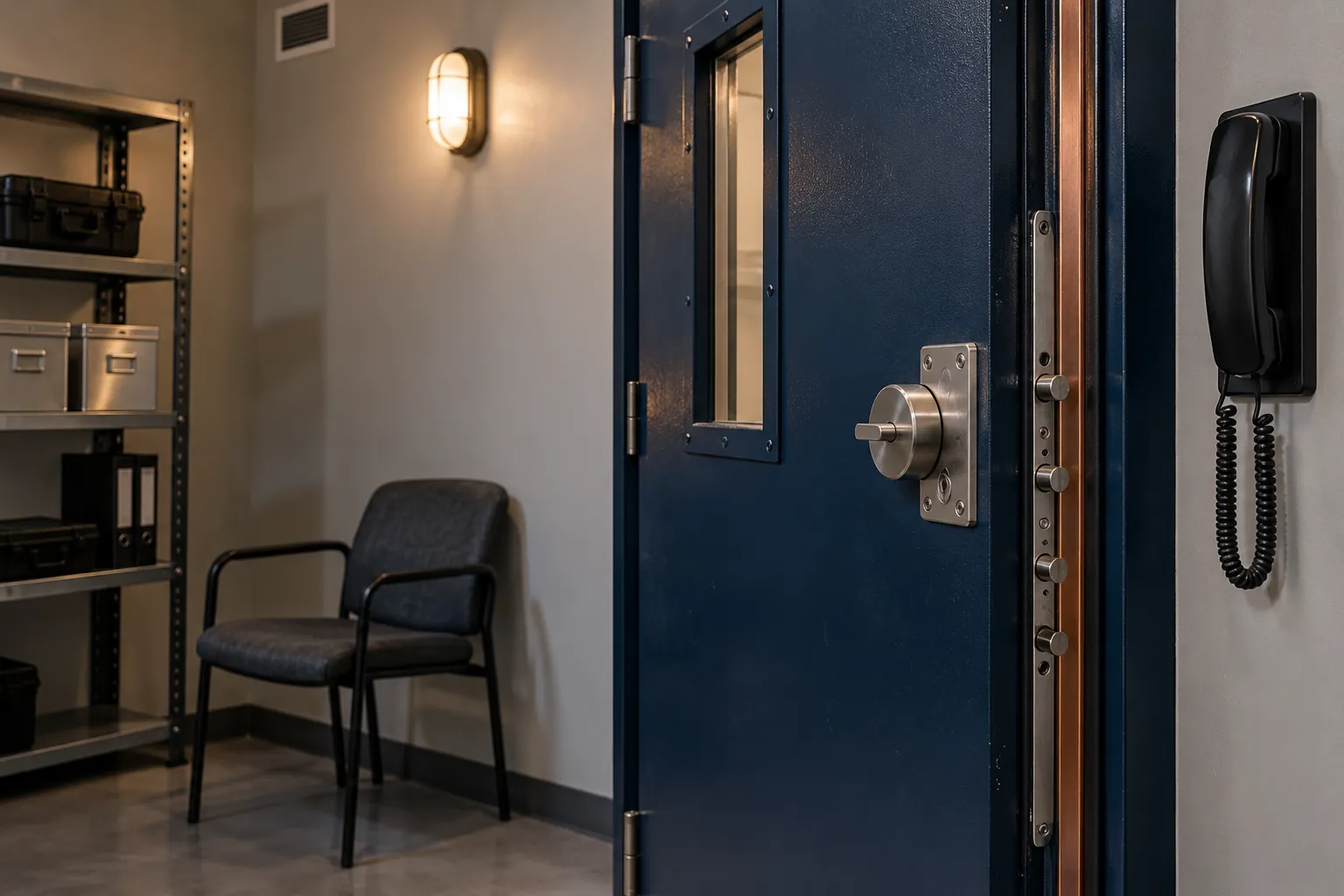
A safe room door only works as part of a threat-led design: define the threat first, then match the door, the wall and the frame to it. The door should carry a tested ballistic or forced-entry rating, lock securely from the inside, and still allow communication, ventilation and escape.
- Threat-led designDefine the threat before choosing the door
- Weakest linkThe door is only as strong as the wall and frame
- RatingsBallistic to EN 1522, forced entry to LPS 1175
- EscapeAlways openable from the inside without a key
Start with the threat, not the door
Every safe room starts with the same question: who or what is it protecting against? A room that shelters a family during a break-in faces a different threat from a room that protects staff during an armed intrusion or a control room that must keep operating through civil disorder. The threat defines the ratings, and the ratings define the door.
Write the threat down in plain terms before looking at products. Forced entry with hand tools, forced entry with power tools, handgun fire, rifle fire: each points to a different test standard and a different level within it. A vague brief produces a vague room, and the door ends up either under-specified for the real risk or over-specified for a risk that does not exist.
Where the threat is unclear, get advice before spending. Our security consultancy service defines the threat model first, so the specification that follows is grounded in the actual risk rather than in guesswork.
The door is only as strong as the wall and frame
A tested door in an untested wall is theatre. Attackers go around the door if the wall gives way first, so the wall, the frame and the fixings must meet the same threat as the door leaf. Specify the assembly as one tested unit wherever possible: door, frame, locks and fixings covered by the same test evidence.
Walls need honest assessment. A solid masonry or concrete wall can be brought up to the required level; a stud partition usually cannot without rebuilding. The frame must be anchored into structure that can hold it under attack, and the gap between frame and wall must be filled and finished so it cannot be exploited. These details are unglamorous and they decide whether the room works.
The floor and ceiling deserve the same attention. A safe room on an upper floor with a lightweight ceiling above it has a route in that bypasses the door entirely. Walk the whole envelope, not just the doorway, and treat every surface as part of the specification.
Ballistic and forced-entry ratings
Two families of standards cover the door itself. Forced entry is tested to LPS 1175, which pairs a tool category with minutes of resistance: A1 against basic hand tools, B3 against tools such as screwdrivers and hand saws for three minutes, C5 against crowbars and drills for five minutes, and D10 against sledgehammers and disc cutters for ten minutes. Our LPS 1175 guide sets out the full table.
Ballistic protection is tested to EN 1522, which classes the door by the weapon it stops: FB1 for .22 LR, FB2 for 9mm, FB3 for .357 Magnum, FB4 for .357 and .44 Magnum, FB5 and FB6 for rifle calibres including 5.56×45 and 7.62×51, and FB7 for armour piercing 7.62×51. The suffix NS means no splinters on the protected side. Our ballistic ratings guide explains each class.
Many safe room doors carry both ratings, and some add fire resistance as well. Combined ratings are tested as a combination, so ask for evidence covering the tested assembly rather than separate certificates for separate parts. The table below maps common threats to the ratings worth discussing.
| Threat | Forced entry rating to discuss | Ballistic rating to discuss |
|---|---|---|
| Opportunist break-in, basic tools | LPS 1175 A1 or B3 | None usually needed |
| Determined attack with hand and power tools | LPS 1175 C5 or D10 | None usually needed |
| Armed intrusion, handguns | LPS 1175 C5 or D10 | EN 1522 FB4 |
| Armed intrusion, rifles | LPS 1175 D10 | EN 1522 FB6 or FB7 |
Glazing in the door needs the same level as the leaf. A ballistic door with ordinary glass in its vision panel is not a ballistic door. Any vision panel, sidelight or transom must carry a matching tested rating, and it must be part of the tested assembly.
Locking from the inside
The lock must work from the inside under stress, in the dark, by someone who may never have used it before. A single positive action, one handle turn or one bolt throw, is the right level of simplicity. Anything that needs a key, a code remembered under pressure, or a sequence of moves will fail the person it is meant to protect.
From the outside the door should resist manipulation for the rated time. That means protected cylinders, no exposed fixings and hinges that cannot be lifted or cut through within the rating period. The lock, the keep and the frame work as one system; a strong lock in a weak keep is a weak door.
Decide in advance who can open the door from outside and how. In a home that may be a second key held elsewhere; in a commercial building it may be a security manager with an override. Write the procedure down and make sure the people who need it know it. An override that nobody can find is the same as no override.
Communications and ventilation
A safe room is a place to wait for help, so it needs a way to call for it. A dedicated phone line or a hardwired intercom to a monitored point is the reliable choice; mobile signal cannot be assumed, least of all inside a steel-lined room. Test the communication method from inside the finished room, with the door closed.
Ventilation matters because a sealed room with several people inside becomes uncomfortable quickly. Options include a ventilated lobby, louvred vents with the same rating as the door, or a small independent air supply, depending on how long occupants may need to stay. Whatever the method, the ventilation path must not create a weak point in the envelope.
Power, light and water are worth planning at the same time. A light that works, a way to charge a phone and drinking water turn a frightening wait into a manageable one. None of this is complex; it just needs to be on the drawing before the room is built.
A panic room door that cannot be opened from the inside without a key is a trap, not a refuge. Single-action escape from the inside is non-negotiable, whatever the rating on the door.
Fire escape and building regulations
The safe room must not become a fire trap. Anyone inside must be able to leave quickly if the building is on fire, which means the door opens from the inside without a key, without tools and without special knowledge. Test this with the actual occupants, not just on paper.
Where the safe room door also needs to hold back fire, specify a combined fire and security doorset so one tested assembly covers both jobs. Our fire and security doors page explains how the combined ratings work. Do not assume a security door resists fire or a fire door resists attack; each performance must be tested and evidenced.
Check the work against building regulations before building. Ventilation, means of escape and structural alterations can all trigger requirements, and a safe room built without the right approvals creates problems when the property is sold or insured. A short conversation with building control at the design stage avoids all of it.
Residential and commercial safe rooms
In homes the safe room is usually a bedroom, a dressing room or a cupboard converted with a rated door and strengthened walls. Discretion matters: the room should look ordinary, the door should match the house, and as few people as possible should know its purpose. The family needs a simple drill: get in, lock the door, call for help, wait.
In commercial buildings the safe room is more likely a control room, a cash office or a staff refuge, and it must work for people who did not choose to be there. Signage, lighting and communication become more important, and the procedure must be part of staff training rather than family knowledge. Our residential sector page covers the home context; commercial projects usually start from a formal threat assessment.
Whatever the setting, the principles do not change: threat first, envelope as one assembly, tested ratings, simple locking, communication, ventilation and a way out. Get those right and the door does its job. Some projects combine a safe room with other specialist protection; where the room also needs radio frequency screening, our guide to MRI and RF shielded rooms explains the principles, and where the building’s other openings need out of hours protection, our guide to security shutters vs retractable grilles compares the options. You can browse all our guides for related reading.
What the ratings do not prove
A forced-entry rating and a ballistic rating describe the door leaf and its tested assembly. They say nothing about smoke, gas or blast unless those were tested too, so a room that must hold against more than force and fire needs each threat tested on its own. A door that stops a bullet has not shown anything about smoke coming under it, and a rating that covers one threat never stands in for another.
The ratings say nothing about the room after the door is fitted. The wall, floor and ceiling sit outside the door certificate, and a door rated D10 in a stud partition is a strong door in a weak room. The envelope must meet the same threat as the door, or the rating protects a doorway that attackers can walk around.
The ratings do not prove the room will be used correctly. A drill that was never practised, an override nobody can find, a room used as a store so the door cannot be reached or shut quickly: none of these appear on a certificate, and each of them decides whether the room works on the night. The procedure matters as much as the product, and it needs the same attention as the specification.
The ratings do not prove the door stays rated. Locks wear, seals harden, and a replacement part that differs from the tested make-up needs its own evidence. A door that was rated as built can lose its performance without anyone noticing, so the inspection intervals belong in the handover pack with the certificate.
Test the room as a room, not as a door. Lock it from the inside in the dark, call for help through the fitted communication, and time how long it takes everyone to get in and lock the door. A test that finds a problem before the room is needed is the cheapest test there is.
Mistakes that weaken a safe room
Most safe rooms fail on the night, not on the drawing, because the room was never tested as a room. The six checks below catch the errors that appear most often.
- Writing the threat after choosing the door, so the ratings answer a risk the room does not face.
- Rating the door above the wall, floor or ceiling, so the envelope gives way first.
- Fitting glazing or a vision panel below the leaf rating, so the weakest part of the door is the glass in it.
- Using the room as a store, so the door cannot be reached or shut quickly when it matters.
- Changing a lock or hinge after handover without checking the evidence, and voiding the rating.
- Buying the highest rating instead of the one the threat assessment points to, and paying for performance the room does not need.
Each of these is cheap to prevent at specification stage and costly to fix once the room is in use. A specification that names the threat, the ratings that answer it, and the envelope that carries them leaves nothing to interpret. For which class fits which threat, see choosing a ballistic rating and the ballistic ratings page, and for where the opening also needs fire performance, see the dual certification guide.
Frequently asked questions
Can a safe room door also be a fire door?
Yes, if it is tested for both. Specify a combined fire and security doorset so one tested assembly covers forced entry, ballistic protection and fire resistance together. Never assume one performance implies the other.
What does FB4 mean on a door?
FB4 is an EN 1522 ballistic class meaning the door stops .357 Magnum and .44 Magnum rounds. Higher classes cover rifles: FB6 stops 5.56×45 and 7.62×51, and FB7 stops armour piercing 7.62×51.
How strong does the safe room wall need to be?
As strong as the door. The wall, frame and fixings must meet the same threat as the door leaf, or attackers will simply go around the door. Assess the whole envelope, including floor and ceiling.
Can the door be opened from the outside?
That is a design decision. Most safe rooms allow an override for a nominated person, such as a key held elsewhere or a security manager’s override. Write the procedure down and make sure the right people know it.
Does a safe room need planning permission?
Usually not for the room itself, but structural alterations, new ventilation routes and changes to escape routes can trigger building regulations. Check with building control at the design stage.
Get a free quote
Related
More in guides for specifiers
Products
One supplier for the whole building envelope
Ready to specify your project?
Free assessment, written specification and test evidence. Reply within one working day.