
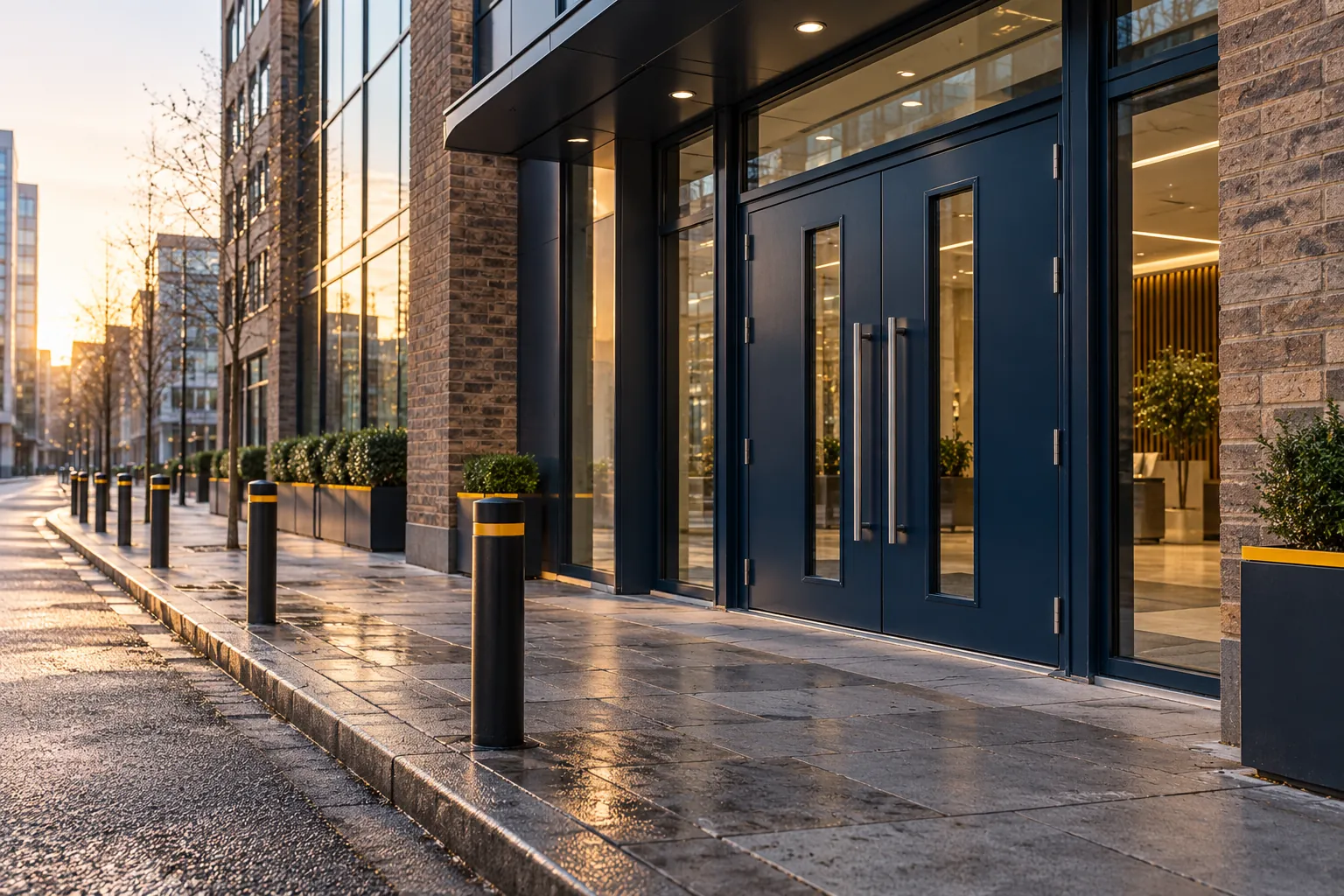
Security · LPS 1175 SR2 to SR5
Security Doors in London
Security doors for London offices, retail and large public buildings: ratings, fire and security on one doorset, and what to name on the order.
- ✓Third-party test evidence with every product
- ✓Written specification you can issue to tender
- ✓Supplied and installed in London
Get a free quote in London
Rating, written specification and budget range within one working day.
Confidential. No cost, no obligation.
Third-party tested
Evidence with every quote
UK manufactured
Made to your sizes
One accountable team
Specify, supply, install
Confidential handling
Details never shared
Supplied and installed in London
What we supply in London
A London buyer begins with the opening and the crowd it serves, not with a catalogue page. A rated steel door suits a staffed entrance, a fire rated doorset belongs on every escape route, and a gate at the yard needs a rating of its own.
London holds more commercial building than any other city in the UK: head offices, shops, public buildings and distribution units, spread from the centre to the outer boroughs. Each kind of building puts a different demand on its doors. An office entrance must admit hundreds of people at the start of the day and release them in one movement when the alarm sounds. A shopfront must face the street all day and still open for escape. A distribution unit needs a personnel door that takes a shift of workers, a forklift and a pallet, every day of the week.
Build the order as a schedule, one line for each opening, naming the building and position, the fire period and the security rating where one is needed, and the leaf, frame, glass, seals and hardware as one tested doorset. Our London page covers the city as a whole, and our Sheffield page covers a city built around making things.
- LPS 1175Forced entry rating, B3 to D10
- PAS 24Enhanced security doorset standard
- FD30 / FD60Fire resistance periods tested to EN 1634-1
- Martyn’s LawTiers for premises holding 200 or more people
Head offices and towers: the entrance that sets the standard
A head office entrance in London carries more traffic than any other door on the estate. Staff arrive in a wave at the start of the day, visitors arrive through the day, and couriers arrive at the side door, so the entrance must admit the right people and keep strangers out. Glazing at the entrance lets reception staff see a visitor before the door opens, while a rated screen holds if the visitor turns hostile. A screen with no rating gives way at the first blow, and the entrance behind it is open.
The same entrance must release the crowd in one movement when the alarm sounds. Panic hardware to BS EN 1125 belongs on doors that serve more than 60 people, with a bar across the leaf covering at least 60 percent of the leaf width. A door must open with less than 30 N in the first 30 degrees and less than 22.5 N beyond that, under BS 8300 and Approved Document M. For the power sizes, see our guide to fire door closers.
Retail streets and shopping centres: doors that face the public
A shopfront in London faces the street from opening to closing, and the doors behind it must do two jobs at once. They must admit shoppers through the day and release them in one action if the alarm sounds, so the escape hardware must work without a key and without a code. A door that needs a key from the inside cannot serve as an escape door. Our fire door regulations for retail guide works through the same duties for a building full of shoppers.
Rear doors deserve the same attention as the shopfront. A stockroom door faces a quieter approach than the front, so it usually needs a higher rating than the entrance the public uses. Walk around the outside of the building and list every door a person can reach, then set the rating of each one by the attack it could face. Our fire rated windows guide sets out how glass, frame and beads are tested together as one assembly.
Public buildings and the crowds they hold
Public buildings in London hold crowds every day: visitors, patients, students and staff moving through entrances, concourses and corridors. The doors on those routes must hold fire while crowds pass them, and must open in one action, in the direction of escape, without a key. Premises that hold crowds face duties under Martyn’s Law, which sets tiers for premises that hold 200 or more people, with Royal Assent in April 2025 and go-live expected in spring 2027. Our Martyn’s Law guide sets out the tiers and what they ask of a building.
The doors that release for escape sit inside those duties, so every escape door, every hold-open device and every access control point belongs on the schedule, with the fire period and the hardware for each one. A door held open by a wedge has no such release, and will stand open in a fire. A hold-open device to BS EN 1155 lets a door stand open for use and releases it when the alarm sounds. The release belongs on the inspection routine, checked every time the door is checked.
Wembley and The O2: doors that release a crowd
Wembley Stadium stands in north west London, opened in 2007, and holds 90,000 people, which makes it the largest stadium in the United Kingdom. The O2 Arena stands on the Greenwich Peninsula in south east London, opened in its present form in 2007, and holds 20,000 people. Both buildings fill and empty through the same doors, so the doors on the escape routes must release a whole crowd in one action, with no key and no code, and then lock down again after the event.
Panic hardware to BS EN 1125 belongs on any door serving a room of more than 60 people. The push bar must span at least 60 percent of the leaf. Martyn’s Law received Royal Assent in April 2025. The standard tier covers premises that hold 200 to 799 people, and the enhanced tier covers premises that hold 800 or more. The duties have not started yet, and the Act is expected to come into force in spring 2027. Work from the busiest day, not the quietest, to find the tier that applies. The Martyn’s Law guide for premises explains the tiers and the duties beside them.
A wide leaf on a stadium exit also needs hinges sized for its mass. Under BS EN 1935 a hinge is graded by the test cycles it survives and the leaf mass it can carry. Grade 13 is proved to 200,000 cycles with a 120 kg leaf. Grade 14 is proved to 200,000 cycles with a 160 kg leaf. Write the hinge grade and the leaf mass on the door schedule, and check the hinge fitted on site against the hinge in the test. The stadium security doors guide covers the doors a ground needs.
| Building | Door | Rating to name |
|---|---|---|
| Wembley Stadium | Stadium exit doors | Panic hardware, BS EN 1125 |
| The O2 Arena | Arena exit doors | Panic hardware, BS EN 1125 |
| University College London | Teaching block entrance | LPS 1175 B3 or C5 where rated |
| Westfield Stratford City | Shopfront and service doors | LPS 1175 C5 for a rear door |
Universities and hospitals: doors in daily public use
University College London was founded in 1826, and its main campus stands in Bloomsbury in central London. A campus holds teaching rooms, libraries, laboratories and halls of residence, and the doors change with each use. A teaching room door must open easily for a full class, a laboratory door must guard people and equipment together, and a hall of residence door must let residents in and keep strangers out. The university security doors guide sets out campus doors in full, and the student accommodation guide gives the doors for halls of residence in full.
Westfield Stratford City opened in Stratford on 13 September 2011, and it is the largest urban shopping centre in the United Kingdom by land area. A shopfront door faces staffed trading hours in a well lit mall, while the service door round the back faces a quiet service road once the shops shut. The rear door faces a quiet service road, so give it a higher rating than the staffed front, because an attacker gets more time unseen. Name C5 for the rear door and B3 for the front. The shopping centre security doors guide gives the same split between front and rear doors in full.
Name the building, the crowd it holds and the hours the doors work, and order the rating and the hardware for what the door will face, with the access control to match. An office door will not do the work of a stadium exit, a teaching block entrance or a shop service door.
Reading LPS 1175 ratings on a London order
Under LPS 1175, a doorset earns its rating by the tools it resists and the minutes it holds. Category B tools are screwdrivers, pliers and hand saws, and three minutes against them gives B3. Category C tools are crowbars, drills and chisels, and five minutes against them gives C5. Category D tools are sledgehammers, disc cutters and jigsaws, and ten minutes against them gives D10. The old labels still appear on drawings: SR2 is the old name for B3, SR3 is the old name for C5, and SR4 is the old name for D10.
Set the rating by the risk at each opening, not by the address. A staffed front entrance suits B3, a rear door that faces a quiet yard suits C5, and a door guarding high value stock, a plant room or a cash handling area suits D10. PAS 24 is the enhanced security standard for doorsets, and EN 1627 sets resistance classes RC1 to RC6. Secured by Design is a scheme, not a rating: a scheme mark on its own proves nothing about resistance, so ask for the test rating behind it. The three ratings buyers meet most often are compared in our SR2 vs SR3 vs SR4 guide.
Only the whole tested assembly carries the rating. A leaf that was tested on its own proves nothing about the frame, the fixings, the glazing or the hardware around it, and a change to any of those parts can break the tested construction. Ask for the test report and the classification naming the exact doorset before the order is placed, and file both with the order. What voids a rating after handover is set out in our guide to keeping an LPS 1175 rating valid.
Fire and forced entry on one London doorset
A London door often carries two duties at once. A server room door must hold fire and keep an attacker from the equipment inside. A plant room door must hold fire and resist a forced entry. Each duty needs its own evidence on the same assembly: a fire classification to EN 1634-1 and a forced entry rating to LPS 1175 or PAS 24. How fire and security sit on one assembly is worked through in our dual certification guide.
FD30 and FD60 are the fire resistance periods tested to EN 1634-1, and the number is the minutes the doorset holds in the furnace test. FD30S adds smoke control to 30 minutes of integrity, tested to BS EN 1634-3. EI limits the temperature rise on the safe side, an average of 140 degrees Celsius and a maximum of 180 degrees Celsius. Any change to the leaf, frame, glass, seals or hardware can break the tested construction, and a door changed without fresh evidence has no proven rating.
One access system for a London estate
A London estate that spans several sites should run on a single access system. Cards suit staff, a code or a pass suits visitors, and a temporary credential that expires when the work ends suits contractors. The method should match the entrance: readers that keep pace with a walking crowd suit an office, and cards that work at shift change suit a distribution unit.
The system must open for the right people, stay closed for everyone else, and keep a record of who passed and when. The doors, the turnstiles, the lifts and the car park should answer to the same system, so that losing access in one place means losing it everywhere at once. The fail state belongs in writing before the doors are fitted: a door that must stay locked for security and a door that must release for escape need different answers, and the answer should be tested with the power off. Readers, fobs and biometrics, and how the lane is wired into the access system, are covered in our security turnstiles guide.
A tower lobby earns its rating at the turnstile line
One Canada Square stands in Canary Wharf in the London Borough of Tower Hamlets, 235 m tall with 50 floors, completed in 1991. 22 Bishopsgate stands in the City of London, 278 m tall with 62 storeys, completed in 2020, and it is the tallest building in the City of London. Both towers run the same lobby pattern: a glazed entrance from the pavement, a turnstile lane, and a lift lobby behind it.
The turnstile lane sets the pace of the morning. Readers must keep up with staff walking in at speed, and the lane must stop a second person following on one credential. A speed gate suits a lane where the flow is high, and a full height turnstile suits a service entrance where the flow is low. The security turnstiles guide works through readers, fobs and biometrics, and the turnstile, speed gate and portal comparison sets the three lane types side by side.
Behind the lane, the lift lobby doors hold fire while staff and visitors pass through them all day. Name FD30 or FD60 to EN 1634-1 for those doors, with a self closer that shuts the leaf against its seals every time. The service core doors sit further back: the plant room, the stores and the cash handling room. A staffed front entrance suits B3, while a service door that faces a quiet core corridor suits C5. The office security doors guide works through the same split between front and rear doors.
| Building | Door | Rating to name |
|---|---|---|
| One Canada Square | Tower lobby and turnstile lane | Speed gate, LPS 1175 where rated |
| 22 Bishopsgate | Lift lobby doors | FD30 or FD60 to EN 1634-1 |
| Theatre Royal Drury Lane | Stage door and auditorium exits | BS EN 1125 panic hardware |
| West End theatre | Front of house entrance | LPS 1175 B3 where rated |
After the curtain falls, the stage door still has to lock
Theatreland holds about 40 theatres in the West End. The Theatre Royal Drury Lane opened in 1663 and is the oldest theatre in London, and the current building dates from 1812. A theatre of that age holds three kinds of door in one building: the front of house entrance, the auditorium exits, and the stage door the cast and crew use.
Auditorium exits must release a full house in one action, with no key and no code. Panic hardware to BS EN 1125 belongs on any door serving a room of more than 60 people, with the bar across at least 60 percent of the leaf width, and the door must open with less than 30 N in the first 30 degrees under BS 8300. The stage door works the other way: it stays shut to the street, admits named staff, and locks again after the show. Give it a higher rating than the staffed front, because it faces a quiet lane once the audience has gone. The theatre security doors guide covers auditorium, stage and front of house doors in full.
Many West End theatres sit in listed buildings, so a new doorset in an old opening needs the conservation officer to accept the leaf, the finish and the fixings before the order is placed. The same care applies to a hotel lobby in the same streets, where the entrance must admit guests at all hours and still hold a stranger out. The listed building fire doors guide works through consent and fire ratings in old fabric, and the hotel security doors guide covers guest entrances and bedroom doors.
Listed facades and borough planning: the checks before ordering
A door swapped like for like inside an existing opening usually needs no planning permission. Three cases call for a check first: a major alteration to the outside of the building, work in a conservation area, and work to a listed building, which needs its own consent. The listed building case is the one buyers miss most often.
In London the planning authority is the local borough council, and a listed building carries duties that a new building does not. A door fitted without the right consent can be ordered out again, so the enquiry should name the listing and the conservation area beside the door schedule. A steel leaf in a listed facade needs a finish and fixing that the conservation officer accepts. Start the planning early, and allow its time in the programme from the start.
The London enquiry: what to name before the order
Ordering for a London site is a specification exercise, not a shopping exercise. Name the building and the position, the fire rating and the security rating where one is needed, and the leaf, frame, glass, beads, seals and hardware as one doorset. Where the door must also resist attack, the security side needs its own evidence: a rating to LPS 1175 or PAS 24, proved on the whole doorset, not on the leaf alone. The same discipline, column by column, is covered in our how to specify security doors guide.
Ask for the evidence to travel with the doors: the test report, the classification and the hardware schedule should arrive with the doorset, and the handover pack should name the inspection routine the site will follow. File the evidence on the day the doors arrive, and the estate holds a record it can use for the whole life of the building. The checks that catch a failing leaf before it matters are in our fire door inspection checklist.
| Premises | Door position | Rating | What to check |
|---|---|---|---|
| Head office | Glazed entrance | LPS 1175 where rated | Screen rating, reader pace |
| Retail unit | Escape and entrance doors | FD30 or FD60 | Panic hardware, opening force |
| Public building | Concourse and escape doors | FD30 or FD60 | Hold-open release, opening force |
| Distribution unit | Personnel door | LPS 1175 where rated | Steel leaf, hinges, latch |
| Stores and plant room | Internal doors | FD60 | Seals, gaps, self-closing |
In London, the door that suits a head office does not suit a distribution unit, and the schedule should name the crowd each opening serves.
What LPS 1175 rating do I need for a London office door?
For most office entrances, B3 suits a staffed front entrance and C5 suits a rear or side door facing a quiet approach. Let the risk assessment for that opening decide.
Can one doorset carry a fire rating and a security rating?
Yes, where the same construction proves both. The fire classification comes from EN 1634-1 and the forced entry rating from LPS 1175 or PAS 24, and both must name the doorset that will be fitted.
Do I need planning permission to replace a door in London?
A like-for-like replacement inside an existing opening usually needs none. A new opening, work in a conservation area, or work to a listed building calls for a check with the local borough council first.
What finish suits a London distribution unit door?
Galvanising fits a door that faces wet weather: the zinc coating protects the steel itself, including edges and cut sections. Confirm the tested doorset allows the finish before ordering.
How do I order doors for more than one London site?
Build one door schedule with one line per opening, naming the building, the position, the fire rating, the security rating and the whole doorset, and ask for the evidence to arrive with the doors.
Pricing several openings at once? The security door enquiry checklist lists what to send for each one: location, size, rating and hardware.
Get a free quote
Other areas
Security doors in other areas
Ready to specify your project?
Free assessment, written specification and test evidence. Reply within one working day.