
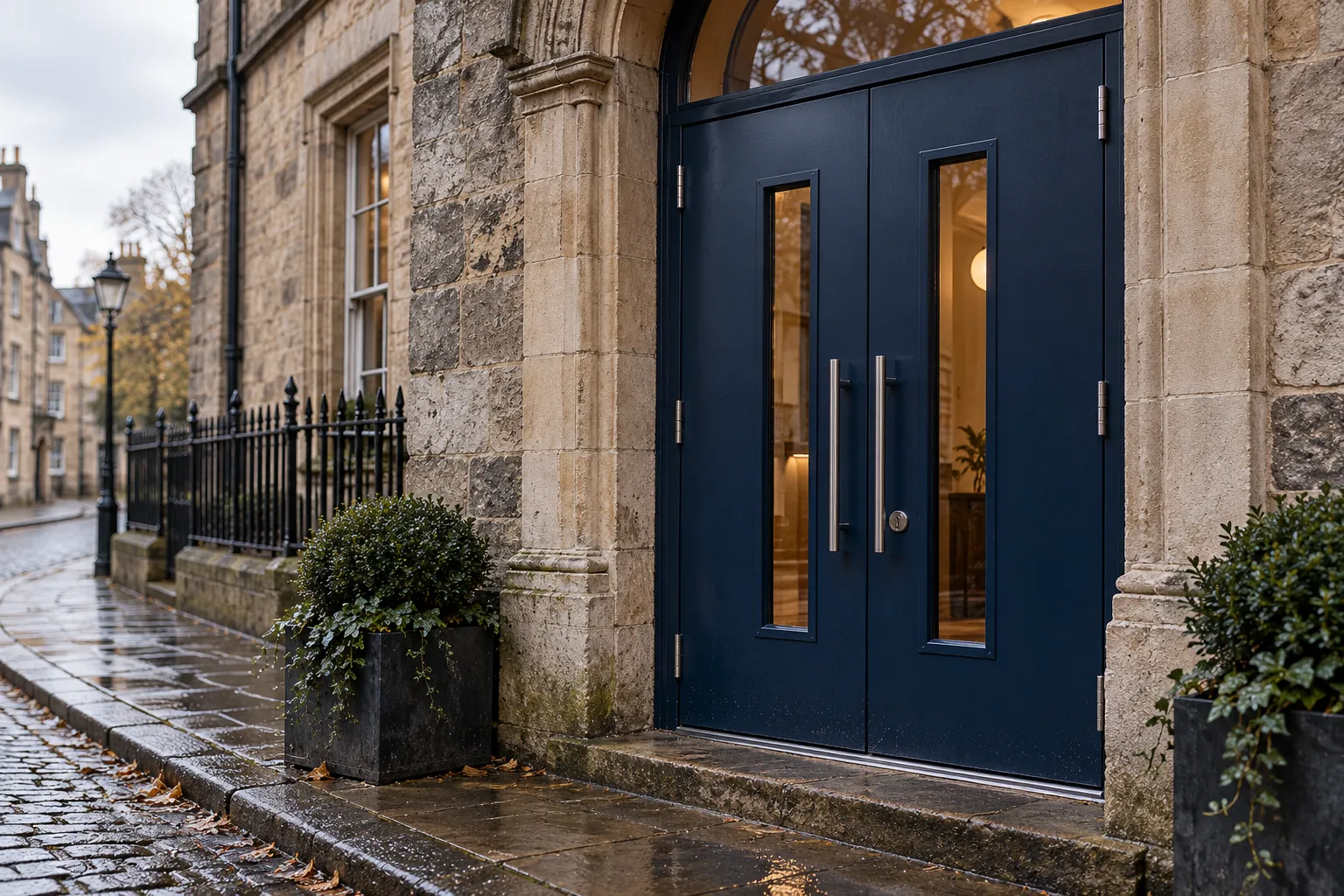
Security · LPS 1175 SR2 to SR5
Security Doors in Edinburgh
Security doors for Edinburgh offices, public buildings and historic sites: ratings, fire and security on one doorset, and what to name on the order.
- ✓Third-party test evidence with every product
- ✓Written specification you can issue to tender
- ✓Supplied and installed in Edinburgh
Get a free quote in Edinburgh
Rating, written specification and budget range within one working day.
Confidential. No cost, no obligation.
Third-party tested
Evidence with every quote
UK manufactured
Made to your sizes
One accountable team
Specify, supply, install
Confidential handling
Details never shared
Supplied and installed in Edinburgh
What we supply in Edinburgh
An Edinburgh order goes right when it starts with the opening and the building it serves. A rated steel door suits a staffed entrance, a fire rated doorset belongs on every escape route, and a gate beside a yard needs a rating of its own.
Edinburgh is Scotland’s capital, and its buildings ask different questions of their doors. Offices and public buildings fill the city centre, historic buildings and listed facades stand beside them, and each kind of building needs a door that suits its own use.
Keep the order straight with one list, one row for each opening. Each row should carry the building and the position, the fire period, the security rating where one is needed, and the leaf, the frame, the glass, the seals and the hardware as a single doorset. Our Edinburgh page covers the city as a whole, and our Glasgow page covers the city to the west.
- LPS 1175Forced entry rating, B3 to D10
- ISO 22343-1Vehicle impact test for gates and yards
- FD30 / FD60Fire resistance periods tested to EN 1634-1
- Martyn’s LawTiers for premises holding 200 or more people
Offices and public buildings: entrances that serve a capital city
Staff, visitors and deliveries pass an Edinburgh office entrance through the day, and the door has to admit the right people while keeping strangers out. Glazing lets reception staff see a visitor before the door opens, while a rated screen holds if the visitor turns hostile. A screen with no rating gives way at the first blow, leaving the entrance behind it open. How glass, frame and beads are tested together as one assembly is set out in our fire rated windows guide.
Crowded premises fall inside the duties of Martyn’s Law, which sets tiers for premises that hold 200 or more people, with Royal Assent in April 2025 and go-live expected in spring 2027. That puts the doors that release a crowd inside the same duties: they have to open in one action, in the direction of escape, without a key. Our Martyn’s Law guide sets out the tiers and what each one asks of a building.
Murrayfield and the Fringe: doors for festival crowds
Murrayfield Stadium stands in the west of Edinburgh, opened in 1925, and holds 67,144 people, the largest stadium in Scotland. Every August the Edinburgh Festival Fringe takes over the city, and in 2025 it ran 53,942 performances of 3,893 shows across 301 venues, with more than 2.6 million tickets sold. A stadium and a festival put crowds through doors in waves, before a show, at the interval and after it ends.
Festival venues range from theatres and halls to rooms in pubs and church halls, and many of them were never built for the crowds they now hold. Panic hardware to BS EN 1125 is needed on doors serving rooms of more than 60 people, and the push bar must cover 60 percent of the leaf or more. Martyn’s Law puts premises that hold 200 to 799 people in the standard tier, and premises that hold 800 or more in the enhanced tier. Royal Assent was granted in April 2025. The duties are expected to start in spring 2027. The Martyn’s Law guide for premises lists the tiers.
A festival venue also needs a door that shuts on its own once the crowd has gone. A closer to BS EN 1154 must be sized to the leaf, and EN 3 is the lowest power size for a fire door. Check the gap around the leaf as well: 4 mm is the figure, and a wider gap lets smoke pass. The exhibition centre security doors guide sets out venue doors.
| Building | Door | Rating to name |
|---|---|---|
| Murrayfield Stadium | Stadium bowl exit doors | BS EN 1125 panic hardware |
| Festival venue | Theatre and hall doors | BS EN 1125 panic hardware |
| St James Quarter | Shopfront and service doors | LPS 1175 C5 on the rear door |
| Royal Infirmary of Edinburgh | Ward and store doors | Fire to EN 1634-1 and LPS 1175 where rated |
Little France and the Old Town: hospital and university doors
The Royal Infirmary of Edinburgh moved to Little France, in the south east of the city, in 2003, on a 900 bed site. The hospital was first established in 1729, and it is the oldest voluntary hospital in Scotland. Its medical school building, the Chancellor’s Building, stands beside the hospital, so teaching and treatment share one site. On that site a door must do three things at once: hold fire for its rated period, resist forced entry where the room needs it, and open with a force a patient can manage.
The University of Edinburgh was founded in 1582, and its buildings sit across the Old Town and the south of the city. The Old Town and the New Town together were listed as a UNESCO World Heritage Site in 1995, so a door on a listed facade needs a planning check before it is ordered. St James Quarter opened in the east end of the New Town on 24 June 2021, and its shopfronts face the public all day while its service doors face quiet yards after closing. A service door at the back faces a quiet yard after the shops close, so it needs a higher rating than the staffed front. Order the rear door at C5 and the front entrance at B3. The university security doors guide lists campus doors in full. The shopping centre security doors guide sets out retail doors.
Put the stadium, the festival venues, the hospital and the university on one schedule. Give each opening one rating, and file the evidence with it.
Historic buildings and listed facades: doors that respect the fabric
Edinburgh is a city of listed buildings, and a door in a historic facade has to respect the fabric around it. A steel leaf in a listed facade needs a finish and fixing that the conservation officer accepts, and the work may need listed building consent before it starts. Ask the planning authority what the job needs before the order is placed.
Let the weather the door will face choose the finish. Powder coating gives a sheltered door colour and a hard surface, while galvanising puts a zinc coat on the steel that guards the edges and cut sections against wet weather. A powder coated top coat over a galvanised base gives the door both. Our powder coating vs galvanising guide compares the two finishes, and our powder coating page covers the finish options.
The leaf gets the attention, but the hinges decide whether it keeps working. Fit hinges to BS EN 1935, grade 13 or grade 14 for a heavy leaf, because a hinge that has dropped lets the leaf sag until the closer cannot pull it square. Use the same visit to look at the gaps and the seals: the usual limit is a 4 mm gap round the leaf, and the intumescent seal is the part that closes that gap in a fire, swelling at roughly 200 to 250 degrees.
The Castle and the Royal Mile put a fortress at the top of a shopping street
Edinburgh Castle stands on Castle Rock, the plug of an extinct volcano, and St Margaret’s Chapel inside it dates from the early 12th century, which makes it the oldest building in Edinburgh. The castle is in the care of Historic Environment Scotland and drew 2,044,963 visitors in 2025. A building that takes that many visitors needs doors that admit a crowd, let it out in one movement when the alarm sounds, and sit in stonework that consent protects from change. Where a room holds over 60 people, fit its doors with panic hardware under BS EN 1125, and give each door a push bar that spans 60 percent of the leaf at least. The museum security doors guide lists visitor doors and the ratings beside them.
The Royal Mile runs from the Castle down to the Palace of Holyroodhouse, a series of streets almost exactly one mile long: Castlehill, the Lawnmarket, the High Street, the Canongate and Abbey Strand. Shopfronts along the Mile face the public all day, while service doors open onto closes that fall quiet after closing, so the front and the rear of one shop need different ratings. LPS 1175 B3 fits a staffed front, and LPS 1175 C5 fits a rear door that faces a quiet close after hours. The retail security doors guide compares a staffed front with a quiet rear door, and the shopping centre security doors guide works through mall entrances and service doors.
| Building | Door | Rating to name |
|---|---|---|
| Edinburgh Castle | Visitor entrance doors | Panic hardware to BS EN 1125 |
| Royal Mile shop | Front and rear doors | B3 at the front, C5 at the rear |
| Ocean Terminal | Mall entrance | Closer to BS EN 1154, EN 3 minimum |
| Royal Yacht Britannia | Visitor entrance | LPS 1175 B3 where rated |
Britannia berthed at Ocean Terminal, and the docks around her changed use
The Royal Yacht Britannia served the Royal Family from 1954 until she was decommissioned in 1997, and she has been berthed at Ocean Terminal in Leith since 1998 as a visitor attraction, with over 300,000 visits a year. Ocean Terminal opened in 2001 on land that once held a shipyard, and it now holds shops, restaurants and a cinema beside the yacht. Doors on that waterfront face damp and salt air, so a galvanised base under a powder coated top coat suits them, provided the tested doorset allows that finish. The powder coating versus galvanising guide sets the two finishes side by side.
Leith still works as a port beside its leisure uses, and a dock personnel door cycles more often in a day than any other door in the city. Steel takes the knocks a dock door meets every day, yet a leaf that takes a knock can still fail the forced entry test. The rating sits on the whole assembly, not on the leaf alone: leaf, frame, fixings, glazing and hardware proved in one test together, and a rated leaf in an untested frame proves nothing. Fire periods of FD30 or FD60 to EN 1634-1 belong on escape routes, and the gap round the leaf stays at 4 mm as the usual limit. The warehouse security doors guide works through the doors dock and distribution buildings need most.
Put the Castle, the Royal Mile, the yacht and the docks on one schedule, and name one rating for each opening beside the evidence that proves it. The castle entrance and the dock personnel door take different use, and one schedule shows both side by side.
Reading B3, C5 and D10 on an Edinburgh order
Buyers meet three ratings most often, and each one names a tool set and a time. B3 stands for three minutes against category B tools: screwdrivers, pliers and hand saws. C5 stands for five minutes against category C tools: crowbars, drills and chisels. D10 stands for ten minutes against category D tools: sledgehammers, disc cutters and jigsaws. The letters and numbers replaced the old SR labels, so SR2 on an old drawing means B3, SR3 means C5, and SR4 means D10.
Give each opening the rating its approach calls for, not the rating its postcode suggests. A staffed front entrance needs less than a rear door that faces a quiet yard after hours, so walk the outside of the building, list every door a person can reach, and set the rating of each one by the attack it could face. The changes that void a rating are set out in our keeping an LPS 1175 rating valid guide, and the two routes are compared side by side in our LPS 1175 vs PAS 24 guide.
The enhanced security standard for doorsets is PAS 24, and EN 1627 sets resistance classes RC1 to RC6 for windows, doors and shutters. A Secured by Design mark is a scheme mark, not a rating, so on its own it proves nothing about resistance: always ask for the test rating behind it. Our SR2 vs SR3 vs SR4 guide compares the three ratings buyers meet most often.
One Edinburgh doorset, two duties: fire and forced entry
Fire and forced entry often sit on the same Edinburgh doorset. A server room door holds fire while it keeps an attacker from the equipment inside, and a plant room door holds fire while it resists a forced entry. Each duty needs its own evidence on the same assembly: a fire classification to EN 1634-1 and a forced entry rating to LPS 1175 or PAS 24. Our dual certification guide works through how the two sets of evidence sit on one assembly.
A fire classification comes from the EN 1634-1 furnace test, and the number after FD is the minutes the doorset holds: 30 for FD30, 60 for FD60. FD30S adds smoke control to 30 minutes of integrity, tested to BS EN 1634-3, and EI caps the temperature rise on the safe side at 140 degrees Celsius on average and 180 degrees at most. The rating belongs to the whole tested assembly, so a change to the leaf, the frame, the glass, the seals or the hardware can break the tested construction and leave the door with no proven rating.
Crowds, festivals and the doors that release them
Edinburgh holds festivals that fill its streets and venues with crowds, and the doors on those routes must release a crowd in one movement when the alarm sounds. Panic hardware to BS EN 1125 belongs on doors that serve more than 60 people, with a bar across the leaf covering at least 60 percent of the leaf width. A door must open with less than 30 N in the first 30 degrees and less than 22.5 N beyond that, under BS 8300 and Approved Document M. A closer that is too strong for the leaf makes the door fail the access rules. Our fire door closers guide sets out the power sizes in BS EN 1154.
A wedge gives a door no release at all: the leaf stands open through a fire and the smoke follows it. Fit a hold-open device to BS EN 1155 instead, which keeps the leaf open for use and lets it go the moment the alarm sounds, then put the release on the inspection routine so it is proved at every visit. The full set of checks that catch a failing leaf early is in our fire door inspection checklist.
Access control for an Edinburgh estate
Run the whole Edinburgh estate on one access system rather than a different one at each site. Give staff cards, give visitors a code or a pass, and give contractors a credential that stops working when the job ends. Then match the method to the door: a city centre office needs readers that keep up with a walking crowd, and a distribution unit needs cards that work at shift change.
Write down the fail state for every door, then prove each one with the power switched off. Security asks a door to stay locked, escape asks it to open, and the two answers are opposites, so the facilities team needs both in writing where they can be found. Bring the doors, the turnstiles, the lifts and the car park onto the same system, so a lost credential stops working everywhere at once. For readers, fobs and biometrics, and how the lane is wired in, see our security turnstiles guide.
City of Edinburgh Council and the planning check
Replacing a door like for like inside its existing opening usually needs no planning permission. Three cases need a check first: major alterations to the outside of a building, work in a conservation area, and work to a listed building, which needs separate consent. The listed building case is the one buyers miss most often.
City of Edinburgh Council is the planning authority, and listed buildings answer to duties a new building never meets. Fit a door without the right consent and it can be ordered out again, so the enquiry should carry the listing and the conservation area next to the door schedule. A steel leaf set into a listed facade needs a finish and a fixing the conservation officer will accept, and the planning needs starting early, with its time allowed for in the programme.
What an Edinburgh enquiry should name
Treat an Edinburgh order as a specification exercise, not a purchase from a catalogue. The enquiry must carry the building and the position, the fire rating, the security rating where one is needed, and the leaf, the frame, the glass, the beads, the seals and the hardware as a single doorset. Where attack resistance is part of the job, the security evidence has to cover the whole doorset, a rating to LPS 1175 or PAS 24 proved on the assembly, not on the leaf alone. The same discipline, column by column, is in our how to specify security doors guide.
Make sure the test report, the classification and the hardware schedule arrive with the doorset, and check that the handover pack names the inspection routine the site will follow. Evidence filed on the day the doors arrive gives the estate a record it can use for the whole life of the building. Write the schedule first, then order against it. The checks that catch a failing leaf before it matters are in our fire door inspection checklist.
| Premises | Door position | Rating | What to check |
|---|---|---|---|
| City centre office | Glazed entrance | LPS 1175 where rated | Screen rating, reader pace |
| Public building | Concourse and escape doors | FD30 or FD60 | Hold-open release, opening force |
| Historic building | Listed facade door | LPS 1175 where rated | Finish, fixings, consent |
| Stores and plant room | Internal doors | FD60 | Seals, gaps, self-closing |
| Distribution unit | Personnel door | LPS 1175 B3 or C5 | Leaf, hinges, latch |
In Edinburgh, the entrance that serves a city centre office and the door in a listed facade answer different questions, and a schedule that gives them the same answer will fail one of them.
What LPS 1175 rating suits an Edinburgh office door?
For most office entrances, B3 suits a staffed front entrance and C5 suits a rear or side door facing a quiet approach. The risk assessment for that opening should decide.
Can an Edinburgh doorset hold a fire rating and a security rating at once?
Yes, where one doorset carries the proof for both. The fire classification comes from a test to EN 1634-1 and the forced entry rating from a test to LPS 1175 or PAS 24.
Do I need planning permission to change a door in Edinburgh?
A like-for-like replacement inside an existing opening usually needs none. A new opening, work in a conservation area, or work on a listed building calls for a check with City of Edinburgh Council before ordering.
What finish lasts on an Edinburgh door?
A door that stands in rain and cold suits a galvanised finish, because the zinc coat guards the steel itself, edges and cut sections included. Ask whether the tested doorset allows the finish before ordering.
How do I order doors for several Edinburgh sites?
Build one door schedule with one line per opening, naming the building, the position, the fire rating, the security rating and the whole doorset. Ask for the evidence to travel with the doors, and file it on the day they arrive.
For a building with more than one opening, our enquiry checklist for security doors sets out the rating, hardware and evidence to name for each door.
Get a free quote
Other areas
Security doors in other areas
Ready to specify your project?
Free assessment, written specification and test evidence. Reply within one working day.