
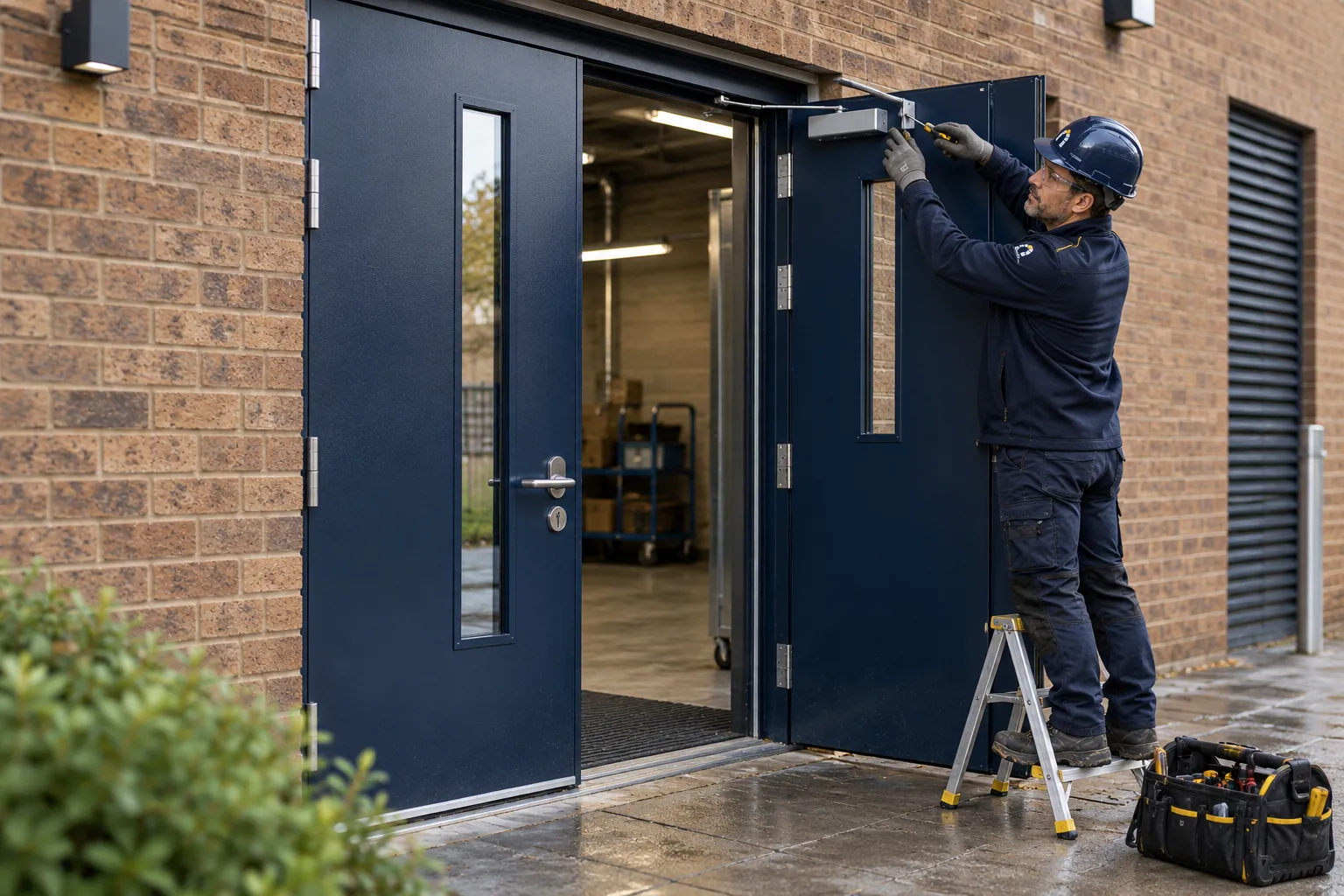
Security · LPS 1175 SR2 to SR5
Security Doors in Coventry
Security doors for Coventry manufacturing, research and logistics sites: ratings, gates and yards, fire and security on one doorset, and the order itself.
- ✓Third-party test evidence with every product
- ✓Written specification you can issue to tender
- ✓Supplied and installed in Coventry
Get a free quote in Coventry
Rating, written specification and budget range within one working day.
Confidential. No cost, no obligation.
Third-party tested
Evidence with every quote
UK manufactured
Made to your sizes
One accountable team
Specify, supply, install
Confidential handling
Details never shared
Supplied and installed in Coventry
What we supply in Coventry
A Coventry buyer should start from the opening, not the catalogue. A rated steel door at B3 or C5 suits most manufacturing and logistics entrances, a fire rated doorset suits any escape route, and a personnel door beside a loading bay needs its own rating.
Coventry holds manufacturing and research sites, industrial estates and logistics yards, and each kind of site asks a different question of its doors. A factory needs a steel personnel door that takes a forklift, a pallet and a shift of workers every day. A research site needs doors that guard rooms holding equipment and records. A logistics yard needs a gate, a turnstile lane and a door that guards the stores behind them.
The answer is a door schedule with one line per opening. Each line names the building, the position, the fire rating, the security rating where one is needed, and the leaf, the frame, the glass, the seals and the hardware as one doorset. Our West Midlands guide covers the region as one market, and our Birmingham page covers the city beside Coventry.
- LPS 1175Forced entry rating, B3 to D10
- ISO 22343-1Vehicle impact test for gates and yards
- FD30 / FD60Fire resistance periods tested to EN 1634-1
- BS EN 1154Closer power sizes, minimum EN 3 on fire doors
Manufacturing sites: the doors that take the most use
A personnel door on a Coventry factory opens for every shift change, every delivery and every break. A door that is specified for a quiet office will not last on a factory floor, and a door that will not last will be wedged open within a week. Walk the site at shift change before spending on higher ratings, because doors propped open during shift changes undo the rating before any test matters.
Steel carries the use. A steel leaf resists the knocks a factory door takes every day: a trolley, a pallet, a boot, a crate. A steel leaf is strong, but strength is not a security rating. The rating belongs to the complete tested assembly, so a rated leaf in an untested frame is not a rated door. Our warehouse security doors guide covers the doors manufacturing buildings need most.
What a working door must survive
A factory floor door takes more in a day than most doors take in a month. Forklifts cross it, pallets clip it, dust settles on it and trolleys run through it, and the door must still shut tight at the end of the shift. The door that survives the floor is the one whose frame, threshold and closer were ordered for the floor, not for a quiet corridor. Dust gets into the hinges, and a hinge full of dust stiffens and drags.
Impact comes first, and the frame takes it. A steel frame stays square where a forklift clips the corner, so the bolt still meets its keep and the seal still meets the frame. A frame that bends lets the door drop, and a dropped door drags its bottom edge and leaves a gap above it. The steel door frames guide sets out the frame, the fixing and the shape it must hold.
Dust is the slow test. Dust settles in the gap round the door and on the seal, and a seal clogged with dust cannot shut the gap when it must. The gap round a fire door is gauged at 4 mm, and smoke control is tested to BS EN 1634-3, with Sa and S200 as the classes. The fire door gaps guide sets the limits, and the smoke control doors guide gives the seal and the smoke it must hold back.
The closer is set to the door it serves, not to its strongest point. Closers take their power sizes from BS EN 1154, and a fire door takes no smaller power than EN 3, so the setting must pull a heavy factory door home without slamming it into the frame. The fire door closers guide works through the power sizes and the setting for a door that works all day.
| Part | Factory floor test | What fails first |
|---|---|---|
| Threshold | Forklifts and trolleys all day | Wear into a hollow, trip at the edge |
| Frame | Pallets clipping the corner | Frame out of square, bolt misses its keep |
| Closer | Door opening a hundred times a day | Power lost, door stands open |
| Seal | Dust settling in the gap | Seal clogged, gap left open |
The threshold takes the traffic first
It meets every wheel that crosses the floor, and it wears before any other part. Forklift wheels run over it all day, and a threshold that wears into a hollow trips the next trolley and lets the door drop onto its bottom edge. Check the threshold on the same visit as the closer, and write down any edge that has started to rise.
A door that works this hard needs its inspection on the calendar, not in the memory of one person. The fire door inspection checklist guide gives the checks in order, and the security door specification mistakes guide gives the errors that order a corridor door for a factory floor.
Put the frame, the threshold and the closer on one line of the schedule, with the rating beside each one.
Research sites and the rooms behind the door
A research site guards rooms that hold equipment, records and work in progress, and its doors must resist an attack on those rooms while still letting staff out fast. A server room door and a plant room door must each hold fire and resist a forced entry, and the two jobs need two sets of evidence on one assembly. Our dual certification guide works through how fire and security sit on one assembly.
A vision panel lets staff see who is on the other side before opening the door, and the glass must carry the same fire rating as the leaf where the fire strategy asks for it, with beads and seals tested as part of the doorset. EI adds an insulation limit on temperature rise on the unexposed face. Our fire rated windows guide sets out how glass, frame and beads are tested together.
The CBS Arena: doors that empty 32,609 seats
The Coventry Building Society Arena opened in 2005 as the Ricoh Arena, and its stadium holds 32,609 people for football as the home of Coventry City FC. At full time the exits must empty the ground fast: every exit door opens with one push, no key and no code. Martyn’s Law sets its standard tier at premises holding 200 to 799 people and its enhanced tier at premises holding 800 or more. The Act received Royal Assent in April 2025, with the duties expected to take effect in spring 2027. The stadium security doors guide deals with exit doors, turnstile lanes and service doors for a ground.
West Orchards stands on Smithford Way in Coventry city centre, and it opened on 23 April 1991 with 11 stores. Up front the shopfront is staffed and lit through trading hours. Round the back the service door opens onto a service road that goes quiet once trading ends, so rate the rear door higher: nobody watches that side after the shops shut. Give the staffed front B3 and the rear door C5.
Crowd doors need closers matched to the leaf, not just strong ones. BS EN 1154 sizes closers by power: EN 1 is the smallest size, and a fire door needs EN 3 at least. Under BS 8300 and Approved Document M the door must open with under 30 N of force through the first 30 degrees, then with under 22.5 N beyond that.
| Building | Door | Rating to name |
|---|---|---|
| Coventry Building Society Arena | Stadium exit doors | Panic hardware, BS EN 1125 |
| West Orchards | Shopfront door | LPS 1175 B3 where rated |
| West Orchards | Service door | LPS 1175 C5 for a rear door |
| University Hospital Coventry | Ward entrance | Fire to EN 1634-1 and low opening force |
Priory Street, the cathedral quarter and Walsgrave: campus, civic and hospital doors
Coventry University stands on Priory Street in the city centre, and it gained university status in 1992 on a purpose-built 33 acre campus beside Coventry Cathedral. On a campus the door changes with the room: a teaching room door swings easily for a full class, a laboratory door guards the equipment inside, and a hall door admits residents and keeps strangers out. Campus doors are covered in the university security doors guide, which deals with entrances, teaching blocks and laboratories, and hall doors are covered in the student accommodation guide.
Coventry Cathedral holds two buildings side by side. The old St Michael’s was largely destroyed in the Coventry Blitz of 14 November 1940, and the new cathedral beside the ruins was consecrated on 25 May 1962. Both are Grade I listed, so consent comes before the order. A listed building door must still hold fire where the fire strategy asks for it, with the glass carrying the same fire rating as the leaf. The listed building fire doors guide covers fire doors in listed fabric and the consent that sits beside them.
University Hospital Coventry stands on Clifford Bridge Road at Walsgrave, about four miles north east of the city centre, and it opened on 10 July 2006. A hospital ward door must hold fire and let beds and trolleys through without a struggle. EN 1634-1 is the fire test behind the periods: 30 minutes in the furnace earns FD30, and 60 minutes earns FD60. Check the gaps round the leaf on the same visit: 4 mm is the usual limit, and intumescent seals shut the gap when fire reaches them. For ward, corridor and entrance doors, the hospital security doors guide covers a hospital estate in full.
Work from the building, the crowd and the hours, and order each door for what it will face.
Logistics and distribution: gates, yards and personnel doors
A logistics yard in Coventry needs a gate, a turnstile lane and a door that guards the stores behind them, and the three work as one line. A rated fence beside an unrated gate is a line with a gate-shaped hole in it. The gate that closes the opening in the yard needs its own rating on the same line, and the pedestrian gate beside it needs a lock and a closer that hold it shut. Our anti-ram gates and barriers guide works through the gate that closes the opening.
Where the yard must stop a vehicle as well as a person, the gate needs an impact rating beside its forced entry rating. ISO 22343-1:2023 is the current vehicle barrier test standard, and it supersedes PAS 68:2013 and cancels and replaces IWA 14-1:2013. The example rating V/7500[N3]/80/90:0/0 shows the parts: the vehicle type and mass, the impact speed, the impact angle and the penetration distance. Test vehicles run from a 1,500 kg car to a 30,000 kg truck, and test speeds are 48, 64 and 80 km per hour. ProtectUK guidance sets 1,200 mm as the maximum clear gap between barriers in a line and 500 mm as the minimum height, so check the whole frontage, not one product.
Loading bays need doors of their own. A high performance roller door opens and closes all day on a busy bay, and a personnel door beside it lets staff in and out without opening the bay. Our loading bay doors guide covers the bay doors in full. A powered gate in the yard adds an operator, and safety in use of power operated gates is covered by EN 12453, with the test methods in EN 12445.
What a rating means for a Coventry buyer
LPS 1175 rates a doorset by the tools and the time it resists. B3 is three minutes against category B tools, screwdrivers, pliers and hand saws. C5 is five minutes against category C tools, crowbars, drills and chisels. D10 is ten minutes against category D tools, sledgehammers, disc cutters and jigsaws. PAS 24 is the enhanced security standard for doorsets, and EN 1627 sets resistance classes RC1 to RC6. Secured by Design is a scheme, not a rating, and a door that carries the scheme mark without a test rating has no proven resistance behind it.
The rating should follow the risk, not the postcode. A factory door that guards stock and equipment needs a forced entry rating to LPS 1175 or PAS 24, on the whole doorset, while a corridor door in the same building may need none. Walk the site from outside and note every door a person can reach, then rate those doors for the attack they could face. Our keeping an LPS 1175 rating valid guide sets out the changes that void a rating, and our LPS 1175 vs PAS 24 guide compares the two routes side by side.
FD30 and FD60 are fire resistance periods tested to EN 1634-1, and the number is the minutes the doorset holds its rating in the furnace test. A door marked FD30S carries 30 minutes of integrity plus smoke control, tested to BS EN 1634-3. The fire strategy names the period for each opening, and Sa or S200 covers smoke control where the fire strategy asks for it.
Fire and security on one doorset for a Coventry building
Many doors in Coventry must do two jobs: hold fire and resist forced entry. A server room door must hold fire and resist an attack on the equipment inside. A plant room door must hold fire and resist a forced entry. The two jobs need two sets of evidence on one assembly, and a change to the leaf, the frame, the glass, the seals or the hardware can break the tested construction. Ask for the evidence when a change is proposed, not after it is made. The test report, the classification and the hardware schedule should name the exact doorset.
Check the wall the door fixes into. A rated leaf in an unrated wall gives an unrated opening, and a frame fixed into a partition that was never built to hold it will move when the door is used. Check the gaps and the seals on the same visit: a 4 mm gap around the leaf is the usual limit, and intumescent seals close the gap in a fire by expanding at roughly 200 to 250 degrees.
Access control across a Coventry estate
An estate that holds sites across Coventry needs one access system, not one per site. Staff carry cards, visitors use a code or a pass, and contractors use a temporary credential that expires when the work ends. Each method suits a different entrance: a factory needs cards that work at shift change, and a research building needs readers that work at walking pace.
The system should open for the right people and stay closed for everyone else, and it should keep a record of who passed and when. The doors should talk to the same system as the turnstiles, the lifts and the car park, so a person who loses access loses it everywhere at once. Our security turnstiles guide works through readers, fobs and biometrics and how the lane is wired into the access system.
Planning and listed buildings in Coventry
Most like-for-like door replacements inside an existing opening need no planning permission, but three cases need a check with Coventry City Council before ordering. First, major alterations to the outside of a building can need planning permission. Second, work in a conservation area faces additional controls. Third, listed buildings need separate consent, and this is the case buyers miss most often.
Consent comes before the order, not after it. A listed building carries duties that a new building does not, and a door fitted without the right consent can be ordered out again. Ask the conservation officer what the facade will accept, and put the time the consent takes in the programme from the start. A door ordered before the planning is settled is a door that may never be fitted.
Ordering for a Coventry site: what the enquiry should name
Ordering doors for a Coventry site is a specification exercise, not a shopping exercise. The enquiry should name the building, the position, the fire rating, the security rating where one is needed, and the leaf, the frame, the glass, the beads, the seals and the hardware as one doorset. The security side needs its own evidence where the door must also resist attack: a rating to LPS 1175 or PAS 24, on the whole doorset, not on the leaf alone. Where the site needs a gate as well as doors, the enquiry should name the gate type, the width and the impact rating where one is needed. Our how to specify security doors guide covers the same discipline column by column.
Order the evidence with the doors. The test report, the classification and the hardware schedule should arrive with the doorset, and the handover pack should name the inspection routine the site will follow. A site that files the evidence on the day the doors arrive has a record it can use for the whole life of the estate. Write the schedule first, then order against it. Our fire door inspection checklist gives the checks that catch a failing leaf before it matters.
| Premises | Door position | Rating | What to check |
|---|---|---|---|
| Factory unit | Personnel door | LPS 1175 where rated | Steel leaf, hinges, latch |
| Research building | Server and plant room doors | FD60 | Seals, gaps, self-closing |
| Logistics yard | Vehicle and pedestrian gates | ISO 22343-1 where rated | Posts, foundations, gaps |
| Industrial estate | Stores and loading bay doors | LPS 1175 where rated | Closer, latch, hold-open release |
In Coventry, the door that suits a research site does not suit a logistics yard.
What LPS 1175 rating do I need for a Coventry factory door?
For most factory entrances, B3 suits a staffed front entrance and C5 suits a rear or side door facing a quiet approach. The rating should follow the risk assessment for that opening.
Can one doorset carry a fire rating and a security rating?
Yes, where both tests were run on the same doorset. The fire classification comes from EN 1634-1 and the forced entry rating from LPS 1175 or PAS 24, and the evidence must name the same construction for both. Strength alone is not a security rating.
Do I need planning permission to replace a door in Coventry?
Most like-for-like replacements inside an existing opening need none, but a new opening, work in a conservation area, or work to a listed building needs a check with Coventry City Council before ordering.
What should a Coventry logistics enquiry name?
The gate type, the width, the impact rating where one is needed, and the leaf, the posts, the fixings, the foundations, the operator and the access control as one system.
How do I keep access control consistent across Coventry sites?
Run one access system across the estate, not one per site, so a person who loses access loses it everywhere at once. Cancel cards when they are lost and change codes when staff leave.
Get a free quote
Other areas
Security doors in other areas
Ready to specify your project?
Free assessment, written specification and test evidence. Reply within one working day.