
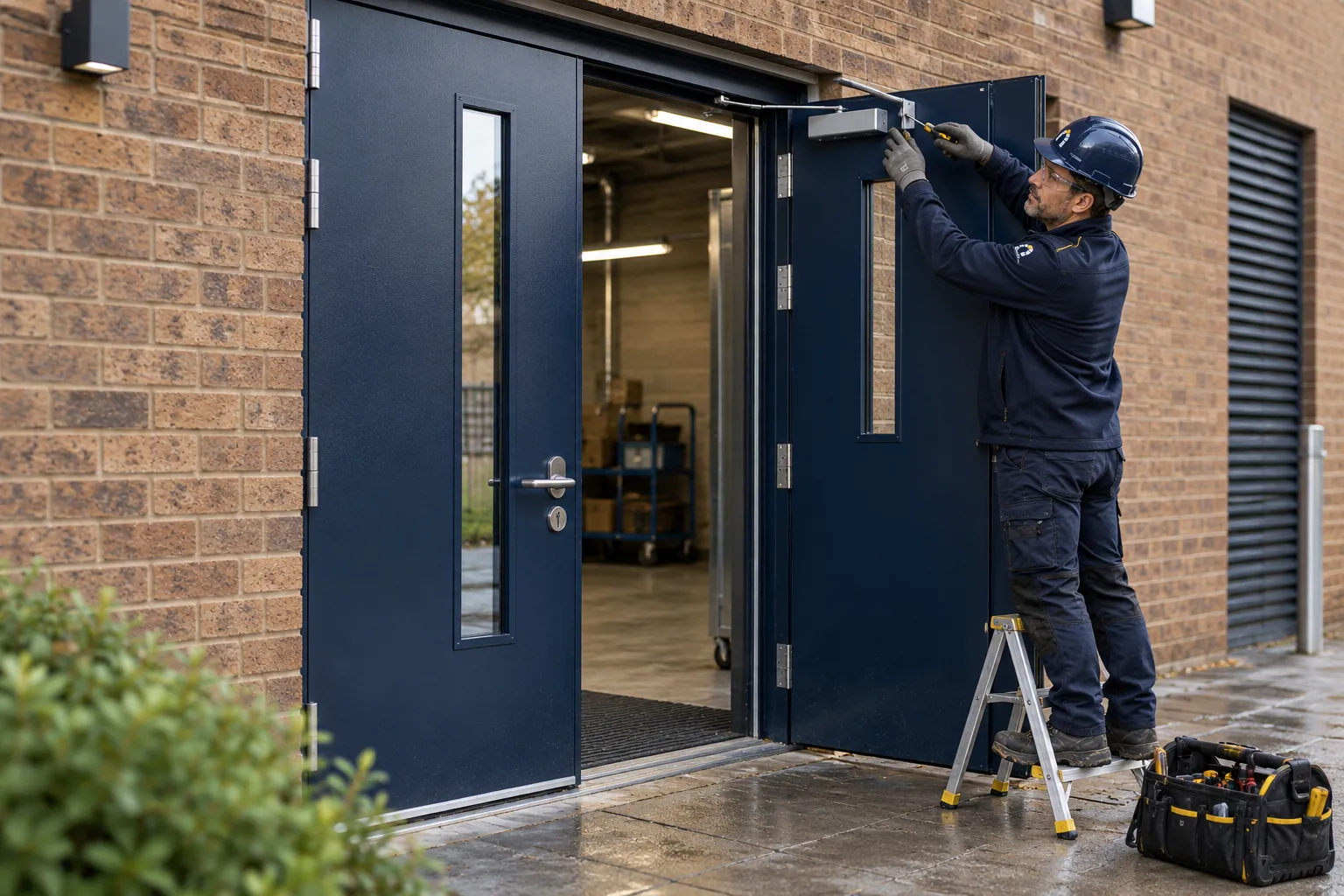
Security · LPS 1175 SR2 to SR5
Security Doors in Wolverhampton
Security doors for Wolverhampton industrial estates, workshops and logistics yards: ratings, fire and security on one doorset, and what to name on the order.
- ✓Third-party test evidence with every product
- ✓Written specification you can issue to tender
- ✓Supplied and installed in Wolverhampton
Get a free quote in Wolverhampton
Rating, written specification and budget range within one working day.
Confidential. No cost, no obligation.
Third-party tested
Evidence with every quote
UK manufactured
Made to your sizes
One accountable team
Specify, supply, install
Confidential handling
Details never shared
Supplied and installed in Wolverhampton
What we supply in Wolverhampton
A Wolverhampton buyer should start from the opening, not the catalogue. A rated steel door at B3 or C5 suits most industrial and workshop entrances, a fire rated doorset suits any escape route, and a steel leaf with a hard wearing finish suits doors that take a shift of use every day.
The sections below work through the buildings that set the brief, the steel personnel door, the ratings behind an order, fire and security on one doorset, access control, loading bays and rear doors, planning checks, and the enquiry itself. Our security doors West Midlands guide covers the region as one market, and our Birmingham page covers the city at the centre of it.
Wolverhampton holds industrial estates, workshops, logistics yards and distribution units, and a door that suits one of those buildings does not always suit another. A personnel door on a workshop opens for every shift change, and a door on a distribution yard opens for every lorry that arrives and leaves. The schedule should name the building and the position for each opening.
- LPS 1175Forced entry rating, B3 to D10
- PAS 24Enhanced security doorset standard
- FD30 / FD60Fire resistance periods tested to EN 1634-1
- BS EN 1154Closer power sizes, minimum EN 3 on fire doors
Workshops, yards and distribution units: the buildings that set the brief
A workshop is a small unit where the door takes daily use and the stock inside is worth protecting. Staff come and go through the personnel door, deliveries arrive at the side door, and the rear door faces a yard that is quiet after hours. A door on a workshop must resist a forced entry from a quiet side street and still open easily for the people who use it every day.
A logistics yard runs to a different rhythm. Lorries arrive and leave through the gate, staff pass through the personnel door at every shift change, and the stores behind the door hold goods in transit. A personnel door on a yard needs a rating that suits the approach it faces. Our warehouses and logistics sector page covers the buildings that hold the stock, and our warehouse security doors guide covers the doors those buildings need most.
Steel personnel doors that take a shift of use
Steel carries the use a Wolverhampton door takes every day. A steel leaf resists the knocks a workshop door meets: a trolley, a pallet, a boot, a crate. A leaf that dents beside the lock weakens the lock fixing, and a leaf that splits through its edge breaks the edge the seals press against. Our fire rated steel doors page covers the steel leaf that carries the hardest use most often.
Hinges and closers decide whether the leaf keeps working after the first year. Hinges to BS EN 1935 carry the leaf, grade 13 or grade 14, and a hinge that has dropped lets the leaf sag, so the closer cannot close it squarely. A closer to BS EN 1154 should bring the leaf back and hold the latch every time, without a slam and without stopping short, and the minimum power size on a fire door is EN 3. A door that does not close has no fire performance and no security performance, whatever its certificate says.
The personnel door works harder than any other door on the site
On any site with a shift, one door opens more often than all the others put together. It takes the first arrival of the morning, the trolleys at midday, the visitors in the afternoon and the last person out at night, and it must shut after each one of them. A door that is asked to do this all day needs its closer, its threshold and its lock ordered for the shift, not for a quiet office.
The closer does the shutting, and the setting decides whether it works. A closer set too weak leaves the door standing open, and a closer set too strong slams it into the frame and wears the hinges. BS EN 1154 sizes closers by power, and the power must pull the door home after every passage without slamming it. The fire door closers guide deals with closer power and the setting that brings the door home.
Trolleys test the threshold, not the door. The wheels cross the same strip all day, and the strip wears where the wheels run, so the door starts to catch and the gap at the top grows. Measure the gap with a gauge, and keep it at 4 mm on a fire door. The fire door gaps guide gives the gap limits round the door, and a door that has dropped shows its gap at the top first.
The lock must work from inside as well as from outside. A person inside must be able to open the door without a key and without a code, and panic hardware to BS EN 1125 gives that release at a single push. The security door locks guide covers the lock, the bolt and the fixing that holds them, and the panic hardware guide gives the bar and the single action release.
| Moment in the shift | What the door does | What wears |
|---|---|---|
| First arrival | Opens for every card | Reader and handle |
| Mid-shift | Shuts after every passage | Closer arm and hinges |
| Trolley run | Takes wheels over the threshold | Threshold edge |
| End of shift | Locks behind the last person | Lock and bolt |
After every passage, the door must shut
A door that closes behind each person does three jobs at once: it holds fire, it holds the weather out and it holds the building shut. A fire door that stands open holds nothing, so the gap and the seal are checked on the same visit as the closer. The fire door maintenance guide lists the seal checks and the closer checks together, and the how to specify security doors guide gives the schedule the checks are written against.
The test of a personnel door is simple, and it is done by hand. Open it, let it go and watch it shut, then try the lock from inside and from outside. A door that passes that test at the end of a shift will pass it at the start of the next one.
A personnel door that works all day without being noticed is doing its job.
What B3, C5 and D10 mean on a Wolverhampton order
LPS 1175 rates a doorset by the tools and the time it resists. A SR2 rated steel door resists three minutes of attack with tools such as screwdrivers, pliers and hand saws. C5 covers five minutes with crowbars, drills and chisels, and D10 covers ten minutes with sledgehammers, disc cutters and jigsaws. The rating is written as a letter and a number, and both halves must be read together.
The rating should follow the risk for each opening. A front entrance that is staffed all day suits B3, a rear door that faces a quiet yard suits C5, and a door that guards high value stock, a plant room or a cash handling area suits D10. PAS 24 is the enhanced security standard for doorsets, tested against a lower threat level than LPS 1175, and it suits entrances where the threat is opportunistic rather than planned. EN 1627 sets resistance classes RC1 to RC6, and Secured by Design is a scheme, not a rating. Our LPS 1175 vs PAS 24 guide compares the two routes, and our SR2 vs SR3 vs SR4 guide works through the three ratings buyers meet most often.
The rating belongs to the complete tested assembly, not to the leaf alone. A rated leaf in an untested frame is not a rated doorset, and a change to the leaf, the frame, the glass, the seals or the hardware can break the tested construction. Ask for the test report and the classification naming the exact doorset before the order is placed. Our guide to keeping an LPS 1175 rating valid sets out the changes that void a rating and the inspection routine that keeps it alive.
Fire and security on one Wolverhampton doorset
Many doors in Wolverhampton must do two jobs: hold fire and resist forced entry. A server room door must hold fire and resist an attack on the equipment inside, and a plant room door must hold fire and resist a forced entry. The two jobs need two sets of evidence on one assembly: a fire classification to EN 1634-1 and a forced entry rating to LPS 1175 or PAS 24. FD30 and FD60 are fire resistance periods tested to EN 1634-1, and the number is the minutes the doorset holds its rating in the furnace test. A door marked FD30S carries 30 minutes of integrity plus smoke control, tested to BS EN 1634-3.
Escape hardware deserves its own check on a door that carries both jobs. A panic bar to BS EN 1125 should cover at least 60 percent of the leaf width, and the door should open in one action, in the direction of escape, without a key. A door must open with less than 30 N in the first 30 degrees and less than 22.5 N beyond that, under BS 8300 and Approved Document M. A change that breaks one rating often breaks the other, so ask for the evidence when a change is proposed, not after it is made. Our dual certification guide works through how fire and security sit on one assembly.
Access control on a site with many doors
A site with many doors needs one access system, not a different method at each door. Staff carry cards, visitors use a code or a pass, and contractors use a temporary credential that expires when the work ends. Each method suits a different entrance: a workshop needs cards that work at shift change, a stores door needs a check that cannot be lent to another person, and a gate needs a reader that works at walking pace.
The fail state must be agreed in advance and tested with the power off. A door that must stay locked for security and a door that must release for escape need different answers, and the answer should be written down where the facilities team can find it. A turnstile lane beside the vehicle route handles foot traffic without opening the vehicle lane, and walking through the vehicle lane lets a person tailgate a legitimate vehicle. Our security turnstiles guide works through readers, fobs and biometrics and how the lane is wired into the access system.
Molineux and the City Campus: doors for a matchday and a lecture day
Molineux Stadium stands on Waterloo Road in Wolverhampton, and Wolverhampton Wanderers have played there since 1889. The ground holds 31,750 supporters, all seated, and on a matchday the exit doors carry that whole crowd out in a short time. Every door on an escape route must open in a single movement, with nothing to turn and nothing to type, and it must hold against a crowd pressing from behind. On an escape route that serves more than 60 people, fit a push bar made to BS EN 1125, spanning at least 60 percent of the leaf, which covers every exit at a ground of this size. Two tiers sit behind Martyn’s Law, drawn by headcount: a standard tier for places holding 200 to 799 people, and an enhanced tier for places holding 800 or more. The Act reached Royal Assent in April 2025, and spring 2027 is the date expected for the duties to bite, so a specification written now should already work to the tier the ground falls in. For the doors themselves, the stadium security doors guide is the reference, and the Martyn’s Law guide for premises lays out the tiers and what each tier asks of a premises.
The University of Wolverhampton has its City Campus on Wulfruna Street, in the city centre opposite Molineux, and three halls of residence stand on the campus at North Road, Lomas Street and Randall Lines. A city campus packs lecture theatres, laboratories, libraries and student bedrooms into a small area, and the doors change with each room. A lecture theatre door must let a full audience out between sessions, a laboratory door keeps people and equipment behind one leaf, and a hall door must let residents in while keeping strangers out. Campus doors are set out in the university security doors guide, while halls of residence have their own treatment in the student accommodation guide.
| Building | Door | Rating to name |
|---|---|---|
| Molineux Stadium | Stadium exit doors | Panic hardware, BS EN 1125 |
| University of Wolverhampton | Teaching block entrance | LPS 1175 B3 or C5 where rated |
| New Cross Hospital | Ward and corridor doors | FD30 or FD60 to EN 1634-1 |
| Mander Centre | Shopfront and service doors | LPS 1175 C5 rear, B3 front |
New Cross Hospital and the Mander Centre: doors for wards and shopfronts
New Cross Hospital stands on Wolverhampton Road in Heath Town, and it is run by The Royal Wolverhampton NHS Trust. A hospital never closes, so its doors face constant use from staff, patients and visitors at every hour. Fire resistance is written as FD30 or FD60, the periods tested to EN 1634-1, and a door marked FD30S adds smoke control tested to BS EN 1634-3. A ward door must also open with little effort, so the force it takes stays under the BS 8300 and Approved Document M limits: under 30 N while the leaf moves through its first 30 degrees, and under 22.5 N after that point. The fire door regulations for hospitals give the fire requirements for a hospital doorset.
The Mander Centre stands in the city centre, entered from Dudley Street, and it opened on 6 March 1968 with 70 stores under one roof, anchored now by Frasers, H&M and Matalan. A centre of that size runs two kinds of door all day: shopfronts that face staffed trading hours, and service doors at the rear that face a quiet yard once the shops shut. The rear door is the one to rate higher, so name C5 there and B3 at the watched front, because the rear approach gives an attacker time nobody sees. For the two door types a centre of this size needs, the shopping centre security doors guide is the reference.
Order from the building and the crowd, not from the catalogue. In Wolverhampton a ward door, a shop service door, a lecture theatre door and a stadium exit each face a different day, and the schedule should name the rating and the hardware for each one.
Loading bays, rear doors and the quiet approach
A loading bay door opens and closes all day, and the personnel door beside it lets staff in and out without opening the bay. A high performance roller door suits a busy bay, and the personnel door beside the bay should be specified at the same time, so the two work as one entrance. Our loading bay doors guide covers the bay doors in full.
A rear door faces a quieter, darker approach than a front entrance, so it usually needs a higher rating than the front door. An attacker who cannot pass the front door will look for the rear door, the side door and the service entrance, and a door that faces a quiet yard gives that attacker more time unseen. Rear lighting and visibility matter as much as the rating: a rear door that is lit and overlooked is a harder target than a rear door in the dark.
Planning checks with City of Wolverhampton Council
Most like-for-like door replacements inside an existing opening need no planning permission, but three cases need a check with City of Wolverhampton Council before ordering. First, major alterations to the outside of a building, including a new opening or a changed frontage, can need planning permission. Second, work in a conservation area faces additional controls. Third, listed buildings need separate consent, and this is the case buyers miss most often.
A listed building carries duties that a new building does not, and a door fitted without the right consent can be ordered out again. Listing covers the whole building, inside and out, and altering or replacing any of the doors or windows of a listed building needs listed building consent, separate from planning permission and building regulations approval. Unauthorised work to a listed building is an offence, with severe penalties, so anyone unsure should ask the council’s conservation officer well in advance of planned works.
What the enquiry should name for a Wolverhampton site
Ordering doors for a Wolverhampton site is a specification exercise, not a shopping exercise. The enquiry should name the town, the building, the position, the fire rating, the security rating where one is needed, and the leaf, the frame, the glass, the beads, the seals and the hardware as one doorset.
Finally, order the evidence with the doors. The test report, the classification and the hardware schedule should arrive with the doorset, and the handover pack should name the inspection routine the site will follow. A site that files the evidence on the day the doors arrive has a record it can use for the whole life of the estate. Our how to specify security doors guide covers the same discipline for rated doors, our security door cost factors guide covers the factors behind a quote, and our fire door inspection checklist gives the checks that catch a failing leaf before it matters.
| Premises | Door position | Rating | What to check |
|---|---|---|---|
| Industrial unit | Personnel door | LPS 1175 B3 or C5 | Steel leaf, hinges, latch |
| Workshop | Rear and side doors | LPS 1175 C5 | Quiet approach, lighting |
| Logistics yard | Stores and plant room doors | FD60 | Seals, gaps, self-closing |
| Distribution unit | Loading bay personnel door | LPS 1175 B3 or C5 | Closer, latch, hold-open release |
| Commercial centre | Escape and entrance doors | FD30 or FD60 | Panic hardware, opening force |
In Wolverhampton, the door that suits a workshop does not suit a distribution yard, and the estate that orders one door for every opening will have doors that fail in different buildings for different reasons.
What LPS 1175 rating do I need for a workshop door in Wolverhampton?
For most workshop entrances, B3 suits a staffed front entrance and C5 suits a rear or side door facing a quiet approach. The rating should follow the risk assessment for that opening.
Is PAS 24 enough for a Wolverhampton industrial door?
PAS 24 is enhanced security for doorsets, tested against a lower threat level than LPS 1175. It suits entrances where the threat is opportunistic rather than planned. Where the risk assessment points to determined attack with heavier tools, LPS 1175 at B3 or C5 is the stronger route.
Can a fire exit door also be a security door?
Yes, if it carries both ratings on the same doorset and the escape hardware releases in one action from the inside, without a key or a code.
Do I need planning permission to replace a door in Wolverhampton?
A like-for-like replacement in an existing opening usually needs none. Major alterations, work in a conservation area and work to a listed building need a check with City of Wolverhampton Council before ordering, and a listed building needs listed building consent as well as any planning permission.
What should a Wolverhampton door enquiry name?
The town, the building, the position, the fire rating, the security rating where one is needed, and the leaf, the frame, the glass, the beads, the seals and the hardware as one doorset.
Get a free quote
Other areas
Security doors in other areas
Ready to specify your project?
Free assessment, written specification and test evidence. Reply within one working day.