
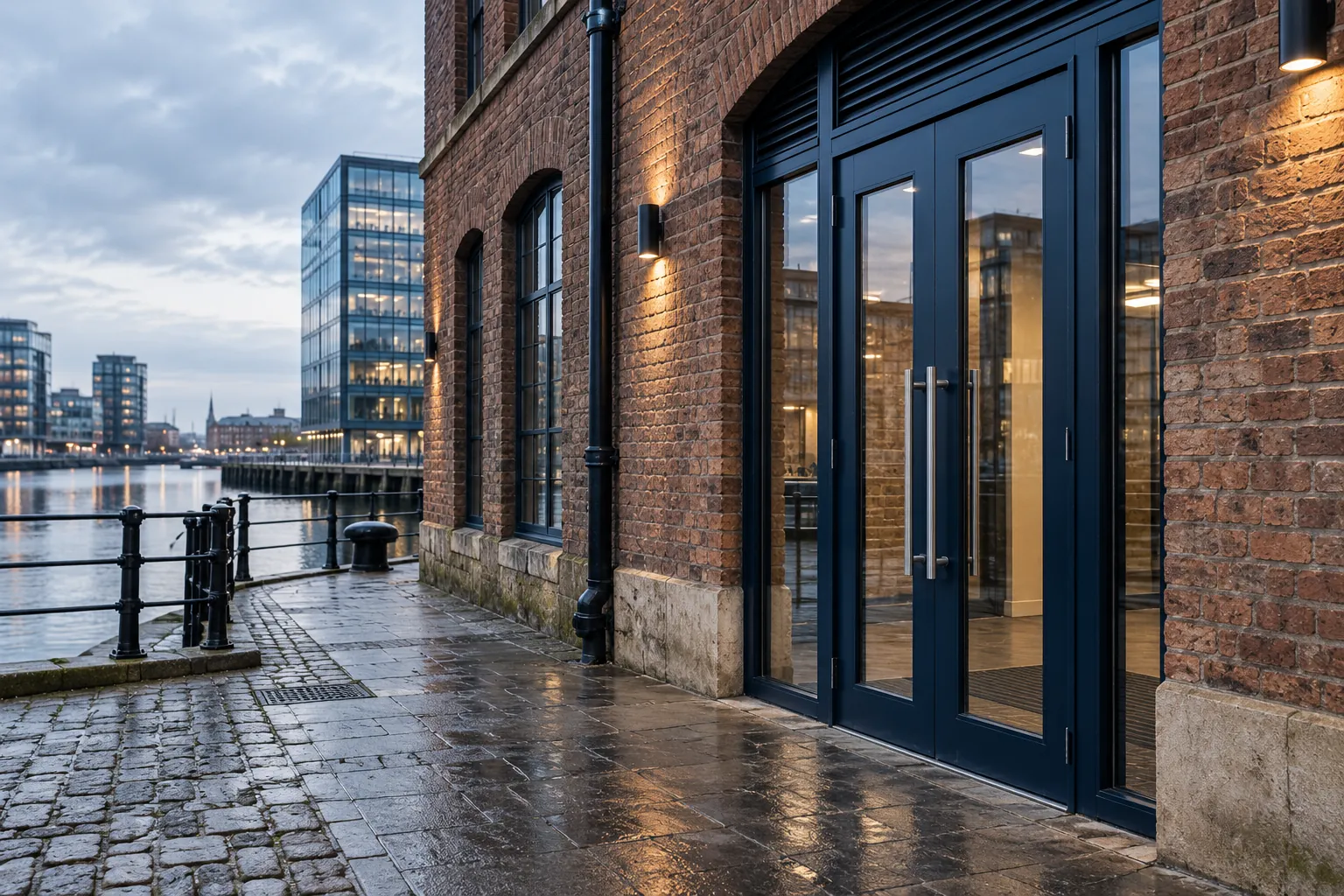
Security · LPS 1175 SR2 to SR5
Security Doors in Liverpool
Security doors for Liverpool docks, warehouses and city offices: ratings, fire and security on one doorset, salt air finishes, and what to name on the order.
- ✓Third-party test evidence with every product
- ✓Written specification you can issue to tender
- ✓Supplied and installed in Liverpool
Get a free quote in Liverpool
Rating, written specification and budget range within one working day.
Confidential. No cost, no obligation.
Third-party tested
Evidence with every quote
UK manufactured
Made to your sizes
One accountable team
Specify, supply, install
Confidential handling
Details never shared
Supplied and installed in Liverpool
What we supply in Liverpool
A Liverpool buyer should start from the opening and the exposure, not the catalogue. A rated steel door at B3 or C5 suits most warehouse and commercial entrances, a fire rated doorset suits any escape route, and a galvanised finish suits doors facing salt air and wet weather.
Liverpool holds docks, warehouses, industrial estates and a growing commercial centre, and each kind of building asks a different question of its doors. A dockside warehouse needs doors that take vehicles and shift changes. An industrial unit needs a steel personnel door that takes a forklift, a pallet and a shift of workers every day. A city office needs an entrance that admits staff and visitors and keeps strangers out. Our Liverpool page covers the city itself, and our security doors Southampton page covers another port city on the south coast.
The answer is a door schedule with one line per opening. Each line names the building, the position, the fire rating, the security rating where one is needed, and the leaf, the frame, the glass, the seals and the hardware as one doorset. The schedule should also name the exposure each opening faces, salt air, wet weather or heavy vehicle traffic, so the finish is ordered with the door. Our security doors Portsmouth page covers a port city with the same salt air problem.
- LPS 1175Forced entry rating, B3 to D10
- PAS 24Enhanced security doorset standard
- FD30 / FD60Fire resistance periods tested to EN 1634-1
- GalvanisedFinish for salt air and wet weather
Docks, warehouses and city offices: the buildings that set the brief
A dockside warehouse runs to the rhythm of vehicles and shift changes. Lorries arrive and leave through the gate, staff pass through the personnel door at every shift change, and the stores behind the door hold goods in transit. A personnel door on a warehouse needs a rating that suits the approach it faces, and a door that faces a quiet yard after hours needs a higher rating than a door that faces a staffed front entrance.
A city office asks a different question of its doors. An office entrance must admit staff and visitors and keep strangers out, and a glazed entrance lets reception see who is at the door before it is opened. Our warehouse security doors guide covers the doors dockside buildings need most, and our warehouses and logistics sector page covers the buildings that hold the stock.
Anfield and the new Everton stadium: doors for matchday crowds
Anfield stands about 2 miles north of Liverpool city centre, and Liverpool have played there since the club was formed in 1892. The Anfield Road stand expansion, completed in 2024, took the capacity to 61,276. Everton’s new home, Hill Dickinson Stadium, stands at Bramley-Moore Dock on the River Mersey, opened in 2025, and holds 52,769 people. Two grounds close together put two matchday crowds through their doors on the same weekend.
A crowd door must release a whole stand at once, without a key and without a second move, and the same door must hold a crowd out when the ground is closed. Doors that serve rooms of more than 60 people need panic hardware to BS EN 1125. Its push bar must stretch across 60 percent of the leaf or more. Both grounds sit far above the 800 person mark for the enhanced tier of Martyn’s Law. The Act passed into law in April 2025, with the duties expected to start in spring 2027. The tiers are in the Martyn’s Law guide for premises.
The leaves on a stadium exit are wide and heavy, so the hinges and the closer must be sized for the leaf, not for a quiet corridor. A hinge earns its grade under BS EN 1935 by surviving a set number of cycles with a set leaf mass. Grade 13 means 200,000 cycles at 120 kg, and grade 14 means 200,000 cycles at 160 kg. Under BS 8300 and Approved Document M the opening force stays under 30 N during the first 30 degrees, then under 22 and a half newtons once the leaf is past 30 degrees, so the closer must be set to the leaf, not wound to its strongest point. The stadium security doors guide covers stadium doors.
| Building | Door | Rating to name |
|---|---|---|
| Anfield | Concourse and turnstile doors | Panic hardware to BS EN 1125 |
| Hill Dickinson Stadium | Stadium exit doors | BS EN 1125 panic hardware |
| Liverpool2 terminal | Dockside office and store doors | LPS 1175 C5 |
| Royal Liverpool University Hospital | Ward doors | Fire to EN 1634-1, low opening force |
The port and the universities: doors that work around the clock
Liverpool2, the deep water container terminal at Seaforth, opened on 4 November 2016, and it lets the largest container vessels dock in Liverpool. The Port of Liverpool is the country’s largest transatlantic port. A dockside door faces salt air, wet weather and heavy use, so the finish must last as long as the rating. Name the finish on the schedule beside the rating, because a door that rusts through its fixings loses its rating in practice. The security doors for ports guide gives dockside doors in full.
The University of Liverpool was established in 1881 as University College Liverpool, and Liverpool John Moores University stands beside it in the Knowledge Quarter. The new Royal Liverpool University Hospital opened in October 2022, with 640 beds, and it is the largest and busiest hospital in Merseyside. Campus doors stay in use from first lecture to last, and a lecture theatre door must empty a full room at once when the alarm sounds. A ward door must close by itself and hold fire for its rated period, yet still open under a push a patient can give. The university security doors guide covers the campus brief in full. The hospital security doors guide covers ward doors in full.
Albert Dock opened in 1846, and it holds the largest group of Grade I listed buildings in the United Kingdom. A door on a listed facade needs the planning check first, before it is ordered. Liverpool ONE opened in May 2008. Its shopfronts face the public all day, and the service doors round the back face quiet yards after closing. The shopping centre security doors guide covers retail doors in full.
Put the two grounds, the port, the campuses and the hospital on one schedule. Give every opening its own rating, and file the evidence beside it.
Doors for dockside and warehouse premises
Loading bay doors cycle all day on a dockside site, personnel doors sit at the side or rear, and yard gates control vehicles. A personnel door at the rear of a warehouse faces a quieter, darker approach than a front entrance, so it usually needs a higher rating than the front door. Our loading bay doors guide covers the bay doors in full.
Steel carries the use these doors take every day. A steel leaf resists the knocks a warehouse door meets: a trolley, a pallet, a boot, a crate. Hinges to BS EN 1935 carry the leaf, grade 13 or grade 14, and a hinge that has dropped lets the leaf sag, so the closer cannot close it squarely. A closer to BS EN 1154 should bring the leaf back and hold the latch every time, and the minimum power size on a fire door is EN 3. Our anti-ram gates and barriers guide works through the gate that closes the opening, and our security gates cost factors guide covers the factors behind a gate quote.
Reading B3, C5 and D10 on a Liverpool order
LPS 1175 rates a doorset by the tools and the time it resists. B3 is three minutes against category B tools, screwdrivers, pliers and hand saws. C5 is five minutes against category C tools, crowbars, drills and chisels. D10 is ten minutes against category D tools, sledgehammers, disc cutters and jigsaws. SR2 is the old name for B3, SR3 is the old name for C5, and SR4 is the old name for D10. The rating is written as a letter and a number, and both halves must be read together.
The rating should follow the risk for each opening. A staffed front entrance suits B3, a rear door facing a quiet yard suits C5, and a door guarding high value stock, a plant room or a cash handling area suits D10. PAS 24 is the enhanced security standard for doorsets, and it suits entrances where the threat is opportunistic rather than planned. EN 1627 sets resistance classes RC1 to RC6, and Secured by Design is a scheme, not a rating. Our LPS 1175 vs PAS 24 guide compares the two routes, and our SR2 vs SR3 vs SR4 guide works through the three ratings buyers meet most often.
Only the complete tested assembly carries the rating, not the leaf alone. A rated leaf in an untested frame is not a rated doorset, and a change to the leaf, the frame, the glass, the seals or the hardware can break the tested construction. Ask for the test report and the classification naming the exact doorset before the order is placed. Our guide to keeping an LPS 1175 rating valid sets out the changes that void a rating and the inspection routine that keeps it alive.
Fire and security on one Liverpool doorset
Many doors in Liverpool must do two jobs: hold fire and resist forced entry. A server room door must hold fire and resist an attack on the equipment inside, and a plant room door must hold fire and resist a forced entry. The two jobs need two sets of evidence on one assembly: a fire classification to EN 1634-1 and a forced entry rating to LPS 1175 or PAS 24. FD30 and FD60 are fire resistance periods tested to EN 1634-1, and the number is the minutes the doorset holds its rating in the furnace test. A door marked FD30S carries 30 minutes of integrity plus smoke control, tested to BS EN 1634-3.
Escape hardware deserves its own check on a door that carries both jobs. A panic bar to BS EN 1125 should cover at least 60 percent of the leaf width, and the door should open in one action, in the direction of escape, without a key. A door must open with less than 30 N in the first 30 degrees and less than 22.5 N beyond that, under BS 8300 and Approved Document M. Our dual certification guide works through how fire and security sit on one assembly.
Access control across a Liverpool estate
An estate that holds sites across Liverpool needs one access system, not one per site. Staff carry cards, visitors use a code or a pass, and contractors use a temporary credential that expires when the work ends. Each method suits a different entrance: a warehouse needs cards that work at shift change, and an office needs readers that work at walking pace.
Decide the fail state before the doors are fitted, and test it with the power off. A door that must stay locked for security and a door that must release for escape need different answers, and the answer belongs in writing where the facilities team can find it. The doors should talk to the same system as the turnstiles, the lifts and the car park, so a person who loses access loses it everywhere at once. Our security turnstiles guide works through readers, fobs and biometrics and how the lane is wired into the access system.
What does the round check before the site opens?
The round starts while the building is still quiet, ahead of the first arrival of the day. One person walks every opening, tries each door by hand and watches it shut behind them. A door that needs a second push, a handle that turns without moving the bolt and a reader that takes two tries all go on the list before the site opens, not after a fault stops the day.
The closer gets the first look on every fire door. BS EN 1154 gives closer power sizes from EN 1 to EN 7, and a fire door needs EN 3 at least, so a weaker closer cannot pull the door home against its seals. Watch the door close from fully open, then from half open, and note the size on the schedule beside the opening. The fire door closers guide sets out the sizes and the setting.
Hinges carry the weight, so the round checks screws and knuckles first. BS EN 1935 grades a hinge by the cycles it survives with a stated weight on it: grade 13 stands 200,000 cycles carrying 120 kg, while grade 14 carries 160 kg through the same count. A hinge that drops the door drags the bottom edge and opens a gap at the top, and the gap is what the next check measures.
The gap round the door is gauged, and 4 mm is the limit on a fire door. Intumescent seals sit in the frame or the door edge and swell shut when heat reaches about 200 to 250 degrees, so a split, painted or missing seal leaves the gap open in a fire. The fire door gaps guide gives the limits, and the intumescent seals guide gives the seal and the heat that sets it working.
| Opening | Check on the round | Fault to write down |
|---|---|---|
| Main entrance | Reader pace and the door closing behind people | Reader needs two tries; door held open |
| Fire door on a corridor | Closer power and the gap | Closer below EN 3; gap over 4 mm |
| Store door | Lock, hinges and frame fixings | Loose screws; bolt does not throw fully |
| Rear service door | Seal, threshold and shutting from half open | Split seal; door stops short |
So the fault list starts beside the opening, not in the office
A fault goes on the list with its opening number and its part named, because a line that says only “door faulty” helps nobody the next morning. The access control doors guide covers readers and the release beside them, and the security door maintenance checklist gives the round its order.
The round ends at the main entrance, where the list is read back against the openings. A fault on the list gets a part named and a date set, and a door that passed the round gets a tick and nothing more. The list goes to the person who orders the parts, because a round that finds faults and files them away proves nothing.
Let the how to specify security doors guide set what the round must prove, and let the fault list carry the proof back to the order.
Salt air and wet weather: finishes that last on the Mersey
Doors near the water face two slow enemies: salt air and standing water. Salt air corrodes unprotected steel first at the edges, the hinges and the bottom rail. Standing water after heavy rain attacks the threshold, the bottom seal and the base of the frame.
For the finish, the choice is between powder coating, galvanising and a galvanised base with a powder coated top coat. Powder coating gives colour and a hard surface, and suits sheltered doors. Galvanising gives a zinc coating that protects the steel itself, including edges and cut sections, and suits doors facing salt air and wet weather. A galvanised base with a powder coated top coat gives both. Ask which finish the tested doorset allows. Our powder coating vs galvanising guide compares the two finishes, and our powder coating page covers the finish options.
Planning checks with Liverpool City Council
Most like-for-like door replacements inside an existing opening need no planning permission, but three cases need a check with Liverpool City Council before ordering. First, major alterations to the outside of a building can need planning permission. Second, work in a conservation area faces additional controls. Third, listed buildings need separate consent, and this is the case buyers miss most often.
A listed building carries duties that a new building does not, and a door fitted without the right consent can be ordered out again. Unauthorised work to a listed building is an offence, with severe penalties, so anyone unsure should ask the council’s conservation officer well in advance of planned works.
What the enquiry should name for a Liverpool site
Ordering doors for a Liverpool site is a specification exercise, not a shopping exercise. The enquiry should name the town, the building, the position, the fire rating, the security rating where one is needed, and the leaf, the frame, the glass, the beads, the seals and the hardware as one doorset. The security side needs its own evidence where the door must also resist attack: a rating to LPS 1175 or PAS 24, on the whole doorset, not on the leaf alone.
Ask for the evidence at the same time as the doors. The test report, the classification and the hardware schedule should travel with the doorset, and the handover pack should set out the inspection routine the site will follow. A site that keeps the evidence from the day the doors arrive holds a record it can use for the whole life of the estate. Our how to specify security doors guide covers the same discipline for rated doors, our security door cost factors guide covers the factors behind a quote, and our fire door inspection checklist gives the checks that catch a failing leaf before it matters.
| Premises | Door position | Rating | What to check |
|---|---|---|---|
| Dockside warehouse | Personnel door | LPS 1175 B3 or C5 | Steel leaf, hinges, latch |
| City office | Glazed entrance | LPS 1175 where rated | Screen rating, reader pace |
| Industrial unit | Stores and plant room doors | FD60 | Seals, gaps, self-closing |
| Logistics yard | Loading bay personnel door | LPS 1175 B3 or C5 | Closer, latch, hold-open release |
| Commercial centre | Escape and entrance doors | FD30 or FD60 | Panic hardware, opening force |
In Liverpool, a door that faces salt air and night traffic needs a different finish and a different rating from a door in a sheltered office, and the schedule should name the exposure for each opening.
What LPS 1175 rating do I need for a Liverpool warehouse door?
For most warehouse doors, B3 fits a staffed front entrance and C5 fits a rear or side door that faces a quiet approach. Let the risk assessment for that opening decide, not the postcode.
What finish suits a door near the water in Liverpool?
A galvanised finish fits doors that face salt air and wet weather, because the zinc coating protects the steel itself, edges and cut sections included. A galvanised base with a powder coated top coat adds colour over that protection, and the finish should be one the tested doorset allows.
Can a fire exit door also be a security door?
Yes, where the same doorset holds both ratings and the escape hardware releases in one action from the inside, with no key and no code.
Do I need listed building consent to replace a door in Liverpool?
If the building is listed, yes, usually. Altering or replacing any of the doors or windows of a listed building needs listed building consent, separate from planning permission. Ask Liverpool City Council’s conservation officer well in advance of planned works.
Does a security door protect against flooding?
No. A standard steel security door is not a flood barrier. Treat thresholds, seals and drainage for standing water as a separate matter from the security rating.
Get a free quote
Other areas
Security doors in other areas
Ready to specify your project?
Free assessment, written specification and test evidence. Reply within one working day.