
Security · LPS 1175 SR2 to SR5
Security Doors in Bristol
Security doors for Bristol offices, business parks and industrial estates: ratings, fire and security on one doorset, dockside finishes, and the order.
- ✓Third-party test evidence with every product
- ✓Written specification you can issue to tender
- ✓Supplied and installed in Bristol
Get a free quote in Bristol
Rating, written specification and budget range within one working day.
Confidential. No cost, no obligation.
Third-party tested
Evidence with every quote
UK manufactured
Made to your sizes
One accountable team
Specify, supply, install
Confidential handling
Details never shared
Supplied and installed in Bristol
What we supply in Bristol
Start with the opening, not the catalogue: that is where a Bristol order goes right or wrong. A steel door rated B3 or C5 fits most entrances, a fire rated doorset belongs on every escape route, and a yard gate needs a rating of its own.
Bristol is the largest city in the South West, and its buildings ask different questions of their doors. Offices and business parks hold the commercial centre, industrial estates and distribution units sit on out-of-town sites, and docks and warehouses work beside the water.
One list keeps the order straight, with one row per opening. Each row carries the building, the position, the fire period, the security rating where one is needed, and the leaf, the frame, the glass, the seals and the hardware as a single doorset. Our Bristol page covers the city as a whole, and our Cardiff page covers the city across the Severn to the west.
- LPS 1175Forced entry rating, B3 to D10
- PAS 24Enhanced security doorset standard
- FD30 / FD60Fire resistance periods tested to EN 1634-1
- BS EN 1154Closer power sizes, minimum EN 3 on fire doors
Business parks and the city centre: where Bristol buyers start
A business park office in Bristol meets staff and visitors all day, and its entrance has to admit the right people and keep strangers out. A glazed entrance lets reception see who stands at the door before it is opened, and a rated screen holds while the door is checked. A screen without a rating fails at the first blow, and the entrance behind it is open. Our fire rated windows guide sets out how glass, frame and beads are tested together.
Doors that serve more than 60 people need panic hardware to BS EN 1125, a bar across at least 60 percent of the leaf width. The door has to open with less than 30 N in the first 30 degrees and less than 22.5 N beyond that, under BS 8300 and Approved Document M, and a closer that is too strong for the leaf will fail the access rules. Our fire door closers guide sets out the power sizes in BS EN 1154.
Martyn’s Law sets tiers for premises that hold 200 or more people, with Royal Assent in April 2025 and go-live expected in spring 2027, and crowded premises fall inside those duties. That puts the doors that release a crowd inside the same duties: they have to open in one action, in the direction of escape, without a key. Our Martyn’s Law guide sets out the tiers and what each one asks of a building.
Industrial units and distribution sites: doors under daily use
A personnel door on an industrial unit opens for every shift change, every delivery and every break.
These doors meet forklifts, pallets, trolleys and boots every day, and a steel leaf takes that punishment. Strength is not a rating, though: a leaf that stands up to a knock can still fail a forced entry test. Only the whole tested assembly carries the rating, leaf, frame, fixings, glazing and hardware tested together, so a rated leaf in an untested frame is not a rated door. Our warehouse security doors guide covers the doors distribution buildings need most.
The bay door and the personnel door beside it are two different doors. A high performance roller door suits a busy bay that opens and closes all day, and the personnel door beside it lets staff in and out without opening the bay. Order the two together, so they work as one entrance. Our loading bay doors guide covers the bay doors in full.
What B3, C5 and D10 mean when the order is written
Under LPS 1175, a doorset is tested against a tool set for a set time. B3, the old SR2, stands for three minutes against screwdrivers, pliers and hand saws. C5, the old SR3, stands for five minutes against crowbars, drills and chisels. D10, the old SR4, stands for ten minutes against sledgehammers, disc cutters and jigsaws. The letter and the number belong together, and reading one without the other tells you nothing.
The rating follows the opening, not the postcode. A front entrance that is staffed all day needs less than a rear door that faces a quiet yard after hours. Start outside the building, list every door a person can reach, and give each one the rating its approach calls for. Our keeping an LPS 1175 rating valid guide sets out the changes that void a rating, and our LPS 1175 vs PAS 24 guide compares the two routes side by side.
PAS 24 sets the enhanced security standard for doorsets, and EN 1627 sets resistance classes RC1 to RC6. Secured by Design is a scheme, not a rating: a door can carry the scheme mark and still have no test rating behind it. Our SR2 vs SR3 vs SR4 guide works through the three ratings buyers meet most often.
Fire resistance and forced entry on the same Bristol doorset
Many Bristol doors have to hold fire and resist a forced entry at the same time. A server room door has to hold fire and resist an attack on the equipment inside, and a plant room door has to hold fire and resist a forced entry. Both jobs need their own evidence on one assembly: a fire classification to EN 1634-1 and a forced entry rating to LPS 1175 or PAS 24. Our dual certification guide works through how fire and security sit on one assembly.
The EN 1634-1 test gives the fire resistance periods FD30 and FD60, and the number is the minutes the doorset holds its rating in the furnace. A door marked FD30S carries 30 minutes of integrity plus smoke control, tested to BS EN 1634-3. EI limits how hot the safe side gets, an average of 140 degrees Celsius and a maximum of 180 degrees Celsius. Any change to the leaf, the frame, the glass, the seals or the hardware can break the tested construction, and a changed door without fresh evidence has no proven rating.
Running access control across a multi-site Bristol estate
One access system should cover every Bristol site on an estate, not one system per site. Staff carry cards, visitors use a code or a pass, and contractors get a credential that runs out when the work ends. Match the method to the entrance: a business park office needs readers that work at walking pace, and an industrial unit needs cards that work at shift change.
Work out the fail state for every door before the doors go in, and test it with the power off. A door that has to stay locked and a door that has to open for escape give opposite answers, so write both down where the facilities team will find them. Link the doors to the same system as the turnstiles, the lifts and the car park, so a person who loses access loses it everywhere at once. Our security turnstiles guide works through readers, fobs and biometrics and how the lane is wired into the access system.
Bristol universities and hospitals: doors that never close
Bristol holds two universities . The University of Bristol received its Royal Charter in 1909, and its predecessor, University College, Bristol, had been in existence since 1876. Most of its teaching takes place in Clifton, close to the city centre. The University of the West of England, Bristol, gained university status in 1992, and its Frenchay Campus is its largest campus. Between them the two universities run teaching blocks, libraries, laboratories and halls of residence across the city.
Southmead Hospital adds a second estate that never closes. The hospital is part of North Bristol NHS Trust. Its Brunel Building opened in May 2014 with 800 beds, and the accident and emergency department moved there from Frenchay Hospital at the same time. A hospital door must open with little force, so a patient in a wheelchair or a member of staff with a trolley can pass. Opening force under BS 8300 and Approved Document M stays under 30 N for the first 30 degrees of opening, and below 22 and a half newtons beyond that point. The hospital security doors guide covers wards and corridors, and the university security doors guide covers campus doors.
Hinges carry the traffic on both estates. A student block entrance or a hospital corridor door can open and close hundreds of times in a day. BS EN 1935 grades a hinge by the cycles it survives and the mass of the leaf it can carry. Grade 13 is tested to 200,000 cycles on a 120 kg leaf, and grade 14 is tested to 200,000 cycles on a 160 kg leaf. Name the grade, the cycle count and the leaf mass at enquiry stage. Hardware fitted outside the tested design leaves the rating unproved. The student accommodation guide covers halls of residence where residents come and go at all hours.
Ashton Gate and Cabot Circus: doors for crowds and shopfronts
Ashton Gate has been the home of Bristol City since 1904, and the ground now holds 27,000 people. A stadium door works in surges: a crowd arrives together before kick off, leaves together at the end, and the doors on the concourse and at the exits must release the whole crowd in one action when the alarm sounds. After the crowd has gone, the same doors must lock down, with access for staff controlled by fob or keypad. Name the crowd size at enquiry stage, so the hardware is ordered for the busiest day. The stadium security doors guide works through the doors a ground needs.
Cabot Circus sits beside Broadmead in the city centre and opened on 25 September 2008, with shops and a thirteen screen cinema. The front of a unit and the back of the same unit face different risks. The front is staffed and lit through trading hours, and LPS 1175 B3 fits it. A rear door on a quiet service road gives an attacker more time unseen, so LPS 1175 C5 fits it. The value held in stockrooms and cash handling areas calls for the same rating as the rear door. The shopping centre security doors guide covers front and rear doors, and the retail security doors guide covers the shopfront and the stockroom.
| Building | Opening | Rating to name |
|---|---|---|
| University teaching block | Main entrance | LPS 1175 B3, reader inside the tested design |
| Southmead Hospital | Ward door | EI 30 to EI 120 to EN 1634-1, low opening force |
| Ashton Gate | Concourse and exit doors | Panic hardware to BS EN 1125 |
| Cabot Circus | Rear service door | LPS 1175 C5 |
Put the building, the opening and the hours of use on the schedule, with a rating and hardware on each line. A teaching block entrance, a ward door, a stadium exit and a shop service door each fail in a different way, and the schedule is where those differences are caught.
Docks, rain and road salt: choosing a finish that lasts
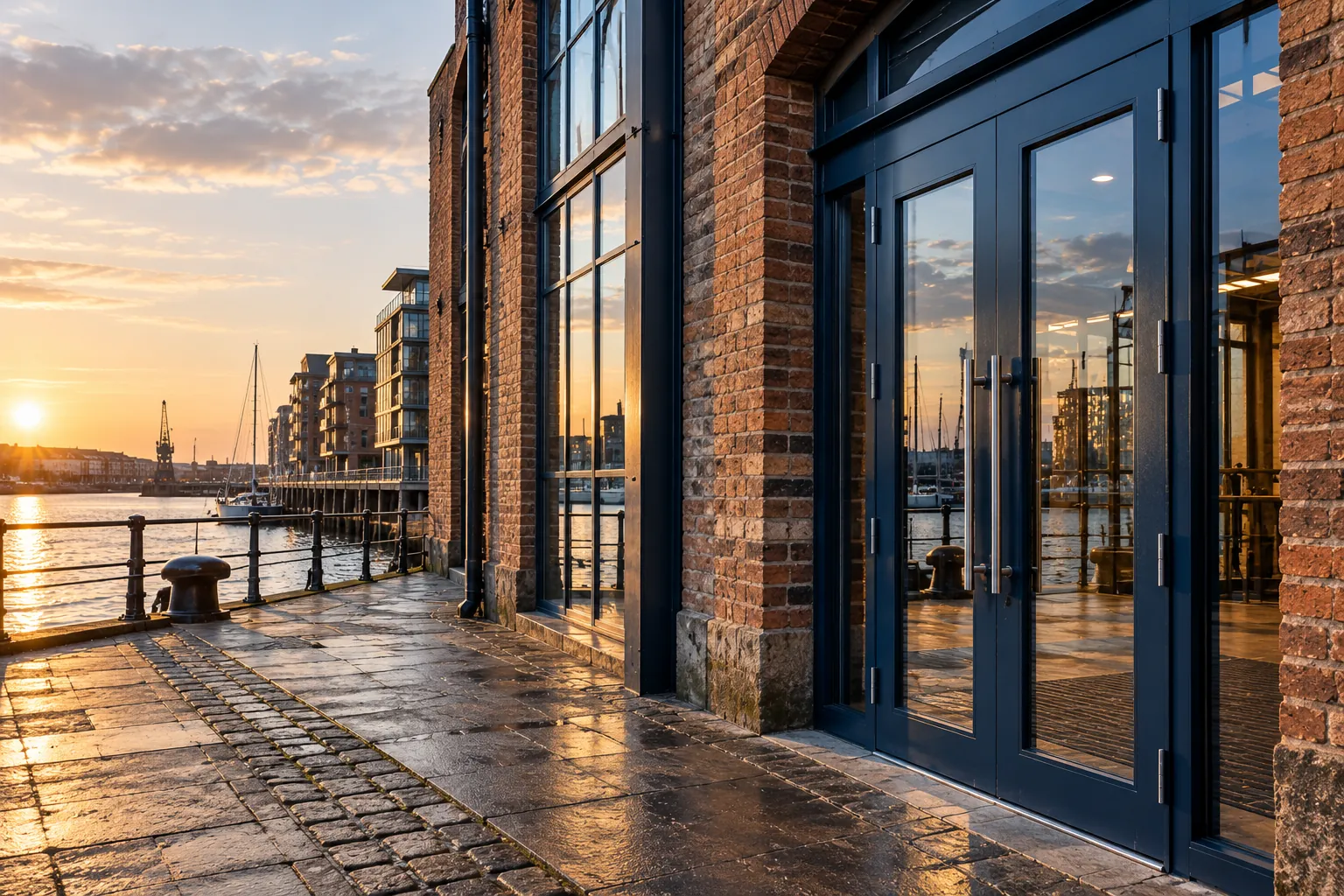
Bristol’s docks and wet weather set the finish a door needs. Powder coating gives colour and a hard surface for a door that stays sheltered. Galvanising puts a zinc coat on the steel, and it protects the edges and cut sections a dockside door exposes to weather. Put a powder coated top coat over a galvanised base and the door gets both. Our powder coating vs galvanising guide compares the two finishes, and our powder coating page covers the finish options.
Hinges and fixings need the same attention as the leaf itself. A hinge to BS EN 1935, grade 13 or grade 14, carries the leaf, and once a hinge drops the leaf sags and the closer cannot shut it square. A hold-open device to BS EN 1155 keeps a door open while it is in use and releases it when the alarm sounds, so the release needs a test at every inspection. Check the gaps and the seals on the same visit: a 4 mm gap around the leaf is the usual limit, and intumescent seals shut the gap in a fire by expanding at roughly 200 to 250 degrees.
Temple Meads still runs a working station inside a Grade I listed shell
Bristol Temple Meads opened on 31 August 1840 as the western terminus of the Great Western Railway, designed by Isambard Kingdom Brunel, and most of the site is Grade I listed. The station still runs as a working station inside that listed shell, so its doors must suit modern passenger flow and listed consent at the same time. Concourse and gateline doors take crowds in waves, and a room that holds over 60 people needs its doors fitted with panic hardware to BS EN 1125, the bar covering 60 percent of the leaf or more. The transport hub security guide lists station doors and the ratings beside them.
The Harbourside works at water level, where the Floating Harbour opened on 1 May 1809 and still covers 70 acres. The SS Great Britain, launched on 19 July 1843 to a design by Brunel, came back to the Bristol dry dock where she was built in 1970 and now stands as a museum ship in the harbour. Museum and harbourside doors face damp air and road salt, so a top coat of powder coating over a galvanised base suits them, as long as the tested doorset allows that finish. The museum security doors guide works through visitor doors, and the powder coating versus galvanising guide compares the two finishes.
| Building | Door | Rating to name |
|---|---|---|
| Temple Meads | Concourse and gateline doors | Panic hardware to BS EN 1125 |
| SS Great Britain | Museum visitor entrance | LPS 1175 B3 where rated |
| Harbourside venue | Waterside entrance | Galvanised finish, LPS 1175 B3 |
| Clifton village shop | Front and rear doors | Front B3, rear C5 |
Clifton looks across the gorge while the Harbourside works at water level
The Clifton Suspension Bridge opened on 8 December 1864 to a design by Brunel, completed by Sir John Hawkshaw and William Henry Barlow, with a main span of 214 metres standing 75 metres above high water. Clifton village sits at the Bristol end of the bridge, with shops and cafes in listed buildings that trade all day. A shopfront there is staffed and lit, so LPS 1175 B3 fits it, while a rear service door on a quiet lane faces nobody after the shops close, so order it at LPS 1175 C5. The retail security doors guide lists front and rear doors and the rating each one needs, and the listed building fire doors guide explains consent and the doorset beside it.
Wind off the gorge and damp off the harbour punish a finish, so the choice follows the exposure the door faces. A zinc coat from galvanising guards the edges and cut sections that weather reaches first, and a powder coated top coat laid over that base adds colour on top of the protection. Hinges face the same weather: name hinges to BS EN 1935, grade 13 on a 120 kg leaf, grade 14 on a 160 kg leaf, because a dropped hinge lets the leaf sag, and a sagging leaf will not close square. The fire door hardware guide works through hinges, closers and the fixings beside them.
Put Temple Meads, the Harbourside, the museum ship and Clifton on one schedule, with a rating and its evidence on every line. The station door and the Clifton shopfront door fail in different ways, and only the schedule shows both failures side by side.
Planning permission and listed buildings in Bristol
Changing a door like for like inside an existing opening usually needs no planning permission. Three cases are different, and each one needs a check with Bristol City Council before ordering: major changes to the outside of a building, work in a conservation area, and work on a listed building, which needs separate consent and is the case buyers miss most often.
Listed buildings carry duties new buildings do not, and a door put in without the right consent can be ordered out again. The planning authority will say what the job needs, so name the listing and the conservation area in the enquiry beside the door schedule. A steel leaf in a listed facade needs a finish and a fixing the conservation officer will accept, so start the planning early and put the time it takes in the programme from the start.
Writing the enquiry: the details a Bristol order must carry
A Bristol order is a specification exercise, not a shopping exercise. Name the building, the position, the fire rating, the security rating where one is needed, and the leaf, the frame, the glass, the beads, the seals and the hardware as one doorset in the enquiry. Where the door must also resist attack, ask for a rating to LPS 1175 or PAS 24 on the whole doorset, not on the leaf alone. Our how to specify security doors guide covers the same discipline column by column.
The test report, the classification and the hardware schedule should travel with the doorset, and the handover pack should set out the inspection routine the site will follow. A site that keeps its evidence from the day the doors arrive holds a record it can use for the whole life of the estate. Get the schedule written first, then order against it. Our fire door inspection checklist gives the checks that catch a failing leaf before it matters.
| Premises | Door position | Rating | What to check |
|---|---|---|---|
| Business park office | Glazed entrance | LPS 1175 where rated | Screen rating, reader pace |
| Dockside warehouse | Personnel door | LPS 1175 B3 or C5 | Leaf, hinges, latch |
| Industrial unit | Stores and plant room doors | FD60 | Seals, gaps, self-closing |
| Distribution site | Escape and entrance doors | FD30 or FD60 | Panic hardware, opening force |
| Logistics yard | Loading bay personnel door | LPS 1175 where rated | Closer, latch, hold-open release |
In Bristol, the dockside door and the business park door answer different questions, and a schedule that treats them the same will fail one of them.
What LPS 1175 rating suits a Bristol industrial unit door?
B3 suits a staffed front entrance and C5 suits a rear or side door that faces a quiet approach, for most industrial unit doors. The rating should follow the risk assessment for that opening.
Can a Bristol doorset hold a fire rating and a security rating at once?
Yes, where the fire proof and the security proof name the same doorset. The fire classification comes from a test to EN 1634-1 and the forced entry rating from a test to LPS 1175 or PAS 24.
Do I need planning permission to change a door in Bristol?
A like-for-like replacement usually needs none. A new opening, work in a conservation area, or work on a listed building needs a check with Bristol City Council before ordering.
What finish lasts on a Bristol dockside door?
A galvanised finish fits a dockside door, because the zinc coating protects the steel itself, edges and cut sections included. Check that the tested doorset allows the finish before ordering.
How do I order doors for several Bristol sites?
Write one schedule with one row per opening, naming the building, the position, the fire rating, the security rating and the whole doorset. Ask for the evidence with the doors, and file it on the day the doors arrive.
Pricing several openings at once? The security door enquiry checklist lists what to send for each one: location, size, rating and hardware.
Get a free quote
Other areas
Security doors in other areas
Ready to specify your project?
Free assessment, written specification and test evidence. Reply within one working day.