
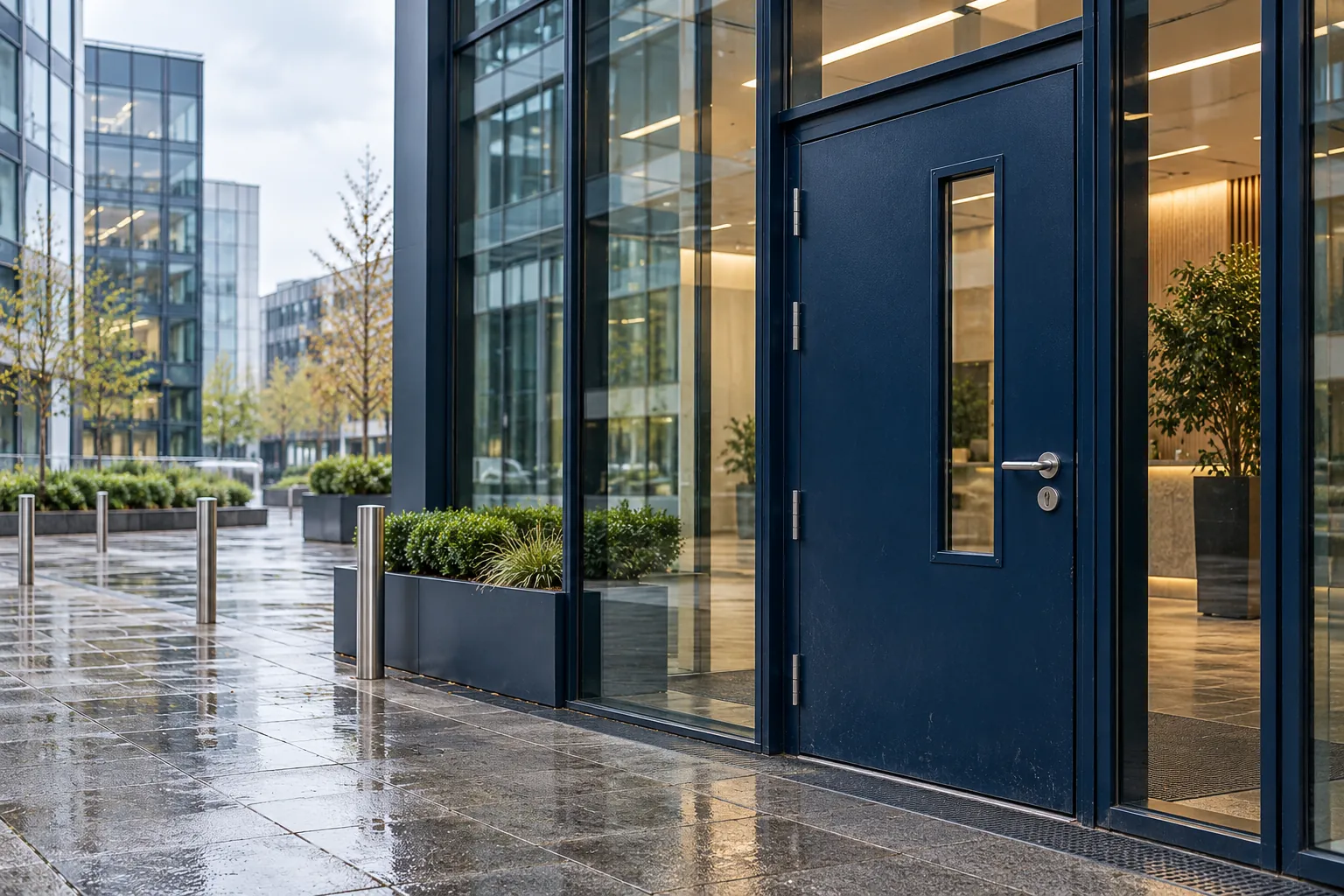
Security · LPS 1175 SR2 to SR5
Security Doors in Milton Keynes
Security doors for Milton Keynes distribution centres, business parks and offices: ratings, fire and security on one doorset, and the order.
- ✓Third-party test evidence with every product
- ✓Written specification you can issue to tender
- ✓Supplied and installed in Milton Keynes
Get a free quote in Milton Keynes
Rating, written specification and budget range within one working day.
Confidential. No cost, no obligation.
Third-party tested
Evidence with every quote
UK manufactured
Made to your sizes
One accountable team
Specify, supply, install
Confidential handling
Details never shared
Supplied and installed in Milton Keynes
What we supply in Milton Keynes
A Milton Keynes buyer begins with the opening and the traffic it carries, not with a catalogue page. A rated steel door suits a distribution centre entrance, a fire rated doorset belongs on every escape route, and a gate at the yard needs a rating of its own.
Milton Keynes is built around distribution: warehouses, logistics yards and business parks beside offices and public buildings, spread across a grid of fast roads. Each kind of building puts a different demand on its doors. A distribution centre needs a personnel door that takes a shift of workers, a forklift and a pallet every day. A business park office needs an entrance that takes a crowd in at the start of the day and lets it out in one movement when the alarm sounds.
Put the order together as a schedule, one line for each opening, naming the building and position, the fire period and the security rating where one is needed, and the leaf, frame, glass, seals and hardware as one tested doorset. Our Milton Keynes page covers the city as a whole, and our West Midlands guide covers the region around it.
- LPS 1175Forced entry rating, B3 to D10
- PAS 24Enhanced security doorset standard
- FD30 / FD60Fire resistance periods tested to EN 1634-1
- ISO 22343-1Vehicle impact test for gates and yards
Distribution centres and logistics yards: doors that move with the stock
A personnel door on a distribution centre opens and closes more often than any other door in Milton Keynes. It opens at every shift change, at every delivery and at every break, and a door made for a quiet office will not survive on a warehouse floor.
Steel takes the daily knocks these doors meet: forklifts, pallets, trolleys and boots all strike the same leaf, day after day. Yet a strong leaf is not a rated door. The rating belongs to the whole tested assembly, leaf, frame, fixings, glazing and hardware tested together, so a rated leaf in an untested frame carries no rating at all. Our warehouse security doors guide covers the doors distribution buildings need most.
Business parks and commercial campuses: entrances the public meets
Staff and visitors pass a Milton Keynes business park entrance all day, and the door has to let the right people in while keeping strangers out. Glazing lets reception see who stands at the door before it opens, and a rated screen holds while the visitor is checked. How glass, frame and beads are tested together is set out in our fire rated windows guide.
Where more than 60 people use a door, panic hardware to BS EN 1125 belongs on it, with a bar that spans at least 60 percent of the leaf. BS 8300 and Approved Document M ask for an opening force below 30 N through the first 30 degrees and below 22.5 N after that, so a closer set too strong puts the door outside the access rules. The power sizes in BS EN 1154 are set out in our fire door closers guide. Premises that hold crowds face duties under Martyn’s Law, which sets tiers for premises that hold 200 or more people, with Royal Assent in April 2025 and go-live expected in spring 2027. Our Martyn’s Law guide sets out the tiers and what they ask of a premises.
Stadium MK: doors that hold a crowd
Stadium MK stands in Denbigh, Bletchley. It opened in 2007 as the home ground of Milton Keynes Dons, and its two tiers hold 30,500 people. A crowd of that size moves through the same doors before a match and again at the end, so the doors on the concourse and at the turnstile lines work harder than any door on an office floor. The doors the crowd passes through need hardware sized for that traffic, not for a quiet corridor.
Hinges carry that traffic. BS EN 1935 grades a hinge by test cycles and by the mass of the leaf it can carry. Grade 13 covers 200,000 cycles with a leaf of 120 kg, and grade 14 covers 200,000 cycles with a leaf of 160 kg. Name the grade and the leaf mass on the schedule, so the hinge on site matches the hinge in the test. A hinge that passes its test on a light leaf proves nothing about a heavy steel leaf. Our stadium security doors guide works through the doors a ground needs.
Leisure centres across the city put the same demand on their doors in a different way. Visitors arrive through the day rather than in one surge, and the doors stay in constant use from opening to closing, so the same hinge grade applies. Our leisure centre security doors guide sets out the doors a leisure building needs most.
Central retail, hospital and university: doors the public uses all day
The centre:mk opened on 25 September 1979 as the Shopping Building, with 130 shops and six department stores arranged along two parallel daylit arcades. The building is now Grade II listed, and its entrances still take the public all day, so a mall entrance closer must hold its setting through that traffic. BS EN 1154 sets the power sizes for door closers, and EN 3 is the minimum to name on a fire door, so a closer below EN 3 leaves the leaf without the force to shut against its seals. The gaps around the leaf matter as much as the closer: a fire door is checked against a 4 mm gap, and a wider gap lets smoke through. Our shopping centre security doors guide covers the doors a retail building needs, and our retail security doors guide covers the shopfront and the stockroom.
Milton Keynes University Hospital stands in Eaglestone, off Standing Way. It opened in 1984 as a district general hospital, and its main entrance stays open day and night. Hospital doors divide into two kinds: public doors in use around the clock, and ward and plant room doors that stay shut and locked. A keyed door on a ward or a plant room needs a cylinder that resists snapping and picking. TS 007 rates the cylinder and the handle together, and a 1 star cylinder fitted with a 2 star handle gives a 3 star door. Name the stars on the schedule, because a strong cylinder in a weak handle still fails as a set. Our hospital security doors guide works through wards, emergency departments and plant rooms.
The Open University has its headquarters at Walton Hall in Milton Keynes, on a 110 acre campus, and the university was established in 1969. A campus holds buildings of many ages and many uses, and the doors change with them. A teaching room needs a door that opens easily for a full class, a store needs a door that stays locked, and a plant room needs a fire period and a lock for staff only. Name each opening on its own, with its rating where one is needed, because an order that groups unlike doors together will fail one of them. Our university security doors guide covers the doors a campus needs most.
| Building | Door | What to name |
|---|---|---|
| Stadium MK | Concourse door | Hinge grade and leaf mass |
| Leisure centre | Main entrance | Hinge grade and closer size |
| The centre:mk | Mall entrance | Closer size and fire door gap |
| Milton Keynes University Hospital | Ward door | TS 007 stars |
B3, C5 and D10 on a Milton Keynes order: reading the rating
LPS 1175 grades a doorset by what it stands up to and for how long. Category B covers screwdrivers, pliers and hand saws, and three minutes against them earns B3. Category C covers crowbars, drills and chisels, and five minutes against them earns C5. Category D covers sledgehammers, disc cutters and jigsaws, and ten minutes against them earns D10. Drawings still carry the old labels, so remember that SR2 is the old name for B3, SR3 is the old name for C5, and SR4 is the old name for D10.
Let the risk of the opening set the rating, not the address on the order. B3 fits a staffed front entrance, C5 fits a rear door that faces a quiet yard, and D10 fits a door guarding high value stock, a plant room or a cash handling area. PAS 24 is the enhanced security doorset standard, while EN 1627 gives resistance classes RC1 to RC6 for windows, doors and shutters. Secured by Design is a scheme, not a rating, so a scheme mark without a test rating proves nothing about resistance. Our SR2 vs SR3 vs SR4 guide compares the three ratings buyers meet most often.
Fire doors and security doors on the same Milton Keynes doorset
One Milton Keynes doorset can be asked to hold back fire and to stand up to an attack, and the two demands are proved separately on the same construction. The server room needs a leaf that keeps fire out of the corridor and keeps a thief away from the racks, while the plant room needs the same pair of proofs for a different risk. Fire evidence comes as a classification to EN 1634-1 and forced entry evidence as a rating to LPS 1175 or PAS 24, and both must name the doorset that will be fitted. How the two proofs sit together is worked through in our dual certification guide.
Fire resistance is read off the furnace test to EN 1634-1: the figure after FD is the minutes of protection, 30 for FD30 and 60 for FD60. Where smoke control is needed as well, FD30S pairs 30 minutes of integrity with a smoke seal tested to BS EN 1634-3. The EI figure caps the heat that reaches the safe side, 140 degrees Celsius on average and 180 at the hottest point. Swap the leaf, the frame, the glass, the seals or the hardware for something untested and the construction that passed the test no longer exists, so the door holds no proven rating.
Access across a Milton Keynes estate: cards, codes and the fail state
One access system should cover a Milton Keynes estate that spans several sites. Give staff cards, visitors a code or a pass, and contractors a temporary credential that expires when the work ends. Match the method to the entrance: readers that keep pace with a walking crowd suit an office, and cards that work at shift change suit a distribution centre.
Decide the fail state for each door before fitting, then prove it with the power off. A door that stays locked for security and a door that opens for escape need opposite answers, and both answers belong in writing where the facilities team can find them. Put the doors, the turnstiles, the lifts and the car park on one system, so losing access in one place means losing it everywhere at once. How readers, fobs and biometrics are wired into the access system is covered in our security turnstiles guide.
Milton Keynes Central station: doors for a station that never stands still
Milton Keynes Central opened in May 1982 on the West Coast Main Line, about 50 miles north-west of London, and it serves the city through seven platforms. It sits between Bletchley and Wolverton stations, both inside Milton Keynes. Its doors take the commuter peaks twice a day: the entrance doors admit a crowd arriving from the car park and the bus stops, the platform doors release the same crowd again, while the staff and service doors behind them stay locked. A quiet-office door will not last on a station concourse, so treat the concourse doors as high-traffic doors from the start.
A station holds a crowd, so the tiers in the Terrorism (Protection of Premises) Act 2025, known as Martyn’s Law, must be settled before the doors are ordered. The Act received Royal Assent in April 2025. The standard tier covers premises where 200 to 799 people may be present at one time, and the enhanced tier covers 800 or more. The duties are not yet in force, and the Security Industry Authority expects them in spring 2027. Count the morning peak, not a quiet midday hour, to find the station’s tier. Read the tiers in our Martyn’s Law guide for premises before the doors are ordered.
A door that serves more than 60 people needs a push bar made to BS EN 1125, and the bar must cover at least 60 percent of the leaf width, so a crowd can open it with one push and no key. The opening force matters as much as the bar: BS 8300 and Approved Document M set it below 30 N through the first 30 degrees and below 22.5 N beyond that, and a closer wound too tight pushes the door past those limits. Name the bar, the closer size and the opening force on the schedule. Our transport hub security requirements guide works through the doors a station needs.
Bletchley Park: doors for a listed museum
Bletchley Park stands on Sherwood Drive in Bletchley, the principal centre of Allied codebreaking in the Second World War. The site opened to visitors in 1993 and was formally opened as a museum in July 1994. The park is Grade II listed, and most of it has been a conservation area since February 1992, so every door change answers to the listing and to the fire and security ratings at once. A new doorset has to fit the opening as it stands, with a finish and fixings that suit the listed fabric, and the listing should travel with the door schedule from the start.
A public door between exhibition rooms needs the fire period the strategy names, proved to EN 1634-1, and where smoke control is needed too, FD30S pairs 30 minutes of integrity with a smoke seal tested to BS EN 1634-3. A service door at the back needs a forced entry rating: LPS 1175 B3 suits a staffed entrance, and C5 suits a rear door on a quiet approach, with the rating proved on the whole doorset, leaf, frame, fixings, glazing and hardware together. A rated leaf in an untested frame carries no rating at all, so the evidence must name the doorset to be fitted. Our museum security doors guide works through the doors a museum needs, and our fire door regulations for museums guide sets out the fire periods.
| Building | Door | What to name |
|---|---|---|
| Milton Keynes Central | Concourse entrance door | Closer size and opening force |
| Milton Keynes Central | Platform escape door | BS EN 1125 bar, 60 percent of leaf |
| Bletchley Park | Exhibition room door | Fire period to EN 1634-1, smoke seal where needed |
| Bletchley Park | Rear service door | LPS 1175 B3 or C5 on the whole doorset |
Put the station and the museum on the same schedule, one line per opening, and file the test evidence beside each line on the day the doors arrive. The crowd checks the station doors every morning, and the listing checks the museum doors, so neither one can be ordered on a guess.
Grid roads, vehicle approaches and the yard gate
Milton Keynes runs on a grid of fast roads, and vehicles reach a yard gate at speed. A gate that must stop a vehicle needs an impact rating, not just a strong leaf: ask for a rating to ISO 22343-1:2023, proved by a test report for the leaf, the posts and the foundations. The rating string on its own is not evidence. Our ISO 22343 vehicle security barriers guide reads the rating field by field.
A rating such as V/7500[N3]/80/90:0/0 reads from left to right: the vehicle and its mass, the impact speed, the impact angle, and the figures after the colon for penetration and debris. The test uses vehicles from a 1,500 kg car to a 30,000 kg truck, at speeds of 48, 64 and 80 km per hour, and the foundation in the test is part of the rating, not an afterthought. ProtectUK guidance asks for no more than 1,200 mm of clear gap between barriers in a line and a height of at least 500 mm. Our HVM standards guide works through PAS 68, IWA 14-1 and ISO 22343-1 side by side.
Milton Keynes City Council: the planning check before ordering
Changing a door like for like inside an existing opening usually needs no planning permission. Three cases are different, and each one needs a check with Milton Keynes City Council before ordering: major changes to the outside of a building, work in a conservation area, and work on a listed building, which needs separate consent and is the case buyers miss most often.
Listed buildings answer to duties a new building never meets, and a door fitted without consent can be ordered out again. Ask the planning authority what the job needs before ordering, and carry the listing and the conservation area in the enquiry beside the door schedule. A steel leaf set into a listed facade needs a finish and a fixing the conservation officer will accept, so start the planning early and allow its time in the programme.
The Milton Keynes enquiry: what to put in writing
Treat a Milton Keynes order as a specification job, not a shopping trip. The enquiry should name the building and the position, the fire rating and the security rating where one is needed, with the leaf, the frame, the glass, the beads, the seals and the hardware as one doorset. Where attack resistance is part of the job, the rating to LPS 1175 or PAS 24 must cover the whole doorset, not the leaf alone. Our how to specify security doors guide covers the same discipline column by column.
Order the evidence with the doors, not after them. The test report, the classification and the hardware schedule belong with the doorset on delivery, and the handover pack should carry the inspection routine the site will follow from day one. Keep that pack where the next responsible person can find it without asking, and the estate holds its proof for the whole life of the building. Our fire door inspection checklist sets out the checks that catch a failing leaf before it matters.
| Premises | Door position | Rating | What to check |
|---|---|---|---|
| Distribution centre | Personnel door | LPS 1175 B3 or C5 | Steel leaf, hinges, latch |
| Logistics yard | Vehicle gate | ISO 22343-1 where rated | Posts, foundations, gaps |
| Business park office | Glazed entrance | LPS 1175 where rated | Screen rating, reader pace |
| Stores and plant room | Internal doors | FD60 | Seals, gaps, self-closing |
| Loading bay | Bay personnel door | LPS 1175 B3 or C5 | Closer, latch, hold-open release |
In Milton Keynes, the distribution centre door and the business park door answer different questions, and a schedule that treats them the same will fail one of them.
What LPS 1175 rating do I need for a Milton Keynes distribution centre door?
For most distribution centre doors, B3 suits a staffed front entrance and C5 suits a rear or side door facing a quiet approach. The risk assessment for that opening should decide.
What impact rating does a Milton Keynes yard gate need?
Where a yard must stop a vehicle, the gate needs a rating to ISO 22343-1:2023, proved by a test report for the leaf, the posts and the foundations. A rating string on its own proves nothing.
Can one doorset carry a fire rating and a security rating?
Yes, where the same doorset proves both duties. The fire classification comes from EN 1634-1 and the forced entry rating from LPS 1175 or PAS 24, and the test evidence has to name the doorset that will be fitted.
Do I need planning permission to replace a door in Milton Keynes?
A like-for-like replacement inside an existing opening usually needs none. A new opening, work in a conservation area, or work to a listed building calls for a check with Milton Keynes City Council first.
How do I order doors for more than one Milton Keynes site?
Write one schedule with one line per opening, naming the building, the position, the fire rating, the security rating and the whole doorset, and ask for the evidence to arrive with the doors.
Get a free quote
Other areas
Security doors in other areas
Ready to specify your project?
Free assessment, written specification and test evidence. Reply within one working day.