
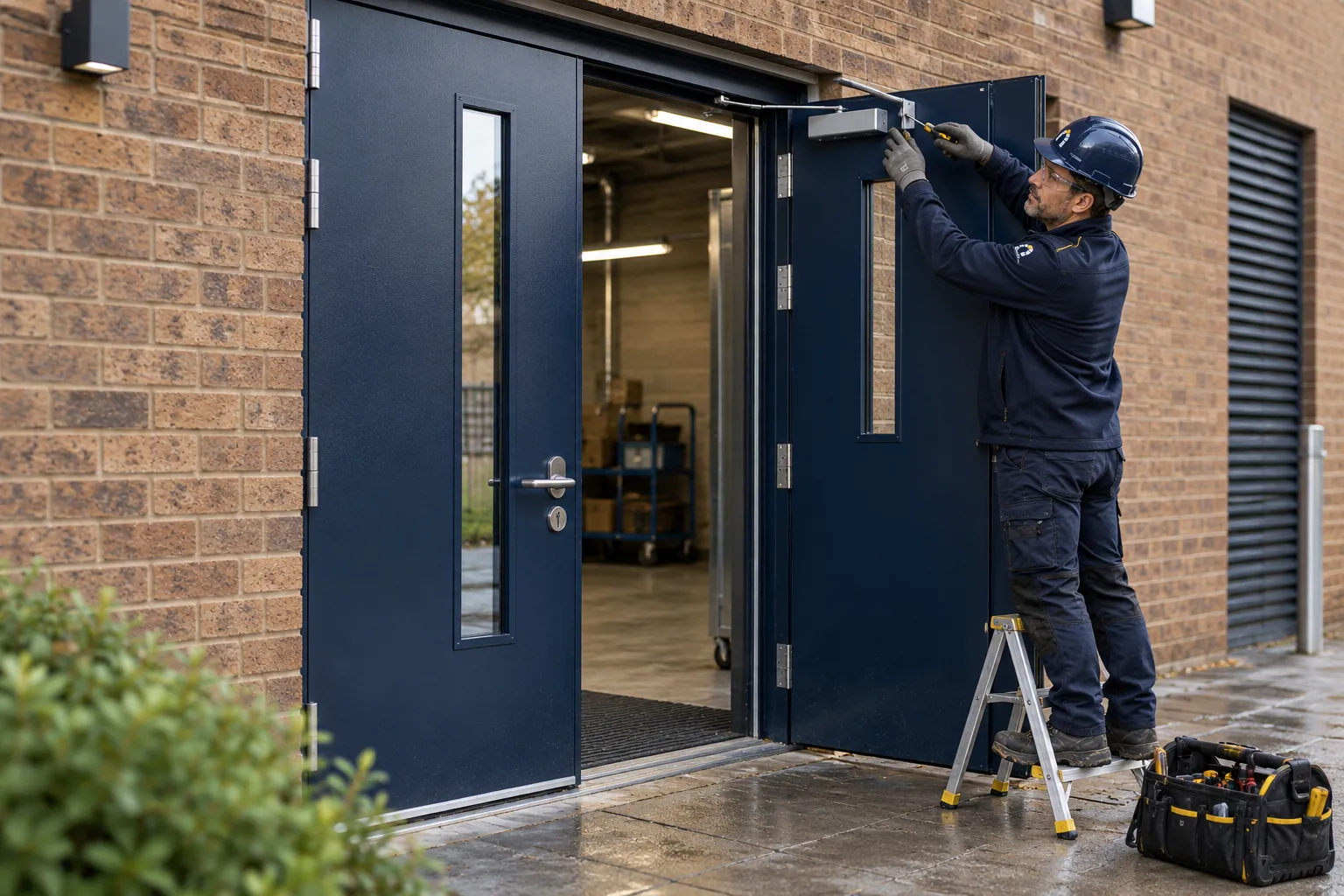
Security · LPS 1175 SR2 to SR5
Security Doors in Portsmouth
Security doors for Portsmouth port city premises: marine and logistics buildings, salt air finishes, ratings, and what to name on the order.
- ✓Third-party test evidence with every product
- ✓Written specification you can issue to tender
- ✓Supplied and installed in Portsmouth
Get a free quote in Portsmouth
Rating, written specification and budget range within one working day.
Confidential. No cost, no obligation.
Third-party tested
Evidence with every quote
UK manufactured
Made to your sizes
One accountable team
Specify, supply, install
Confidential handling
Details never shared
Supplied and installed in Portsmouth
What we supply in Portsmouth
A Portsmouth buyer should start from the opening and the exposure, not the catalogue. A rated steel door at B3 or C5 suits most commercial and logistics entrances, a fire rated doorset suits any escape route, and a galvanised finish suits doors facing salt air and wet weather.
The sections below work through what the port setting changes, the marine and logistics premises, salt air finishes, the ratings behind an order, fire and security on one doorset, access control, planning checks, and the enquiry itself. Our security doors Southampton page covers the city along the south coast.
Portsmouth is a port city on the south coast, and its premises mix marine and logistics buildings with commercial centres and industrial estates. A door that faces salt air and heavy vehicle traffic needs a different finish and a different rating from a door in a sheltered office, and the schedule should name the exposure for each opening.
- LPS 1175Forced entry rating, B3 to D10
- PAS 24Enhanced security doorset standard
- FD30 / FD60Fire resistance periods tested to EN 1634-1
- GalvanisedFinish for salt air and wet weather
A port city: what the setting changes about a door
A port city puts a door in front of heavy vehicle traffic, goods in transit and night shift work. Lorries arrive and leave at all hours, staff pass through the personnel door at every shift change, and the stores behind the door hold goods that are moving on. A door in that setting needs access control as much as it needs a rating. Our warehouses and logistics sector page covers the buildings that hold the stock.
Marine and logistics buildings sit beside commercial centres and industrial estates in the same city, and each kind of building asks a different question of its doors. A logistics building needs doors that take vehicles and shift changes. A commercial centre needs doors that take a crowd and let it out fast. An industrial estate needs doors that take daily use and resist a forced entry from a quiet approach.
Doors for marine and logistics premises
Loading bay doors cycle all day on a marine and logistics site, personnel doors sit at the side or rear, and yard gates control vehicles. A personnel door at the rear of a warehouse faces a quieter, darker approach than a front entrance, so it usually needs a higher rating than the front door. Our loading bay doors guide covers the bay doors in full.
Steel carries the use these doors take every day. A steel leaf resists the knocks a logistics door meets: a trolley, a pallet, a boot, a crate. Hinges to BS EN 1935 carry the leaf, grade 13 or grade 14, and a hinge that has dropped lets the leaf sag, so the closer cannot close it squarely. A closer to BS EN 1154 should bring the leaf back and hold the latch every time, and the minimum power size on a fire door is EN 3.
The yard gate decides what reaches the dock
Every load passes one opening on its way in. Lorries, forklifts and staff on foot all come through the yard gate, and the gate decides what gets in and what stays out. A gate that stands open all day is no gate at all, and a store door behind it is only as strong as the gate in front of it.
The gate is the vehicle line, and the line is measured. ProtectUK guidance for hostile vehicle mitigation puts the clear gap between measures at no more than 1,200 mm, with a minimum height of 500 mm, so a vehicle cannot pass between them. The hostile vehicle mitigation guide gives the measures, the gaps and the line they draw, and the security bollards guide gives the bollards that hold the line where a gate cannot.
Past the gate, the dock door takes the loads. A dock door that shuts tight after each lorry keeps the weather out of the store, and a dock door left standing open lets harbour wind and rain straight through to the goods. The loading bay doors guide deals with the dock, the door and the loads that pass it.
The store door faces the harbour wind and the salt it carries. Salt air attacks the fixings first, then the hinges, then the threshold, so the store door is checked at the screws and the knuckles before its face is judged. A finish named beside the rating on the order is what keeps the door working after a winter of harbour weather. The security doors for ports guide treats the finish and the fixings on a door that faces the water.
| Stop on the route | What it does | What to check |
|---|---|---|
| Yard gate | Decides what reaches the dock | Gate shuts behind each lorry |
| Dock door | Takes loads in and out | Door shuts tight after each load |
| Store door | Guards the goods inside | Fixings, hinges and threshold |
| Rear service door | Staff and waste out | Lock, seal and the door shutting |
Loads in, waste out and staff on foot all pass through one gate
One gate serves three kinds of traffic, and each kind needs its own way through. Loads come in through the vehicle gate, waste goes out the same way, and staff on foot use a pedestrian gate beside it, so nobody walks where the lorries turn. A frame that holds its shape keeps the gate true, and a gate that stays true shuts after every passage.
The route from the gate to the dock is walked on the same round as the doors, and the round does not end at the store. The security door maintenance checklist puts the round in order from the gate inward, and the warehouse security doors guide takes the yard, the dock and the store as one site.
Check the gate, the dock and the store door before the order goes in, and let the route from the gate to the dock set the ratings.
Salt air and wet weather: finishes that last on the south coast
Doors near the coast face two slow enemies: salt air and standing water. Salt air corrodes unprotected steel first at the edges, the hinges and the bottom rail. Standing water after heavy rain attacks the threshold, the bottom seal and the base of the frame. A door that is checked once a year will show corrosion only when it has already spread.
For the finish, the choice is between powder coating, galvanising and a galvanised base with a powder coated top coat. Powder coating gives colour and a hard surface, and suits sheltered doors. Galvanising gives a zinc coating that protects the steel itself, including edges and cut sections, and suits doors facing salt air and wet weather. A galvanised base with a powder coated top coat gives both. Our powder coating vs galvanising guide compares the two finishes.
For standing water, check what the threshold detail does when water stands against it. A raised threshold, a sealed frame base and drainage that keeps water away from the door all help, but no standard steel door is a flood barrier.
What B3, C5 and D10 mean on a Portsmouth order
An LPS 1175 rating is written as a letter for the tool category and a number for the minutes of attack time, and the two halves are read together. B3, the old SR2, resists three minutes of attack with tools such as screwdrivers, pliers and hand saws. C5 covers five minutes with crowbars, drills and chisels, and D10 covers ten minutes with sledgehammers, disc cutters and jigsaws.
A staffed front entrance suits B3, a rear door facing a quiet yard suits C5, and a door guarding high value stock, a plant room or a cash handling area suits D10. PAS 24 is the enhanced security standard for doorsets, tested against a lower threat level than LPS 1175, and it fits entrances where the threat is opportunistic rather than planned. EN 1627 sets resistance classes RC1 to RC6 for windows, doors and shutters, and Secured by Design is a scheme, not a rating, so a door carrying the scheme mark without a test rating has no proven resistance behind it.
Only the complete tested assembly carries the rating. A rated leaf in an untested frame is not a rated doorset, and a change to the leaf, the frame, the glass, the seals or the hardware can break the tested construction. Ask for the test report and the classification naming the exact doorset before the order is placed. Our guide to keeping an LPS 1175 rating valid sets out the changes that void a rating and the inspection routine that keeps it alive.
Fire and security on one Portsmouth doorset
Many doors in Portsmouth must do two jobs: hold fire and resist forced entry. A server room door must hold fire and resist an attack on the equipment inside, and a plant room door must hold fire and resist a forced entry. The two jobs need two sets of evidence on one assembly: a fire classification to EN 1634-1 and a forced entry rating to LPS 1175 or PAS 24. FD30 and FD60 are fire resistance periods tested to EN 1634-1, and the number is the minutes the doorset holds its rating in the furnace test.
Check the escape hardware on a door that carries both jobs. A panic bar to BS EN 1125 should cover at least 60 percent of the leaf width, and the door should open in one action, in the direction of escape, without a key. A door must open with less than 30 N in the first 30 degrees and less than 22.5 N beyond that, under BS 8300 and Approved Document M. Our dual certification guide works through how fire and security sit on one assembly.
Fratton Park and Gunwharf Quays: doors for crowds by the harbour
Fratton Park stands on Frogmore Road in Portsmouth, and it has been the home of Portsmouth Football Club since 1899. The ground is all seater, with room for 20,867 supporters, and every one of them leaves through the same exit doors at full time. A door on that route must release in a single movement, with no key and no code, then lock down again once the crowd has gone. On any door that serves more than 60 people, BS EN 1125 calls for a push bar that covers no less than 60 percent of the leaf, so the bar belongs in the specification from the start. Royal Assent came in April 2025 for Martyn’s Law, which places premises holding 200 to 799 people in a standard tier and premises holding 800 or more in an enhanced tier. The duties are not live yet, and spring 2027 is the expected date for them to come into force. The Martyn’s Law guide for premises gives the tiers and what each one asks of a premises, and the doors a ground needs are given in the stadium security doors guide.
Gunwharf Quays sits in the Portsea area beside Portsmouth Harbour station, and it opened on 28 February 2001 as a designer outlet on the site of the old HM Gunwharf. The centre holds 93 stores with a cinema and 25 pubs and restaurants, so its doors face two very different days: a busy trading day with staff at every entrance, and a quiet night when only the service doors are in use. A shopfront door that is watched all day can carry B3, while a service door at the rear, where nobody passes after closing, needs C5, because the approach stays unwatched once the centre shuts. The shopping centre security doors guide works through front and rear doors for a centre like this.
| Building | Door | Rating to name |
|---|---|---|
| Fratton Park | Stadium exit doors | Panic hardware, BS EN 1125 |
| Gunwharf Quays | Shopfront and service doors | LPS 1175 C5 rear, B3 front |
| Cascades Shopping Centre | Mall entrance and service doors | LPS 1175 C5 rear door |
| University of Portsmouth | Teaching block entrance | LPS 1175 B3 or C5 where rated |
Queen Alexandra Hospital and the Guildhall Campus: doors for wards and lecture rooms
Queen Alexandra Hospital stands on Southwick Hill Road in Cosham, inside the Portsmouth city boundary, and it is one of the largest hospitals on the south coast, with more than 8,700 staff. A hospital door works all day and all night, and it must hold fire as well as control who passes. A fire rating is written as FD30 or FD60, the minutes the doorset holds in a furnace test to EN 1634-1. A ward door also has to open easily for a porter pushing a bed, so BS 8300 and Approved Document M hold the opening force to under 30 N across the first 30 degrees, and under 22.5 N once the leaf has swung past them. The fire door regulations for hospitals set out the fire side of a hospital doorset.
The University of Portsmouth keeps most of its teaching in the Guildhall Campus in the city centre, with further departments in the Northern Quarter and sports facilities at the Langstone Campus in Milton. Teaching rooms, laboratories, libraries and halls of residence share one campus, yet no single door suits them all. A lecture room door swings for a full class between sessions, a laboratory door guards people and equipment at once, and a hall door admits residents while holding strangers outside. For the campus as a whole, the university security doors guide is the place to start, and halls of residence are covered on their own in the student accommodation guide.
Start with the building and the crowd, not the catalogue. A ward door, a hall door, a shop service door and a stadium exit all open in Portsmouth, and none of them does the work of the others.
Access control for a site that never closes
A site that never closes needs access control that works at night as well as it works at midday. Staff carry cards, visitors use a code or a pass, and contractors use a temporary credential that expires when the work ends. A reader that works at walking pace suits a busy entrance, and a check that cannot be lent to another person suits a server room or a stores door.
Agree the fail state in advance and test it with the power off. A door that must stay locked for security and a door that must release for escape need different answers, and the answer should be written down where the facilities team can find it. Premises that hold crowds face duties under Martyn’s Law, which sets tiers for premises that hold 200 or more people, with Royal Assent in April 2025 and go-live expected in spring 2027.
Planning checks with Portsmouth City Council
Three cases need a check with Portsmouth City Council before ordering, while most like-for-like door replacements inside an existing opening need no planning permission at all. Major alterations to the outside of a building, including a new opening or a changed frontage, can need planning permission. Work in a conservation area faces additional controls, and listed buildings need separate consent.
Listing covers the whole building, inside and out, and a listed building carries duties that a new building does not. Altering or replacing any of the doors or windows of a listed building needs listed building consent, separate from planning permission and building regulations approval, and a door fitted without the right consent can be ordered out again. Unauthorised work to a listed building is an offence, with severe penalties, so anyone unsure should ask the council’s conservation officer well in advance. Consent applications need drawings of the building as it exists and the proposed changes.
What the enquiry should name for a Portsmouth site
Ordering doors for a Portsmouth site is a specification exercise, not a shopping exercise. The enquiry should name the town, the building, the position, the fire rating, the security rating where one is needed, and the leaf, the frame, the glass, the beads, the seals and the hardware as one doorset. The security side needs its own evidence where the door must also resist attack: a rating to LPS 1175 or PAS 24, on the whole doorset, not on the leaf alone. The enquiry should also name the exposure each opening faces, salt air, wet weather or heavy vehicle traffic, so the finish is ordered with the door.
Order the evidence at the same time as the doors. The test report, the classification and the hardware schedule should travel with the doorset, and the handover pack should set out the inspection routine the site will follow. A site that keeps the evidence from the day the doors arrive holds a record it can use for the whole life of the estate. Our how to specify security doors guide covers the same discipline for rated doors, our security door cost factors guide covers the factors behind a quote, and our fire door inspection checklist gives the checks that catch a failing leaf before it matters.
| Premises | Door position | Rating | What to check |
|---|---|---|---|
| Marine and logistics unit | Personnel door | LPS 1175 B3 or C5 | Steel leaf, hinges, latch |
| Commercial centre | Escape and entrance doors | FD30 or FD60 | Panic hardware, opening force |
| Industrial estate | Stores and plant room doors | FD60 | Seals, gaps, self-closing |
| Logistics yard | Loading bay personnel door | LPS 1175 B3 or C5 | Closer, latch, hold-open release |
| Coastal entrance | Door facing salt air | LPS 1175 where rated | Galvanised finish, seals |
In Portsmouth, a door that faces salt air and night traffic needs a different finish and a different rating from a door in a sheltered office, and the schedule should name the exposure for each opening.
What LPS 1175 rating do I need for a Portsmouth commercial door?
For most commercial entrances, B3 suits a staffed front entrance and C5 suits a rear or side door facing a quiet approach. The rating should follow the risk assessment for that opening.
What finish suits a door near the sea in Portsmouth?
A galvanised finish suits doors facing salt air and wet weather, because it protects the steel itself, including edges and cut sections. A galvanised base with a powder coated top coat adds colour over that protection, and the finish should be one the tested doorset allows.
Can a fire exit door also be a security door?
Yes, where both ratings cover the same doorset and the escape hardware releases in one action from the inside, without a key or a code.
Do I need listed building consent to replace a door in Portsmouth?
If the building is listed, yes, usually. Altering or replacing any of the doors or windows of a listed building needs listed building consent, separate from planning permission. Ask Portsmouth City Council’s conservation officer well in advance of planned works.
Does a security door protect against flooding?
No. A standard steel security door is not a flood barrier. Specify thresholds, seals and drainage for standing water as a separate matter from the security rating.
Get a free quote
Other areas
Security doors in other areas
Ready to specify your project?
Free assessment, written specification and test evidence. Reply within one working day.