
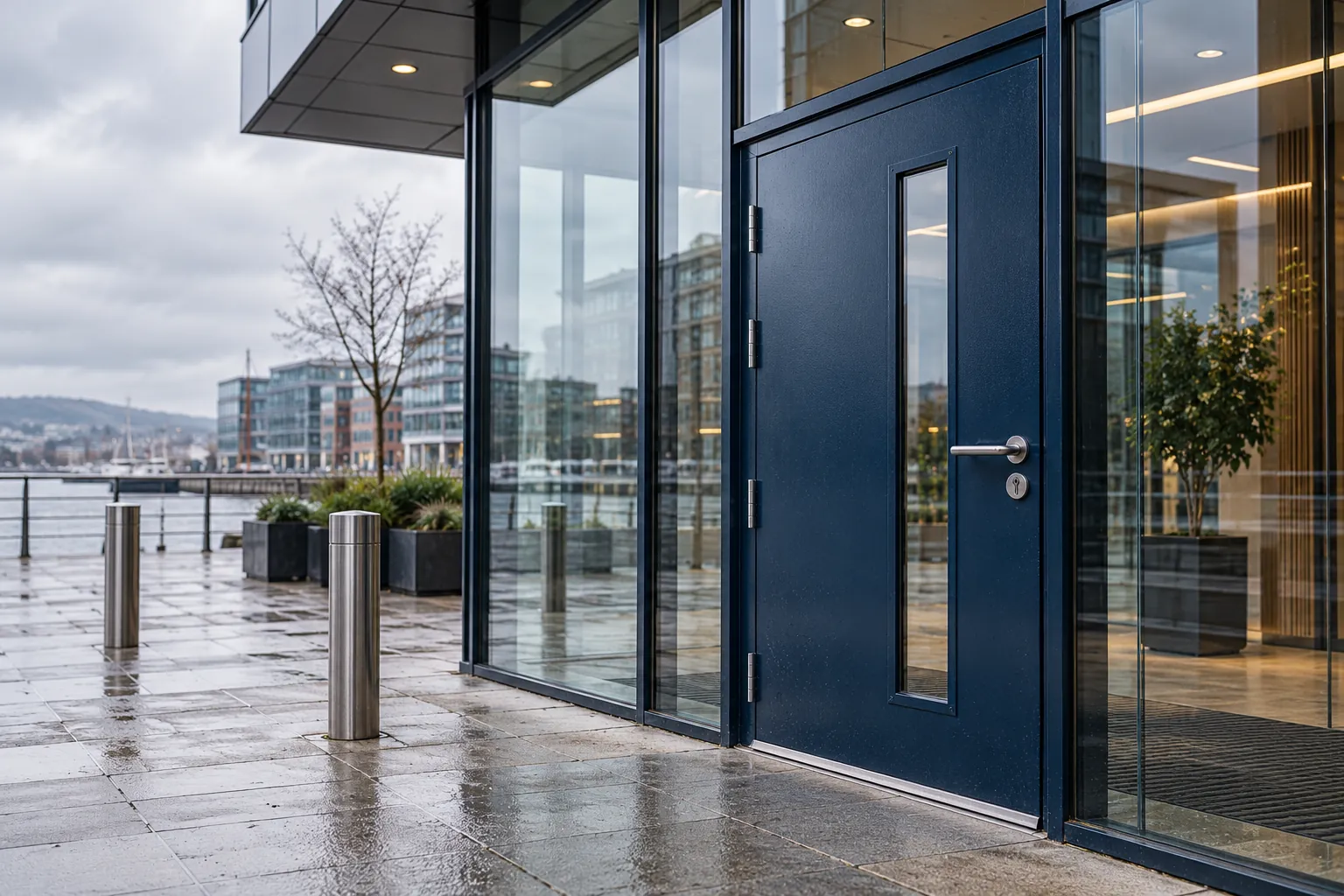
Security · LPS 1175 SR2 to SR5
Security Doors in Cardiff
Security doors for Cardiff offices, civic buildings and dockside sites: ratings, fire and security on one doorset, and what to name on the order.
- ✓Third-party test evidence with every product
- ✓Written specification you can issue to tender
- ✓Supplied and installed in Cardiff
Get a free quote in Cardiff
Rating, written specification and budget range within one working day.
Confidential. No cost, no obligation.
Third-party tested
Evidence with every quote
UK manufactured
Made to your sizes
One accountable team
Specify, supply, install
Confidential handling
Details never shared
Supplied and installed in Cardiff
What we supply in Cardiff
A Cardiff order goes right when it starts with the opening and the people who pass through it. A steel door with a forced entry rating suits a staffed entrance, a fire rated doorset belongs on every escape route, and a gate at a yard needs a rating of its own.
Cardiff is the capital of Wales, and its buildings put different demands on their doors. Civic buildings and offices fill the city centre, shops and leisure premises serve the public through the day, and docks and industrial estates work beside the water. Each kind of building needs a door that suits its own use.
Keep the order straight with one list and one row for each opening. Each row names the building and the position, the fire period and the security rating where one is needed, and the leaf, the frame, the glass, the seals and the hardware as a single doorset. Our Cardiff page covers the city as a whole, and our Bristol page covers the city across the Severn to the east.
- LPS 1175Forced entry rating, B3 to D10
- PAS 24Enhanced security doorset standard
- FD30 / FD60Fire resistance periods tested to EN 1634-1
- Martyn’s LawTiers for premises holding 200 or more people
Civic buildings and the city centre: doors the public walks through
A civic building in Cardiff meets the public from the morning onwards. Staff arrive at the start of the day, visitors arrive through the day, and deliveries come to a side door, so the entrance has to admit the right people and keep strangers out. A glazed entrance lets reception see who stands at the door before it is opened, and a rated screen holds while the visitor is checked.
The same entrance has to let the crowd out in one movement when the alarm sounds. Panic hardware to BS EN 1125 belongs on doors that serve more than 60 people, with a bar across the leaf covering at least 60 percent of the leaf width. A door has to open with less than 30 N in the first 30 degrees and less than 22.5 N beyond that, under BS 8300 and Approved Document M, and a closer that is too strong for the leaf will fail the access rules. Our fire door closers guide works through the power sizes in BS EN 1154.
Premises that hold crowds fall inside the duties of Martyn’s Law, which sets tiers for premises that hold 200 or more people, with Royal Assent in April 2025 and go-live expected in spring 2027. The doors that release a crowd sit inside those duties, so they have to open in one action, in the direction of escape, without a key. Our Martyn’s Law guide works through the tiers and what they ask of a building.
The bay and the docks: doors that face water and weather
A door beside the water works in wet weather and salt air, so the finish has to match that exposure. For a sheltered door, powder coating gives colour and a hard surface. For a dockside door, galvanising puts a zinc coat on the steel that guards the edges and cut sections the weather reaches. A powder coated top coat over a galvanised base gives both kinds of protection. Our powder coating vs galvanising guide compares the two finishes, and our powder coating page covers the finish options.
A personnel door on a dockside warehouse opens for every shift change, every delivery and every break. Strength is not a rating, though: a leaf that stands up to a knock can still fail a forced entry test. Only the whole tested assembly carries the rating, leaf, frame, fixings, glazing and hardware tested together, so a rated leaf in an untested frame is not a rated door. Our warehouse security doors guide covers the doors distribution buildings need.
B3, C5 and D10: reading the rating before a Cardiff order
LPS 1175 rates a doorset by two things: which tools it stands up to and how long it stands up to them. Hold for three minutes against category B tools, screwdrivers, pliers and hand saws, and the doorset is B3. Hold for five minutes against category C tools, crowbars, drills and chisels, and it is C5. Hold for ten minutes against category D tools, sledgehammers, disc cutters and jigsaws, and it is D10. Old drawings still use the earlier labels, and they map across as SR2 for B3, SR3 for C5 and SR4 for D10.
Match the rating to the risk: B3 for a staffed front entrance, C5 for a rear door on a quiet yard, D10 for a door guarding high value stock, a plant room or a cash handling area. PAS 24 is the enhanced security doorset standard, and EN 1627 gives resistance classes RC1 to RC6. A Secured by Design mark is a scheme mark, not a rating, and on its own it proves nothing about resistance, so always ask for the test rating behind it. The three ratings buyers meet most often are compared in our SR2 vs SR3 vs SR4 guide.
The rating sits on the whole tested assembly, never on one part of it. A leaf tested on its own says nothing about the frame, the fixings, the glazing or the hardware round it, and changing any of those parts can break the construction that passed the test. Get the test report and the classification naming the exact doorset before ordering, and file both with the order. What voids a rating after handover is set out in our guide to keeping an LPS 1175 rating valid, and the two routes are compared in our LPS 1175 vs PAS 24 guide.
A doorset with two ratings: fire and forced entry in Cardiff
A Cardiff door is often asked to do two jobs on one assembly: hold fire and resist a forced entry. The server room door has to keep fire out and keep an attacker away from the equipment, and the plant room door has to do the same for a different risk. Each duty needs its own proof on that one assembly, a fire classification to EN 1634-1 and a forced entry rating to LPS 1175 or PAS 24. How the two proofs sit together is worked through in our dual certification guide.
The fire periods come from the EN 1634-1 furnace test: FD30 holds for 30 minutes and FD60 for 60. FD30S adds smoke control to 30 minutes of integrity, tested to BS EN 1634-3. EI caps the temperature rise on the safe side, 140 degrees Celsius on average and 180 degrees at most. Alter any part of the tested construction and the door holds no proven rating afterwards.
Principality Stadium: doors for a crowd of more than 70,000
Principality Stadium sits in the city centre and opened in June 1999 as the Millennium Stadium, built to host the Rugby World Cup. It is the national stadium of Wales and the home of the Welsh Rugby Union. The stadium holds 73,931 people, after its capacity was reduced from 74,500 in 2019 to improve access for disabled supporters. A crowd of that size enters through the same gates and leaves by the same exits, so the doors face a surge twice on a matchday.
Escape doors on a stadium must open at one push, with no key, no code and no second move. A push bar to BS EN 1125 runs across at least 60 percent of the leaf. With more than 800 people present, the stadium falls in the enhanced tier of Martyn’s Law. The Terrorism (Protection of Premises) Act 2025 was given Royal Assent in April 2025, and its tiers turn on how many people may be present: 200 to 799 in the standard tier, and 800 or more in the enhanced tier. The Martyn’s Law guide for premises sets out the tiers that apply to a crowd of that size, and turnstiles, concourses and exits are ordered together in the stadium security doors guide.
A stadium door often has to prove two things at once: the same leaf must hold back fire for its rated period and resist a forced entry attempt, and both proofs must name the same doorset. Fire classes to EN 1634-1 run E, EW and EI from 30 to 120 minutes. Forced entry classes to LPS 1175 Issue 8 run from B3, which is SR2 and three minutes, through C5, which is SR3 and five minutes, to D10, which is SR4 and ten minutes. Ask for test evidence that names both ratings on one assembly.
Cardiff Bay and the city centre: doors for venues and shops
The Wales Millennium Centre stands at Bute Place in Cardiff Bay. Phase 1 of the building opened during the weekend of 26 to 28 November 2004, and phase 2 opened on 22 January 2009. An arts centre fills and empties in waves, and the doors on the auditorium must clear a full house fast when the alarm sounds. The exhibition centre security doors guide covers large venues beside it.
St David’s shopping centre in the city centre was extended in 2009. Shoppers pass the glazed front while staff are on the floor, so LPS 1175 B3 fits the front entrance. The service door at the back opens onto a quiet road after the shops close, and LPS 1175 C5 fits it. Stockrooms and cash handling areas take the rear door rating too. The shopping centre security doors guide puts front and rear doors on one page, and the retail security doors guide puts the shopfront and the stockroom on theirs.
The University Hospital of Wales stands in the Heath district of Cardiff and opened in 1971. It holds 1,080 beds, and it is the largest hospital in Wales. Cardiff University began as the University College of South Wales and Monmouthshire, which opened on 24 October 1883. A hospital ward door must hold fire for its rated period and still open under a light push. A door on a store for drugs or equipment needs a forced entry rating as well, with the evidence naming the whole doorset. The hospital security doors guide gives the ward and department order, and the university security doors guide gives the campus order.
| Building | Opening | Rating to name |
|---|---|---|
| Principality Stadium | Stand exit doors | Panic hardware to BS EN 1125 |
| University Hospital of Wales | Ward doors | EI 30 to EI 120 to EN 1634-1 |
| St David’s | Rear service door | LPS 1175 C5 |
Write each opening on the schedule with its building, its crowd and its rating. The stadium exit, the auditorium door, the ward door and the shop service door each need a different answer, and the schedule is where those answers are set down.
One system, many Cardiff sites: access control that stays joined up
Run a Cardiff estate that spans several sites on one access system. Staff carry cards, visitors use a code or a pass, and contractors get a temporary credential that runs out when the work ends.
It has to open for the right people, stay shut for everyone else, and record who passed and when. Tie the doors, the turnstiles, the lifts and the car park into the same system, so access lost in one place is lost everywhere at once. Settle the fail state in writing before the doors go in: a door that must stay locked for security and a door that must release for escape need opposite answers, and each answer should be proved with the power off. Our security turnstiles guide works through readers, fobs and biometrics and how the lane is wired into the access system.
Rain, salt and the finish that survives them
How long a Cardiff door lasts is decided by its finish, and the choice follows the exposure it faces. A galvanised base with a powder coated top coat gives both kinds of protection, so ask which finish the tested doorset allows.
The hinges and fixings decide whether the leaf keeps working. A hinge to BS EN 1935, grade 13 or grade 14, carries the leaf, and once a hinge drops the leaf sags and the closer cannot shut it square. A hold-open device to BS EN 1155 holds a door open for use and lets it go when the alarm sounds, so test the release at every inspection. Check the gaps and seals on the same visit: 4 mm around the leaf is the usual limit, and intumescent seals close the gap in a fire as they expand at roughly 200 to 250 degrees.
Checking the fixings before the finish fails
Wet air and salt air do their work slowly, and the first sign is rarely on the face of the door. It shows on the small parts first: a hinge screw with rust at its head, a fixing that no longer holds tight, a threshold edge that has started to pit. By the time the face of the door shows rust, the fixings have already been losing their grip for months.
Hinges take the weather and the weight together. A hinge that rusts at the knuckle stiffens, and a stiff hinge drags the door out of square, so the bolt no longer meets its keep and the seal no longer meets the frame. Check the knuckles and the screws on the same visit, and write down any hinge that needs a free swing to move. The steel door frames guide covers the frame, the hinges and the fixings that hold them.
The rating and the finish belong on the same line of the order. LPS 1175 Issue 8 gives B3 at 3 minutes, C5 at 5 minutes and D10 at 10 minutes, and each of those ratings is proved on a doorset with its finish and its fixings in place. A finish ordered on its own, with no rating beside it, proves nothing about the door it covers. The LPS 1175 standard sets out the ratings, and the ten steps to specify an LPS 1175 door guide puts the rating and the finish on one order.
The threshold is the part the weather reaches from below. Rain runs down the face of the door and settles on the threshold, and salt in the air settles with it, so the threshold edge and the fixings under it corrode while the face above still looks sound. Lift the mat, look at the edge and try the fixings with a driver before the inspection moves on.
| Part | What salt air does first | What to name on the order |
|---|---|---|
| Hinges | Rust at the knuckle, stiff swing | Hinge grade and finish |
| Fixings and screws | Rust at the head, grip lost | Fixing type and finish |
| Threshold | Pitting at the edge | Threshold material and finish |
| Frame and seal | Seal lifts where the frame corrodes | Frame finish and seal type |
Before the order goes in, name the finish beside the rating
An inspection that catches rust early saves the rating, because rust on a fixing is a small job and rust through a frame is a new door. Walk the doors twice a year, look at the fixings before the face, and write the worst opening first on the list. The security door maintenance checklist gives the inspection its order, and the fire door maintenance guide sets out the checks for the seal and the closer beside it.
Doors that face water and weather need the same treatment as doors on a dockside, where salt air is part of the working day. The security doors for ports guide covers the finish and the fixings for a door that never gets a dry day.
What rusts first? The fixings, so name them on the order.
Cardiff Council, conservation areas and listed buildings
Changing a door like for like inside an existing opening usually needs no planning permission. Three cases are different, and each one needs a check with Cardiff Council before ordering: major changes to the outside of a building, work in a conservation area, and work on a listed building, which needs separate consent and is the case buyers miss most often.
Cardiff Council is the planning authority, and listed buildings carry duties a new building never meets. A door fitted without the right consent can be ordered out again, so the enquiry should carry the listing and the conservation area beside the door schedule. A steel leaf in a listed facade needs a finish and a fixing the conservation officer accepts.
Putting the Cardiff enquiry together: the schedule that orders the doors
Put a Cardiff order together as a specification, not as a purchase from a catalogue. The enquiry should carry the building, the position, the fire rating and the security rating where one is needed, with the leaf, the frame, the glass, the beads, the seals and the hardware as a single doorset. Where the door must also resist attack, ask for the security evidence on the whole doorset, a rating to LPS 1175 or PAS 24, not a rating for the leaf alone. The same discipline, column by column, is covered in our how to specify security doors guide.
Let the evidence travel with the doors. Ask for the test report, the classification and the hardware schedule to arrive with the doorset, and check that the handover pack names the inspection routine the site will follow. File everything on the day the doors arrive, and the estate keeps a record it can use for the whole life of the building. The checks that catch a failing leaf before it matters are in our fire door inspection checklist.
| Premises | Door position | Rating | What to check |
|---|---|---|---|
| Civic building | Glazed entrance | LPS 1175 where rated | Screen rating, reader pace |
| Retail unit | Escape and entrance doors | FD30 or FD60 | Panic hardware, opening force |
| Dockside warehouse | Personnel door | LPS 1175 B3 or C5 | Steel leaf, hinges, latch |
| Distribution unit | Loading bay personnel door | LPS 1175 where rated | Closer, latch, hold-open release |
| Stores and plant room | Internal doors | FD60 | Seals, gaps, self-closing |
In Cardiff, the door that suits a civic building does not suit a dockside warehouse, and the schedule should name the use each opening serves.
What LPS 1175 rating do I need for a Cardiff office door?
B3 fits a staffed front entrance and C5 fits a rear or side door that faces a quiet approach, for most office entrances. The rating should follow the risk assessment for that opening.
Can one doorset carry a fire rating and a security rating?
Yes, where both proofs name the same doorset. The fire side needs a classification from EN 1634-1 and the security side needs a rating from LPS 1175 or PAS 24, and both must name the doorset that will be fitted.
Do I need planning permission to replace a door in Cardiff?
A like-for-like replacement inside an existing opening usually needs none. A new opening, work in a conservation area, or work to a listed building calls for a check with Cardiff Council first.
What finish suits a Cardiff dockside door?
Galvanising fits a door that faces wet weather and salt air: the zinc coating protects the steel itself, including edges and cut sections. Confirm the tested doorset allows the finish before ordering.
How do I order doors for more than one Cardiff site?
One schedule does the job: one row per opening, naming the building, the position, the fire rating, the security rating and the whole doorset. Ask for the evidence to arrive with the doors, and file it on the day the doors arrive.
Get a free quote
Other areas
Security doors in other areas
Ready to specify your project?
Free assessment, written specification and test evidence. Reply within one working day.