
Sectors
Security for warehouses and logistics sites
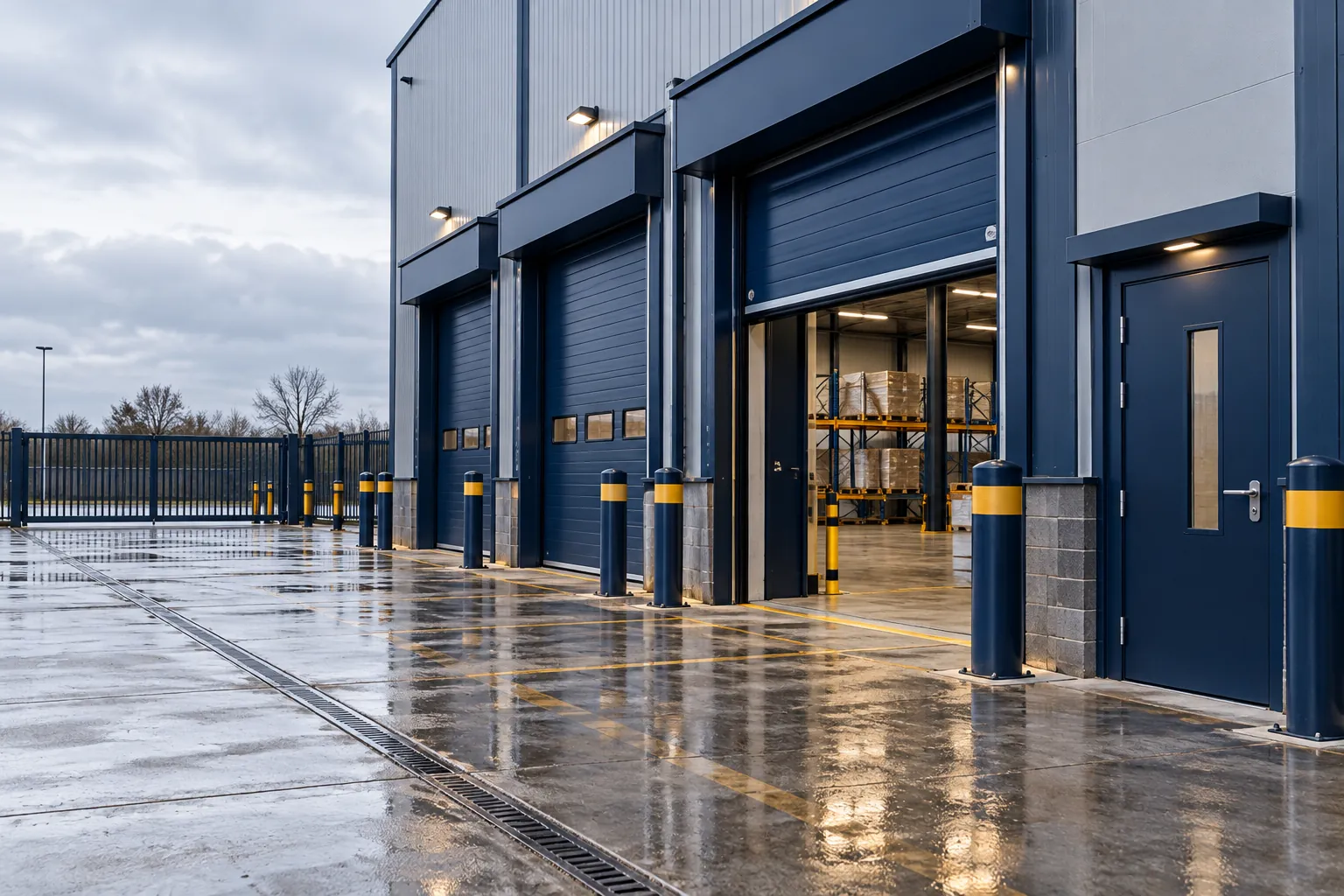
Security doors for warehouses: loading bays, personnel doors, yard gates and bollards, specified in the right order for UK warehouse and logistics sites.
- ✓Third-party test evidence with every product
- ✓Written specification you can issue to tender
- ✓Supplied and installed across the UK
Get a free project quote
Rating, written specification and budget range within one working day.
Confidential. No cost, no obligation.
Third-party tested
Evidence with every quote
UK manufactured
Made to your sizes
One accountable team
Specify, supply, install
Confidential handling
Details never shared
Start with the loading bay, then the personnel doors, then the yard gates. A warehouse is entered through its working openings, not through its walls, so the order of spend follows the order of use: the doors that open most often, the doors left open during shifts, and the gates that stand open for deliveries.
- B3 to D10LPS 1175 ratings for steel personnel doors
- PAS 68, IWA 14-1, ISO 22343-1Vehicle impact standards for gates and bollards
- E, EW or EI 30 to 120Fire classifications to EN 1634-1
- 48, 64 and 80 km/hCommon vehicle impact test speeds
Where a warehouse is actually entered
A warehouse has four kinds of opening, and they fail in a clear order. Loading bay doors are the largest and most used openings, so they spend the most time open and take the most knocks. Personnel doors are the quiet way in, often at the side or rear of the building, and they are the doors most likely to be left open during a shift change. Yard gates control vehicles, but a gate that stands open for deliveries controls nothing. Stockroom doors inside are the last layer.
Work in that order: a high rated personnel door adds little beside a light shutter with a basic lock, and a strong gate adds little if staff prop a side door open. Walk the site at shift change and lock up, and note which doors are open, propped or never locked. Those are the openings to fix first.
Loading bays: high performance roller doors
A loading bay door works harder than any other door on the site: it opens for every vehicle, faces wind and rain across a wide opening, and takes forklift traffic all day. A door built for occasional use fails early here, in motor, guides or curtain. High performance roller doors are built for that cycle count and for speed of operation, which matters for security too: a fast closing door spends far less time open.
Specify by opening size, cycle count and wind and impact exposure, not by price alone. Ask what the curtain is made of, how the guides are fixed, and what happens when a forklift clips the curtain: a curtain that jams halfway leaves the bay open until repaired. A bay left half open overnight is an open bay.
Security shutters and personnel steel doors
Stockrooms, workshops and outbuildings are usually closed with security shutters. A solid curtain gives the most privacy and resistance, while a perforated or grille type keeps some visibility and airflow. High value stock calls for a solid curtain and a strong locking arrangement, and a shutter is only as strong as its guides and lock, so ask how both are fixed and whether the locking is part of the tested assembly.
Personnel doors take the forced entry ratings. Under LPS 1175 Issue 8, a rating is a tool category letter plus minutes of attack time: B3 is 3 minutes against screwdrivers, pliers and hand saws; C5 is 5 minutes against crowbars, drills and chisels; D10 is 10 minutes against sledgehammers, disc cutters and jigsaws. Most warehouse personnel doors sit at B3 or C5, with D10 for stockrooms, cash offices and sites with a known threat. The rating belongs to the whole doorset, so changing the lock or hinges after the test can void the evidence. The LPS 1175 standards page sets out the full scale.
| Opening | Main risk | What to specify | Evidence to ask for |
|---|---|---|---|
| Loading bay door | Left open, knocked by forklifts | High performance roller door, fast close | Cycle rating and curtain construction |
| Personnel door | Forced entry at side or rear | Steel door, LPS 1175 B3, C5 or D10 | Whole doorset test evidence |
| Yard gate | Vehicle entry, tailgating | Sliding or swing gate, separate pedestrian gate | Gate construction and locking detail |
| Stockroom shutter | Targeted break-in out of hours | Solid curtain, strong guides and lock | Shutter and locking assembly detail |
| Fire exit door | Escape blocked by security | Fire rated doorset with escape hardware | EN 1634-1 classification and escape detail |
Access control belongs in the same specification: a door with a keypad, fob reader or intercom still needs its lock and closer inside the tested design, and any device cut into the leaf must be one the test allowed. State it at enquiry stage. Security doors covers the steel doorset range.
Yard gates and anti-ram gates
Yard gates let authorised vehicles in and out all day and keep unauthorised vehicles out at night. A sliding gate suits a wide entrance with room to slide; a swing gate suits a narrower entrance. Keep pedestrian access separate: a pedestrian gate beside the vehicle gate stops staff walking through the vehicle entrance and stops tailgating through a gate held open for a lorry. Security gates and sliding vehicle gates cover the main types, and turnstiles or pedestrian speed gates suit sites with controlled foot access.
Where a vehicle itself is the threat, an ordinary gate is not enough. Anti-ram gates and road blockers are crash tested, and the rating must state the vehicle type and mass, the impact speed, the impact angle and the penetration distance. Common test vehicles run from a 1,500 kg car and a 2,500 kg 4×4 up to a 3,500 kg van, a 7,200 or 7,500 kg truck and a 30,000 kg truck, at 48, 64 and 80 km/h. The standards are PAS 68, IWA 14-1 and ISO 22343-1:2023, the current international standard that supersedes both. The anti-ram gates and barriers guide compares gate types, and the vehicle impact ratings page sets out what a rating must state.
Ask for the full rating. A gate described only as “anti-ram”, with no vehicle mass, speed, angle and penetration distance, has no rating you can check. Ask for all four, in writing.
Bollards: two different jobs
Bollards on a warehouse site do two separate jobs, and mixing them up is the most common error in yard specification. The first is forklift protection: short, stout bollards or guards protecting racking, door frames, corners, columns and dock equipment from low speed knocks. They are not tested to stop a road vehicle.
The second job is hostile vehicle mitigation. HVM bollards are crash tested to PAS 68, IWA 14-1 or ISO 22343-1, and their rating covers vehicle, speed, angle and penetration distance. The foundation is part of the tested system: a tested bollard in an untested foundation has no rating. The line must run continuously, with no gap at a drain, gate post or corner.
Never use one type for the other job: a forklift guard will not stop a van, and an HVM bollard is wasted cost and digging where only a forklift passes. Walk the yard and mark each position by its job before ordering. Security bollards covers the range, and the bollard regulations guide explains spacing, height and foundations.
Fire exits that stay secure
Fire exits and security pull in opposite directions. An escape door must open easily, in the direction of escape, by anyone, without a key or code, even in smoke and panic, while a security door must resist unauthorised opening. The answer is a doorset carrying both ratings on the same tested construction, with escape hardware forming part of the test.
Fire doors are tested to EN 1634-1 and classified E for integrity, EW for integrity and radiation, or EI for integrity and insulation, with 30, 60, 90 or 120 minutes. LPS 1056 is the LPCB scheme for fire doors. A fire exit chained shut, locked with a key or blocked by pallets fails its purpose. The fire rated steel doors page covers steel doorsets with fire ratings, and the fire ratings page sets out the classifications.
Large sites should also note Martyn’s Law: the Terrorism (Protection of Premises) Act 2025 received Royal Assent in April 2025. Premises where 200 to 799 people may be present fall in the standard tier, and 800 or more in the enhanced tier, with at least 24 months before enforcement. The regulator is the Security Industry Authority. Enhanced tier premises must consider physical measures, but the Act does not mandate specific products. The Martyn’s Law page sets out the tiers.
Finishes, insurer questions and the layered checklist
Yard facing steel takes weather, forklift scuffs and pallet knocks, so the finish is part of the specification. Powder coating gives colour and corrosion protection for doors, gates and bollards. It must sit on the tested construction without changing it, and scuffs should be touched up before rust starts.
Insurer expectations are a question to ask, not a rule to guess: ask which rating the insurer expects for each opening, whether they want whole doorset test evidence, and whether the policy names a standard for gates or shutters. Keep the evidence with the building records. No insurer rule is stated here, because policies differ by site, stock and insurer.
The installation page covers how a doorset should be fixed into the structure. Installers should fix the frame with the tested fixings, into the structure the test assumed, and hand over the test evidence with the building records. Other sectors pages show the same products specified for transport hubs and data centres.
- Walk the site at lock up. Note every door open, propped or never locked, and every gate standing open.
- Fix the loading bays first. Fast closing, high cycle doors.
- Rate the personnel doors. LPS 1175 B3, C5 or D10 by risk, with hardware inside the tested design.
- Separate people from vehicles. A pedestrian gate beside every vehicle gate; anti-ram ratings where a vehicle is the threat.
- Mark every bollard by its job. Forklift guards for knocks, HVM bollards for vehicles, never swapped.
- Check every fire exit. Escape hardware working, route clear, fire and security ratings on one doorset.
- File the evidence. Certificates, ratings and insurer answers with the building records; doors checked on a schedule.
Should every warehouse door be LPS 1175 rated?
No. Rate by risk: personnel, stockroom and rear doors facing a quiet yard justify a rating, usually B3 or C5, with D10 for high value openings. A bay door or internal office door may not need one.
Can a loading bay door also serve as the fire exit?
No. A bay door is built for vehicles and cycles, while a fire exit must open easily by anyone in an emergency. Give the escape route its own fire rated doorset with escape hardware.
What should an anti-ram gate rating state?
The vehicle type and mass, the impact speed, the impact angle and the penetration distance, against PAS 68, IWA 14-1 or ISO 22343-1. A gate described only as anti-ram, with no numbers, has no rating you can check.
Do bollards need special foundations?
HVM bollards do: the foundation is part of the tested system, so a tested bollard in an untested foundation has no rating. Forklift guards are fixed for knocks, not vehicle impact.
Get a free quote
Related
More in sectors we protect
Products
One supplier for the whole building envelope
Ready to specify your project?
Free assessment, written specification and test evidence. Reply within one working day.