
Security · LPS 1175 SR2 to SR5
Security doors in Southampton
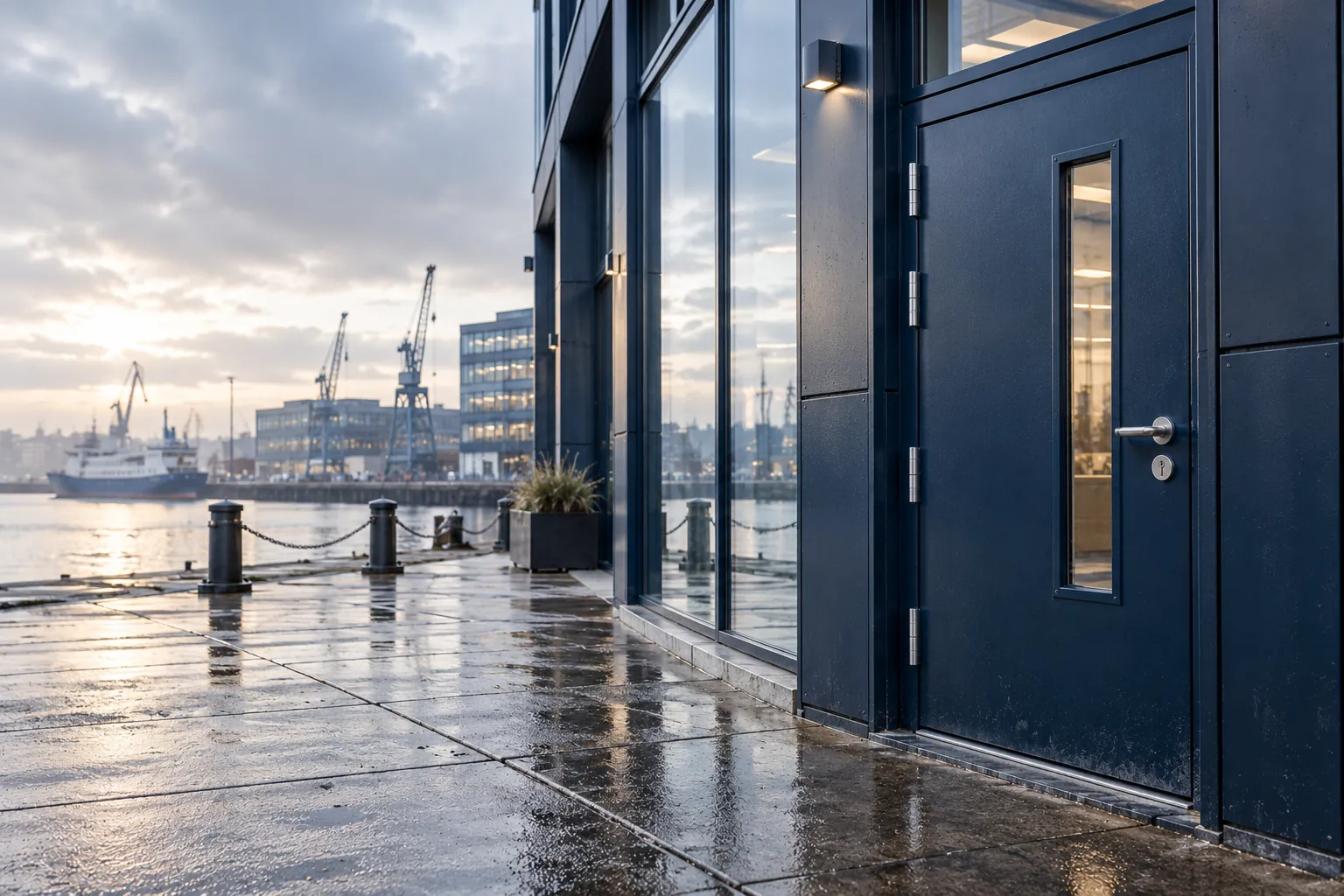
Security doors Southampton: LPS 1175 ratings, fire rated steel doors and coastal finishes for commercial, port-adjacent and residential block buyers in the UK.
- ✓Third-party test evidence with every product
- ✓Written specification you can issue to tender
- ✓Supplied and installed in Southampton
Get a free quote in Southampton
Rating, written specification and budget range within one working day.
Confidential. No cost, no obligation.
Third-party tested
Evidence with every quote
UK manufactured
Made to your sizes
One accountable team
Specify, supply, install
Confidential handling
Details never shared
Supplied and installed in Southampton
What we supply in Southampton
A Southampton buyer should start from the opening, not the catalogue. A rated steel door at B3 or C5 suits most commercial and block entrances, a fire rated doorset suits any escape route, and a galvanised finish suits doors facing salt air and wet weather.
- A1 to D10LPS 1175 ratings from SR1 to SR4
- PAS 24Enhanced security, below LPS 1175
- E, EW or EI 30 to 120Fire classifications to EN 1634-1
- Check firstPlanning and listed building consent
LPS 1175 ratings SR1 to SR4, explained for a buyer
LPS 1175 Issue 8 rates a doorset by tool category letter plus minutes of attack time. The rating belongs to the whole doorset, leaf, frame, fixings, glazing and hardware tested together, so a rated leaf in an unrated frame is not a rated door.
A1, the old SR1, is the entry level, for opportunist attack with basic hand tools. B3, the old SR2, resists 3 minutes with screwdrivers, pliers and hand saws. C5, the old SR3, resists 5 minutes with crowbars, drills and chisels. D10, the old SR4, resists 10 minutes with sledgehammers, disc cutters and jigsaws. Each level means heavier construction and stronger fixings.
For most Southampton commercial entrances, rear doors and block entrances, B3 is the working choice. C5 suits doors facing a quiet yard, a side street or an unstaffed building, where an attacker gets more time unseen. D10 suits doors protecting high value stock, plant rooms and cash handling areas, and doors on isolated buildings. The LPS 1175 standards page sets out the full scale, and the SR2 versus SR3 versus SR4 guide compares the three middle levels in detail.
Check the doorset, not the leaf. A rating that names only the steel sheet or the lock is not a rating for the door. Ask for evidence naming the complete doorset reference.
PAS 24 and where it fits
PAS 24 is enhanced security for doors and windows, tested against a lower threat level than LPS 1175. It suits residential block entrances, flat entrance doors and communal doors where the threat is opportunistic rather than planned. For a block manager, PAS 24 often balances security with everyday use, access control and fire escape.
The line between PAS 24 and LPS 1175 is a risk decision. A block entrance on a busy, well lit street faces a different threat from a rear door facing a quiet service road. Where the risk assessment points to determined attack with heavier tools, LPS 1175 at B3 or C5 is the stronger route. Where the door must also meet fire escape rules, both ratings must name the same doorset. The LPS 1175 versus PAS 24 guide compares the two routes, and residential security doors covers doors for flats and blocks.
Fire rated steel doors and dual certification
Any door on an escape route must let people out fast, without a key or a code, and still resist attack from outside. A fire rated steel door can carry both jobs in one doorset, tested to EN 1634-1 and classified E for integrity, EW for integrity and radiation, or EI for integrity and insulation, with 30, 60, 90 or 120 minutes. LPS 1056 is the LPCB scheme for fire doors.
Dual certification only works when both ratings name the same doorset reference. A fire door with a security lock fitted afterwards, or a security door with a closer changed after the test, may have lost its evidence, because the test attacked the assembly as built. The fire ratings page explains the classifications, and the dual certification guide covers the questions to ask. The SR2 fire doors, SR3 fire doors and SR4 fire doors pages show how the two ratings combine.
Escape hardware deserves its own check. Panic bars and emergency exit devices must release in one action from the inside, even when the door is locked from the outside. Confirm in writing what happens to each lock when the fire alarm sounds.
Doors for industrial, logistics and port-adjacent sites
Industrial and logistics sites use doors differently from offices and blocks. Loading bay doors cycle all day, personnel doors sit at the side or rear, and yard gates control vehicles. A personnel door at the rear of a warehouse faces a quieter, darker approach than a front entrance, so it usually needs a higher rating than the front door. High performance roller doors suit loading bays that cycle often, because a fast closing door spends less time open, and security shutters suit stockrooms closed out of hours.
Port-adjacent sites form their own category. Doors there face heavy vehicle traffic, night shift work and goods in transit, so access control matters as much as the door rating. A door with a keypad, fob reader or intercom still needs its lock and closer inside the tested design. State access control at enquiry stage. The warehouses and logistics page covers the same products for yard and bay openings, and the transport hubs sector page covers sites where people and vehicles mix.
Honest limit: a rated door does not secure a site on its own. Doors propped open during shift changes, gates held open for deliveries and codes shared between staff all undo the rating. Walk the site at shift change and lock up before spending on higher ratings.
University and hospital estates: doors that work all day, every day
Southampton holds two large estates that set a different test for a door. The University of Southampton has its main campus at Highfield, with Avenue Campus for humanities, Boldrewood Innovation Campus for engineering, a Waterfront Campus at the National Oceanography Centre, and medicine and health sciences taught at Southampton General Hospital. University Hospital Southampton NHS Foundation Trust runs Southampton General Hospital and Princess Anne Hospital. A door on either estate serves many people, opens and closes through the day, and must still latch, lock and release on demand.
Student accommodation and teaching buildings put cycle count first. A door on a student block entrance or a teaching corridor can open and close hundreds of times in a day. Hinges to BS EN 1935 grade 13 cover two hundred thousand cycles at 120 kg, and grade 14 covers two hundred thousand cycles at 160 kg. Name the cycle count and the leaf weight at enquiry stage, and ask for hardware inside the tested design. Hardware fitted outside the tested design leaves the rating unproved. The student accommodation guide covers the same thinking for blocks where residents come and go at all hours.
Hospital doors add a second test, because escape and access pull opposite ways. A ward door or a corridor door must open with little force, so a person with a trolley or a wheelchair can pass. Opening force under BS 8300 and Approved Document M stays below 30 N through the first 30 degrees, and below 22 and a half newtons beyond that point. Where the corridor is an escape route, the fire rating to EN 1634-1 must name the same doorset as the security rating. The hospital security door guide covers wards and corridors, and the A and E department guide covers the entrance where arrivals never stop.
| Opening | Rating to name | Hardware point |
|---|---|---|
| Student block entrance | LPS 1175 B3 or PAS 24 | Fob reader inside the tested design |
| Teaching building entrance | LPS 1175 B3 | Closer to BS EN 1154, EN 3 minimum on fire doors |
| Hospital ward door | EI 30 to EI 120 to EN 1634-1 | Opening force below 30 N, then lower beyond |
| Hospital service door | LPS 1175 C5 | Lock and closer inside the tested design |
Retail and leisure doors in the city centre
Westquay sits in the city centre, close to the docks, and opened on 28 September 2000 with around 130 shops. A later southern extension added a cinema, bowling lanes and dining places. That pattern sets the door order. A shopfront door faces staffed, well lit trading hours, while a service door at the rear faces a quiet service road after the shops close. LPS 1175 C5 suits a rear door where an attacker gets more time unseen, while LPS 1175 B3 suits a staffed front entrance. Stockrooms and cash handling areas need the same thinking, because the value inside raises the risk. The shopping centre guide covers the same split between front and rear doors.
Leisure doors face evening use and large crowds at closing time. A cinema or a bowling alley fills and empties in waves, and the doors on the escape routes must let people out fast without a key or a code. After closing, the same doors must lock down, with access for cleaning and restocking staff controlled by fob or keypad. Name the trading hours at enquiry stage, so the access control and the closer are ordered for the night as well as the day. The cinema guide covers doors where audiences arrive and leave together.
Name the estate, the opening and its hours at enquiry stage, so the rating, the hardware and the access control are ordered for the use the door will see. A door that suits a quiet office will not suit a student block entrance, a hospital corridor or a shop service door.
Flood risk and coastal corrosion: finishes that last
Doors near the coast and on low lying ground face two slow enemies: salt air and standing water. Salt air corrodes unprotected steel, hinges and fixings first, showing at edges, hinges and the bottom rail. Standing water after heavy rain attacks thresholds, bottom seals and the base of the frame. Neither problem is solved by a higher security rating.
For the finish, the choice is between powder coating, galvanising and a galvanised base with a powder coated top coat. Powder coating gives colour and a hard surface, and suits sheltered doors. Galvanising gives a zinc coating that protects the steel itself, including edges and cut sections, and suits doors facing salt air and wet weather. A galvanised base with a powder coated top coat gives both. Ask which finish the tested doorset allows. The powder coating page covers the finish options, and the installation page covers fixing into the structure.
For flood risk, check whether the site is at risk of surface water flooding, and ask what the threshold detail does when water stands against it. A raised threshold, a sealed frame base and drainage that keeps water away from the door all help, but no standard steel door is a flood barrier. The maintenance page covers upkeep on a schedule, which matters more on coastal sites where corrosion works quietly.
Standing water: thresholds, drainage and the limits of a steel door
Standing water after heavy rain attacks a door from below. It attacks the threshold, the bottom seal and the base of the frame, and a door that is checked once a year will show the damage only when it has already spread. The threshold detail decides what happens when water stands against the door: a raised threshold, a sealed frame base and drainage that keeps water away from the door all help, and the three should be specified together, not left to chance on site.
A standard steel door is not a flood barrier. No security rating and no fire rating proves a door against standing water, and a door that must hold water back needs a separate specification for the threshold, the seals and the drainage, agreed before the door is ordered. The enquiry should name the exposure each opening faces, so the threshold is ordered with the door and not discovered as a gap after the doors arrive.
Salt air corrodes unprotected steel first at the edges, the hinges and the bottom rail. Galvanising gives a zinc coating that protects the steel itself, including edges and cut sections, and suits doors facing salt air and wet weather. Powder coating gives colour and a hard surface, and suits sheltered doors. A galvanised base with a powder coated top coat gives both. Our powder coating vs galvanising guide compares the two finishes side by side.
A routine that keeps a coastal door working
A coastal door needs a routine, not a single check. Salt air works slowly, and the door that is checked once a year will show corrosion only when it has already spread. Check the edges, the hinges and the bottom rail for the first signs, and check the bottom seal and the threshold for standing water after heavy rain. A small patch of corrosion found early is a small repair; the same patch found a year later is a new leaf.
Check the closer and the hold-open release every time. A closer to BS EN 1154 should bring the leaf back and hold the latch every time, and the minimum power size on a fire door is EN 3. A hold-open device to BS EN 1155 lets a door stand open for use and releases it when the alarm sounds, so test the release at every inspection. A wedge has no such release, and a door held open by one will stand open in a fire.
Write the routine down and keep it with the building records. The checks, the dates and the parts changed should be written down where the next responsible person will find them, because a door that is checked on a routine has a record behind it, and a door that is checked from memory has none. Our fire door inspection checklist gives the checks that catch a failing leaf before it matters, and our how to specify security doors guide covers the same discipline column by column.
| Check | What to look for | How often |
|---|---|---|
| Edges, hinges, bottom rail | First signs of corrosion from salt air | Every month |
| Threshold and drainage | Standing water after heavy rain | After heavy rain |
| Gaps and seals | 4 mm gap, seals whole and fixed | Every month |
| Closer and hold-open release | Leaf closes squarely, release works | Every month |
Order the evidence with the doors, and file it on the day the doors arrive. A Southampton site that can show the test report, the classification and the hardware schedule for every opening has a record it can use for the whole life of the estate.
Planning and listed building checks in Southampton
Most like-for-like door replacements inside an existing opening need no planning permission, but three cases need a check with Southampton City Council before ordering. First, major alterations to the outside of a building, including a new opening or a changed frontage, can need planning permission. Second, work in a conservation area faces additional controls. Third, listed buildings need separate consent, and this is the case buyers miss most often.
Southampton City Council states that internal or external alterations to a listed building need an application for listed building consent, separate from planning permission and building regulations approval. The council also states that altering or replacing any of the doors or windows of a listed building needs listed building consent, and that listing covers the whole building, inside and out, including features within the curtilage such as walls and railings. Unauthorised work to a listed building is an offence, with severe penalties including unlimited fines. The council advises anyone unsure to ask its conservation officer well in advance of planned works. The council page is at Southampton City Council planning permission guidance.
Put the check early in the order, not after the door is made. Consent applications need drawings of the building as it exists and the proposed changes, and the council may impose a building recording condition. A rated steel door in a modern frame can still suit a listed building, but the frame, finish and fixings must be part of the consent. If the building is not listed and not in a conservation area, a like-for-like replacement in an existing opening is usually straightforward.
A selection table for Southampton buyers
Use the table below as a starting point, then confirm the rating against the risk assessment and the fire assessment for the actual opening.
| Buyer and opening | Security rating | Fire and finish | Check first |
|---|---|---|---|
| Commercial front entrance | LPS 1175 B3 | Fire rating only on escape routes | Access control in tested design |
| Rear door, quiet yard | LPS 1175 C5 | Fire rating on escape routes | Rear lighting and visibility |
| Residential block entrance | PAS 24 or LPS 1175 B3 | Escape hardware releasing in one action | Resident access, fob control |
| Warehouse personnel door | LPS 1175 B3 or C5 | Galvanised finish near the coast | Doors propped open |
| Port-adjacent personnel door | LPS 1175 C5 | Galvanised finish; access control early | Night shift access |
| Listed building entrance | As risk assessment requires | Finish and frame inside the consent | Listed building consent |
Honest limits close the choice. A rating does not cover a door left open, a closer that fails, or a frame fixed into weak brickwork. A galvanised finish does not make a door a flood barrier. The consent and the specification must be settled together. The security door cost factors guide explains what drives the price of a rated door, and the guide to keeping an LPS 1175 rating valid covers what voids the evidence after fitting. See the Southampton location page and all locations, and the security doors range.
What LPS 1175 rating do I need for a shop or office door in Southampton?
For most commercial entrances, B3 suits a staffed front entrance and C5 suits a rear or side door facing a quiet approach. The rating should follow the risk assessment for that opening.
Is PAS 24 enough for a residential block entrance?
Often yes. PAS 24 is enhanced security for doors and windows, tested against a lower threat level than LPS 1175, and it suits block entrances where the threat is opportunistic.
Can a fire exit door also be a security door?
Yes, if it carries both ratings on the same doorset and the escape hardware releases in one action from the inside, without a key or a code.
What finish suits a door near the coast?
A galvanised finish suits doors facing salt air and wet weather, because it protects the steel itself, including edges. A galvanised base with a powder coated top coat adds colour over that protection.
Do I need listed building consent to replace a door in Southampton?
If the building is listed, yes, usually. Southampton City Council states that altering or replacing any of the doors or windows of a listed building needs listed building consent, separate from planning permission. Ask the conservation officer well in advance.
Does a security door protect against flooding?
No. A standard steel security door is not a flood barrier. Specify thresholds, seals and drainage for standing water as a separate matter from the security rating.
Get a free quote
Other areas
Security doors in other areas
Ready to specify your project?
Free assessment, written specification and test evidence. Reply within one working day.