
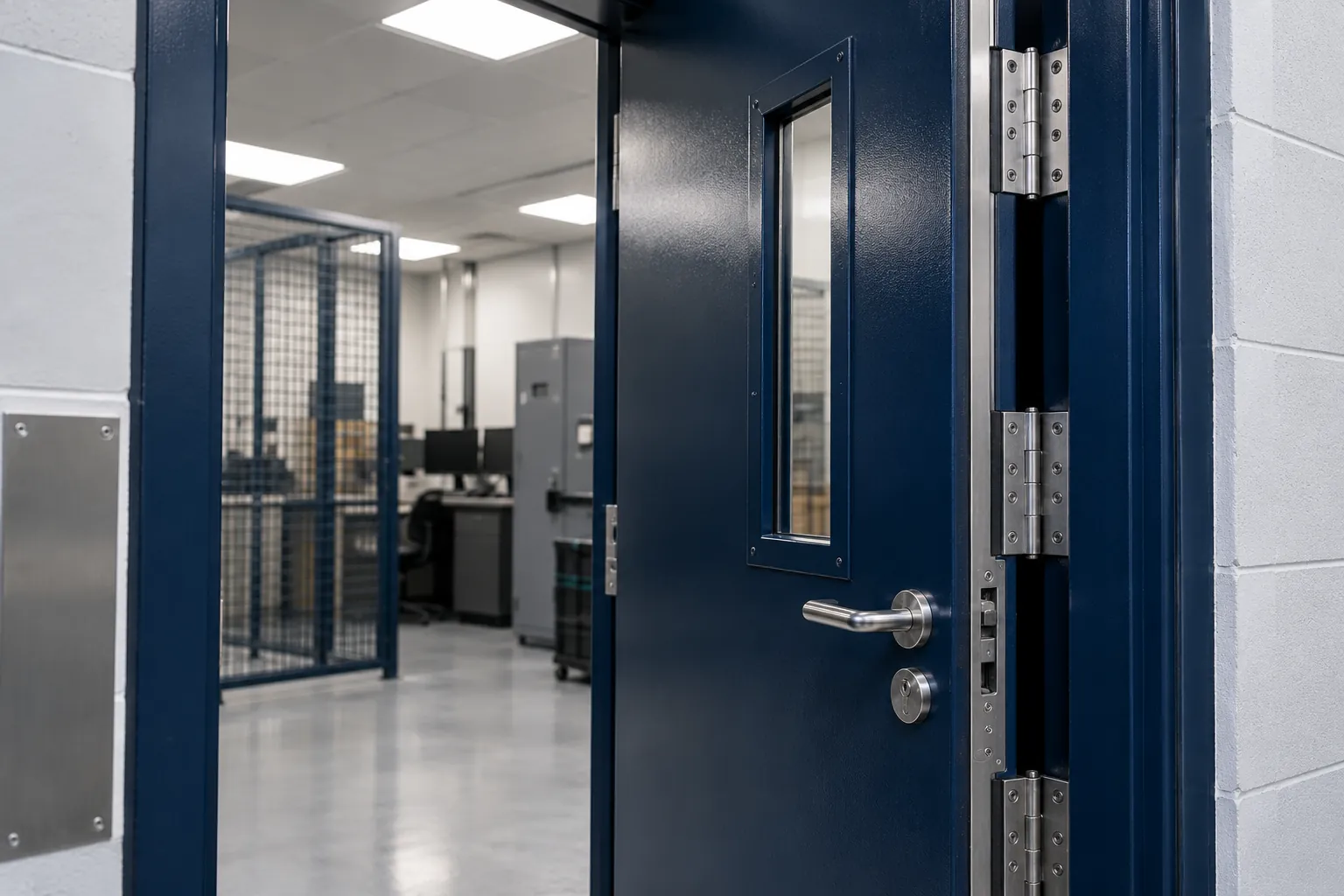
Fire · EI 30 to EI 120
SR3 fire doors
SR3 fire doors combine a C5 forced entry rating to LPS 1175 with a tested fire classification, for UK cash handling rooms and higher risk plant.
- ✓Third-party test evidence with every product
- ✓Written specification you can issue to tender
- ✓Supplied and installed across the UK
Get a free project quote
Rating, written specification and budget range within one working day.
Confidential. No cost, no obligation.
Third-party tested
Evidence with every quote
UK manufactured
Made to your sizes
One accountable team
Specify, supply, install
Confidential handling
Details never shared
An SR3 fire door is a single steel doorset tested to two standards at once: LPS 1175 C5 for forced entry, 5 minutes against category C tools such as crowbars, drills and chisels, and EN 1634-1 for fire resistance. Specifiers use it where cash handling rooms and higher risk plant need attack resistance and fire separation in one door.
- C5 to LPS 11755 minutes against category C tools, Issue 8
- EN 1634-1Fire tested, classed E, EW or EI with minutes
- One doorsetBoth ratings on the same tested assembly
- LPS 1056The LPCB scheme for fire doors
What “SR3 fire door” means on a specification
SR3 is the LPS 1175 Issue 8 name for the C5 rating. It means the doorset resisted 5 minutes of attack with category C tools. That places it above B3, which is SR2 at 3 minutes, and below D10, which is SR4 at 10 minutes. The LPS 1175 ratings page sets out the full scale from A1 to H20.
The fire side is a separate claim. The doorset is tested to EN 1634-1 and classed E for integrity, EW for integrity and radiation, or EI for integrity and insulation, with a time such as 30, 60, 90 or 120 minutes. The fire ratings explained page describes what each class proves.
A door sold as an SR3 fire door must carry test evidence for both halves. A door with a fire certificate but no attack evidence is not an SR3 door. A door with an SR3 attack certificate but no fire test is not a fire door. Ask for both documents before the order is placed.
How the fire test and the attack test fit together
The two tests probe different weaknesses. The fire test checks whether flames, hot gases and heat pass through the doorset. The attack test checks whether an intruder can force a way through with tools. A door can pass one and fail the other, so neither result implies the other.
Both tests are run against the same doorset design: leaf, frame, seals, hinges and locking, built and fixed exactly as specified. The certificates describe that single tested assembly. If any part of the built door differs from the tested design, the evidence no longer covers it.
The minutes are not interchangeable. Five minutes against category C tools says nothing about how long the door holds back fire. An EI60 classification says nothing about forced entry. Keep the two numbers apart in the specification.
Where cash handling and higher risk plant need SR3
Cash handling areas face a determined intruder. Cash rooms, counting areas and bank back-of-house spaces hold value that justifies a planned attack, so SR2 can fall short. Our banking sector page covers these spaces in more detail.
Higher risk plant brings a different mix of threats. Plant rooms, substations and building services areas contain equipment that is costly to replace and disruptive to lose. The utilities sector page covers sites where both security and fire separation matter.
Both settings often sit on compartment lines. A cash room or a plant room is commonly a fire compartment, which means the door needs a fire classification as well as an attack rating. One dual rated doorset answers both requirements, which simplifies the specification and avoids two doors where one will do.
The one-doorset rule: frames, hardware and seals
The rating belongs to the tested doorset, not to its parts. A rated leaf hung in an unrated frame is not a rated door. The frame and the fixings into the wall are all part of the tested assembly.
Every piece of hardware must be the tested type. Hinges, locks, closers, and any viewer in the leaf were present in the test, or the test does not cover them. Swapping the lock, changing the hinges, or drilling a new hole all move the door outside its evidence.
Seals are tested parts. Intumescent, smoke and security seals each sit in a defined position in the tested design. The table below sets out what each half of the dual rating proves.
| What is rated | Test standard | What it proves |
|---|---|---|
| Fire integrity | EN 1634-1, class E | Stops flames and hot gases for the stated minutes |
| Fire integrity and radiation | EN 1634-1, class EW | Also limits heat radiation passing through the door |
| Fire integrity and insulation | EN 1634-1, class EI | Also limits temperature rise on the safe side |
| Forced entry | LPS 1175 Issue 8, C5 (SR3) | 5 minutes against category C tools |
Escape hardware, intumescent seals and thresholds
Escape routes create the hardest conflict. Fire safety wants the door to open fast from the inside with panic or emergency hardware. Security wants it locked against the intruder. The answer is hardware that does both and was part of the tested design. The dual certification guide works through this conflict in more depth.
Panic hardware cannot be added after the event. If the test doorset carried a panic bar, the built door must carry the same type in the same position. Fitting different escape hardware to a certified door voids the evidence for both ratings.
Intumescent seals expand in heat to close the gaps around the leaf. They are sized, positioned and fixed as in the tested design. Painting over them or cutting them back breaks the fire evidence. Check them at handover and at every service visit.
Thresholds deserve the same care. The gap under the door matters for smoke passage and for attack: too large a gap lets smoke through and gives tools a start. The tested threshold detail must be built exactly as tested.
Write both ratings in one line. A door with only a fire certificate is not an SR3 door, and a door with only an attack certificate is not a fire door. One line, two standards, one tested doorset.
Certificates, labels and specification wording
Ask for three things before accepting the door. First, the LPS 1175 listing or certificate showing C5, the Issue 8 name for SR3. Second, the fire test evidence to EN 1634-1 with the exact classification, for example EI60, and the field of application covering your door size. Third, the LPS 1056 scheme listing where used. The labels on the door should match this paperwork.
Know what voids either rating. Changed locks, hinges or closers. New holes drilled for cables or viewers. Vision panels or hardware that were not in the tested design. Damaged or painted intumescent seals. A frame fixed differently from the tested detail. Propping the door open leaves the compartment unprotected whatever the certificate says.
For example: steel doorset, LPS 1175 C5 (SR3) and EI60 to EN 1634-1, supplied as one tested doorset with third-party test evidence; leaf, frame, hardware, seals and fixings as tested; no substitutions without new evidence. The SR2 vs SR3 vs SR4 guide helps you pick the right level before you write that line.
If the project also needs attack rated doors without a fire classification, the SR2 security doors page and the fire doors range cover the neighbouring options. For doors that must carry both ratings, start from the dual rated fire and security doors page.
Is an SR3 fire door tested for fire and attack at the same time?
No. Fire and attack are separate tests run against the same doorset design, to EN 1634-1 and LPS 1175. Both certificates must exist for the door to be described as an SR3 fire door.
What fire classification can an SR3 door carry?
Whatever the tested design achieved: E, EW or EI with minutes such as 30, 60, 90 or 120. There is no fixed pairing between SR3 and a fire class. Check the fire test evidence for the exact classification and the field of application that covers your door size.
Does the 5 minute SR3 rating include fire resistance?
No. The 5 minutes is attack time against category C tools under LPS 1175. It says nothing about fire. Fire performance comes only from the EN 1634-1 classification, stated separately in minutes.
Can I change the lock on an SR3 fire door?
Not without new test evidence. The lock is part of the tested doorset. A different lock changes the cut-outs, the fixings and the way the leaf behaves, so the door falls outside both certificates. Any change needs the test house or certification body to confirm the evidence still applies.
Can SR3 fire doors have panic hardware for escape routes?
Only the panic hardware type that was in the tested design. Escape and security pull in opposite directions, and the tested hardware schedule resolves that conflict. Adding different panic hardware after installation voids both ratings.
What paperwork should I ask the supplier for?
The LPS 1175 listing or certificate showing C5 (SR3), the EN 1634-1 fire test evidence with the exact classification, the LPS 1056 scheme listing where used, and labels on the door that match the paperwork. Keep copies with the building’s fire safety information.
Get a free quote
Related
More in fire rated doors
Ready to specify your project?
Free assessment, written specification and test evidence. Reply within one working day.