
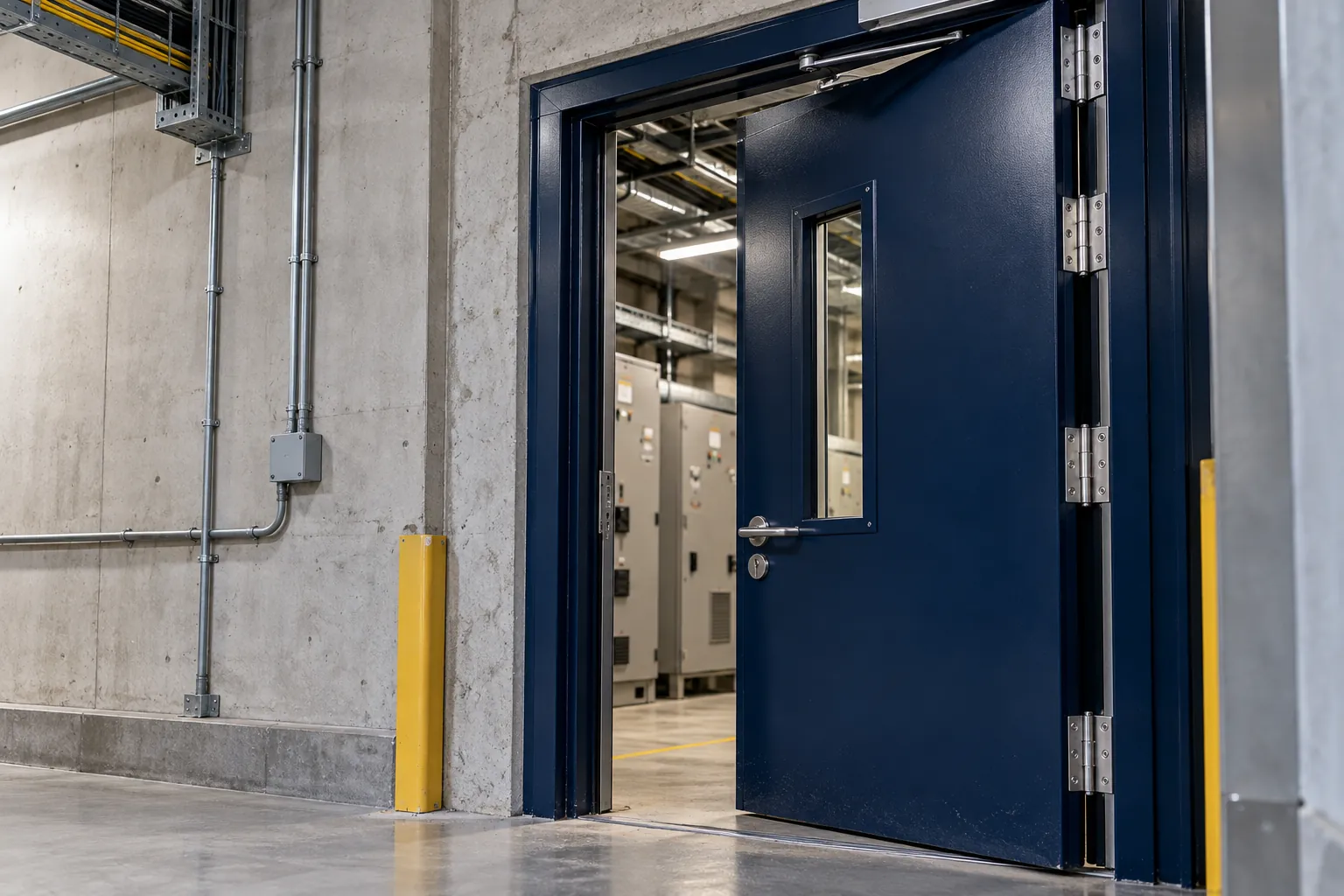
Fire · EI 30 to EI 120
SR4 fire doors
SR4 fire doors pair an LPS 1175 D10 forced entry rating with a tested fire classification in one doorset. Specifier guidance for UK critical sites.
- ✓Third-party test evidence with every product
- ✓Written specification you can issue to tender
- ✓Supplied and installed across the UK
Get a free project quote
Rating, written specification and budget range within one working day.
Confidential. No cost, no obligation.
Third-party tested
Evidence with every quote
UK manufactured
Made to your sizes
One accountable team
Specify, supply, install
Confidential handling
Details never shared
An SR4 fire door is one doorset that carries two tested ratings: SR4 (D10) forced entry resistance to LPS 1175, meaning 10 minutes against category D tools, and a fire classification such as EI60 tested to EN 1634-1. Specifiers choose it for critical infrastructure where attack risk and fire risk meet in the same opening.
- SR4 (D10)10 minutes against category D tools to LPS 1175
- E, EW, EIFire classifications tested to EN 1634-1
- One doorsetBoth ratings from the same tested construction
- Critical sitesPower, water, data and plant rooms
What an SR4 fire door is
An SR4 fire door starts as a security doorset. The SR4 label, also written D10 under LPS 1175 Issue 8, means the complete doorset resisted a 10 minute attack using category D tools such as sledgehammers, disc cutters and jigsaws. That is a high threat level, aimed at experienced and well equipped attackers. The LPS 1175 standard page explains how the tool categories and attack times work.
The same doorset also carries a fire classification. Fire doors are tested to EN 1634-1 and classified as E (integrity), EW (integrity and radiation) or EI (integrity and insulation), with minutes of 30, 60, 90 or 120. Both ratings sit on one certificate schedule for one construction: leaf, frame, seals and ironmongery as tested. The fire ratings guide sets out the classifications in full.
This page covers dual rating at SR4 level only, for sites where SR2 or SR3 would not give enough delay. The SR2 vs SR3 vs SR4 comparison shows where each level fits, and the fire and security doors hub covers the wider range.
Fire classifications on a security doorset: E, EW and EI
The letter tells you what the door proved in the furnace test. E means integrity: flames and hot gases do not pass through for the stated minutes. EW adds a limit on radiated heat, so people can pass closer to the door. EI adds insulation, limiting how hot the unexposed face gets. Each is available at 30, 60, 90 or 120 minutes.
| Classification | What it proves | Minutes | Typical SR4 use |
|---|---|---|---|
| E | Integrity against flames and hot gases | 30, 60, 90, 120 | Escape routes and compartment walls |
| EW | Integrity plus limited radiated heat | 30, 60 | Corridors where people pass near the door |
| EI | Integrity plus insulation of the cool face | 30, 60, 90, 120 | Plant rooms, risers and fuel stores |
The minutes come from the building’s fire strategy, not the security rating. A fire engineer sets whether an opening needs 30, 60 or 120 minutes. The specifier’s job is to confirm those minutes are available on a construction that also holds SR4. Not every SR4 doorset carries every classification, so check the schedule before you specify.
Specifier check. Ask for both certificates against the same doorset reference. A fire certificate for one construction and an SR4 certificate for another does not make a dual rated door.
One doorset, two tests, one construction
Both ratings must belong to the same tested assembly. The attack test and the fire test are separate, but the same construction must have passed both: the same leaf build, frame, seals and ironmongery. The dual certification guide explains how the two test programmes relate.
Mixing and matching is ruled out. A fire rated leaf in an untested frame is not a rated doorset. An SR4 leaf with seals that were never fire tested is not a fire doorset. Even small changes matter: a different lock case, hinge or threshold can sit outside the tested scope and leave you with one rating instead of two.
Vision panels and side panels are only acceptable when they appear in the tested design. If the schedule does not list them for that exact doorset, they cannot be added while keeping both ratings.
Where critical infrastructure uses SR4 fire doors
SR4 fire doors sit where determined attackers, valuable or hazardous contents, and slow response times overlap. Substations and switching stations are a clear case: equipment whose loss has wide effects, often unmanned for long periods. The utilities sector page covers the threat picture for power and water sites, including treatment works and pumping stations with control systems that must keep running.
Data centres use them on plant and cooling equipment rooms and on service entrances, where a breach could reach the systems behind the halls. The data centres sector page explains the layers around those rooms. Transport infrastructure uses them on plant rooms, signalling accommodation and depots; the transport hubs sector page covers that mix of public safety and asset protection.
There are limits. SR4 is not the default for ordinary commercial or communal buildings; the SR2 fire door page covers that level, and cash handling and higher risk plant usually sit at SR3, covered on the SR3 fire door page. Specify SR4 where the threat assessment names experienced attackers and the fire strategy marks the opening as a compartment line.
Escape hardware and the security conflict
Doors on escape routes must open easily from the inside, usually with panic or emergency hardware. That sits in tension with SR4, which is about keeping people out. The conflict is resolved in the test programme: the panic or emergency device must be the exact device in the tested doorset, fitted as tested. The schedule names which devices keep both ratings.
An untested device fitted after the fact can weaken the leaf at the fixing points, change how the door latches, or introduce a release the attack test never saw. If the schedule lists a specific panic device, that device fitted to the tested detail is the only one that keeps the dual rating. The same applies to electrified hardware: readers, strikes and cabling must be within the tested scope, so raise them at specification stage.
Seals, thresholds and ironmongery that protect both ratings
Intumescent seals expand in heat to close the gap between leaf and frame, holding back flames and smoke. The same gaps matter for security: oversize gaps give tools a start. The tested doorset defines the gap tolerances that satisfy both, and installation must achieve them on site.
Thresholds need equal care. Fire performance wants controlled, even gaps at the sill; security wants no weak point at the base of the door. Some tested designs use a specific threshold or drop seal, and substituting a generic one can undo both ratings. Hinges, locks, bolts and closers must be the tested items with the tested fixings. A closer that fails to shut the door fully leaves both the fire line and the security line open.
Certificates, labels, specification wording and what voids a rating
Ask for two things against one doorset reference: the LPS 1175 certificate or schedule naming D10 (SR4), and the fire test evidence to EN 1634-1 naming the classification and minutes, for example EI60. Fire doors under the LPCB scheme appear on LPS 1056 listings. Each door should carry its labels, and the schedule should describe the permitted sizes, configurations, seals and ironmongery.
Write the specification around the schedule: name the SR4 rating, the fire classification and minutes, the exact ironmongery and seals, and require that labels stay on the door. Ask the supplier to confirm in writing that the quoted doorset matches the tested reference, including handing, leaf sizes and any vision panels.
Several things void one or both ratings after installation: trimming the leaf, swapping ironmongery for untested items, fitting the wrong seals, gaps outside tolerance, and damage from impact or corrosion. Planned maintenance and inspection keep both ratings alive: check closing action, seal condition, label legibility and hardware fixings on a schedule, and record the findings.
Can one doorset really carry both an SR4 rating and a fire rating?
Yes, when the same construction has passed both test programmes. The LPS 1175 attack test proves the 10 minute forced entry resistance, and the EN 1634-1 furnace test proves the fire classification. Ask for both certificates against the same doorset reference; two certificates for two different constructions do not make a dual rated door.
Which fire classification should I pair with SR4?
It depends on the building’s fire strategy. Escape routes usually need E as a minimum, plant rooms and fuel stores often need EI, and EW suits corridors where people pass close to the door. The minutes, 30 to 120, come from the compartmentation design. A fire engineer should set the classification; your check is that it is available on an SR4 tested construction.
Does fitting a panic bar cancel the SR4 rating?
It does if the panic device was never tested on that doorset. The schedule names the exact panic or emergency hardware that keeps both ratings, fitted as tested. Any other device, or the same device fitted differently, sits outside the tested scope and can void the security rating, the fire rating, or both.
What is the difference between E, EW and EI?
E proves integrity: flames and hot gases are held back for the stated minutes. EW adds a limit on the heat radiated from the door face. EI adds insulation, limiting how hot the unexposed face gets. All three are tested to EN 1634-1 and available at 30, 60, 90 or 120 minutes.
What voids the ratings after the door is installed?
Trimming the leaf, changing ironmongery to untested items, fitting the wrong seals, gaps outside the tested tolerance, and damage from impact or corrosion. Even a well specified doorset loses its ratings if site changes ignore the certificate schedule, so check every alteration against the schedule first.
Do I need SR4, or would SR2 be enough?
SR4 suits critical infrastructure where the threat assessment names experienced, well equipped attackers and response times are slow. Ordinary commercial and communal buildings rarely need that delay; the SR2 fire door page covers the lower level, and higher risk plant usually sits at SR3. Match the rating to the assessed threat, not to the highest number available.
Get a free quote
Related
More in fire rated doors
Ready to specify your project?
Free assessment, written specification and test evidence. Reply within one working day.