
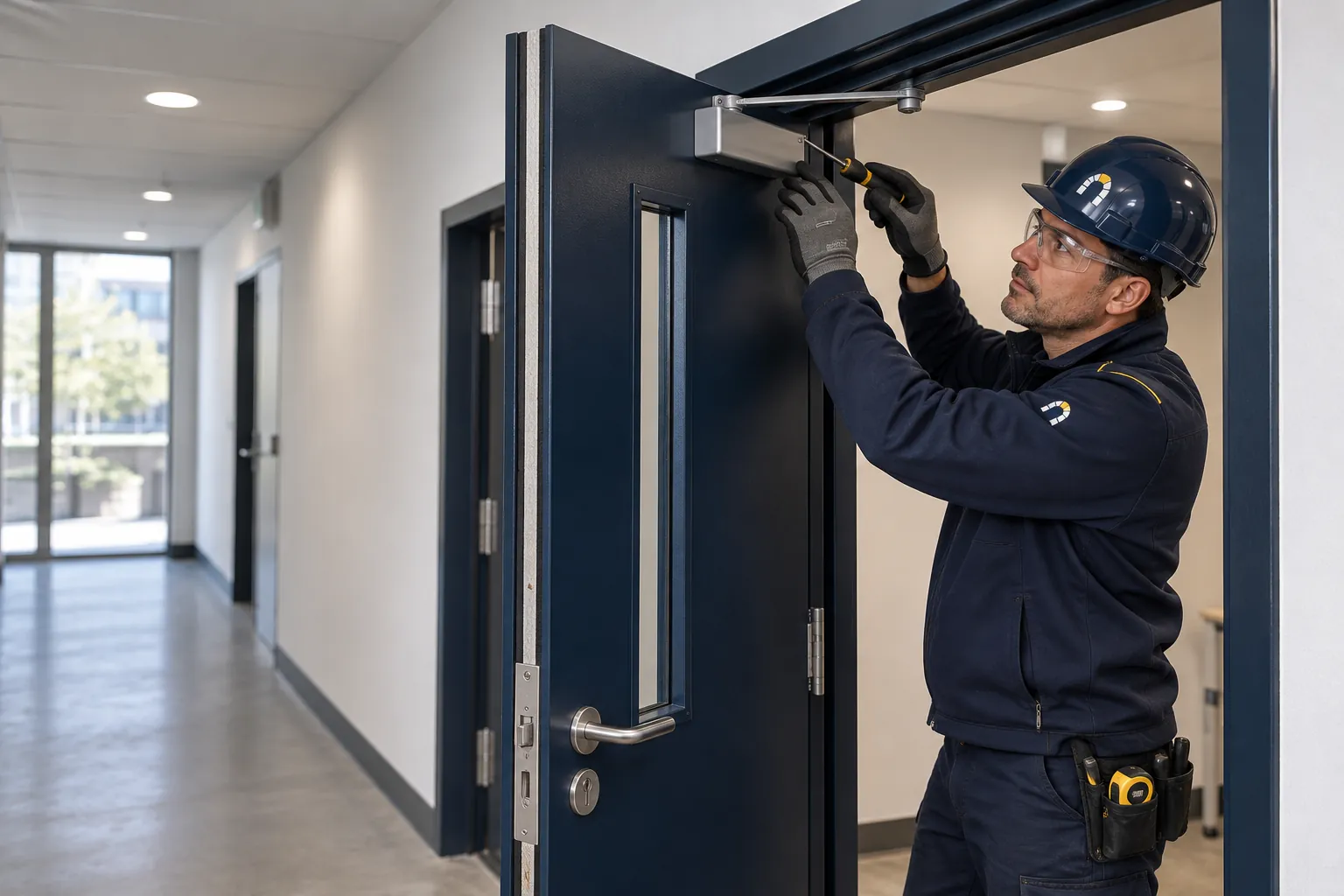
Fire · EI 30 to EI 120
SR2 fire doors
SR2 fire doors: LPS 1175 B3 forced entry resistance plus a tested EN 1634-1 fire rating for UK commercial buildings, and what voids either rating.
- ✓Third-party test evidence with every product
- ✓Written specification you can issue to tender
- ✓Supplied and installed across the UK
Get a free project quote
Rating, written specification and budget range within one working day.
Confidential. No cost, no obligation.
Third-party tested
Evidence with every quote
UK manufactured
Made to your sizes
One accountable team
Specify, supply, install
Confidential handling
Details never shared
An SR2 fire door is a steel doorset tested to two standards at once: LPS 1175 SR2 (B3) for forced entry and EN 1634-1 for fire resistance. One doorset carries both ratings. It suits commercial and communal buildings where a door must hold back an attacker and hold back fire.
- SR2 = B33 minutes against category B tools
- E, EW or EIFire ratings from 30 to 120 minutes
- EN 1634-1The fire resistance test standard
- One doorsetBoth ratings on the same tested assembly
What an SR2 fire door is
A security door and a fire door solve different problems. A security door resists attack. A fire door resists fire. An SR2 fire door does both, because the same doorset has passed both test programmes. Our fire and security doors range follows the same principle: one assembly, two jobs.
The rule that matters most is the same construction rule. The leaf, frame, seals, glazing and hardware are tested together as one assembly. You cannot take an SR2 leaf, hang it in an ordinary frame, add fire seals afterwards and call the result an SR2 fire door. The certificate names the exact construction that passed, and anything outside that construction is not covered.
Under LPS 1175 Issue 8, SR2 is the B3 rating: 3 minutes of attack with category B tools such as screwdrivers, pliers and hand saws, the step above SR1 in the LPS 1175 standard. The fire side is tested to EN 1634-1 and classified E, EW or EI, as our fire ratings guide explains.
Fire ratings on a security doorset: E, EW and EI
Fire classification tells you what the doorset does in a fire and for how long. The three classes used with security doorsets are:
| Classification | What it measures | Minutes |
|---|---|---|
| E | Integrity: flames and hot gases do not pass through | 30, 60, 90, 120 |
| EW | Integrity plus limits on radiated heat through the door | 30, 60, 90, 120 |
| EI | Integrity plus insulation: the unexposed face stays below set temperatures | 30, 60, 90, 120 |
Most SR2 fire doors on the UK market carry E or EI ratings. E keeps flames and gases back. EI also keeps the cold face cool enough that stored goods or people on the other side are protected from heat. EW sits between the two and is less common on steel doorsets. Your fire strategy decides which class you need, so confirm it before you specify.
The two ratings are separate results from separate tests on the same construction. Passing the attack test does not pass the fire test, and a fire upgrade does not keep the SR2 result on its own. Only the tested combination counts.
Where SR2 fire doors suit commercial and communal buildings
This is the natural level for busy commercial and communal buildings: offices, retail back of house areas, plant and riser rooms, corridors and stairwells in apartment blocks, schools and healthcare service areas. These doors sit on escape routes or compartment lines and face a real but not extreme attack risk. Our shared entrance security guide applies the same thinking to shared residential entrances.
SR2 fits where SR1, roughly the PAS 24 level for homes, is not enough. A determined intruder with hand tools is the threat here, not an opportunist with a screwdriver. The B3 tool set, screwdrivers, pliers and hand saws worked for 3 minutes, matches that threat without the weight and cost of higher ratings.
There are clear limits. Cash handling rooms, server halls with high value kit and critical plant usually need SR3 fire doors, which step up to C5: 5 minutes against crowbars, drills and chisels. Critical infrastructure goes further to SR4 fire doors at D10. If the threat includes stealth attack with quiet tools, that is a different standard, LPS 2081, not LPS 1175. And an SR2 fire door is not a blast resistant door; fire and forced entry cover two threats, not every threat. The SR2 vs SR3 vs SR4 guide compares the three levels side by side.
Escape hardware: the conflict you must resolve
Here is the genuine tension in this product. Security locking wants to keep people out. Escape hardware must let people out fast. On any door that sits on an escape route, the escape function wins, and the hardware fitted must still be the hardware that was tested.
Panic hardware and emergency exit hardware release the door with a push, while a multipoint security lock engages at several points around the leaf. These two ideas pull in opposite directions. The tested doorset resolves the conflict in one specific way, with named hardware in a named configuration. Fit a different lock, a different panic bar or an extra bolt afterwards, and you have left the tested design. Both ratings are then in doubt.
Access control adds a second layer to check. Electric strikes, magnetic locks and intercom release all interact with both performances, so include them in the specification from the start. If your door needs escape and access control together, say so in the enquiry, not after the door is made.
Ask for both certificates. One certificate for LPS 1175 SR2 and one for the fire classification, both naming the exact doorset, size range and hardware. A door with only one of the two is not an SR2 fire door.
Seals, thresholds, glazing and installation
Small parts decide whether the ratings survive in the real building. Intumescent seals sit in the frame or leaf edge and expand in heat to close the gaps that fire would exploit. Cold smoke seals stop smoke at lower temperatures, before the intumescent activates. Both must be the tested type in the tested position.
Thresholds matter for both ratings. A large gap under the door leaks fire and smoke, and it gives an attacker a starting point for tools. The tested doorset includes a tested threshold detail, so do not swap it for a generic strip on site.
Vision panels are only acceptable if the exact glazing was tested in that doorset. Fire rated glazing and attack resistance are separate properties. Anything cut into the leaf changes the tested construction.
Installation is part of the rating. The frame must be fixed to the structure as tested, gaps packed with tested materials, and the door commissioned with its seals, closer and hardware working together. A perfect doorset fitted badly performs badly. Use an experienced installation team and keep the handover documents with the building records.
A rated door only performs if it is checked and maintained. Our fire door inspection checklist walks through what to look at on every door, from gaps to seals to labels.
Certificates, labels and specification wording
Ask the supplier for three things before you order. First, the LPS 1175 certificate showing SR2, ideally naming the B3 Issue 8 rating. Second, the fire test evidence to EN 1634-1 showing the E, EW or EI classification and minutes, within the LPS 1056 scheme. Third, confirmation that the exact size, configuration and hardware you are buying fall inside the certificated scope. Keep copies with the building fire safety information.
Several things void one or both ratings: swapping the lock or hinges for untested equivalents, cutting the leaf, removing or painting over intumescent seals, propping the door open, and unrepaired damage to leaf or frame. Ratings do not expire on a date, but wear is real, so a maintenance routine keeps both ratings meaningful. See our guide to keeping an LPS 1175 rating valid.
For the specification itself, name both standards and the exact performance. A wording that works:
Supply and install steel doorset tested and certified to LPS 1175 SR2 (B3) and to EN 1634-1 achieving [state E, EW or EI and minutes], with the tested frame, seals, threshold and hardware, labelled and installed to the certificated design.
Fill in the bracket with the classification your fire strategy needs, and send the same wording to every bidder. For background see our dual certification guide and the wider fire doors range. Related options: fire rated steel doors, SR2 security doors and thermally broken doors. Typical sectors: retail, education and healthcare.
Can an SR2 fire door be used as an external door?
Yes, if the tested scope covers external use. External positions add weather, thermal and corrosion demands on top of fire and security, so check the certificate and consider a thermally broken option for exposed locations.
Does adding a fire rating weaken the security rating?
Not when the doorset is designed for both. The two ratings come from separate tests on the same construction. Problems only arise when fire parts are added to a security doorset afterwards without testing, which is why the certificate must show the combined construction.
Can I change the lock after the door is installed?
Only to hardware named in the test evidence. The lock, hinges, closer and escape hardware are part of the tested assembly. An untested swap can void both the LPS 1175 rating and the fire classification.
What is the difference between E, EW and EI?
E means the door keeps its integrity, so flames and hot gases do not pass, for the stated minutes. EW adds limits on radiated heat through the door. EI adds insulation, so the unexposed face stays below set temperatures. All three are tested to EN 1634-1.
When should I specify SR3 instead of SR2?
Choose SR3 where the threat or the insurer demands more: cash handling, high value plant and rooms where a 3 minute, category B attack is not enough. SR3 steps up to C5, which is 5 minutes against crowbars, drills and chisels. Compare the levels in our SR2 vs SR3 vs SR4 guide.
Do SR2 fire doors need special maintenance?
They need the same checks as any fire door plus attention to the security hardware: seals intact, closer working, no damage to leaf or frame, hardware operating as tested. Record the checks, since the fire safety records for the building should show the doors are maintained.
Get a free quote
Related
More in fire rated doors
Where we supply SR2 fire doors
Pick your area to see how we specify and supply SR2 fire doors for the buildings there.
Ready to specify your project?
Free assessment, written specification and test evidence. Reply within one working day.