
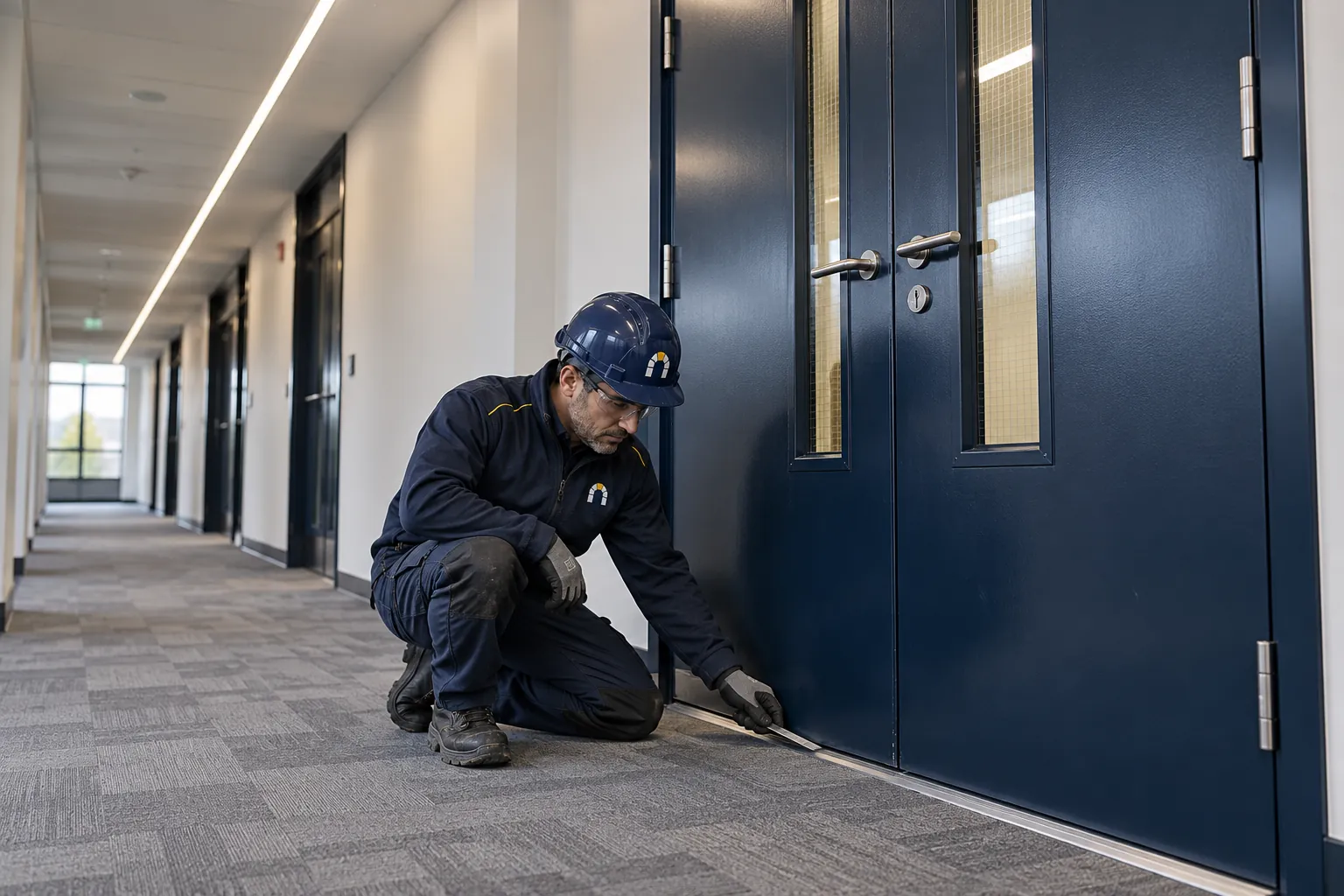
Fire · EI 30 to EI 120
Fire rated steel doors in Portsmouth
Fire rated steel doors in Portsmouth for the naval base, the port, the hospital and the campus, in E, EW and EI classes from 30 to 120 minutes.
- ✓Third-party test evidence with every product
- ✓Written specification you can issue to tender
- ✓Supplied and installed in Portsmouth
Get a free quote in Portsmouth
Rating, written specification and budget range within one working day.
Confidential. No cost, no obligation.
Third-party tested
Evidence with every quote
UK manufactured
Made to your sizes
One accountable team
Specify, supply, install
Confidential handling
Details never shared
Supplied and installed in Portsmouth
What we supply in Portsmouth
Portsmouth stands on the harbour edge, mixing naval workshops, a working port, a university campus, a large hospital and visitor sites. A buyer who orders fire rated steel doors for a Portsmouth building wants a leaf that keeps flame and smoke out for a stated run of minutes, so people reach safety and crews reach the fire. The class on the paper names how long the leaf holds, how much heat moves through it, and whether smoke is stopped as well.
That class covers the whole doorset at once, leaf and frame and seals and closer tested as one unit. The fire rated steel doors page lists the range itself, and the security doors in Portsmouth page covers the wider city picture.
Where Portsmouth buildings use steel fire doors
Queen Alexandra Hospital holds the clearest case. Ward, corridor and plant room doors there must hold their class while patients and kit move through the building with staff, with seals and closers working on an ordinary day as well as a test day. For wards, corridors and plant rooms, see the fire door regulations for hospitals guide, and the checks that keep each door working after handover sit in the fire door maintenance guide.
Workshops and stores at HM Naval Base Portsmouth sit beside visitor routes at the Historic Dockyard, where HMS Victory and the Mary Rose Museum draw crowds. A door on such a route has to shut firm while visitors pass through all day. Galleries and visitor routes sit in the fire door regulations for museums guide, while the working side of the harbour is dealt with in the fire door regulations for ports guide.
Portsmouth International Port moves passengers and freight through terminals where public, staff and service flows meet, the University of Portsmouth runs lecture blocks, laboratories and student rooms around the city centre, and Gunwharf Quays with the Spinnaker Tower beside it mixes shops and restaurants. Portsmouth Cathedral and Southsea add quieter buildings with the same duty, and Fratton Park holds crowds on match days. Terminals and passenger routes are dealt with in the transport hub security requirements guide, campus doorsets get their own treatment in the university security doors guide, and crowd venues are covered in the fire door regulations for stadiums guide.
Fire classes E, EW and EI, and the minutes behind them
Each letter names a different job. E asks the leaf to hold flame and hot gas back for a stated time. EW puts a limit on heat radiated through the leaf. EI puts a limit on the heat of the far face. A low risk office opening may take 30 minutes; a stair core or a plant room may take 120. The fire plan fixes each class opening by opening, and each one goes on the written paper.
The fire test acknowledges BS EN 1634-1:2014+A1:2018 governing E, EW and EI classes and the furnace run of a complete doorset with every part fitted. Leaf, frame, seals and hardware are named in the papers as a single tested unit, so swapping any part wants fresh papers or a written assessment, and the furnace test and the classes behind it are laid out on the fire ratings page. How compartments and doors are planned together is laid out in the fire compartmentation guide.
Smoke seals sit beside the intumescent strip. In heat the strip swells and closes the gap round the leaf edge, while a smoke seal holds back the smoke that moves before the flame arrives. Strip, position and size are laid out in the intumescent seals guide, and the closer that shuts the leaf after every pass is dealt with in the fire door closers guide.
Reading a Portsmouth door schedule
Read the rows as a rough guide. Each opening takes a class from its own risk check, confirmed at survey before pricing.
| Portsmouth building | Door position | Class to name | Also named |
|---|---|---|---|
| Queen Alexandra Hospital | Wards, corridors, plant rooms | EI 60 to EI 120 | Seals, closer, smoke seals |
| HM Naval Base Portsmouth | Workshops, stores, service routes | EI 60 | Closer, seals, lock |
| Historic Dockyard | Galleries, visitor routes, stores | EI 30 to EI 60 | Closer, smoke seals, vision panel |
| Portsmouth International Port | Terminals, passenger routes | EI 60 | Hold open device, seals |
| University of Portsmouth | Lecture rooms, laboratories, student rooms | EI 30 or EI 60 | Closer, seals, ironmongery |
| Gunwharf Quays and Fratton Park | Stair cores, retail units, crowd routes | EI 30 to EI 60 | Closer, seals, reader |
Writing the specification for a Portsmouth order
Begin with the door list. For each opening, note the measured size and the wall build, name the class and the ironmongery, and file the papers for the quoted class alongside the order. A door ordered without its evidence risks a failed handover, so look at the evidence first. What buyer and maker put in writing before an order is placed is laid out in the how to specify security doors pages, and which papers to ask for appears in the fire door certification guide.
The specification addresses LPS 1175 Issue 8.2 (September 2024) weighing the forced entry tool set against the fire class on the same doorset. The scale runs SR1 with tool set A1 for 1 minute, SR2 with B3 for 3 minutes, SR3 with C5 for 5 minutes, and SR4 with D10 for 10 minutes. Glazing beside the leaf carries a class of its own, fixed by LPS 1270 Issue 1.1 (2014); the classes are on the LPS 1270 standard page, and a doorset that pairs a fire class with a forced entry grade gets its own treatment in the fire and security doors dual certification pages. The forced entry classes are given on the LPS 1175 standard page, and a higher grade doorset may pair with LPS 2081 Issue 1.1 (2016) where the opening asks for it.
Access shapes the hardware as much as fire does. Under Approved Document M, the push through the first 30 degrees stays below 30 N, and after that point it stays below 22.5 N, so the closer is tuned to shut the leaf firm yet keep the door easy to open. The Approved Document M access guide lists the figures to check, what decides the price of a doorset is explained in the fire door cost factors page, and why a steel leaf suits a hard used opening is explained in the steel versus timber fire doors page.
How a Portsmouth order moves from survey to fitting
The order moves in five steps. Survey comes first, with every opening measured by hand and wall, reveal and room use noted. Rating comes next, with the class fixed by the fire plan. The written specification follows, naming size, class, seals and hardware for every door. Supply follows the paper, each doorset made to the survey sizes. Install follows on site, frames set square and level, leaves hung with closers fitted. The manufacture service makes each doorset to the paper, and the installation service fits it.
At handover the pack names class, seals and hardware for each opening, and the gaps round each leaf are measured against the figures in the fire door gaps guide. After fitting, a regular check of seals, closers and frame fixings keeps the door working, and a knocked door is checked straight away.
Prices are worked out at the Romford bureau: Saffron Road, Romford, Essex RM5 3ES. The list goes to [email protected] for prices, and the reply comes inside one working day, naming class and price for each opening in the reply.
Get the test paper naming the class on your order, and match the class on the paper against the specification. A leaf called only strong has no test to check at handover.
Questions Portsmouth buyers ask
Which class fits a ward door at Queen Alexandra Hospital?
The fire plan fixes it. Ward, corridor and plant room doors often take EI 60 or EI 120, while a low risk office door often takes EI 30.
Can a Portsmouth fire door also hold against forced entry?
Yes, when a single doorset has passed both tests. Leaf, frame and hardware face the named tool set as one doorset, and both ratings are written in the paper, evidence beside each.
When should the seals on a Portsmouth fire door be changed?
Check the seals at each inspection and swap any seal that is torn, worn, loose or split at the leaf edge. A worn seal goes before it fails.
How long does a Portsmouth order take from survey to fitting?
An answer to the enquiry comes back inside one working day. The specification is drawn up after the survey, and fitting is booked once the sizes are confirmed.
Planning fire rated steel doors for a Portsmouth building?
Send the door list with the class for each opening. The reply names a tested doorset for every opening. Get a free quote and a survey follows.
Other areas
Fire rated steel doors in other areas
Ready to specify your project?
Free assessment, written specification and test evidence. Reply within one working day.