
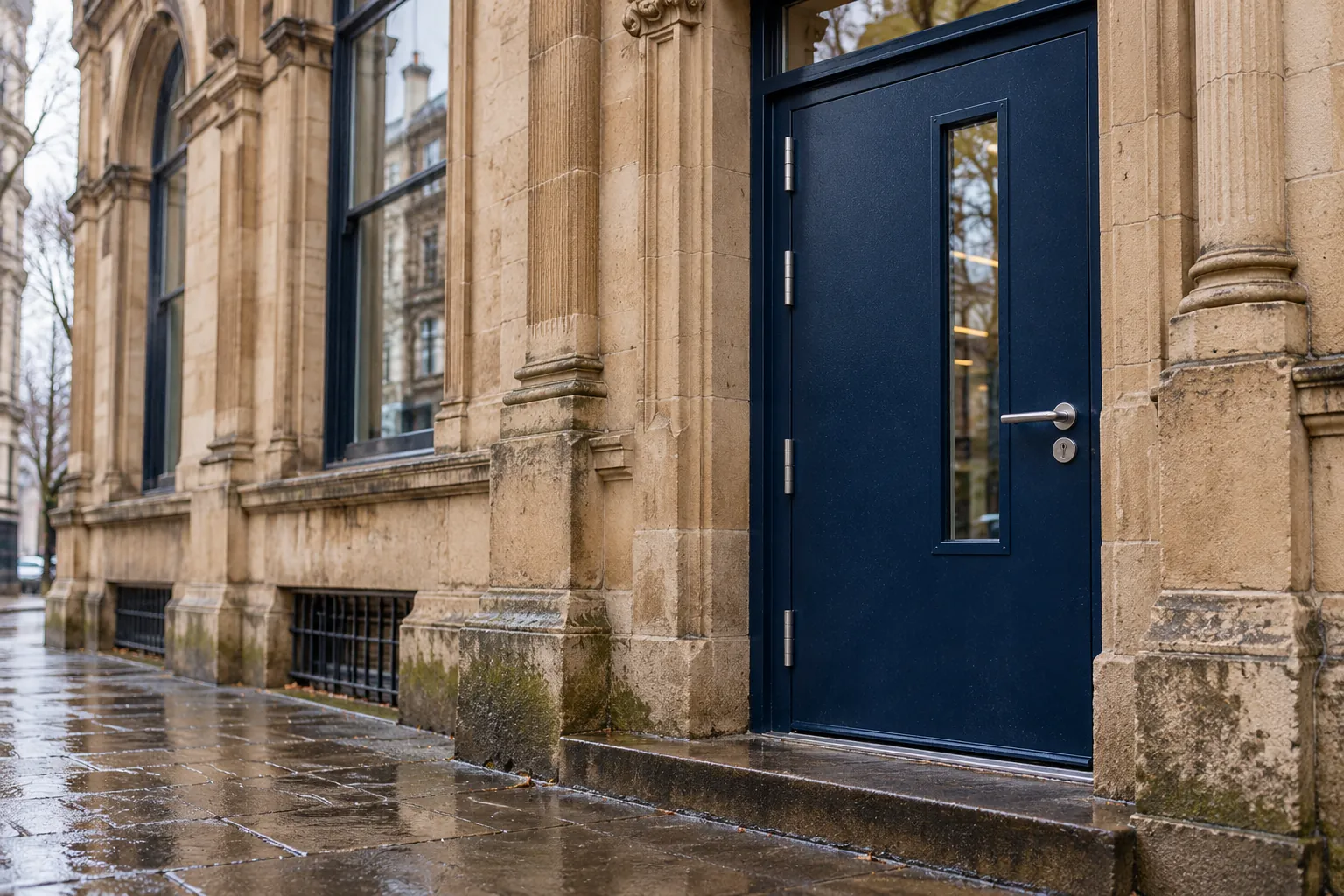
Fire · EI 30 to EI 120
Fire Rated Steel Doors in Glasgow
Fire rated steel doors in Glasgow, classes E, EW and EI from 30 to 120 minutes, with intumescent seals, hardware and test evidence for each door.
- ✓Third-party test evidence with every product
- ✓Written specification you can issue to tender
- ✓Supplied and installed in Glasgow
Get a free quote in Glasgow
Rating, written specification and budget range within one working day.
Confidential. No cost, no obligation.
Third-party tested
Evidence with every quote
UK manufactured
Made to your sizes
One accountable team
Specify, supply, install
Confidential handling
Details never shared
Supplied and installed in Glasgow
What we supply in Glasgow
Fire rated steel doors in Glasgow protect the routes people use to leave a building and the compartments that hold fire back while they do it. A steel leaf holds its shape in heat, and the frame, seals and hardware work with it to keep flame and hot gas on one side for the rated time. The doors suit hospitals, schools, offices, shops, warehouses and blocks of flats, and each door is named with the class it was tested to, so the buyer knows what the door was built to do.
The three classes are E, EW and EI, and the number beside them is the time in minutes, from 30 to 120. E holds back flame and hot gas. EW adds a limit on the heat that passes through the leaf. EI adds insulation, so the face of the door stays cool enough to touch for the rated time. Our Fire Rated Steel Doors page lists the classes and the hardware that goes with them, and the survey for a Glasgow site starts by matching each opening to the class the building needs.
Where Glasgow buildings need fire rated steel doors
Hospitals need fire rated steel doors on ward corridors, stair cores, plant rooms and stores where a fire must not spread while patients are moved. Glasgow Royal Infirmary holds long corridors and many doors. Queen Elizabeth University Hospital holds the same mix, and each door on a compartment line has to carry the right class for that wall. A door on a ward corridor also needs a vision panel at the right height, a closer that staff can manage with a trolley, and a lock that keeps the room secure without blocking escape.
Schools and colleges across Glasgow need the same doors on stairwells, corridors and rooms that hold large numbers of people. A classroom corridor door must close on its own after every use, and the design has to allow for the daily traffic of pupils and staff. The fire door regulations for hospitals guide covers the rules that shape hospital doors, and the fire ratings standard page describes the classes and what each one measures.
The SEC Centre, Glasgow Airport and the shopping streets around Buchanan Street and Buchanan Galleries all hold crowds, and their fire doors must work under heavy use. A door at an exhibition hall entrance sees heavy traffic all day, so the hinges, closer and seals are chosen for that traffic, not for a quiet office. The city wide picture sits on our page on physical security in Glasgow, and the fire compartmentation guide describes how doors, walls and floors form the compartments that hold a fire in one place.
Fire classes and test evidence
Each fire class is proved in a furnace test that BS EN 1634-1:2014+A1:2018 spells out in full, with integrity and insulation measured in minutes. A test report names the door set, the frame, the seals and the hardware that were tested together, and a door supplied to a different build needs its own evidence. We ask for the test evidence before an order is placed, and the specification names the evidence for each door so the buyer can check it at handover.
Intumescent seals sit in the leaf or the frame and swell in heat to close the gap around the door. The seal type, the gap size and the closer strength all work together, and changing one without checking the others can break the rating. Our guide on intumescent seals covers the seal types and the gaps they close, and the guide on fire door certification covers the papers that prove a door set was tested as supplied.
Some Glasgow doors need both ratings on the same leaf, fire and forced entry together. A combined rating is written after LPS 1175 Issue 8.2 (September 2024) assigns the forced entry rating beside the fire rating on the same door set, so both classes appear in one specification line. The LPS 1175 standard page holds the four forced entry ratings in full, and the door set must be tested for both ratings with the same hardware in place.
Use the table to match a fire class to the part of the building it protects.
| Class | What it holds back | Common use in Glasgow |
|---|---|---|
| E 30 | Flame and hot gas for 30 minutes | Corridor doors in offices and shops |
| E 60 | Flame and hot gas for 60 minutes | Stair core doors in schools and flats |
| EI 30 | Flame, hot gas and heat for 30 minutes | Ward corridor and plant room doors |
| EI 60 | Flame, hot gas and heat for 60 minutes | Compartment walls in hospitals |
| EI 120 | Flame, hot gas and heat for 120 minutes | High risk plant and store rooms |
Choosing the right door for each Glasgow site
A hospital ward door needs a vision panel, a closer that works with trolleys, and a leaf that can be cleaned often. A school stair door needs a closer that survives daily use and a leaf that resists knocks. A warehouse door needs a wide leaf for forklifts and a frame that can take the impact of a pallet. The class is only one part of the choice, and the hardware and the finish matter as much as the number beside it.
Where a door must resist forced entry as well as fire, the leaf, frame and lock are chosen together. The checks that keep both ratings in place after fitting are described in the guide titled keeping dual certified fire security doors valid. We name both ratings on the order, and the handover papers list the evidence for each one.
Retail and leisure buildings around Buchanan Street, Buchanan Galleries and the SEC Centre need doors that close quietly and hold their rating under constant use. A shop stock room door, a cinema exit door and a restaurant kitchen door all carry different classes, and the specification for each one names the class, the closer and the seal.
How a Glasgow order runs from specification to fitting
An order starts with a survey of the openings. We measure each leaf and frame, note the wall build up, and record the class each wall needs. The specification then lists every door with its class, its size, its hardware and its finish, and the price is based on that list. Any opening that needs a change to the wall is marked on the drawings before manufacture, so the fitting team arrives with the right frame.
A frame that is out of square will leave a gap that no seal can close. The seal line is tested before the leaf is hung. Glasgow buyers receive the test evidence and the handover papers with the doors, and the papers name the class, seal and hardware of every opening.
After fitting, each door is checked for closing, latching and gap size, and the results go into the handover record. A door that does not latch will not hold back fire, and a gap wider than the seal allows will let hot gas through.
Order the survey before the doors. A class written on an order means little if the opening was never measured, and a measured opening gives a door that fits, closes and latches first time.
Questions Glasgow buyers ask about fire rated steel doors
What fire class do I need for my building?
The class depends on the wall the door sits in and the use of the rooms on each side. A corridor door in an office often needs E 30, a stair door in a school often needs E 60, and a hospital compartment wall often needs EI 60. We match the door to the class named for that wall.
Can a steel fire door also resist forced entry?
Yes. A steel leaf can carry both ratings at the same time, and the specification names each rating on the same line. The door set must be tested for both ratings with the same hardware in place, and the handover papers must list the evidence for each rating.
Do fire doors need intumescent seals?
Most rated steel doors need them. The seals swell in heat and close the gap around the leaf, and the gap size, the seal type and the closer strength are chosen together. A door fitted without the seals named in its test evidence may not hold its class, so the specification lists the seals for each door.
How often should fire doors be checked?
Check them at set gaps through the year, and keep a written note of each check. A check looks at closing, latching, gaps, seals, hinges and the closer, and any fault goes on a list for repair. A planned maintenance visit can carry those checks across a whole site.
Ask for fire rated steel doors in Glasgow and get a specification with the class, seals and evidence for each opening.
Send the door sizes and the fire class you need to [email protected], and a reply comes inside one working day. A short list of openings is enough to start, and we will ask for the rest on the survey.
Other areas
Fire rated steel doors in other areas
Ready to specify your project?
Free assessment, written specification and test evidence. Reply within one working day.