
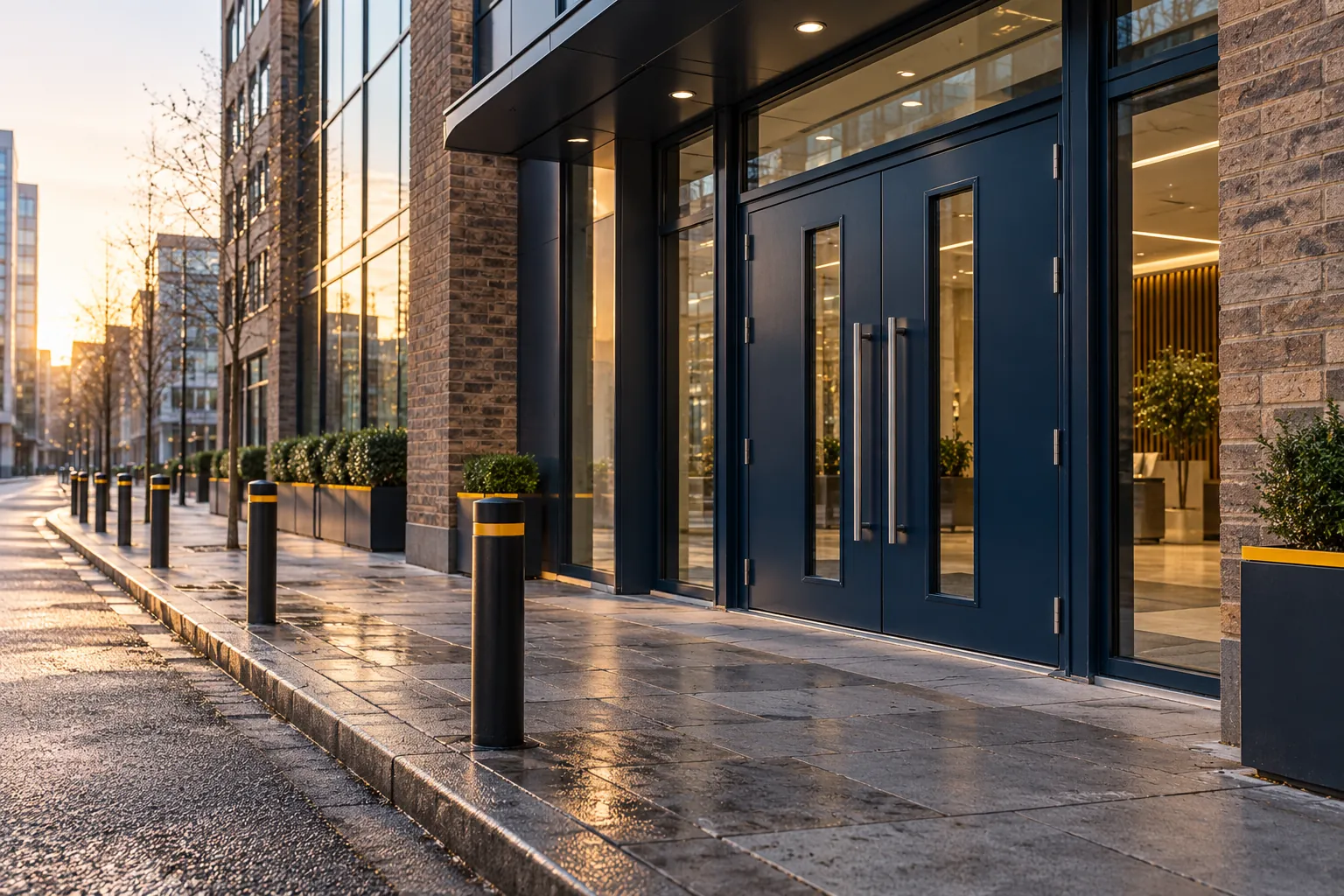
Blast · ISO 16933 EXV45 to EXV10
Blast Resistant Doors in London
Blast resistant doors for London government, offices, stations and venues, specified to ISO 16933 with written evidence and a reply in one working day.
- ✓Third-party test evidence with every product
- ✓Written specification you can issue to tender
- ✓Supplied and installed in London
Get a free quote in London
Rating, written specification and budget range within one working day.
Confidential. No cost, no obligation.
Third-party tested
Evidence with every quote
UK manufactured
Made to your sizes
One accountable team
Specify, supply, install
Confidential handling
Details never shared
Supplied and installed in London
What we supply in London
A blast resistant door in London guards an opening that stands close to traffic. Entrances that face the street, yards where deliveries arrive and plant rooms beside a vehicle route all need a doorset that can take the force of a blast and stay in its frame. Whitehall departments, Square Mile offices, Canary Wharf towers, mainline stations, stadiums, hospitals and universities all hold such openings, and many of them open straight onto roads, delivery bays and forecourts.
Demand follows the shape of the city. Departments and courts around Westminster, banks in the Square Mile, towers in Docklands, hotels in the West End, museums in South Kensington and hospitals along the Thames each hold doors that stand between the street and the people inside. A threat assessment fixes the rating of every opening, and that rating settles the leaf, frame, glazing and hardware together as one tested set. For the wider picture of rated work in the city, see physical security in London.
Where London puts blast resistant doors first
At the Whitehall departments, the courts by the Strand and civic buildings in Westminster, staff doors, public counters and service doors open onto roads used by vans and lorries, so each of those openings needs a forced entry class as well as a blast class. The government and defence sector page explains how estates of this kind are zoned.
The mix is different in the Square Mile and Docklands. Reception doors, trading floor exits, plant rooms and loading bays in the towers sit on open forecourts with vehicle routes close by, and the class for each door follows the distance to the road and the room that sits behind it. Heavy footfall sites treat entrances and service doors in the way the transport hub security requirements guide describes.
Crowded places form the third group. Waterloo, Victoria, King’s Cross, London Bridge and the other mainline stations, Wembley Stadium, the Emirates Stadium, the venues of the Olympic Park and the arenas of the West End all sit inside the scope of Martyn’s Law, which places duties on premises where crowds gather. The Martyn’s Law premises guide lays out the tiers, and blast resistant doors sit in the physical layer on openings that face vehicle routes. The stadium security doors guide looks at the doors of a venue that takes large crowds.
How a blast rating works on a door
A rating belongs to the whole doorset. Every part of it, leaf, frame, hinges, locks, seals and any glazing, was tested as one unit, and a change to one part after the test can leave the rating unsupported. A specification should name every part of the set and set the test evidence for the class next to it, so one document can be checked at handover.
Stand off distance and charge size fix the class. A vehicle borne charge is judged on the EXV scale at a set distance from the door, and a hand carried charge on the SB scale at closer range. Specifiers write those ISO 16933 classes into the specification. The ISO 16933 EXV versus SB guide explains the two scales. The blast ratings page lists the full classes.
Where the leaf holds a vision panel, judge the panel by the glazing hazard scale: A is no break, F is high hazard. Bring the frame up to the same level as the glazing: a strong leaf means little in a weak frame, and a strong frame around a weak panel still leaves the pressure wave a way through the opening. The blast doors glazed versus solid guide weighs a glazed leaf against a solid leaf. For why one rating cannot stand in for another, see the forced entry, ballistic and blast ratings page.
Rating guide for London openings
Use the table as a guide, not as a decision on its own. The consultant or the site security team decides the final class of each opening from the threat assessment, and pricing comes after that.
| Site in London | Opening | Rating to quote | Door type |
|---|---|---|---|
| Whitehall and the courts | Staff and public doors facing the street | EXV or SB, as the assessment sets | Steel doorset with a blast rating |
| City and Canary Wharf towers | Reception, plant room and loading bay doors | ISO 16933 class, LPS 1175 SR2 or SR3 | Door rated for blast and forced entry |
| Stations, stadiums and arenas | Public entrances beside vehicle routes | EXV class, as the assessment sets | Blast door with panic hardware |
| Hospitals and universities | Accident and emergency, wards and plant rooms | ISO 16933 class, hazard A to C on the glazing | Door with glazing, rated for blast |
| Hotels and West End venues | Service doors and delivery bay staff doors | ISO 16933 class, LPS 1175 SR2 | Solid steel door rated for blast |
Specifying a blast resistant door in London
Start each opening from its stand off distance and its threat assessment. Charge size and distance point to the ISO 16933 class. Questions to settle before pricing are in the how to specify security doors guide, and the LPS 1175 ten steps guide covers the forced entry side for a door that needs both ratings. The SR scale comes from LPS 1175 Issue 8.2, published in September 2024, and the scale runs from SR1 to SR5. The LPS 1175 standard page lists each class.
Put the leaf, frame, glazing and hardware down as one set in the specification, with the evidence for the quoted class beside them. Add the finish, the threshold, the access control and the fire rating too, where the door must also resist fire, so the evidence covers both duties and one document can be checked at handover.
Where a London door faces a vehicle route, the boundary needs work too. Gates, barriers and bollards rated to ISO 22343-1:2023 hold the vehicle line at the forecourt, pushing the stand off distance out. The vehicle impact ratings page lists the current classes. ISO 22343-1:2023 is the standard in force now: it took the place of PAS 68:2013, which was withdrawn on 25 October 2023. PAS 24 has no place on a commercial blast resistant door: that standard is for residential doors only.
Survey to fitted doorset in London
A London project begins with drawings or a door schedule that gives the class for each opening. The survey, on site, takes the size of each opening, checks the wall build, the floor level and the services crossing the frame, and records access control, escape routes and the daily use of the door. The survey sets sizes and fixing methods, so each doorset is built to fit the opening that was measured.
Each doorset follows the written specification, and the evidence for the quoted class travels with it. Both sit inside the installation service, and the security door maintenance checklist lists the checks that keep each doorset working well after handover.
Drawings and the class for each opening go to us through the quote form, or by email at [email protected]. The reply gives a written specification and a budget range, plus a check on the class, all inside one working day.
Doors, frames and hardware for London buildings
Give the stand off distance and what the room behind the door is used for with the enquiry. A rating copied from another building seldom suits a London door, so put both figures in first, and the specification follows from them.
Questions about blast resistant doors in London
Which ISO 16933 class fits a tower entrance in the City?
The threat assessment settles it. The EXV class is for a vehicle borne charge, and the SB class is for a hand carried charge, once charge size and stand off are known.
Can a blast resistant door also hold a fire rating?
Yes, if the doorset passed tests for both ratings. Put the ISO 16933 class beside the BS EN 1634-1 fire class on one specification line, with evidence for each beside it.
Do London hotels need blast resistant doors on service entrances?
Service doors and delivery bay doors that face a vehicle route often need a blast class, and the rating comes from the threat assessment for the building, not from the type of hotel.
How does a London blast door project run from survey to fitting?
Drawings and the class for each opening open the project, the survey measures every opening on site, each doorset follows the written specification, and fitting works to the drawings already issued. The first reply, giving a written specification and a budget range, comes back inside one working day.
Need a blast resistant door for a London building? Send the drawings and the class each opening needs, and a tested doorset will be named for each opening.
Other areas
Blast resistant doors in other areas
Ready to specify your project?
Free assessment, written specification and test evidence. Reply within one working day.