
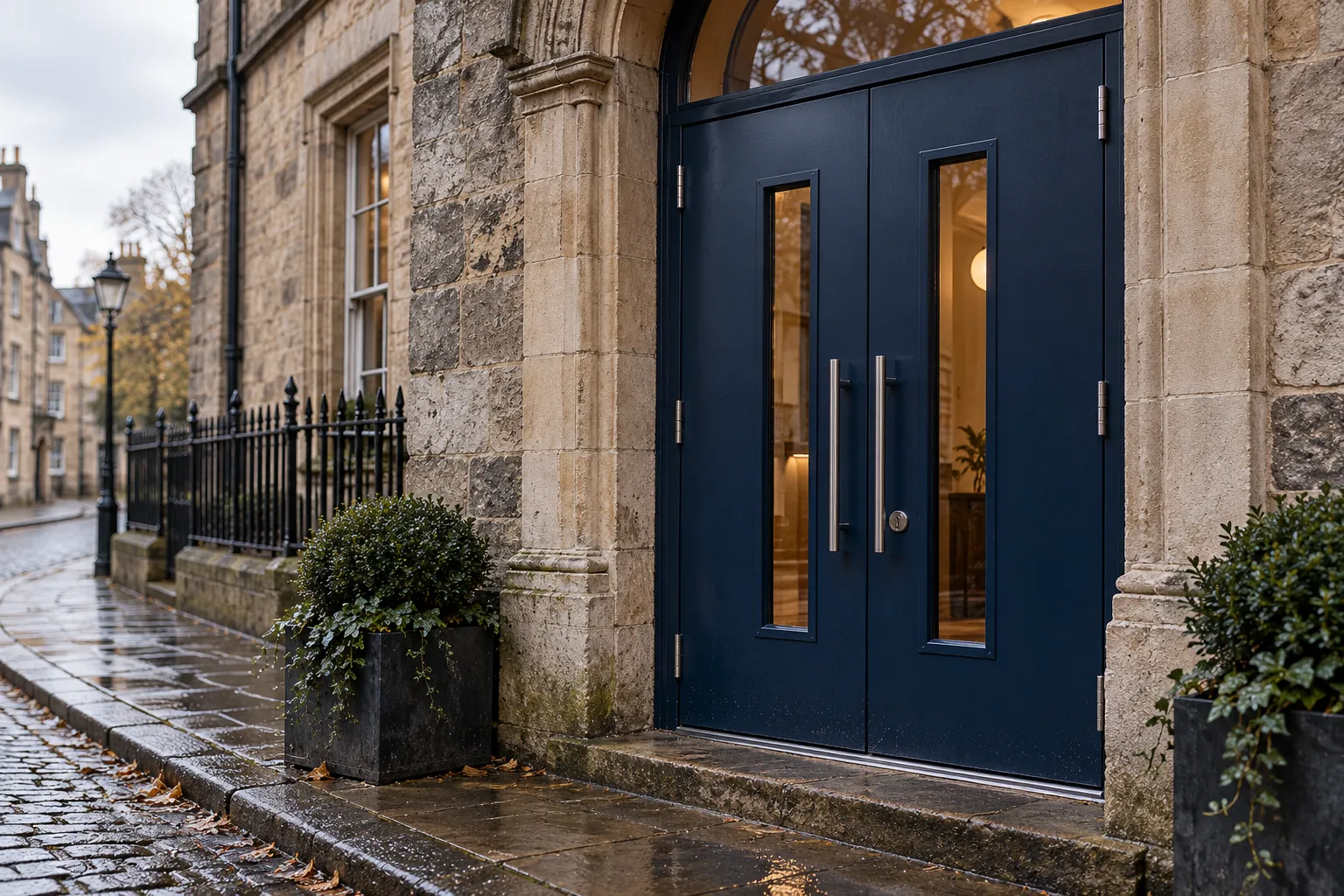
Blast · ISO 16933 EXV45 to EXV10
Blast Resistant Doors in Edinburgh
Blast resistant doors for Edinburgh civic, university and hospital sites, with EXV and SB ratings, tested glazing and a steel frame built to the opening.
- ✓Third-party test evidence with every product
- ✓Written specification you can issue to tender
- ✓Supplied and installed in Edinburgh
Get a free quote in Edinburgh
Rating, written specification and budget range within one working day.
Confidential. No cost, no obligation.
Third-party tested
Evidence with every quote
UK manufactured
Made to your sizes
One accountable team
Specify, supply, install
Confidential handling
Details never shared
Supplied and installed in Edinburgh
What we supply in Edinburgh
For an Edinburgh building that faces a blast threat, the door at the entrance carries more than a lock. It carries a named rating, and the test papers behind that rating. Blast resistant doors are built around that pair: a leaf, a frame, glazing and hardware that pass the blast test as one doorset, graded under ISO 16933.
The city gives the door plenty of places to stand. Civic rooms around Holyrood and the Royal Mile sit close to crowds, the Castle draws visitors through the day, Waverley station and Edinburgh Airport move people through entrances from early morning, the Royal Infirmary of Edinburgh and the University of Edinburgh run wards, laboratories and stores behind locked doors, Murrayfield Stadium fills on match days, and Princes Street, St James Quarter and Leith hold shops, offices and hotels behind busy frontages. The rating for each door follows the threat at its own opening.
Single leaf and double leaf doors are built for this rating, with solid leaves for stores and plant rooms and glazed leaves with rated vision panels for counters and receptions. The glass is graded to the same class as the leaf, the frame is built to the same rating, and the buyer gets the test records and the care notes at handover. The physical security in Edinburgh page sets the city picture, and the blast doors glazed or solid guide shows a glazed leaf and a solid leaf side by side.
Where Edinburgh sites need blast resistant doors
The strongest case sits with civic buildings. Rooms around Holyrood, the Royal Mile and the Castle sit where crowds gather, so the doors at their entrances carry a blast rating beside the forced entry rating. Interview rooms, staff entrances and public counters each face a different threat, and each opening takes its own class. The Martyn’s Law guide for premises names the duties for places where the public gathers, and the layered security guide shows how a door works as part of a wider plan.
Transport comes next. Waverley station keeps entrance, staff and plant room doors working through the day, while Edinburgh Airport keeps check in, baggage and staff doors moving where crowds pass in large numbers. A blast rated leaf at these sites is heavy, so the closer, the hinges and the seals are sized to carry it and to shut it cleanly after every entry. Doors at a transport site are covered by the airport security doors guide, and the transport hub security requirements guide states what a hub asks of its doors.
The third share belongs to hospitals, universities and the stadium. At the Royal Infirmary of Edinburgh, wards, stores and plant rooms need doors that shut and lock without fail. At the University of Edinburgh, teaching rooms, laboratories and stores take doors that see heavy daily use. At Murrayfield Stadium, turnstile routes, staff doors and hospitality doors must work on a match day. Shops, offices and hotels on Princes Street, at St James Quarter and in Leith ask for the same door on stock rooms, back offices and service entrances. The hospital security guide weighs clinical flow against security at each opening, and the university security guide does the same for student flow.
Reading the blast ratings for an Edinburgh door
ISO 16933 gives the blast rating. EXV covers a blast from an explosive charge, and SB covers a blast from a charge carried in a vehicle or placed at a distance, so the class for the opening follows the threat assessment. Glazing carries a rating of its own under EN 13123 and 13124, EPR and EXR, and the pane class must match the leaf class, so a pane graded below the leaf leaves a gap in the door, and a frame that was never tested with that pane leaves the same gap.
| Edinburgh site | Opening | Rating to quote | Door form |
|---|---|---|---|
| Holyrood and Royal Mile | Public counters and staff entrances | EXV, with SR2 or SR3 added where forced entry also counts | Steel doorset with a rated lock |
| Waverley station | Entrance and staff doors | SB, per the threat assessment | Doorset with a rated frame and controlled access |
| Royal Infirmary of Edinburgh | Ward, store and plant room doors | EXV, per the risk at the room | Solid leaf doorset, access control fitted |
| University of Edinburgh | Laboratory and store doors | EXV or SB, per the material held | Glazed or solid leaf, to the room |
| Murrayfield and Princes Street | Stock rooms and back offices | SB, per the value held | Steel doorset, frame tested with the leaf |
Forced entry sits beside blast on many Edinburgh doorsets. A brief that names a blast rating requires LPS 1175 Issue 8.2 (September 2024) if forced entry is named beside it, and the specification carries both ratings for the one doorset. The SR scale runs from SR1 at A1 through SR2 at B3 and SR3 at C5 to SR4 at D10. PAS 68:2013 came to an end on 25 October 2023, when it was withdrawn, and ISO 22343-1:2023 now supersedes it. ISO 22343-1:2023 now stands in place of IWA 14-1:2013 as well, so a vehicle barrier at the approach is quoted to the current standard. The blast ratings page pairs the blast grades side by side, and the ISO 16933 EXV or SB guide sets out the choice in order.
Specifying a blast resistant door in Edinburgh
Start with the threat assessment for the opening. It names the room, the blast threat and the EXV or SB class the door must carry, and the glass class follows from the leaf class. The guide that puts forced entry, ballistic and blast ratings together shows the three rating families together, and the HVM standards guide names the current vehicle barrier standards for the approach.
The specification lists the leaf, the frame, the glazing, the hardware and the fixings as a single tested set, with the proof papers for the quoted class sent beside it. Access control, the closer and the threshold go in as well, so the door serves the building each day rather than only on its test day. Where glazing is needed beside the door, the blast resistant glass page covers the same ratings for glass. For the forced entry side, the SR grades are on the LPS 1175 standard page.
The survey measures the opening, notes the build of the wall and the frame already there, and records how the room is used and who passes through the door. A counter door in a civic building opens a few times a day, so it takes different hardware from a station door that opens all day, and a hospital door that has to shut after each entry takes a closer sized for a heavy leaf. The seals are set once the leaf is on, the installation service handles the fitting, and the handover checks are listed in the acceptance and snagging guide.
To ask for a quote, send the size of the opening, a photograph of the doorway and a short note on the room and its use to [email protected]. The reply comes inside one working day, and it holds the specification, the price and a survey date.
Arxbridge is based at Saffron Road, Romford, Essex RM5 3ES. The office takes calls through the working day.
Starting an Edinburgh blast door enquiry
Put the EXV or SB class, the size of the opening and how the room is used in the first message. A doorset made for another opening seldom fits an Edinburgh reveal, so the specification starts from those details.
Questions about blast resistant doors in Edinburgh
Should an Edinburgh blast door be glazed or solid?
The use of the room sets the answer. A counter or a reception that needs sight lines takes a glazed leaf with a pane rated to match, while a store or a plant room takes a solid leaf. The glass class must equal the leaf class in either case.
What do EXV and SB mean?
Both classes come from ISO 16933. EXV names a blast from an explosive charge, and SB names a blast from a charge in a vehicle or set at a distance. The threat assessment for the opening states which class the door must carry.
Can one doorset hold both a blast class and an SR class?
Yes, when one doorset passes the blast test and the forced entry test. The specification names the EXV or SB class beside the SR class, and the papers for each class go with the specification.
What are the steps from survey to handover for an Edinburgh blast door?
First comes the survey, which measures the opening and notes the use of the room. The doorset is then built to the written specification, fitting runs from the survey drawings, and the first reply comes inside one working day, with handover bringing the test papers and the care notes after it.
Ask for a quote on a blast resistant door for an Edinburgh site. Send the drawings and the rating for the opening, and the quote that comes back names a doorset built for the threat at that opening.
Other areas
Blast resistant doors in other areas
Ready to specify your project?
Free assessment, written specification and test evidence. Reply within one working day.