
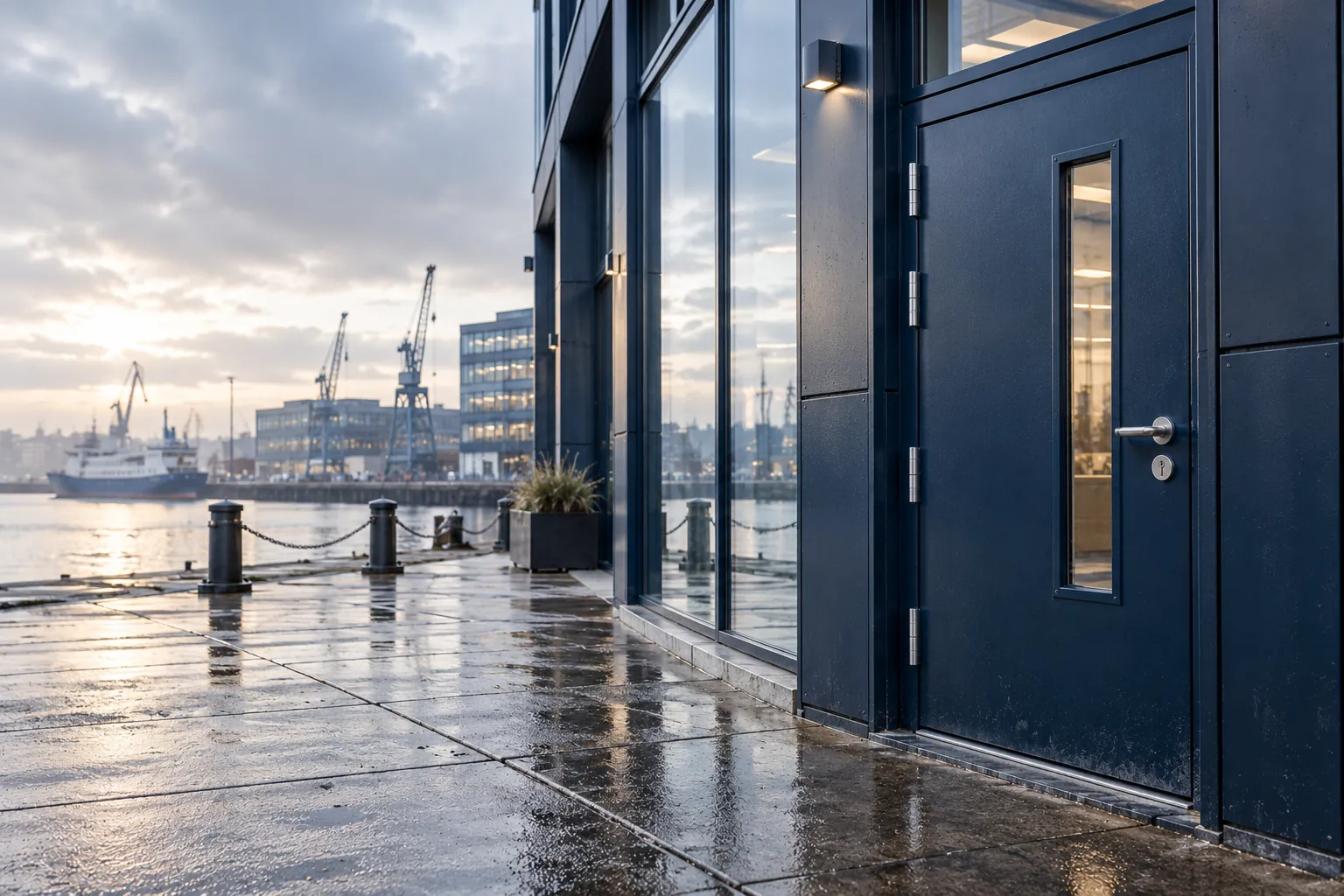
Blast · ISO 16933 EXV45 to EXV10
Blast resistant doors in Southampton
Blast resistant doors in Southampton for cruise terminals, hospitals, universities and offices, rated to ISO 16933 with a survey and written specification.
- ✓Third-party test evidence with every product
- ✓Written specification you can issue to tender
- ✓Supplied and installed in Southampton
Get a free quote in Southampton
Rating, written specification and budget range within one working day.
Confidential. No cost, no obligation.
Third-party tested
Evidence with every quote
UK manufactured
Made to your sizes
One accountable team
Specify, supply, install
Confidential handling
Details never shared
Supplied and installed in Southampton
What we supply in Southampton
A Southampton buyer choosing a blast resistant door is buying cover for the people behind it. Cruise passengers move through the terminals beside the water, patients and staff move through Southampton General Hospital, and students move through the two universities, and each entrance needs a door whose frame stays fast when a blast load hits it.
The test for a blast resistant door puts a blast load on the doorset, not a hand tool on the leaf. The rating sits with the whole doorset, since the leaf, the frame, the fixings and the glazing face the test load as one unit. A leaf that passes on its own means nothing if the frame gives way beside it.
The setting fixes the load, so the rating follows the building. The Port of Southampton moves freight and cruise traffic, Ocean Village pairs marina offices with flats, Westquay draws shoppers through a glazed frontage, and St Mary’s Stadium fills with crowds on a match day. The physical security in Southampton page shows how those quarters sit beside each other across the city, and the door at each entrance takes the class its own setting demands.
Where a blast rated door earns its place in Southampton
Cruise terminals and the port take the heaviest footfall in the city. Passengers arrive in waves, luggage moves beside them, and the entrance doors work long hours with staff watching every lane. A blast resistant door at the terminal entrance keeps the frontage in use while the flow goes on, and a staff door at the rear closes the way in once the last sailing has left.
Hospital and university doors serve people who need time and space. At Southampton General Hospital, ward and department doors must open fast for staff yet stay under control at the entrance, while university halls and libraries stay open to students and shut to strangers after hours. The healthcare sector page covers doors for wards and departments. The education sector page covers doors for schools and universities.
Crowds gather in more places than the port. St Mary’s Stadium holds thousands on a match day, and SeaCity Museum and the Bargate draw visitors through the old centre. Doors at those sites stand beside the entry lanes and the ticket checks, and the public spaces sector page covers how crowd entrances are planned.
Ratings behind a Southampton blast door
A door that must hold a blast load and a forced entry attempt carries two classes on its schedule. The specification agrees LPS 1175 Issue 8.2 (September 2024) arranging the forced entry grade beside the blast class for each opening, so one line names both duties. Tool set and hold time fix the grade, and the full range of classes sits on the LPS 1175 standard page; the ratings compared page sets the three duties side by side for one doorset.
| Forced entry class | Tool set | Hold time | Opening it suits |
|---|---|---|---|
| SR1, class A1 | A | 1 min | Low risk openings |
| SR2, class B3 | B | 3 min | Busy public entrances |
| SR3, class C5 | C | 5 min | High value stores |
| SR4, class D10 | D | 10 min | Named threat openings |
The blast classes come from a different test. ISO 16933 names EXV and SB as its blast load classes, and EN 13123 with EN 13124 sets the EPR and EXR classes for a glazed assembly facing a blast. Pressure, duration and debris set the class the assembly must meet, with each class set out on the blast ratings page. The NPSA guidance page shows how those classes shape a public building scheme.
Glazing in the leaf carries its own grade. EN 1522 and EN 1523 give FB1 to FB7 for the frame with its glazing, FSG included, and EN 1063 grades the glass itself from BR1 to BR7, SG1 and SG2 included. The glass, the frame and the fixings take one grade as a set, and the ballistic glass ratings page explains the glass classes for a glazed leaf. For the glazing beside the leaf, blast resistant glass in Southampton covers the city options.
Two more standards sit beside the blast classes on some schedules. Where the schedule names a doorset approval, the issue to write is LPS 2081 Issue 1.1 (2016), and the glazing approval beside it is LPS 1270 Issue 1.1 (2014). For vehicle barriers, the old test no longer stands: ISO 22343-1:2023 now covers that test, after PAS 68:2013 left the standards list on 25 October 2023, so a barrier named in the same scheme is specified to the current standard, with the classes on the vehicle impact ratings page.
What goes into a Southampton blast door specification
Begin with the opening itself and the load it must meet: the clear width and height, how the wall is built around the opening, and how much room the leaf needs to swing, then set the blast class the site asks for. A cruise terminal entrance busy all day asks for a different class from a back-of-house leaf that stays shut through the week, and the glazed versus solid page shows how glazing changes the leaf.
Next, settle leaf, frame and glazing as one choice. A solid leaf suits an opening where no light is wanted, while a glazed leaf suits a reception where staff watch who waits outside. The frame and its fixings must suit the leaf, as a strong leaf in a weak frame earns no rating. The ten steps to specify page walks through the order of decisions, and the lead times page gives the wait from order to delivery.
Last, settle the hardware, the access control and the cost. The lock, the hinges, the closer and the reader must all suit the weight of the leaf and the cycles of each day, and a leaf locked overnight needs a lock that holds with no power. The installation and handover page lists the papers that go in the handover file for each doorset.
| Where in Southampton | Door build | Class to request | Glazing |
|---|---|---|---|
| Cruise terminal entrance | Two leaves with access control | EXV, SR2 | Vision panels |
| Ward, Southampton General Hospital | One leaf, staff only | EXV, SR2 | Small panel |
| Hall, University of Southampton | Two leaves, timed access | SB, SR2 | Glazed panels |
| Shop front, Westquay | One leaf, entrance | EXV, SR3 | Full height glazing |
| Plant room, Ocean Village | One leaf, solid | SB, SR2 | None |
From survey to fitting in Southampton
The job starts at the openings, with each door position measured on site. The surveyor measures the width, the height, the wall build and the swing, then notes the power, the access points and the flow of staff and visitors between areas. Photos and sketches of each opening go with the record, and the specification is built on them.
That record fixes the rating and the form of the door: the blast class, the forced entry grade, the leaf, the glazing, the frame, the hardware and the finish, with each opening named in full. The evidence file goes with the rated doorset to site. The specification is written at the Romford tower: Saffron Road, Romford, Essex RM5 3ES.
Fitting dates work around hospital hours, teaching times and office hours. Send the opening details to [email protected] with sizes and the class for every opening, and a written answer follows inside one working day, naming the class for each opening and the date of the survey.
Fix the stand-off distance at each entrance before the class is set: a door close to the street faces a harder load than a door set back behind a forecourt.
Questions buyers in Southampton ask about blast doors
Glazed or solid: which suits a Southampton cruise terminal entrance?
The way the entrance works decides. A terminal front where staff watch the lanes fits a glazed leaf, while a staff entrance or a plant room needs a solid leaf.
Does a blast class cover forced entry as well?
Not on its own. The blast class is proved against a blast load, and the forced entry class against hand tools over a set time. Where both duties apply, the door needs proof for each one, with both classes named on the schedule for that opening.
What happens when the leaf is stronger than the frame?
The rating fails with it. The leaf, the frame, the fixings and the glazing are proved as one doorset, so a strong leaf inside a weak frame holds no rating of its own. The specification names the frame and its fixings beside the leaf, so no weak point is left out.
What care does the door need after fitting?
A planned visit starts with the leaf and the frame, checks the hinges, the lock and the closer next, and swaps any part showing wear before it fails. The maintenance contract scope page covers what a contract holds for a fitted door.
Planning blast resistant doors for a Southampton site? Send the width and height of each opening with the blast class each door must meet.
Other areas
Blast resistant doors in other areas
Ready to specify your project?
Free assessment, written specification and test evidence. Reply within one working day.