
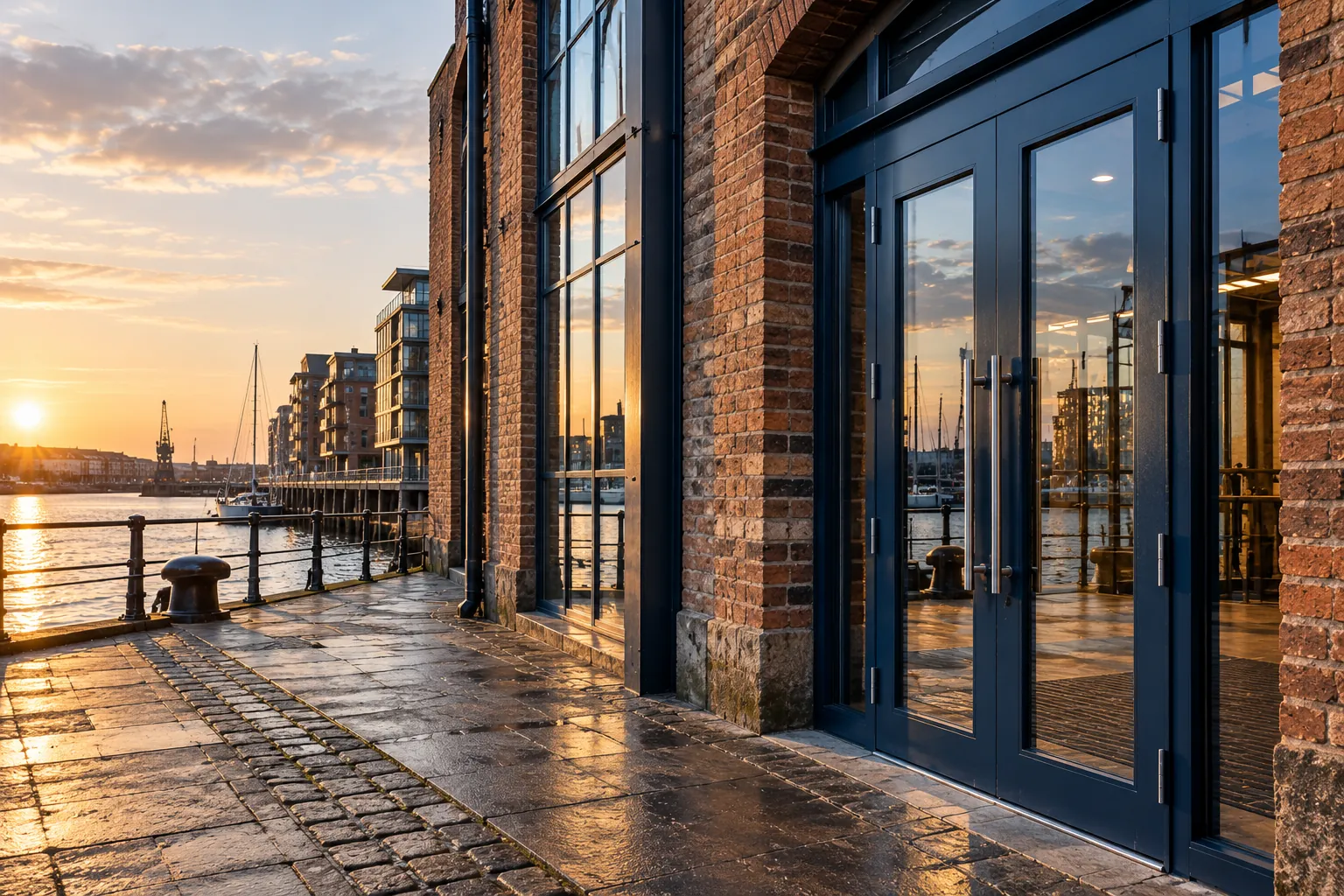
Blast · ISO 16933 EXV45 to EXV10
Blast resistant doors in Bristol
Blast resistant doors for Bristol hospitals, stations and offices, with blast classes, LPS 1175 grades and frames matched to each doorway on site.
- ✓Third-party test evidence with every product
- ✓Written specification you can issue to tender
- ✓Supplied and installed in Bristol
Get a free quote in Bristol
Rating, written specification and budget range within one working day.
Confidential. No cost, no obligation.
Third-party tested
Evidence with every quote
UK manufactured
Made to your sizes
One accountable team
Specify, supply, install
Confidential handling
Details never shared
Supplied and installed in Bristol
What we supply in Bristol
Bristol Temple Meads sends crowds through its entrance doors at each peak, and a blast resistant leaf on that frontage must hold its line while thousands pass beside it. Cabot Circus shopfronts face shoppers at close quarters from opening time, Bristol Royal Infirmary keeps its main entrance open through the night, and office blocks round Temple Quay fill their lobbies before nine. A doorway at each of those addresses takes its own leaf build and frame depth, with a blast class that follows the risk outside that doorway, not the room behind it.
A blast resistant door is a steel leaf set in a steel frame, hung on hinges rated for the leaf weight, sealed at the edges, and locked with hardware that holds under blast load. Leaf, frame and fixings are judged as one build, so a leaf above its frame in rating earns nothing alone. Glass beside the leaf takes its own class, and the blast resistant glass in Bristol page gives the glazed build beside the solid leaf.
Harbour offices near the water, hospital entrances off Marlborough Street, university buildings on Park Street and station doors at Temple Meads each face a different street, a different crowd and a different blast risk. Bristol in full is covered on physical security in Bristol.
Doors at Temple Meads, Cabot Circus and the Royal Infirmary
Temple Meads draws trains from London, Cardiff and Birmingham into one concourse, and the doors at its main entrance swing through crowds that arrive in waves. A leaf there must close cleanly after each wave, keep its seal tight through a cold morning, and still carry the blast class on the schedule. Station entrances fall under the transport hub security requirements guide, and shop doorways with shoppers passing all day fall under the retail sector page.
Cabot Circus fronts Broadmead with shop doors that open onto pavements crowded with shoppers, delivery trolleys and prams, while Bristol Royal Infirmary off Marlborough Street admits patients and porters at every hour. The glazed and solid blast doors guide lays the glazed option beside the solid one for a Bristol doorway, and the healthcare sector page covers hospital entrances. The blast resistant windows in Bristol page gives the window build beside the door, and the blast hub page gathers the blast range in one place.
Fixing the blast class for a Bristol doorway
A leaf that achieves LPS 1175 Issue 8.2 (September 2024) achieving SR3 still needs its blast class written beside the grade, since the grade times a forced entry attack and the class measures a blast load. Grades run SR1 at one minute with class A1, SR2 at three minutes with class B3, SR3 at five minutes with class C5, and SR4 at ten minutes with class D10. Forced entry, ballistic and blast ratings sit side by side in the ratings compared guide. The standard’s own table sets the attack class against each grade, as the LPS 1175 standard page shows.
Blast load has its own classes, separate from forced entry grades. ISO 16933 names EXV and SB for the blast load on a leaf, while EN 13123 and EN 13124 name EPR and EXR for a doorway tested as a whole. A schedule that lists only the forced entry grade leaves the blast duty unproven, so both ratings sit on the same line. Each class and the test behind it appear on the blast ratings page.
The table below pairs five Bristol doorways with their classes, from a station entrance to a hospital doorway. Assessors test leaf, frame and fixings as a single build, so a leaf outrated against its frame earns nothing alone.
| Doorway in Bristol | Leaf build | Blast class | Forced entry grade |
|---|---|---|---|
| Temple Meads main entrance | Steel leaf, solid | EXV | SR3, class C5 |
| Cabot Circus shop doorway, Broadmead | Steel leaf, glazed vision panel | SB | SR2, class B3 |
| Royal Infirmary main entrance | Steel leaf, solid | EXV | SR3, class C5 |
| Temple Quay office lobby | Steel leaf, glazed vision panel | SB | SR2, class B3 |
| University building, Park Street | Steel leaf, solid | EXV | SR2, class B3 |
Forced entry classes run RC1 to RC6 under BS EN 1627, fire classes E, EW and EI each last from 30 minutes to two hours (BS EN 1634-1:2014+A1:2018), bullet classes run FB1 to FB7 under EN 1522 with EN 1523, and glazed panels take BR1 to BR7 under EN 1063. A doorway with more than one duty lists each class apart, and the ballistic ratings page lists the bullet and glass classes.
Martyn’s Law reaches premises in spring 2027, when it sorts them by the number of people inside at one time. While a building with 200 to 799 people belongs to the standard tier, buildings with 800 people or more at one time fall in the enhanced tier. Ahead of that date, the Martyn’s Law guide for premises shows the tier duties for a doorway.
The lines on a Bristol blast door schedule
Leaf size comes first on the list. Each doorway is taped for its clear opening, frame depth is noted on both sides, and every fixing point round the frame is marked for leaf, hinges and lock. A wide station entrance and a narrow shop doorway take different hinges, and the specifying security doors guide walks through those choices before any figure is settled.
The leaf build follows the opening it fills. A solid leaf fits a station entrance where crowds press close to the metal, and a leaf with a glazed vision panel fits a hospital entrance where staff need sight through the leaf before they push it open. The ten steps page orders those choices for a rated leaf, from frame depth to lock type.
A heavy leaf still needs a light push. Under BS 8300 with Approved Document M, the push stays at or below 30 N while the leaf swings open through its first 30 degrees. Past that angle the cap is 22.5 N.
Survey notes and drawings for each Bristol doorway
Each opening is measured on site before anything is ordered. The tape gives the clear opening, frame depth on both sides, fixing points and threshold line, and floor levels each side go on the same sheet with the path beside the leaf. Every doorway carries its own sketch and its own set of photos, and the schedule is built from those sheets.
Our Bristol file holds the measured openings, frame depths and fixing points, filed at the amphitheatre Saffron Road, Romford, Essex RM5 3ES. Ask first for the doorway list with leaf sizes and blast classes, and each class will sit beside the drawing it belongs to.
Email [email protected] to visit the Bristol doorways with the schedule in hand, and the reply arrives the next working day.
Checking each doorway before ordering
Step through each doorway and check the floor on both sides before the leaf is ordered. A step up at the threshold, a mat that lifts at the edge, or a trolley route that cuts across the swing can all slow the leaf, so the threshold line and the floor each side are checked with the leaf size.
Go over the schedule once more before the order is placed, doorway by doorway, checking size, class, frame and leaf against the survey sheets. Cover for parts that wear comes from the warranty, defects and guarantees guide, while the acceptance and snagging guide covers the arrival checks for a leaf.
The figure for a leaf follows its class, size and frame build, and two leaves cut to one size can still need different cores and locks, so the figure stays open until the survey is finished and the class is picked.
Bristol buyers ask about blast resistant doors
Which Bristol doorway takes a blast resistant leaf first?
A Temple Meads entrance takes it first, since crowds stand close to the leaf at each peak. A narrow shop doorway follows, once the wide entrances carry their class.
Can an LPS 1175 grade stand in for a blast class?
No. LPS 1175 times a forced entry attack, while ISO 16933 and EN 13123 test the blast load, so a doorway that must meet both needs a grade and a class on the same schedule line.
What happens when a strong leaf hangs in a weak frame?
The frame carries the leaf, so a weak frame fails before a strong leaf does. A leaf rated above its frame fails at the frame first, which is why frame depth and fixing pattern sit on the schedule beside the leaf size.
How do you look after a blast resistant leaf each day?
The security door maintenance checklist lists the daily care for a doorway. A visit checks hinges, seals and lock in turn, and any seal that has flattened or split is swapped before it lets the leaf drag.
Blast resistant doors at a Bristol opening?
Send the doorway sizes with the blast class each one needs, and the reply quotes leaf, frame and fixings. Get a free quote
Other areas
Blast resistant doors in other areas
Ready to specify your project?
Free assessment, written specification and test evidence. Reply within one working day.