
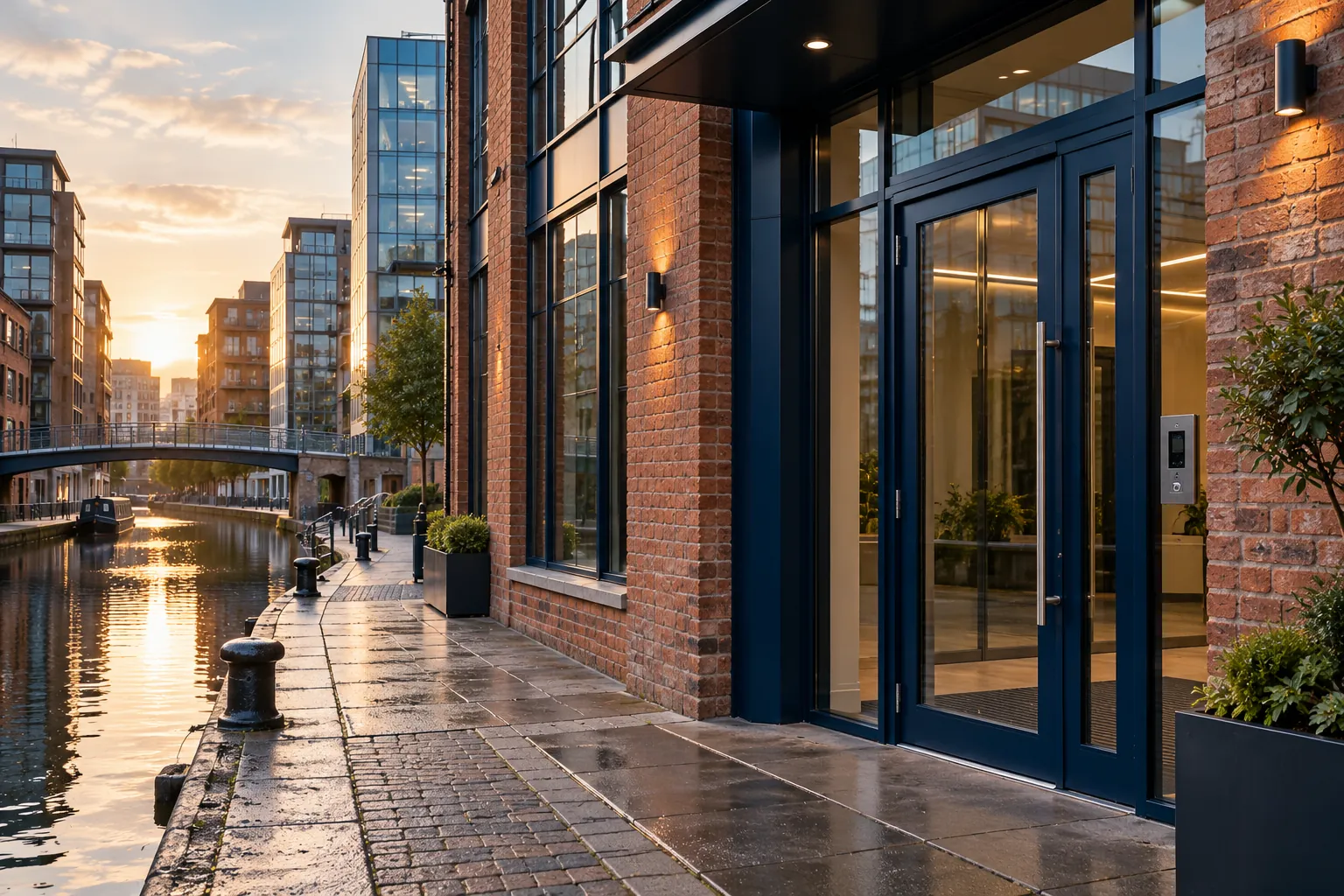
Fire · EI 30 to EI 120
Fire Rated Steel Doors in Birmingham
Fire rated steel doors in Birmingham, classes E, EW and EI from 30 to 120 minutes. Tested under BS EN 1634-1, with intumescent seals and evidence for each door.
- ✓Third-party test evidence with every product
- ✓Written specification you can issue to tender
- ✓Supplied and installed in Birmingham
Get a free quote in Birmingham
Rating, written specification and budget range within one working day.
Confidential. No cost, no obligation.
Third-party tested
Evidence with every quote
UK manufactured
Made to your sizes
One accountable team
Specify, supply, install
Confidential handling
Details never shared
Supplied and installed in Birmingham
What we supply in Birmingham
Fire rated steel doors hold back fire and smoke for a set time, so people can leave a building and fire crews can work inside it. A steel doorset is tested as a complete unit, leaf, frame, seals and hardware together, and the class it earns names how long it resists fire, how much heat it lets through, and whether it stops smoke. A steel door earns an E, EW or EI form, at a time from 30 minutes up to 120, after a furnace test run to the BS EN 1634-1:2014+A1:2018 standard.
Birmingham calls on those doors in very different buildings. Queen Elizabeth Hospital needs fire doors at wards, corridors and plant rooms. The University of Birmingham and Aston University need them at lecture blocks, laboratories and student rooms. The NEC needs them at exhibition halls, and Birmingham Airport at terminals and service routes. Stair cores, lift lobbies and store rooms take the same doors in city centre offices and Jewellery Quarter workshops.
ArxBridge supplies fire rated steel doors for Birmingham buyers who need a tested class for a named opening, rather than a generic fire door. Every opening is measured, every doorset is specified with its class, seals and hardware, and every door is matched to the test evidence for that class. Our page on physical security in Birmingham sets out the wider city picture for rated work across Birmingham.
Where Birmingham buildings need fire rated steel doors
Hospital buildings make the strongest case for them. Queen Elizabeth Hospital holds wards, corridors and plant rooms where a fire door must hold its class while staff move patients and equipment through the building, and the seals and closers on each door must work every day, not only on test day. The fire door regulations for hospitals guide records how fire doors are used in hospital buildings, and the inspection checklist records the checks that keep each door in working order.
The universities, the NEC and the airport bring a different pattern. The University of Birmingham and Aston University hold lecture blocks, laboratories and student rooms where large numbers of people need clear escape routes, the NEC holds exhibition halls where the layout changes from show to show, and Birmingham Airport holds terminals where the public, staff and service routes meet. A fire rated steel door at each stair core and service route keeps those escape routes open. The fire door regulations for offices guide records the pattern for office and public buildings, and the fire doors and Gateway 2 guide records the rules for taller buildings.
City centre offices and Jewellery Quarter workshops look for doors that fit daily use and a fire strategy at the same time. An office stair door is opened many times a day and must still shut firmly on its closer, a workshop store door holds materials behind a rated leaf, and a lift lobby door keeps smoke out of the lift shaft. The fire ratings page records the classes and the test behind them.
Fire classes and test evidence
The class letters name what the door resists. E names integrity, the door holding back flame and hot gas for the stated minutes. EW adds a limit on the heat radiated through the leaf, and EI adds a limit on the temperature of the face away from the fire. A 30 minute class suits a low risk opening, a 120 minute class suits a stair core or a plant room where escape takes longer. Each opening takes its class from the building fire strategy, and the written specification records it opening by opening.
Test evidence is the proof behind the class. Testing covers the whole doorset at once, with every part in place, put through BS EN 1634-1:2014+A1:2018. Evidence names the leaf, frame, seals and hardware tested together, so a change to any part needs fresh evidence or a written assessment. Certification to LPS 1056 is named in the specification where the project asks for it. If a door must also resist forced entry, its grade is fixed by the LPS 1175 Issue 8.2 (September 2024) classes. SR1 to SR8 classes are laid out on the LPS 1175 standard page. Before an order is placed, the certification guide notes which evidence is worth asking for.
What each Birmingham building usually needs
The rows match each kind of building to a class at first glance. The fire strategy settles the final figure, and the survey of each opening fixes the class door by door, with the specification settled before any doorset is ordered.
| Building in Birmingham | Where the door sits | Class to set | What else is specified |
|---|---|---|---|
| Queen Elizabeth Hospital | Wards, corridors and plant rooms | EI 60 to EI 120, as the fire strategy sets | Intumescent seals, closer and smoke seals |
| Universities | Lecture blocks, labs and student rooms | EI 30 to EI 60, as the fire strategy sets | Closer, vision panel and ironmongery |
| NEC and Birmingham Airport | Exhibition halls and airport terminals | EI 60, as the fire strategy sets | Hold open arrangement and seals |
| City centre offices | Stair cores and lift lobbies | EI 30 to EI 60, as the fire strategy sets | Closer, seals and access control |
| Jewellery Quarter workshops | Stores and workshop doors | E 30 to EI 60, as the fire strategy sets | Seals, lock and threshold |
Specifying fire rated steel doors for a Birmingham site
Open the job with a list of openings. For every door, record the measured size, wall make-up, class and hardware, and keep the test papers for the quoted class with the specification. A door ordered without its evidence is a risk at handover, so the evidence is checked before the order is placed, not after the door arrives. The certification guide shows which papers to ask for, and the inspection checklist records the checks that follow at handover.
Intumescent seals sit at the centre of the specification. The seals expand in heat and close the gap between leaf and frame, so the seal type, its position and its size are named for each door, with smoke seals added where the fire strategy asks for them. The closer is adjusted so the leaf closes firmly yet quietly, the hinges and lock are named as tested, and the finish is chosen to suit the room. Where access control is needed, the reader position and power point are put on the drawing too.
From specification to fitting in Birmingham
Once the specification carries a signature, the workshop builds each doorset from it. Survey figures ride along with the build, so a hospital ward door matches the size the survey recorded. Inside the building, frames are set square and level, leaves are hung with closers adjusted, and each seal is checked to the specification written for its opening.
The maintenance guide records the care each door needs after handover, so the class it was tested to is the class it keeps.
Pass the door schedule through the quote form, with the class each opening needs marked on it, or write to the team at [email protected], with a written reply reaching you inside one working day, carrying a price figure and the specification for each doorset.
Fire door notes for Birmingham buyers
Ask for the test evidence before the order goes in. A door with no evidence for its class may fail at handover, and paper evidence is far easier to check than a fitted leaf.
Frequently asked questions
What fire class does a Birmingham hospital ward door need?
The building fire strategy sets it. Ward, corridor and plant room doors at a hospital often sit at EI 60 to EI 120, while a low risk office opening may sit at EI 30. Survey and strategy together settle the class for each opening.
Can a fire rated steel door also hold a security rating?
Yes, where both ratings are tested for the same doorset. Fire resistance was proved by a test against BS EN 1634-1:2014+A1:2018; forced entry resistance rests on LPS 1175 Issue 8.2 (September 2024). Both go in the specification, with the evidence for each.
Do intumescent seals need replacing?
Seals are checked at each inspection and replaced when they are damaged, worn or pulled away from the leaf or frame. The maintenance guide records the care each door needs after handover, so a worn seal is fixed before it fails.
How are fire doors checked after fitting in Birmingham?
Frames are checked square and level, each closer and seal is tested to its opening specification, and the inspection checklist holds the checks that follow at handover. The handover record lists each opening.
Planning fire rated steel doors for a Birmingham building?
Begin with the door schedule and the class for each opening, and a specification returns for every doorset. Request a free quote to open the survey.
Other areas
Fire rated steel doors in other areas
Ready to specify your project?
Free assessment, written specification and test evidence. Reply within one working day.