
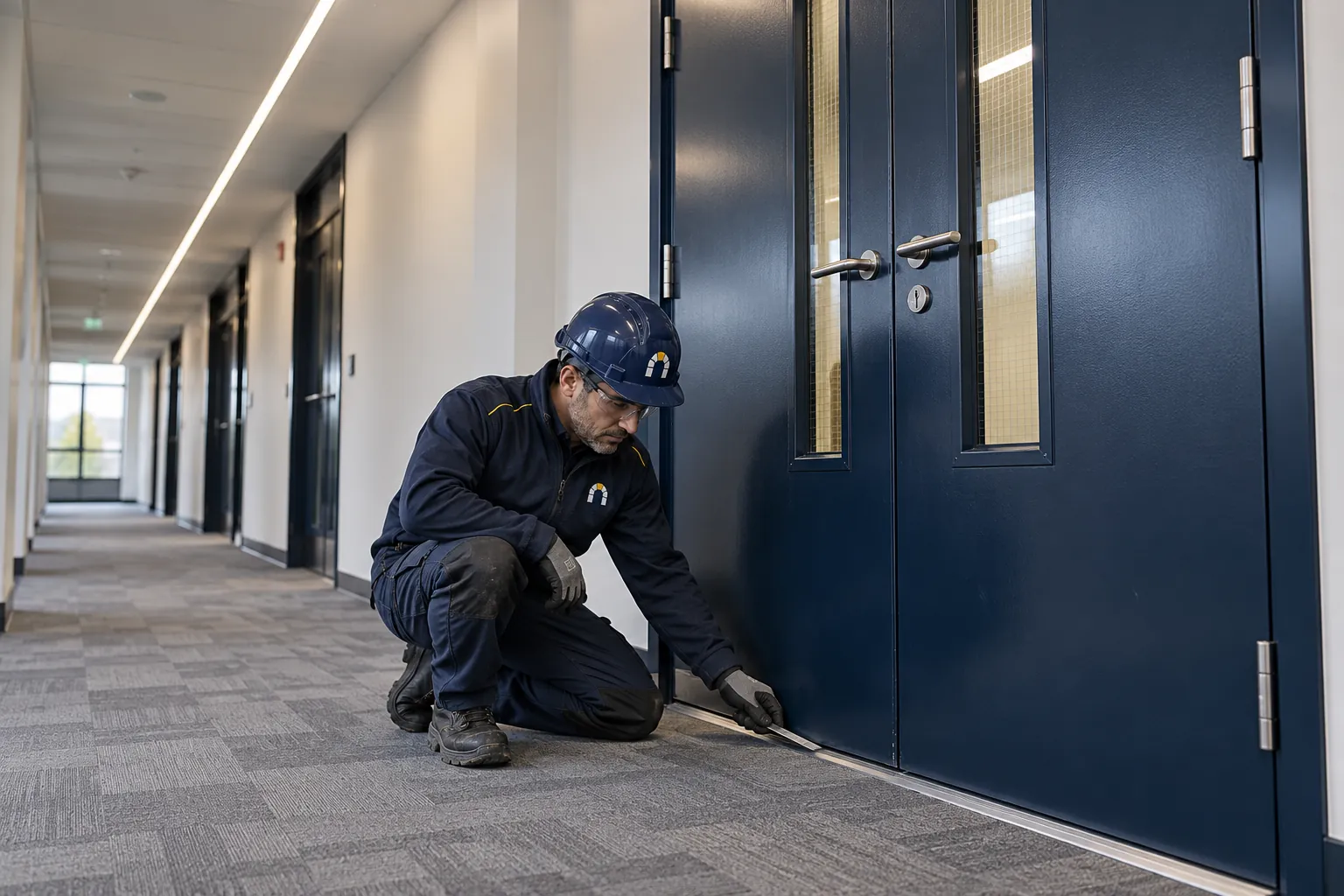
Fire · EI 30 to EI 120
Thermally broken doors in West Midlands
Thermally broken doors for West Midlands hospitals, universities, stations and offices, with fire ratings and forced entry grades on one leaf.
- ✓Third-party test evidence with every product
- ✓Written specification you can issue to tender
- ✓Supplied and installed in the West Midlands
Get a free quote in the West Midlands
Rating, written specification and budget range within one working day.
Confidential. No cost, no obligation.
Third-party tested
Evidence with every quote
UK manufactured
Made to your sizes
One accountable team
Specify, supply, install
Confidential handling
Details never shared
Supplied and installed in the West Midlands
What we supply in the West Midlands
A door that faces a cold yard on one side and a warm corridor on the other soon shows the gap in its frame, with damp gathering at the edges and heat slipping out round the leaf. Round the West Midlands that gap matters at hospital corridors, university teaching blocks and office receptions, where doors open and shut all day. A leaf that breaks the cold path keeps the inside face close to room temperature, so damp stays off the frame.
A thermally broken door carries an insulating break inside its frame and leaf, so heat finds no direct metal path from warm face to cold face. The same leaf carries a fire rating and a forced entry grade, so one door answers three duties at once. This door joins the other products guarding the region; see physical security in the West Midlands for the rest.
Queen Elizabeth Hospital Birmingham and Walsall Manor Hospital ask the most of such a leaf, with corridors that link warm wards to cold service yards, while the University of Birmingham and Coventry University ask the same where students move between lecture rooms, libraries and halls through the day. Birmingham New Street station and Birmingham Airport in Solihull add retail units and offices with the same mix, and the Bullring and Merry Hill add shop fronts and service corridors. Each leaf takes its size from its opening, its fire rating from its compartment, and its grade from the risk at that door.
Which West Midlands buildings ask for a thermally broken door
At Queen Elizabeth Hospital Birmingham, corridors run from warm wards to cold loading bays, and a door on that line faces damp air on one face and heated air on the other through every shift. A thermally broken leaf keeps its inside face warm, so the frame stays dry and the seal stays true, and the same leaf holds its fire rating in the compartment wall. Walsall Manor Hospital runs the same pattern at a smaller scale, with service corridors and ward doors that open onto cold yards.
The University of Birmingham and Coventry University hold lecture rooms, libraries and halls where students walk between warm rooms and cold courtyards all day, and a door that lets heat leak at its frame soon shows damp at its edges. Birmingham New Street station and Birmingham Airport in Solihull hold retail units, offices and staff rooms with the same mix, and the Bullring and Merry Hill hold service corridors behind shop fronts.
Fire and forced entry grades on one leaf
The door schedule leads LPS 1175 Issue 8.2 (September 2024) leading each leaf to a forced entry grade set by the risk at that door. The four grades run SR1, class A1, one minute; SR2, class B3, three minutes; SR3, class C5, five minutes; and SR4, class D10, ten minutes, and the grade rises where the door guards a pharmacy or a plant room door. The LPS 1175 standard page gives all four grades.
The fire test navigates BS EN 1634-1:2014+A1:2018 navigating the leaf through E, EW and EI ratings that run from 30 minutes to 120 minutes, so the schedule names the rating the compartment needs and the leaf that carries it. The fire ratings standard page lists those ratings, and the dual certification guide shows one leaf carrying fire and forced entry together.
A door that staff push open with a trolley needs an opening force under BS 8300 capped at 30 N over the first 30 degrees, with 22.5 N past that point. The fire door hardware guide covers closers and handles, and the fire door gaps guide names the clearances that keep the seal true.
Five doorways below pair a room with a leaf build, a fire rating and a grade.
| Doorway in the West Midlands | Leaf build | Fire rating | Forced entry grade |
|---|---|---|---|
| Ward corridor door, Queen Elizabeth Hospital | Steel leaf, broken frame | EI 60 | SR2, class B3 |
| Teaching block entrance, University of Birmingham | Steel leaf, vision panel | EI 30 | SR2, class B3 |
| Retail unit door, Birmingham New Street | Steel leaf, broken frame | E 60 | SR3, class C5 |
| Reception door, Birmingham office | Steel leaf, glazed side screen | EI 30 | SR1, class A1 |
| Service corridor door, Merry Hill Dudley | Steel leaf, broken frame | EI 60 | SR2, class B3 |
Spring 2027 should bring Martyn’s Law. The tiers turn on headcount: 800 or more puts a place in the enhanced tier; 200 to 799 leaves it in the standard tier, so a leaf at a busy entrance answers duties beyond its own frame. The Martyn’s Law standard sets what each tier asks. The shopping centre fire door guide covers doors where crowds pass through retail space.
How the door is specified opening by opening
Measure the opening first: the clear width and height the leaf must fill, the wall build round it, and how the door is used from morning to night, since a ward door that takes beds needs a wider leaf than an office door. The frame takes the same care, with the thermal break named in the frame and in the leaf, and the seals named at the head, the sides and the threshold, so no cold path stays open at an edge. The specifying security doors page walks through the choices that sit ahead of pricing.
Hardware closes the specification. Hinges, locks and closers all fit the weight of the leaf and its daily use, and a leaf left shut overnight takes a lock that holds with no power. A vision panel suits a corridor door where staff need to see who approaches, while a plant room door stays solid, and the panel glass carries the same fire rating as the leaf round it. The ten steps guide lines those decisions up for a rated leaf.
The fire door cost guide names the drivers of price, from leaf size to hardware choice.
Doors that stand beside a thermally broken leaf
A thermally broken leaf often stands beside other fire doors in the same building. The SR2 fire doors page covers leaves where fire and forced entry meet without a thermal break, while the security doors page covers leaves where forced entry is the main duty. Each opening takes the leaf that matches its own duties, and the schedule lists each leaf beside its own rating.
Compartment walls shape the choice too. The fire compartmentation guide shows how a wall and its doors hold a fire in one part of a building, and the fire door certification guide carries the papers that prove a leaf carries its rating. The dual certified doors guide covers the care that keeps both ratings valid.
Survey notes and drawings for each doorway
Each doorway gets its own measurements before the leaf is specified. The surveyor takes the clear width and height, the wall round the frame, and how the door opens, then where the leaf meets the corridor. Photos and sketches of each doorway form the record, and the schedule is written from that record.
Job notes stay at our West Midlands embrasure Saffron Road, Romford, Essex RM5 3ES. Show them to the surveyor with each doorway size, so the rating sits beside its own drawing.
Send the doorway sizes to [email protected] to fix the leaf size and the fire rating ahead of the schedule, and a written reply arrives the next working day.
Final checks before the order goes in
Shut the leaf and look at the gap round its edges before the order goes in. A gap that runs wide at the head or the jambs will let smoke past the seal, so the frame is put right before the leaf arrives.
Check each opening size against its largest user, each rating against its compartment, and each seal against its test, and keep the order back until every line reads true.
Questions West Midlands buyers put about thermally broken doors
How does the break keep heat out of a fire door?
A break in the frame and the leaf stops heat travelling straight through the metal. The warm face stays close to room temperature, so the frame stays dry and the leaf still holds its fire rating.
Does the break cut the fire rating?
No. The break sits inside the frame and the leaf, and the leaf is tested as one unit for fire, so the rating covers the leaf, the break and the seals together.
Can a thermally broken door take a vision panel?
Yes, where the panel glass carries the same fire rating as the leaf round it. A corridor door takes a panel so staff can see who approaches, while a plant room door keeps a solid leaf.
What care does a thermally broken door need after fitting?
Start care with a booked visit. The seals are checked first, then the closer, the hinges and the lock. The security door maintenance checklist holds the checks that suit a door in daily use.
Thermally broken doors for a West Midlands building?
Send the opening size, the fire rating the compartment needs, and the grade the door must carry. Get a free quote
Other areas
Thermally broken doors in other areas
Ready to specify your project?
Free assessment, written specification and test evidence. Reply within one working day.